A standard homeowners policy usually covers six things: the house itself, other structures on the lot, your belongings, extra living costs while the home can’t be lived in, your liability if you hurt someone or damage their property, and medical bills for guests hurt on your property. It pays for sudden, accidental damage from a covered cause, such as fire, wind, hail, theft or a burst pipe. It usually doesn’t pay for flood, earthquake and other earth movement, sewer backup, wear and tear, pests or most mold. Those are the usual answers under the standard form, and the What’s Covered guides go through each one; your own policy’s wording decides.
General information, not legal or insurance advice, and not a substitute for the advice of an attorney. Your policy’s wording and your state’s law decide, and both change. For help with your claim, your state insurance department’s consumer line and legal aid are free.
This page walks through the standard form clause by clause, then gives each kind of damage a short answer and points to the page that covers it in depth.
The form we read, and why yours may differ
Insurance Services Office (ISO), an insurance industry organization, publishes standard homeowners forms that insurers can adopt or adapt. The National Association of Insurance Commissioners (NAIC), the body of state insurance regulators, calls the “Special Form” the most popular homeowners form (NAIC, A Consumer’s Guide to Home Insurance, 2022). ISO’s version is titled Homeowners 3, Special Form, and is usually called the HO-3.
Everything below comes from the ISO HO-3 specimen form (2000 edition, HO 00 03 10 00), which we read in full in the copy published by the Insurance Information Institute, a trade group (archived copy of 2 September 2026, re-read on 18 November 2026). ISO has issued later editions (Maine’s Bureau of Insurance publishes a copy of the 2011 edition, HO 00 03 05 11), and each insurer can use its own wording, add endorsements and attach a state amendatory endorsement that changes clauses to fit state law. So read this as a map of how the standard form is built, not as a description of your policy. Your policy usually lists its form number and edition date at the bottom of each page and on the declarations page, the summary sheet that shows your limits, deductibles and endorsements.
FAIR plan, state wind pool, surplus lines and National Flood Insurance Program (NFIP) policies are separate products with their own forms. If your coverage comes from one of them, its own wording, not the HO-3, decides.
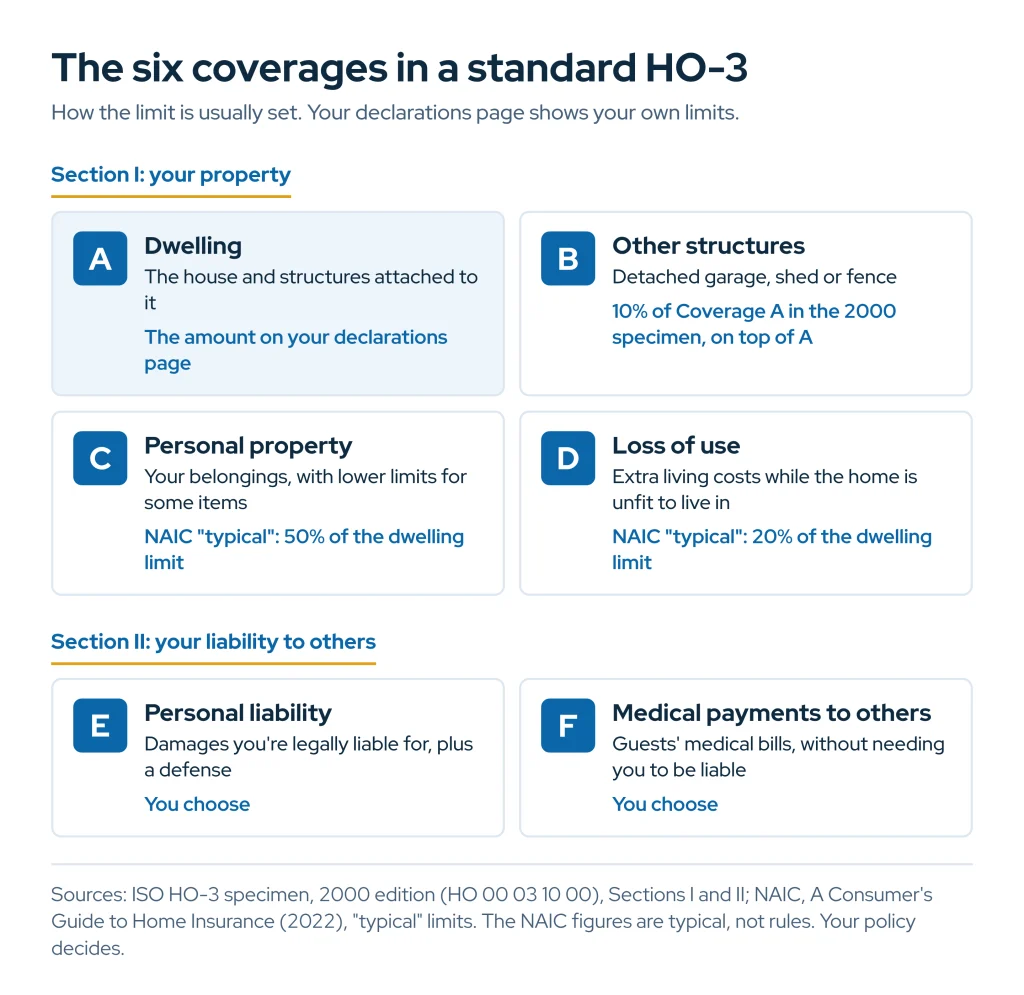
The six coverages at a glance
The policy splits into Section I (your property) and Section II (your liability to others). Each part is lettered.
| Coverage | What it usually covers | How the limit is set |
|---|---|---|
| A: Dwelling | The house and structures attached to it, plus materials on site for building or repairing it. Not the land. | The amount on your declarations page |
| B: Other structures | Structures set apart from the house by clear space: a detached garage, shed or fence. Not land. | 10% of Coverage A in the 2000 specimen, on top of A |
| C: Personal property | Your belongings, anywhere in the world, with lower limits for some items | On your declarations page; the NAIC guide gives 50% of the dwelling limit as typical |
| D: Loss of use | Extra living costs, lost rent and a short civil-authority benefit when a covered loss makes the home unfit to live in | On your declarations page; the NAIC guide gives 20% of the dwelling limit as typical |
| E: Personal liability | Damages you’re legally liable for after bodily injury or property damage to others, plus a legal defense | You choose; on your declarations page |
| F: Medical payments to others | Medical bills of guests and others hurt on your property or by your activities or animal, without needing you to be legally liable | You choose; on your declarations page |
The Coverage C and D percentages are the NAIC’s “typical” figures, not rules; your declarations page shows your own limits. One point the NAIC makes plainly: you are covered only if a covered peril caused the loss. If an excluded cause, such as an earthquake, makes the home unlivable, loss-of-use money doesn’t follow either.
Open perils for the house, named perils for your things
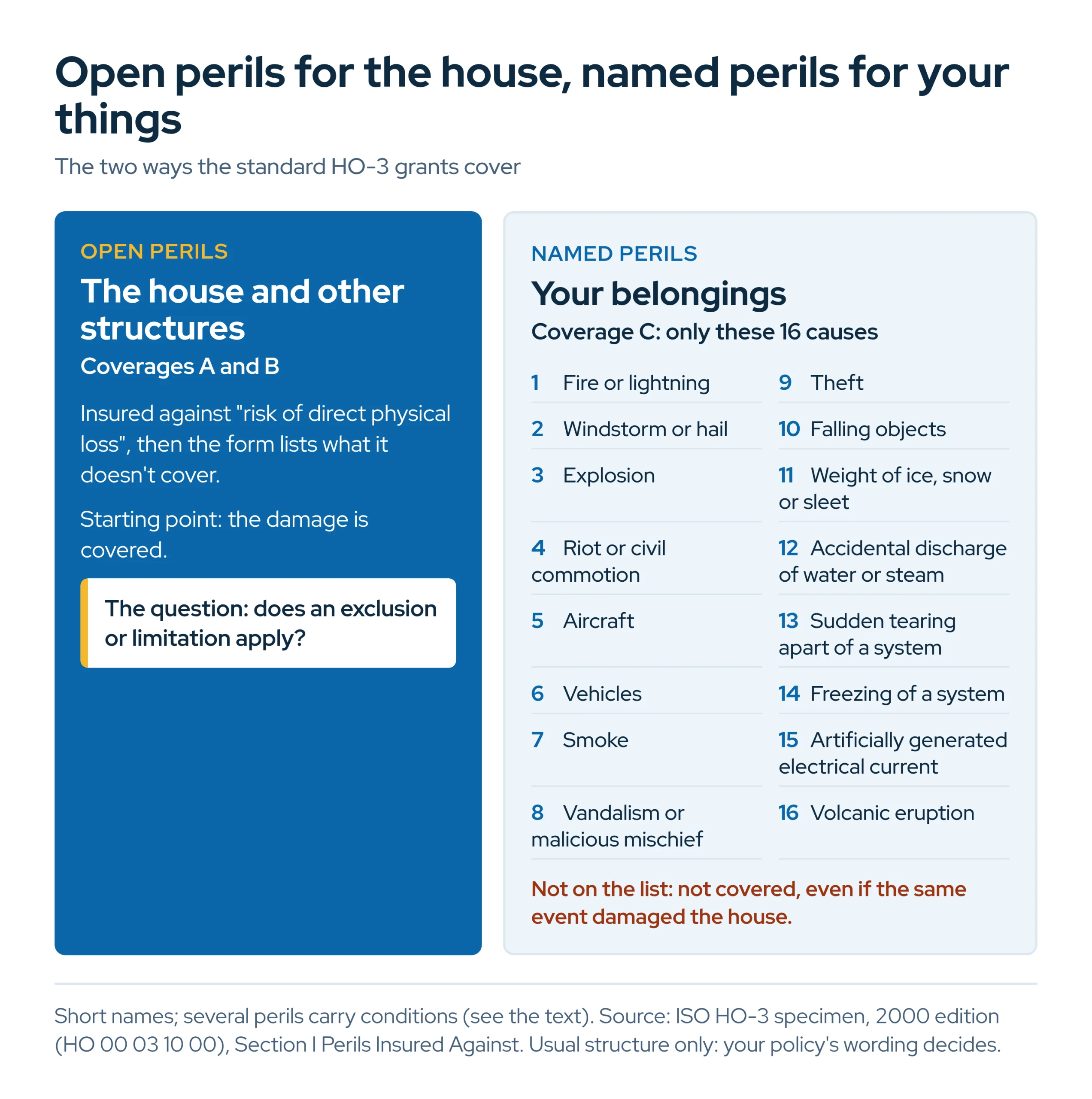
A peril is a cause of loss: fire, wind, theft. Policies name what they cover in one of two ways, and the HO-3 uses both.
- The house and other structures (A and B) are “open perils”. The specimen insures against “risk of direct physical loss” to them, then lists what it doesn’t cover. If something damaged your house, the starting point is that it’s covered, and the question is whether an exclusion or limitation applies.
- Belongings (C) are “named perils”. The specimen covers them only for 16 listed causes. If a cause isn’t on the list, your belongings aren’t covered for it, even if the same event damaged the house.
The 16 named perils for belongings in the 2000 specimen are: fire or lightning; windstorm or hail; explosion; riot or civil commotion; aircraft; vehicles; smoke; vandalism or malicious mischief; theft; falling objects; weight of ice, snow or sleet; accidental discharge or overflow of water or steam from plumbing, heating, air conditioning, a sprinkler system or a household appliance; sudden and accidental tearing apart, cracking, burning or bulging of a heating, hot water, air conditioning or sprinkler system; freezing of those systems; sudden and accidental damage from artificially generated electrical current; and volcanic eruption.
Several of those come with conditions that matter on real claims. Rain, snow or dust that damages belongings is covered under windstorm only if wind or hail first made an opening in the roof or a wall. Falling objects count for belongings indoors only if the object first damaged the roof or an outside wall. Electrical current excludes damage to the electronic parts inside appliances and computers. Theft doesn’t include theft by an insured person, theft from a part of the home rented to someone outside the household, or theft in a house under construction; away from home, it leaves out trailers, campers and boats, and property at another home you own or rent unless you’re staying there at the time.
The NAIC guide describes the other common form types the same way: a Basic Form and a Broad Form that list their perils, the Special Form above, a Tenants Form for renters, a Condominium Unit Owners Form, a Modified Coverage Form for older homes whose rebuilding cost is above their market value, and a Dwelling Fire Form that covers only the building, against a few perils. A Dwelling Fire Form is also the type of policy a lender usually buys if you let your own coverage lapse.
Coverage A and B: the house and other structures
Coverage A takes in the house and anything attached to it, such as an attached garage or deck. The NAIC guide adds that this includes fixtures such as plumbing, wiring, heating and permanently installed air conditioning. Coverage B takes in structures set apart by clear space, including ones joined to the house only by a fence or utility line.
Coverage B in the specimen does not cover a structure you rent to someone who isn’t a tenant of the house (unless it’s used only as a private garage), a structure a business is run from, or one used to store business property (though it does cover a structure holding business property owned only by an insured or a tenant of the house, as long as that property isn’t gas or liquid fuel). If you rent out a backyard cottage or run a workshop from the garage, read that clause and ask your insurer in writing.
How the house is paid for is a separate question from whether it’s covered. The specimen pays buildings at replacement cost (the cost to repair with like kind and quality, without subtracting for age) only if you carry at least 80% of the home’s full replacement cost; below that it pays less. Until repairs are finished it pays no more than the actual cash value (replacement cost minus depreciation), with the rest after the work is done, unless the repair costs less than both 5% of the building’s insurance and $2,500. You can take the actual cash value first and claim the rest later if you tell the insurer of your intent within 180 days after the date of loss (Section I Condition C). Our actual cash value vs replacement cost calculator works through that arithmetic on your own numbers, and extended and guaranteed replacement cost explains the endorsements that add money above the Coverage A limit.
Coverage C: your belongings and their special limits
The specimen covers personal property owned or used by anyone insured, anywhere in the world. Property usually kept at another home of yours (a vacation place, for example) is limited to 10% of the Coverage C limit or $1,000, whichever is greater. That cap doesn’t apply to things moved out while the main home is being repaired, or, for 30 days, to things in a newly bought main home you’re moving into.
Two details catch people out. First, the specimen settles personal property at actual cash value, so a ten-year-old sofa is valued as a ten-year-old sofa; the NAIC guide lists a personal property replacement cost endorsement as a way to change that. Second, some categories have their own lower limit for each loss, inside the Coverage C total:
| Category | Special limit per loss (2000 specimen) |
|---|---|
| Money, bank notes, bullion, coins, stored value cards | $200 |
| Securities, deeds, manuscripts, passports, tickets, stamps | $1,500 |
| Watercraft, with trailers, equipment and motors | $1,500 |
| Other trailers | $1,500 |
| Theft of jewelry, watches, furs, precious stones | $1,500 |
| Theft of firearms and related equipment | $2,500 |
| Theft of silverware, goldware, pewterware | $2,500 |
| Business property at home | $2,500 |
| Business property away from home | $500 (the 2011 edition shows $1,500) |
| Electronics in a vehicle that can also run on other power | $1,500 |
| Business electronics away from home, not in a vehicle | $1,500 |
Note that jewelry, firearms and silverware are capped only for theft; a fire loss to the same ring falls under the ordinary Coverage C limit. The NAIC guide describes a scheduled personal property endorsement (a “floater”) as the usual way to insure valuable items above these caps.

Some property isn’t covered at all under Coverage C in the specimen: motor vehicles, with their parts and built-in electronics while in or on the vehicle (the exception is a vehicle not required to be registered for road use that is used only to service the home or designed to assist a person with a disability), animals, birds and fish, aircraft (model or hobby aircraft aside), hovercraft, items insured separately elsewhere, property of roomers, boarders and other tenants (except roomers and boarders related to an insured), property in a unit you rent to others or rented out away from the home, business data, credit cards (apart from a small additional coverage), and water or steam.
Coverage D: loss of use
If a covered loss makes the part of the home you live in unfit to live in, the specimen pays any necessary increase in living costs so your household can keep its normal standard of living. That’s the increase, not the whole bill: your usual mortgage or grocery spending isn’t part of it. It pays for the shortest time needed to repair, or to settle elsewhere if you move permanently, and that time isn’t cut short if the policy expires in the meantime. It also pays lost rent on a part of the home you rent out.
A separate “civil authority” benefit applies when officials bar you from your home because of damage to a neighboring property by a covered peril: the specimen pays for no more than two weeks. Our page on additional living expenses covers receipts, hotels and how the money is usually paid.
Coverage E and F: liability and medical payments
Coverage E pays damages you are legally liable for when someone else suffers bodily injury or property damage from an accident, up to your limit, and it pays for your defense, even against a groundless suit, until the limit is used up. Coverage F pays necessary medical expenses incurred within three years of an accident, for guests on your property with your permission and for people hurt away from it by your activities, a condition on your property, a residence employee or your animal. It doesn’t require you to be legally liable, and it doesn’t cover you or the regular residents of your household (other than residence employees).
Both have long exclusion lists in the specimen. The main ones: injury or damage you expected or intended (with an exception for reasonable force to protect people or property); business and professional activities (with exceptions, such as occasionally renting out your home); most motor vehicles, larger watercraft, aircraft and hovercraft; property you don’t own but use or look after; injury to you and your household; and claims from communicable disease, abuse or controlled substances. A separate additional coverage pays up to $1,000 per occurrence, at replacement cost, for damage an insured person causes to other people’s property, with its own exclusions. The NAIC guide notes that some insurers won’t insure owners of certain dog breeds and that paid home daycare needs more coverage.
A bite or other injury caused by your pet is usually handled under these two coverages. In the specimen, an “insured” under Section II includes anyone legally responsible for animals owned by you or your household (but not someone keeping them for a business or without the owner’s consent), and Coverage F reaches people hurt away from your home by an animal owned by or in the care of an insured. The specimen has no dog or animal liability exclusion; some insurers add their own animal liability exclusion or a lower limit by endorsement, so look for one on your declarations page. Your policy’s wording decides. Section II also has its own loss assessment coverage: up to $1,000 of your share of an owners’ association assessment arising from bodily injury or property damage the liability part wouldn’t exclude, or from a covered act of the association’s director, officer or trustee.
The extras most people don’t know they have
Section I of the specimen also has a list of “additional coverages”. Some add money on top of the limits; others sit inside them.
| Additional coverage | What the 2000 specimen provides |
|---|---|
| Debris removal | Removing debris of covered property, inside the property’s limit, plus an extra 5% of that limit when damage and debris together exceed it |
| Tree removal | Up to $1,000 per loss, no more than $500 per tree, for your trees felled by windstorm, hail or the weight of ice, snow or sleet (or a neighbor’s tree felled by a covered peril) that hit a covered structure or block a driveway or wheelchair ramp |
| Reasonable repairs | The reasonable cost of necessary steps to protect covered property from further damage after a covered loss, such as a tarp or boarding up |
| Trees, shrubs and plants | Up to 5% of the dwelling limit, no more than $500 per tree, shrub or plant, for listed perils only: fire, lightning, explosion, riot, aircraft, vehicles not owned or driven by someone who lives there, vandalism and theft. Not wind. |
| Fire department service charge | Up to $500, no deductible, where you agreed to pay for a fire department call and live outside the district providing it |
| Property removed | Belongings moved to protect them from a peril, covered against any cause for up to 30 days |
| Credit card, forgery and counterfeit money | Up to $500, no deductible |
| Loss assessment | Up to $1,000 of an owners’ association assessment for damage to commonly owned property by a covered peril (not earthquake) |
| Collapse | Abrupt collapse caused by named causes, including hidden decay or hidden insect damage you didn’t know about, and weight of rain on a roof. Cracking, sagging or bulging alone isn’t collapse. |
| Glass | Breakage of glass that’s part of the building, storm door or storm window, including from earth movement |
| Landlord’s furnishings | Up to $2,500 for appliances, carpeting and furnishings in each apartment on the property rented to others, for the named perils other than theft |
| Ordinance or law | Up to 10% of the Coverage A limit for the extra cost of meeting building codes when repairing covered damage |
| Grave markers | Up to $5,000, for named perils |
The ordinance or law line matters after a large loss to an older house. If the building code now requires something the old house didn’t have, the extra cost of meeting it is excluded from the main coverage and paid only from this 10%, or from a higher limit if you bought an endorsement.
What the standard form usually excludes
An exclusion is a cause or kind of loss the policy says it won’t pay for. The specimen has two layers of them, and the difference matters.
Excluded whatever else contributed
The first group (Section I Exclusions A) applies to everything, and the specimen says these causes are excluded even when another cause contributed “concurrently or in any sequence”. In practice, if flood water and wind both damaged a room, the flood exclusion can still apply to the flood damage. How far this wording is enforced can depend on your state’s law and courts, so read your own policy’s version.
- Ordinance or law: the extra costs of building codes and laws, apart from the 10% additional coverage above.
- Earth movement: earthquake, landslide, mudflow, subsidence, sinkholes and other sinking, rising or shifting of the ground, whether natural or caused by people. A fire or explosion that follows is covered; so is theft.
- Water damage: flood, surface water, waves, tidal water and overflow of a body of water, “whether or not driven by wind”; water that backs up through sewers or drains or overflows from a sump pump; and groundwater pressing on or seeping through a building, sidewalk, driveway, foundation, pool or other structure. A fire, explosion or theft that follows is covered.
- Power failure off your premises, unless it leads to a covered peril at the house.
- Neglect: failing to use reasonable means to save and protect the property at and after a loss.
- War, nuclear hazard and governmental seizure (except property destroyed by order to stop a fire from spreading).
- Intentional loss: a loss any insured person causes, or conspires to cause, on purpose. In the specimen this bars every insured on the policy, including those who had nothing to do with it. State law can change how that works, so read your own policy’s version.
Not covered for the house, with exceptions
The second group applies only to the house and other structures: most of it sits inside their open-perils grant, and the last three items come from Section I Exclusions B. These describe things a house does on its own over time, which insurance isn’t meant to pay for. The NAIC puts it plainly: a homeowners policy “isn’t a maintenance contract”.
- Wear and tear, deterioration, mechanical breakdown, hidden defects, and anything that damages itself because of what it is.
- Rust and other corrosion, dry rot, and smog.
- Settling, shrinking, bulging or expansion, and the cracks they cause, in foundations, walls, floors, roofs, patios and pavements.
- Birds, vermin, rodents and insects, and animals you own or keep.
- Mold, fungus or wet rot, except mold hidden within walls or ceilings, beneath floors or above ceilings that results from an accidental discharge of water or steam from plumbing, heating, air conditioning, a sprinkler system or a household appliance at the home, or from a storm drain or a water, steam or sewer pipe off the premises.
- Freezing of plumbing and heating systems, unless you used reasonable care to keep the heat on or to shut off and drain the water.
- Freezing, thawing and the pressure or weight of water or ice on fences, pavement, patios, pools, foundations, retaining walls and docks.
- Vandalism and the damage that follows if the house had been vacant for more than 60 days in a row just before the loss (a house under construction isn’t vacant).
- Theft in a house under construction, and of building materials, until it’s finished and lived in.
- Smoke from farm smudging or industrial operations, and release of pollutants unless caused by one of the named perils.
- Bad weather only when it combines with an excluded cause; faulty planning, design, workmanship, materials or maintenance; and acts or decisions of any person or government.
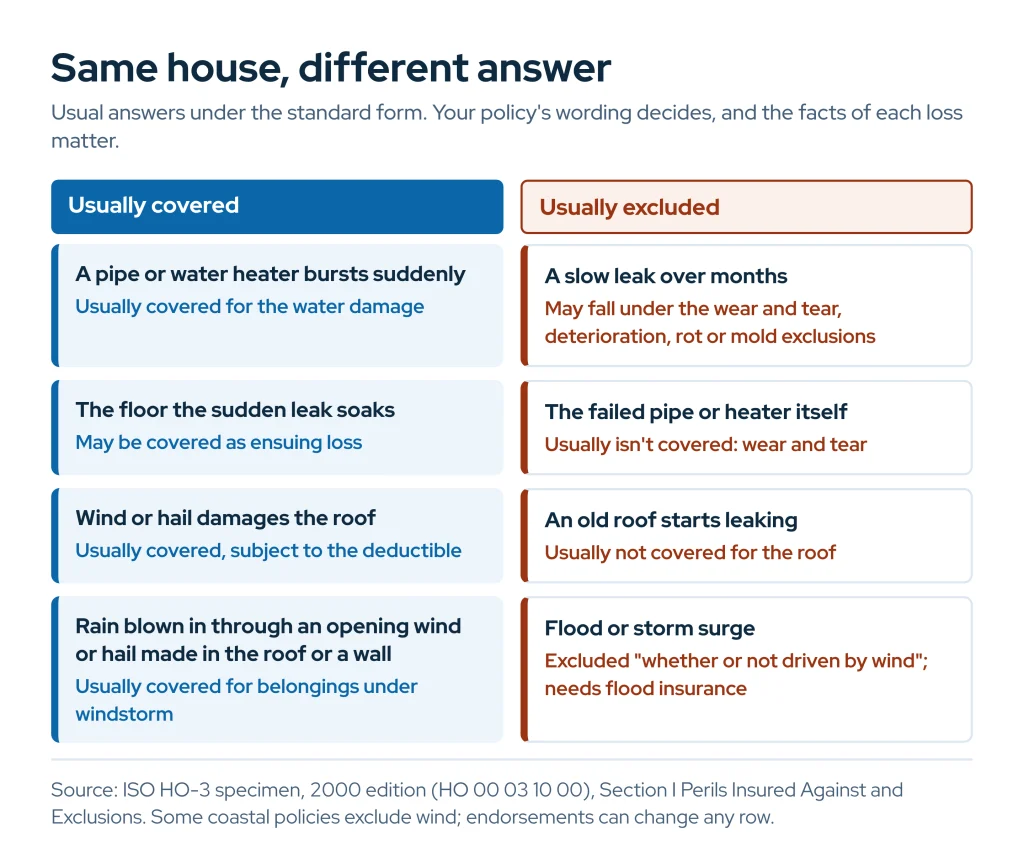
Two exceptions run through this group. Under many of these exclusions, the specimen still covers ensuing loss: damage that follows from the excluded event and isn’t itself excluded. A worn-out water heater isn’t covered, but the floor its sudden leak soaks may be. And the specimen covers water that escapes accidentally from your plumbing or an appliance (including the cost of tearing out a wall to reach the pipe), but not the pipe or appliance it came from.
Covered or not, by kind of damage
Each answer below is what the 2000 specimen usually does, with the clause it rests on. Your policy’s wording and endorsements decide, and the facts of each loss matter.
| What happened | Usual answer under the standard form | What it rests on |
|---|---|---|
| A pipe or water heater bursts suddenly | Usually covered for the water damage; the failed pipe or heater itself usually isn’t | Open perils for the house; accidental discharge peril for belongings; wear-and-tear exclusion for the part |
| A slow leak over months | May fall under the wear and tear, deterioration, rot or mold exclusions | Section I exclusions under the open perils |
| Wind or hail damages the roof | Usually covered, subject to the deductible; some policies carry a separate wind, hail or hurricane deductible, and some coastal policies exclude wind | Open perils; windstorm or hail peril for belongings; NAIC guide on coastal wind exclusions |
| A hurricane | Wind damage usually covered, subject to the deductible, and some policies carry a separate hurricane, named-storm or wind deductible or exclude wind on the coast; flood and storm surge are excluded and need flood insurance, so one storm can mean two claims | Open perils; water damage exclusion; any wind or hurricane deductible endorsement on the declarations page; NAIC guide |
| A tornado | Usually covered as windstorm, with debris and tree removal within their limits; a separate wind or hail deductible may apply | Open perils; windstorm or hail peril; debris and tree removal additional coverage |
| A broken window | Usually covered: glass that is part of the building, a storm door or a storm window, but not if the home was vacant more than 60 days in a row before the loss (unless earth movement broke it); the deductible usually applies | Glass or safety glazing additional coverage (E.9) |
| A damaged garage door | Usually covered when wind, a falling object, a vehicle or another covered cause damages it (attached garage under Coverage A, detached under B); wear, broken springs and an opener failing with age usually aren’t | Open perils; wear-and-tear and mechanical breakdown exclusions |
| An old roof starts leaking | Usually not covered for the roof; interior damage may turn on how the leak started | Wear and tear; windstorm opening rule for belongings |
| Flood, storm surge or rising water | Excluded; needs flood insurance | Water damage exclusion, “whether or not driven by wind” |
| Sewer or drain backup, sump overflow | Excluded unless you added a water backup endorsement | Water damage exclusion |
| Mold | Usually excluded; narrow exception for hidden mold from a covered plumbing or appliance leak | Mold exclusion and its exception |
| Fire, lightning or smoke | Usually covered | Open perils; fire and smoke perils for belongings |
| A lightning strike or power surge | Lightning usually covered. For belongings, damage from artificially generated electrical current leaves out the electronic parts inside appliances and computers; a power failure off the premises is excluded, unless it leads to a covered peril on the premises, such as fire | Fire or lightning peril; artificially generated electrical current peril (Coverage C peril 15); power failure exclusion |
| Smoke, including puffback from a furnace | Usually covered when the smoke damage is sudden and accidental; smoke from farm smudging or industrial operations is excluded. Whether drifting smoke from a distant fire counts can turn on the wording and the facts | Smoke peril (Coverage C peril 7) and the matching exclusion for the house |
| Wildfire | Usually covered as fire, with smoke damage and loss of use if the home is unfit to live in; up to two weeks of civil-authority cover if officials bar use of the home because fire or another covered peril damaged neighboring premises. A later mudflow or flood is excluded | Fire peril; Coverage D; earth movement and water damage exclusions |
| Theft or burglary | Usually covered for belongings, with lower theft limits on jewelry, firearms and silver | Theft peril; Coverage C special limits |
| Belongings in a storage unit | Usually covered for the named perils, since belongings are covered anywhere in the world; the 10%-or-$1,000 cap is for property usually kept at another residence of yours, and an insurer’s own form or endorsement can word this differently | Coverage C, C.2 limit for property at other residences; theft peril |
| A tree falls on the house | Usually covered for the damage; tree removal limited to $1,000 per loss and $500 per tree | Open perils; debris removal additional coverage |
| Foundation cracks from settling | Usually excluded; damage from a sudden covered event can be a different question | Settling exclusion; earth movement exclusion |
| Termite or rodent damage | Usually excluded, except hidden insect damage that causes an abrupt collapse | Insects and vermin exclusion; collapse additional coverage |
| Furnace or AC breaks down | Breakdown excluded; damage to it from a covered peril such as fire or lightning usually covered | Mechanical breakdown exclusion |
| Earthquake or sinkhole | Excluded under the standard form; earthquake cover is sold as an endorsement or a separate policy. State law can add cover: Florida requires insurers to cover catastrophic ground cover collapse, a narrow defined event (among other conditions, the home must be condemned and ordered vacated; settling or cracking alone doesn’t count), and to offer sinkhole coverage for an extra premium | Earth movement exclusion; NAIC guide; Fla. Stat. 627.706(1) and (2)(a) (2026 statutes, read 8 November 2026) |
| A guest is hurt at your home | Medical payments without needing you to be legally liable; liability if you are legally responsible | Coverages E and F |
Each of these has its own page with the clause in full and what to check: water damage, burst pipes and plumbing, roof leaks, hail damage, flooding and the flood exclusion, sewer backup, mold, fire damage, theft, fallen trees, foundation repair, termite damage and HVAC and AC units.
Endorsements that change the answer
An endorsement is a page added to the policy that changes it. When people say “my policy covers sewer backup” or “my policy doesn’t pay replacement cost on contents”, the difference is usually an endorsement. These are the ones worth looking for on your declarations page, not a shopping list:
- Water backup and sump overflow: adds back some cover for what the water damage exclusion removes, usually with its own limit. The NAIC guide notes that most policies offer limited or no cover for these events without it.
- Mold: the NAIC guide says you may be able to buy an endorsement for mold damage.
- Ordinance or law at a higher limit: raises the 10% code-upgrade money.
- Extended or guaranteed replacement cost, and inflation guard: add money above the dwelling limit or raise it each year.
- Personal property replacement cost: pays belongings without subtracting for age.
- Scheduled personal property: lists valuable items at agreed amounts above the special limits.
- Earthquake: sold as an endorsement or a separate policy (NAIC guide).
- Equipment breakdown and service line: if your declarations page lists either, read its own wording and limit. The standard form excludes mechanical breakdown and wear and tear.
Endorsements can also take coverage away. Look for wind or hail exclusions, a separate roof deductible, a roof settlement endorsement that changes how roofs are paid, or a percentage hurricane deductible. Our deductible calculator turns a percentage deductible into dollars on your own numbers, and hurricane deductibles by state covers the states whose rules we’ve read.
Flood and other separate policies
The NAIC guide says homeowners policies don’t cover flood, and the specimen’s water damage exclusion applies even when wind drives the water. Flood cover comes from the NFIP or a private flood insurer. Under the NFIP’s Standard Flood Insurance Policy, the most a single-family home can carry in the regular program is $250,000 on the building and $100,000 on contents (44 CFR 61.6), and new coverage usually starts on the 30th calendar day after you apply and pay, with exceptions such as a policy bought at a loan closing (44 CFR 61.11). Its claim rules are federal, not state, and they are strict; our NFIP flood claim guide covers them. FEMA’s own information is at FloodSmart.
If no insurer will write your home, the NAIC guide points to your state insurance department for a FAIR plan, wind pool or market assistance program. Those policies, like surplus lines policies, have their own forms, and nothing on this page assumes they match the HO-3. Read the policy you actually have.
Claims you may see elsewhere, checked
- “Homeowners insurance doesn’t cover hurricanes.” Too broad. Under the standard form, wind damage from a hurricane is usually covered, while flooding and storm surge are excluded. In some places a separate percentage deductible applies to catastrophes (NAIC guide). Some coastal policies exclude wind, which then needs a separate policy (NAIC guide).
- “Wind-driven water is covered because the wind caused it.” Not under the standard form: its flood exclusion applies “whether or not driven by wind”. Rain blown in through an opening that wind or hail made in the roof or a wall is a different case.
- “Your belongings are covered at full value.” Not in the specimen, which pays personal property at actual cash value, with special limits per category, unless an endorsement changes that.
- “Filing a claim won’t affect your insurance.” Not something anyone can promise. The NAIC guide says how often you file and the kinds of claims you file often affect your premium and whether your insurer renews, and that most insurers report claims to databases such as CLUE. Should you file? explains what is known.
How to check what your own policy covers
- Get the whole policy, not just the declarations page: the policy form, every endorsement listed on the declarations, and any state amendatory endorsement. If you don’t have it, ask your insurer for a complete copy in writing.
- Find the form number and edition at the foot of each page. If it says HO 00 03 with a date, it is an edition of ISO’s HO-3, though endorsements may still change it; if it’s an insurer’s own code, read its wording rather than assuming.
- Read the limits and deductibles for Coverages A to F, and note any percentage, wind, hail or roof deductible.
- Read Section I Exclusions and the endorsements together, since endorsements often change the exclusions.
- If you have damage now: take photos and video before cleanup, stop further damage and keep the receipts, report the loss to your insurer promptly and in writing, and write down every call with its date. The specimen’s Duties After Loss condition requires prompt notice and a signed, sworn proof of loss within 60 days after the insurer asks for one, and its Suit Against Us condition sets two years from the date of loss; your policy and your state’s law can change both. How to file a homeowners insurance claim walks through the steps, and our claim deadlines by state shows the state rules we’ve read.
- If the wording is unclear, ask your insurer in writing what it covers and keep the answer. Your state insurance department’s consumer line can explain the rules for free; find it in the NAIC’s directory of state insurance departments.
Sources checked on 8 November 2026, and the specimen’s clauses re-read on 18 November 2026: ISO HO-3 specimen form, 2000 edition (HO 00 03 10 00), Insurance Information Institute copy archived 2 September 2026, read in full; ISO HO-3, 2011 edition (HO 00 03 05 11), Maine Bureau of Insurance copy, for the one 2011 figure given; NAIC, A Consumer’s Guide to Home Insurance (2022); 44 CFR 61.6 and 61.11 on eCFR; Florida Statutes 627.706 (2026).
Sources
- ISO Homeowners 3 – Special Form, specimen, 2000 edition (HO 00 03 10 00), Insurance Information Institute copy, archived 2 Sep 2026
- ISO Homeowners 3 – Special Form, 2011 edition (HO 00 03 05 11), Maine Bureau of Insurance copy
- NAIC, A Consumer's Guide to Home Insurance (2022)
- 44 CFR 61.6, Maximum amounts of coverage available (eCFR)
- 44 CFR 61.11, Effective date and time of coverage under the SFIP (eCFR)
- FloodSmart (FEMA, National Flood Insurance Program)
- NAIC, State insurance departments directory
- Florida Statutes 627.706, Sinkhole insurance; catastrophic ground cover collapse (2026)