Usually yes for the water damage a burst or leaking pipe causes, and usually yes for opening a wall, floor or slab when that is needed to reach the pipe. Usually no for the pipe itself, for a leak caused by corrosion or wear that went on for weeks, and for pipes that froze in a house that was neither heated nor drained. Those are the usual answers under the standard homeowners form; your own policy’s wording decides, and insurers’ forms differ most on slow leaks, slab leaks and freezing.
General information, not legal or insurance advice, and not a substitute for the advice of an attorney. Your policy’s wording and your state’s law decide, and both change. For help with your claim, your state insurance department’s consumer line and legal aid are free.
This page is part of our Water, Mold and Flood section; for water damage in general, including flood and sewer backup, see does homeowners insurance cover water damage? Below: common plumbing losses at a glance, the three parts of every plumbing bill and which clause each falls under, then frozen pipes, slab leaks, appliances, pipes outside the house, a worked example and what to do first when you make a burst pipe insurance claim.
Plumbing losses at a glance
| What happened | Usual answer under the standard form | Clause it rests on |
|---|---|---|
| A supply pipe bursts inside a wall and soaks the drywall and floor | Water damage usually covered; opening and closing the wall to reach the pipe usually covered; the pipe itself usually not | Exception to the wear-and-tear exclusions, with its tear-out sentence and its “not the system” sentence |
| Pipes freeze and burst while the heat was on | Usually covered | Freezing exclusion, which does not apply if you used reasonable care to keep the heat on |
| Pipes freeze in a house that was unheated and not drained | Usually excluded | Freezing exclusion |
| A pipe under a concrete slab leaks and water comes up through the floor | Water damage and breaking the slab to reach the pipe often covered; movement or cracking of the foundation often disputed | Same exception; the groundwater part of the water exclusion is lifted for it; earth movement and settling exclusions |
| A slow drip behind a wall rots the framing over months | Often excluded | Wear and tear, deterioration, rot and mold exclusions; in many insurers’ forms, a seepage clause with a time period |
| A pinhole leak from a corroded pipe is found within days | Water damage often covered; the corroded pipe not | Rust and corrosion exclusion for the pipe; the exception for the water damage |
| A water heater tank gives way | Water damage usually covered; the heater usually not | Same exception; for belongings, the “tearing apart, cracking, burning or bulging” peril |
| Water backs up through a floor drain or toilet from the sewer | Usually excluded unless you added a water backup endorsement | Water exclusion |
| The water service line in the yard breaks | The line itself usually not covered; look for a service line endorsement | “Not the system” sentence; wear and tear |
| A gutter, downspout or sump pump fails and water comes in | Not treated as plumbing; judged under the other clauses | The form says a sump, roof drain, gutter or downspout is not a plumbing system |
The three parts of every plumbing bill
Many US homeowners policies are built on standard forms from Insurance Services Office (ISO), a national advisory organization that drafts policy forms its member insurers can file and use, or on insurers’ own versions. We read the HO-3 “Special Form” in two editions: the 2000 edition (HO 00 03 10 00), a specimen hosted by the Insurance Information Institute, a trade group (archived copy, 2 September 2026), and the 2011 edition (HO 00 03 05 11), a copy posted by the Maine Bureau of Insurance. On plumbing, the two read the same. Neither is your policy: your insurer’s form, its state endorsements and later editions can differ. Other kinds of policy, such as named-peril homeowners forms, dwelling fire policies, condo and renters forms, and policies from a state FAIR plan, list their own perils and may treat water from pipes differently or not cover it at all; if yours is one of these, read its list of perils first. A policy from a surplus lines insurer can also use wording of its own.
The house itself (Coverage A, the dwelling, and Coverage B, other structures such as a detached garage) is covered on an open-perils basis: any direct physical loss unless the policy excludes it. The exclusions that matter for plumbing are a list of slow causes: wear and tear, deterioration, mechanical breakdown, latent defect, rust and other corrosion, dry rot, and settling or cracking of foundations, walls and floors. Right after that list, the form adds an exception for water, and that exception splits a plumbing bill into three parts.
- The water damage. Unless another exclusion applies, the form covers loss to the house resulting from an accidental discharge or overflow of water or steam from a plumbing, heating, air conditioning or fire sprinkler system or a household appliance on your property. So a pipe that corroded through is excluded as a cause, but the soaked floor, drywall and cabinets it damaged usually are not.
- The tear-out. The same exception includes the cost to tear out and replace part of the building, but only when that is needed to repair the system or appliance. This is the wall a plumber has to open, the tile that has to come up, the slab that has to be broken.
- The pipe or appliance itself. The form then says plainly that it does not cover loss to the system or appliance the water escaped from. The plumber’s bill for the new section of pipe, the new valve, or the new water heater is usually yours.
Two details are easy to miss. First, the exception begins “unless the loss is otherwise excluded”, so the freezing, water (flood and backup), mold and other exclusions still apply on top of it. Second, for this rule a sump, sump pump or related equipment, and a roof drain, gutter or downspout, are not a plumbing system or household appliance. Water from those is judged under the other clauses; for a sump, that is mainly the water exclusion’s wording on water that overflows or is discharged from a sump, sump pump or related equipment.
Many insurers write their own forms and say “sudden and accidental” discharge. The NAIC, the association of state insurance regulators, uses that phrase too: homeowners policies cover damage from a “sudden and accidental” discharge from a plumbing system (NAIC, Will my homeowners insurance policy cover water damage from a burst pipe?, 8 February 2024). The specimen’s wording for the house is “accidental discharge or overflow”; look for the exact words in yours, because “sudden” can matter on a leak that started small.
Tear-out: when opening the wall is covered
The specimen’s tear-out sentence has four limits worth knowing.
- Only when necessary to repair the system. If the plumber can reach the pipe through an access panel, a crawlspace or an unfinished ceiling, there is nothing to tear out. If the wall has to be opened, the cost of opening it and putting it back is part of the covered loss.
- It sits inside the water-damage cover. The tear-out sentence is part of the cover for loss resulting from an accidental discharge. It is not a promise to pay to open walls for any plumbing repair. Where a leak is found before it has damaged anything, ask the insurer in writing how it reads the clause for your loss.
- Other structures. For a detached garage or other structure, the specimen pays tear-out only if the water or steam caused actual damage to a building on the property.
- “Replace” means putting the building back. The tear-out cover is for the wall, floor or slab, not for the pipe that runs through it, and not for upgrading the rest of the plumbing while the wall is open.
Ask the plumber to write the cause on the invoice and to separate the cost of the pipe repair from the cost of opening and closing the building. That split follows the policy’s own clauses.
Frozen pipes: the heat-or-drain condition
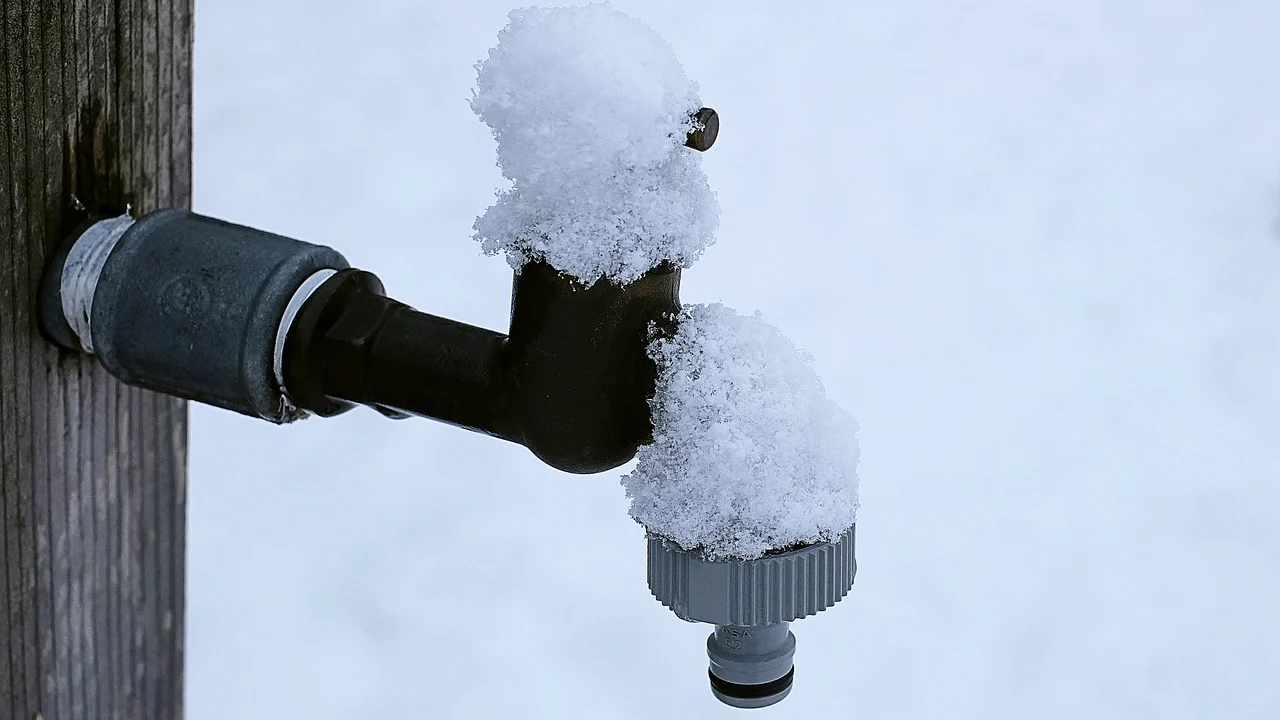
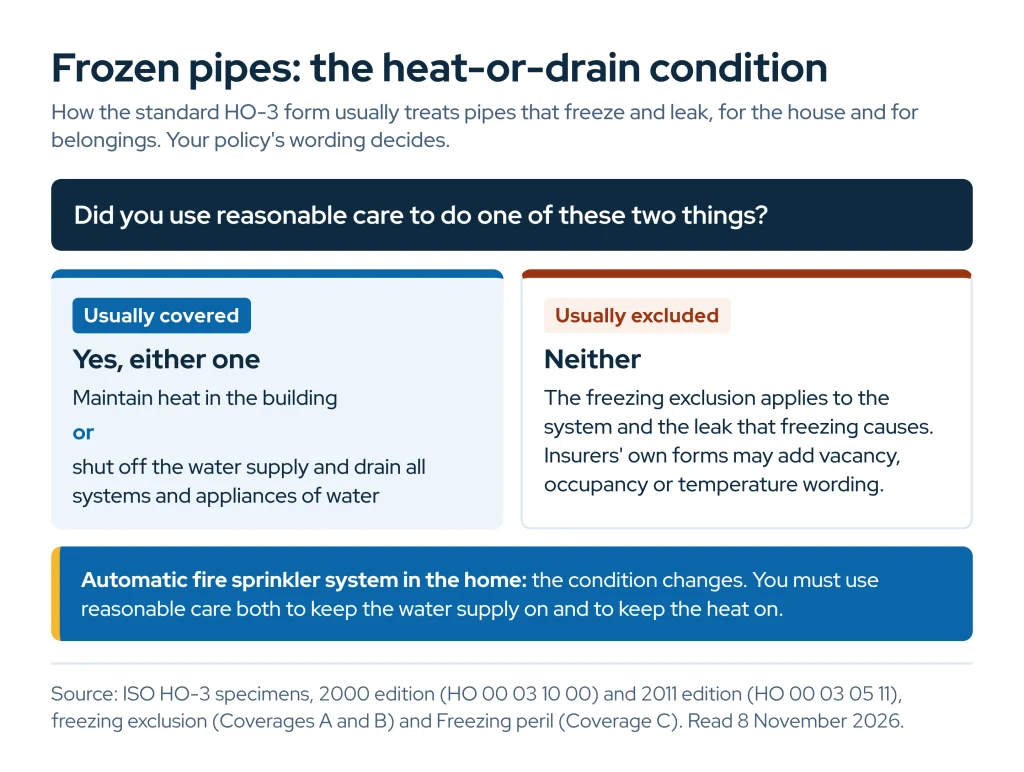
Freezing is the one plumbing cause the specimen names directly. For the house, it excludes freezing of a plumbing, heating, air conditioning or fire sprinkler system or a household appliance, and the leak that freezing causes, unless you used reasonable care to do one of two things:
- maintain heat in the building; or
- shut off the water supply and drain all systems and appliances of water.
Either one is enough under the specimen. If the home has an automatic fire sprinkler system, the condition changes: you must use reasonable care both to keep the water supply on and to keep the heat on. Belongings follow the same test: “Freezing” is one of the named perils for personal property, and it applies only if you used reasonable care to keep the heat on or to shut off and drain.
Separately, freezing, thawing and the pressure or weight of water or ice are excluded outright for fences, pavement, patios, swimming pools, footings, foundations, retaining walls, docks and similar structures. A pool or patio cracked by a freeze is usually outside the cover however careful you were.
Insurers’ own forms often add vacancy or occupancy wording. The Texas Department of Insurance lists “freezing pipes while your house is unoccupied” among the common exclusions in insurers’ forms (TDI, Texas Homeowners Policies, 12 April 2018), and the NAIC says policies generally require you to keep the home at a minimum temperature, or shut off the water supply if the home is vacant. The specimen also has a separate vacancy rule: no cover for vandalism, or for glass breakage, once the home has been vacant for more than 60 consecutive days before the loss. Insurers’ forms set their own periods. If you leave a home empty for the winter, read three things before you go: the freezing wording, the vacancy wording, and whether your form names a temperature.
When the heat went off because the power did. Two clauses meet here. The specimen’s power failure exclusion (the same in the 2000 and 2011 editions) removes loss from a utility failure that happens off your property, but it says that if the failure leads to a loss from a covered peril on your property, that loss is paid. The freezing clause asks whether you used reasonable care to keep the heat on. The specimen does not say how an outage fits that test, and insurers’ own forms may word either clause differently. If this is your claim, ask the insurer in writing which clause it applies, and keep a record of when the power went off, what you did and when.
Slab leaks and pipes under the floor
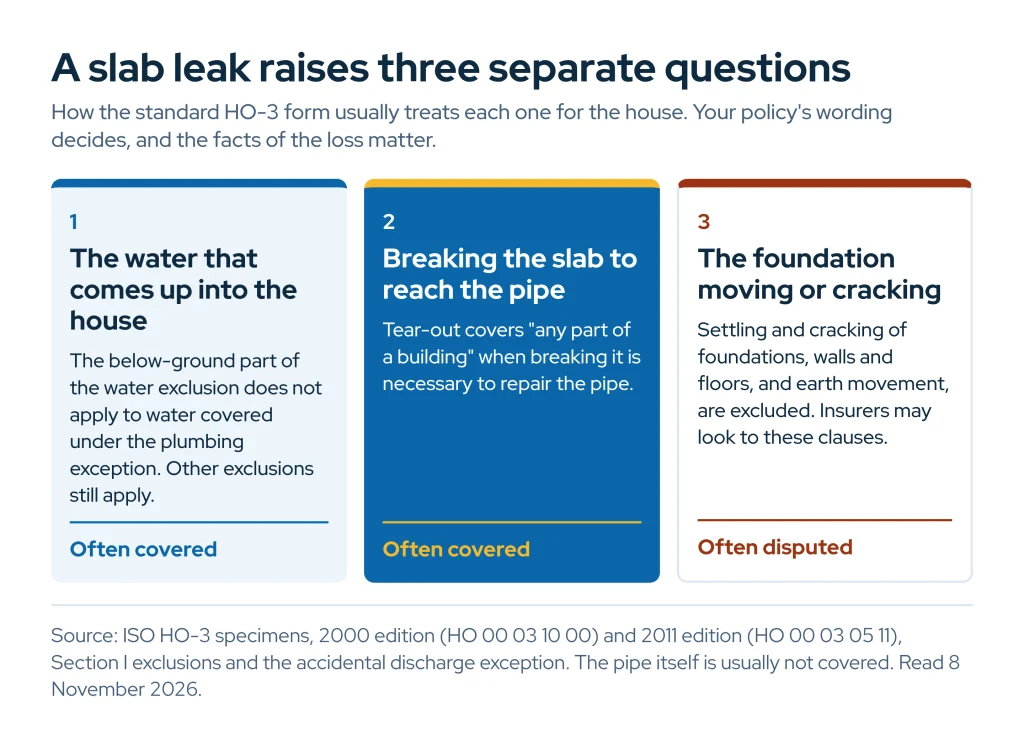
A slab leak is a leak in a water or drain line running under or inside a concrete floor. It raises three questions, and they get different answers.
- The water that comes up into the house. The specimen’s water exclusion removes water below the surface of the ground, including water that seeps or leaks through a foundation. On its own, that would knock out a slab leak. But the form says that the surface-water and below-ground parts of the water exclusion do not apply to water covered under the plumbing exception. So water damage from a plumbing leak under the slab is not excluded merely because the water was underground. The other exclusions still apply.
- Breaking the slab to reach the pipe. The tear-out sentence covers “any part of a building”, which on its wording takes in a concrete floor, when breaking it is necessary to repair the pipe. Rerouting the line through walls or the attic instead is a repair choice; how a policy treats its cost is a question for your wording and your adjuster.
- The foundation itself. This is a separate question. The specimen excludes settling, shrinking, bulging or expansion and the cracking that results in foundations, walls and floors, and it excludes earth movement, including earth sinking, rising or shifting. In both editions the earth movement exclusion applies whether the movement is natural or not: the 2000 edition names “human or animal forces or any act of nature”, and the 2011 edition says it applies whether the movement is caused by nature or otherwise. When water from a leak washes out or swells the soil and the slab moves, those are the clauses an insurer may look to, and the facts of the movement matter. Our page on foundation repair and homeowners insurance goes through them.
A slab leak can also run for a long time before anyone sees water, which brings in the slow-leak wording below. The Texas Department of Insurance’s policy comparison worksheet lists “damage to foundation or slab” as its own line to check when comparing policies, next to sudden and accidental leaking from plumbing and freezing of plumbing (TDI, Homeowners Insurance Comparison Worksheet). Check whether your form or an endorsement says anything specific about foundation or slab damage from a plumbing leak, including a separate limit.
Slow leaks, corrosion and old pipes
The specimen has no time-based seepage clause. A leak that ran for months meets the general exclusions instead: wear and tear, deterioration, rust and corrosion, rot and mold. The water-damage exception still covers loss “resulting from” an accidental discharge, so the question on an old leak becomes which damage came from the escaping water and which came from rot, mold or deterioration that built up over time.
Many insurers’ forms add a seepage clause with a period: TDI found versions in Texas forms in 2018 worded as 14 or more days, as “weeks, months, or years”, and as leakage over a period of time that results in deterioration, corrosion, rust or rot, and noted that some companies let you buy full or limited cover for continuous or repeated leakage or seepage. The same TDI table puts companies using ISO policy forms in Texas under the “weeks, months, or years” wording, so a policy built on an ISO form can still carry a seepage clause, even though the 2000 and 2011 national specimens have none. Look for one in your own policy before you rely on the specimen’s answer. The water damage page linked above sets out those wordings.
Mold is its own exclusion, with a narrow exception in both specimen editions for mold, fungus or wet rot hidden within walls or ceilings, beneath floors or above ceilings, that results from an accidental discharge from your plumbing, heating, air conditioning or sprinkler system or an appliance. Insurers’ own forms may word it differently or add a limit, so read yours; see does homeowners insurance cover mold?
A leaking drain is not a backed-up drain. Water escaping from a cracked drain pipe inside the house is a discharge from the plumbing system. Water that backs up through a sewer or drain, for example sewage coming up through a floor drain or a toilet because the line outside is blocked, falls under the water exclusion instead and needs a water backup endorsement. The difference matters; our sewer backup page covers the endorsement.
Water heaters, washing machines and other appliances
Household appliances follow the same three-part split. A split washing machine hose, a cracked dishwasher line, a refrigerator ice-maker line or a failed water heater tank: the water damage is usually covered for the house, the tear-out is covered when needed, and the appliance the water came from usually is not. A water heater that wore out from age falls under the wear-and-tear and mechanical breakdown exclusions as well. So a leaking water heater raises two separate questions: the tank itself, which usually fails from age, rust or wear, is usually yours to replace under those exclusions and the “not the appliance” sentence, while the water it lets out onto floors, walls and cabinets is judged as water damage under the exception, unless a slow leak runs into the seepage, rot or mold wording above. An appliance damaged by lightning or a power surge, rather than by water, is judged under different perils, explained on our lightning page.
For belongings, two named perils apply: accidental discharge or overflow of water or steam from a plumbing, heating, air conditioning or sprinkler system or a household appliance, and the “sudden and accidental tearing apart, cracking, burning or bulging” of a hot water or steam heating system, an air conditioning or sprinkler system, or an appliance for heating water. The discharge peril does not cover the system or appliance the water escaped from, and neither peril covers freezing, which has its own peril. Look in your policy for an equipment breakdown endorsement, which some insurers offer for systems and appliances; if you have one, read what it lists and its limit.
Pipes outside the house: service lines and water mains
The specimen does not single out the water and sewer lines that run under your yard. Where a line counts as part of your plumbing system, the “not the system” sentence leaves the line itself out, and a line that failed with age also meets the wear-and-tear and corrosion exclusions. Look in your policy for a service line endorsement, which some insurers offer for buried utility lines; if you have one, check what lines it names, its limit and its own deductible. A leak in the yard that floods soil, not the house, may cause no covered damage to the dwelling at all.
A broken water main or storm drain off your property is treated differently: for the house, the specimen’s exception includes it, but for belongings the discharge peril leaves it out, and water backing up through your drains stays excluded either way.
Belongings, living costs and the deductible
Belongings soaked by a burst pipe come under Coverage C and the named perils above, subject to the same freezing and mold conditions. Our page on Coverage C for your belongings explains its special limits and how belongings are valued. If the home can’t be lived in while it dries out and is rebuilt, Coverage D (loss of use) pays the necessary increase in living expenses so your household can keep its normal standard of living, inside its limit; our page on additional living expenses explains it. Your deductible applies to the covered part of the loss, not to the plumber’s bill for the pipe; the deductible calculator shows the arithmetic for a dollar or percentage deductible.
Example: how a burst-pipe bill splits
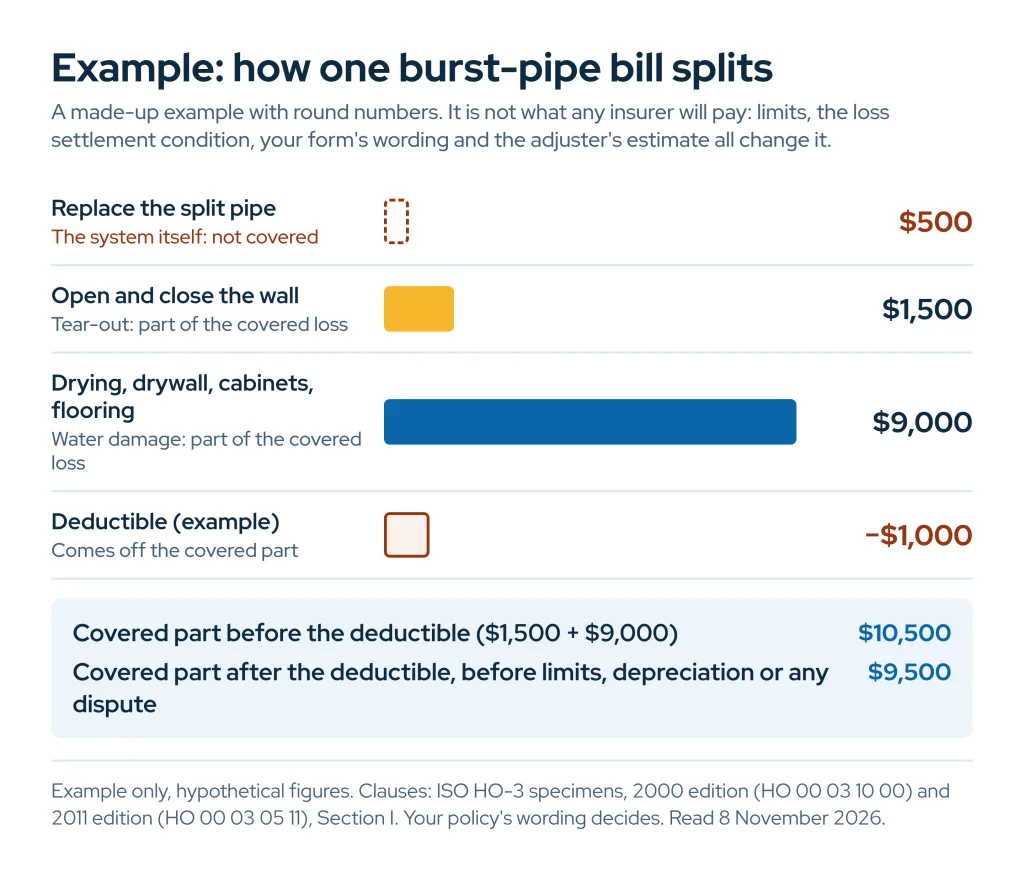
This is a made-up example with round numbers, to show how the specimen’s clauses sort one bill. It is not what any insurer will pay on any claim; limits, the loss settlement condition, your form’s wording and the adjuster’s estimate all change it.
| Line on the bills (example) | Amount (example) | Where the specimen puts it |
|---|---|---|
| Plumber: replace a split section of copper supply pipe in a kitchen wall | $500 | The system the water escaped from: not covered |
| Open the wall to reach the pipe, then close, tape and paint it | $1,500 | Tear-out: part of the covered loss |
| Drying, new drywall below, base cabinets and flooring | $9,000 | Water damage: part of the covered loss |
| Covered part before the deductible | $10,500 | $1,500 + $9,000 |
| Deductible on the declarations page (example) | $1,000 | Comes off the covered part |
| Covered part after the deductible | $9,500 | Before limits, depreciation or any dispute |
One more step applies if the policy pays replacement cost on the building. The specimen pays full replacement cost only when the home is insured to at least 80% of its full replacement cost; below that, it pays the greater of actual cash value or a proportion of the replacement cost. Because this repair is more than $2,500, the specimen pays actual cash value (the cost less depreciation) until the repair is actually done, then the rest. Only repairs under both $2,500 and 5% of the building’s insurance are paid at replacement cost before repair. If you take the actual cash value first, the specimen gives you 180 days after the date of loss to tell the insurer you will claim the rest. The form says “days” without saying calendar or business days. These are the specimen’s terms: your insurer’s form can word them differently, and state law can change them, for example after a declared disaster. The recoverable depreciation calculator shows how that holdback works.
Making a burst pipe insurance claim: what to do first
- Shut off the water at the fixture valve or the main, and switch off power to wet circuits if it is safe to do so. The specimen requires you to protect the property from further damage and keep a record of what that costs, and it pays the reasonable cost of necessary protective measures after a covered loss. Its neglect exclusion removes loss from failing to use all reasonable means to save property.
- Photograph and film before cleanup: the burst pipe, the water line on walls, every wet room, damaged belongings, and the thermostat setting if freezing is involved. Keep the failed section of pipe, the hose or the fitting; the form lets the insurer ask to see damaged property.
- Report the claim promptly and in writing. The specimen asks for “prompt” notice. Minnesota’s Department of Commerce suggests not calling it a “flood”, because the word has a specific meaning in insurance, and keeping damaged items until the adjuster has inspected them (Minnesota Commerce, Insurance tips if your water pipes froze and broke, 4 February 2019).
- Get the cause in writing. Ask the plumber for an invoice that names the cause (frozen, split fitting, corrosion, failed supply line) and separates the pipe repair from opening and closing the building.
- Keep every receipt: water extraction and drying, the plumber, temporary repairs, and hotel and meal costs if you had to move out.
- If the insurer says no, ask which clause. Ask for the exact wording it relies on, whether wear and tear, seepage, freezing or the water exclusion, and read it against your own policy, not against this page.
After the first days, the specimen gives you 60 days after the insurer’s request to send a signed, sworn proof of loss (the form says “days”, without saying calendar or business days), and says a suit must start within two years after the date of loss. State law often changes that suit limit, and some states set their own claim clocks; check yours in our claim deadlines by state table. The full process is in how to file a homeowners insurance claim.
Frozen pipes and water heaters: two common questions
Is a frozen pipe that bursts covered?
Usually yes under the standard HO-3 form if you used reasonable care to keep the heat on in the building, or to shut off the water supply and drain all systems and appliances; usually no if you did neither, because the freezing exclusion then removes both the freezing and the leak it causes. Your policy’s wording decides. The specimen’s test is heat or drain, not a number of days: see the heat-or-drain condition above, including the stricter rule for homes with fire sprinklers. Its 60-day rule is a separate one: once the dwelling has been vacant for more than 60 consecutive days immediately before the loss, the 2000 specimen (HO 00 03 10 00) drops cover for vandalism to the house and other structures and for glass breakage, not for freezing (a dwelling being built is not vacant). Insurers’ own forms often add vacancy, occupancy or minimum-temperature wording to the freezing clause and set their own periods, and condo (HO-6), renters (HO-4), dwelling fire and FAIR plan policies list their own perils, so read the freezing and vacancy wording in yours. If the heat went off in a power cut, see the power failure paragraph in that section.
Is a leaking water heater covered?
Usually the water damage is, and the heater is not. Under the standard form, water that escapes from a household appliance is covered for the house unless another exclusion applies, while the appliance the water escaped from is left out, and a tank that rusted through or wore out also meets the wear-and-tear, mechanical breakdown and corrosion exclusions. Your policy’s wording decides, and a leak that ran for weeks may meet a seepage clause in your insurer’s form. The appliances section above has the belongings side and the equipment breakdown endorsement to look for.
Claims you may see elsewhere
You may see these on other sites. We checked each against the policy forms named above.
- “Homeowners insurance covers plumbing.” Not the plumbing itself, under the specimen: it covers damage the escaping water causes and the tear-out to reach the pipe, and excludes the system the water came from.
- “Frozen pipes are never covered.” Under the specimen they usually are if you used reasonable care to keep the heat on, or shut off the water and drained the system. Insurers’ forms may add vacancy or occupancy conditions.
- “A slab leak is groundwater, so it’s excluded.” Not under the specimen’s wording: the below-ground part of the water exclusion is lifted for water covered under the plumbing exception. Foundation movement is a separate question with separate exclusions.
Your next step
- Gather: the full policy with its declarations page and every endorsement (look for seepage buy-back, water backup, service line, equipment breakdown and any foundation or slab limit), photos and video from before cleanup, the plumber’s invoice naming the cause, the failed part, and every receipt.
- Read: your form’s exception for accidental discharge with its tear-out sentence, the freezing and vacancy wording, any seepage clause, the mold wording, the Duties After Loss condition and the Suit Against Us condition.
- Do now: stop the water, dry out what you can, keep the receipts, and report the claim in writing.
- Ask: the insurer, in writing, which clause it relies on for any part it won’t pay. If you disagree, your state insurance department’s consumer line is free; find it through the NAIC’s list of state insurance departments. For legal advice, contact legal aid or a licensed attorney through your state bar’s referral service.
- Don’t wait on: a proof-of-loss date the insurer gives you, and the suit limit in your policy and your state.
Sources checked on 8 November 2026; the 2000 specimen’s freezing, vacancy and water clauses re-read on 18 November 2026: ISO HO-3 specimens (2000 edition, HO 00 03 10 00, Insurance Information Institute copy, archived 2 September 2026; 2011 edition, HO 00 03 05 11, Maine Bureau of Insurance copy), Texas Department of Insurance policy comparison (12 April 2018) and comparison worksheet, NAIC consumer article (8 February 2024) and list of state insurance departments, and Minnesota Department of Commerce consumer bulletin (4 February 2019).
Sources
- ISO HO-3 Homeowners 3 Special Form specimen, 2000 edition (HO 00 03 10 00), Insurance Information Institute copy, archived 2 Sep 2026
- ISO HO-3 Homeowners 3 Special Form, 2011 edition (HO 00 03 05 11), Maine Bureau of Insurance copy
- Texas Department of Insurance, Texas Homeowners Policies (12 April 2018)
- Texas Department of Insurance, Homeowners Insurance Comparison Worksheet (file dated 5 September 2023)
- NAIC, Will My Homeowners Insurance Policy Cover Water Damage From a Burst Pipe? (8 February 2024)
- Minnesota Department of Commerce, Insurance tips if your water pipes froze and broke (4 February 2019)
- NAIC, State insurance departments