There is no national time limit for a home insurance claim. This lookup is part of our guide to filing a claim. Each state sets its own clocks for the insurer, and each policy sets its own conditions for you. In the states whose rules we read, an insurer must acknowledge a claim within 7 calendar days (Florida) to 30 days (Oklahoma), accept or deny it within 15 days of proof of loss in several states (calendar, working or business days, depending on the state) to 60 days, or 60 business days in Minnesota, in others, and pay within 5 business days to 60 days of an agreement. The shortest suit limit a policy may set runs from 1 year to 5 years where we read it, and two states void such limits. The lookup shows each state’s rule with its unit, what starts it and the citation. It never tells you your own deadline: your policy may give you longer, and exceptions apply.
General information, not legal or insurance advice, and not a substitute for the advice of an attorney. Your policy’s wording and your state’s law decide, and both change. For help with your claim, your state insurance department’s consumer line and legal aid are free.
Every figure in the table comes from the official statute or regulation, and each row carries its section numbers and the date it was read (8 November 2026). Where we couldn’t open the official text, the row says “not confirmed” and links the state’s code instead of repeating a figure from somewhere else. Fourteen rows (13 states and Washington, DC) are not confirmed at all; many others are confirmed for some clocks and not for others.
How the lookup works
Choose a state, or tick the box for Washington, DC. The tool shows the numbers from the rule we read, and nothing else:
- Acknowledge: how many days the insurer has to confirm it received your claim (in some states, to respond or to start adjusting; in Michigan, to tell you in writing what proof of loss it needs).
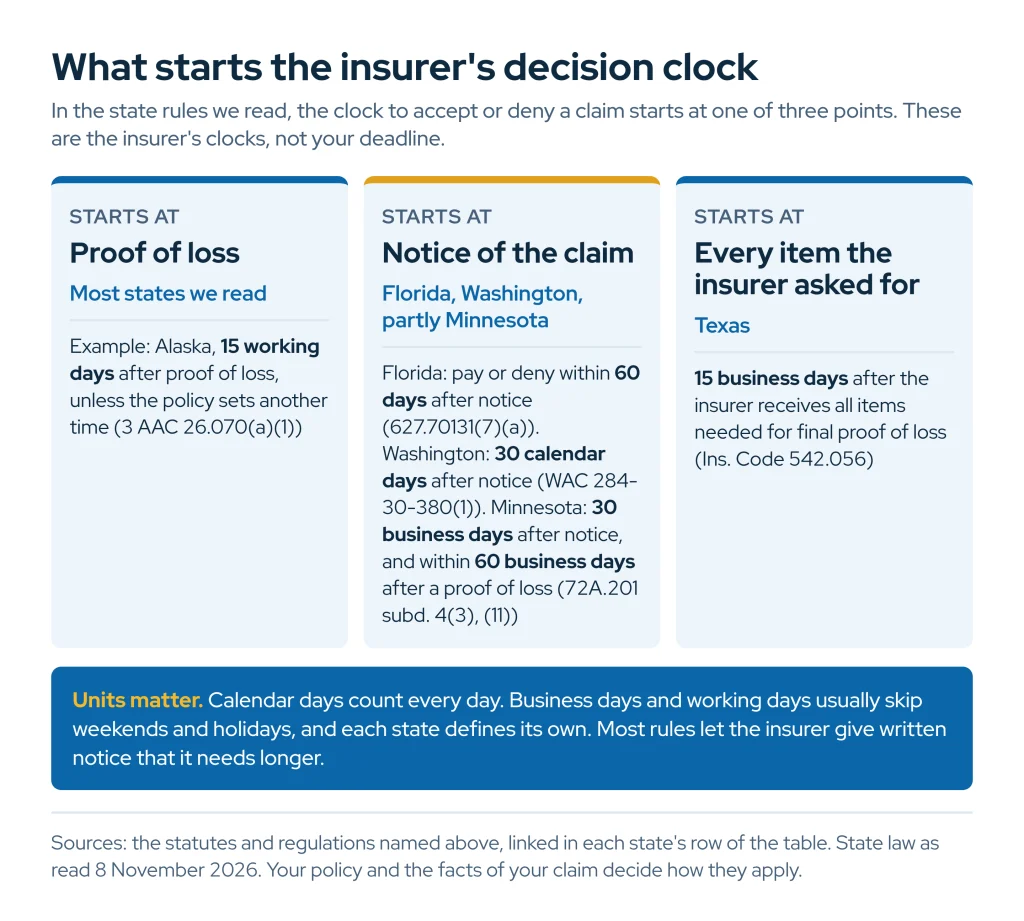
- Accept or deny: how many days it has to decide, and what starts that clock. In most states it starts when the insurer receives a proof of loss, a signed statement of what was lost and what you claim. In Florida, Washington and partly Minnesota it starts with notice of the claim. In Texas it starts when the insurer has every item it asked for.
- Pay: how many days it has to pay once the claim is accepted or the amount is agreed, and what starts that clock.
- Suit rule: what kind of rule limits the time to sue the insurer, and the number of months where the rule gives one.
Units matter. Calendar days count every day. Business days and working days usually skip weekends and holidays, and each state defines its own; Texas, for example, defines a business day as any day but a Saturday, Sunday or state holiday (Ins. Code 542.051). The tool says “days, unit not stated in the rule” where the text says only “days” and the sections we read don’t define them. A count of 0 with “no day count read” means the rule we read has no day count (many say “reasonable time”), or the row is not confirmed. The table below says which, in words.
What the lookup can’t do: read your policy, know whether your insurer is a surplus lines company, a state wind pool or a FAIR plan, know whether a disaster has been declared, or count your days. It shows the rule in your state; your policy may give you longer. Check its Duties After Loss and Suit Against Us conditions, and don’t wait for the last day of any period.
A worked example: Texas, the starting choice
General information, not legal or insurance advice, and not a substitute for the advice of an attorney. Your policy’s wording and your state’s law decide, and both change. For help with your claim, your state insurance department’s consumer line and legal aid are free.
The lookup opens on Texas. This is what each line shows, read against the Texas Insurance Code and Civil Practice and Remedies Code on 8 November 2026. It is an example of how to read the output, not a count for any claim.
- Acknowledge: 15, days, unit not stated in the rule. Within 15 days after the insurer receives written notice of the claim, it must acknowledge it, start investigating and ask for what it needs (542.055(a)).
- Accept or deny: 15, business days, clock starts at all requested items. The insurer must accept or reject the claim in writing within 15 business days after it receives every item, statement and form it asked for (542.056(a)).
- Pay: 5, business days, clock starts at acceptance, agreement or affirmed liability. Payment is due within 5 business days after the insurer says it will pay, or after you do something the payment depends on (542.057(a)-(b)).
- Suit limit rule: shortest a policy may set, 24 months. No contract may set a suit limit under 2 years (CPRC 16.070(a)). Your policy may give you longer: check its Suit Against Us condition.
Now change one fact at a time. If the insurer is an eligible surplus lines insurer, the first and last clocks become 30 and 20 business days (542.055(a), 542.057(c)). If it suspects arson, it has 30 days to decide (542.056(b)). If it sends a notice saying it needs more time, it has 45 days from that notice (542.056(d)). After a weather-related catastrophe or major natural disaster as defined by the commissioner, each claim-handling deadline gets 15 more days (542.059(b)). A Texas Windstorm Insurance Association policy follows chapter 2210 instead. So the same Texas claim can run on several different clocks, which is why the lookup shows the rule and stops there.
The three clocks and what starts each one
“How long should a home insurance claim take” has no single answer, but most state rules break the insurer’s side into the same three steps. Each step has its own trigger, and the trigger is usually something you send.
- Notice of claim starts the acknowledgment clock. In Texas it must be written notice that reasonably tells the insurer the facts (542.051(4)); in the other rules we read, notice is usually defined by the policy’s terms, and several say notice to the insurer’s agent counts as notice to the insurer. Check what your policy asks for, report in writing and keep a copy with the date.
- Proof of loss starts the decision clock in most states. The insurer usually tells you what it needs; Michigan requires it to say so in writing within 30 days of the claim (MCL 500.2006(3)). Until the insurer has a complete, properly signed proof of loss, the decision clock in those states hasn’t started. Our page on the proof of loss explains the form.
- Acceptance or agreement starts the payment clock in most states: once the insurer accepts the claim, or you and the insurer agree the amount, it has a set time to pay. Some states count payment from proof of loss instead, for example Louisiana, Kentucky and Michigan.
Most of these rules give the insurer a way to buy time: a written notice, within the first period, of why it needs longer, followed by updates every 30, 45 or 90 days. Texas allows a decision 45 days after such a notice (542.056(d)); Oklahoma caps the investigation at 120 days after proof of loss, except where fraud or arson is suspected (36 O.S. 1250.7(C)). So a claim can lawfully take longer than the first number in the table.
Two more things about how these rules work. First, many are written as “unfair claim settlement practices” that the insurance department enforces, and several count a breach only when it happens “with such frequency as to indicate a general business practice” (for example Hawaii’s 431:13-103(a)(11), Maryland’s COMAR 31.15.07.03B and New York’s Ins. Law 2601(a)). Some say outright that they create no private right to sue: Ohio’s rule does (OAC 3901-1-54(A)), and Florida says a missed 60-day deadline “does not form the sole basis for a private cause of action” (627.70131(7)(a)). Second, a few states attach interest or a penalty to late payment in a separate statute; those are listed further down. Neither means a missed day is automatically worth money on any particular claim. If you think the insurer has missed a clock, the state’s insurance department is the place to ask; our complaint page by state lists where.
The policy’s own clocks
Your policy has deadlines for you, too, and they sit alongside the state’s rules. As an example of what a standard homeowners policy says, the ISO HO-3 specimen form (2011 edition, HO 00 03 05 11, in the Maine Bureau of Insurance’s copy, and the 2000 edition, HO 00 03 10 00, in the Insurance Information Institute’s copy) requires prompt notice of a loss, a signed, sworn proof of loss within 60 days after the insurer asks for one, and any suit to start within two years after the date of loss. It makes the loss payable 60 days after the insurer receives your proof of loss and you agree the amount, a court gives final judgment, or an appraisal award is filed. Your own policy and its state amendatory endorsement can differ from the specimen, and state law often changes the suit clause.
Many states also write a “standard fire policy” into their statutes, a fixed text that fire policies must follow or improve on. Its suit clause shows up in the table as “standard fire policy”, because the statute sets the wording rather than a floor: for example 12 months after inception of the loss in Iowa (515.109), 24 months in New York (3404) and Oregon (742.240), and 3 years in North Carolina (58-44-16(f)(18)). How that text carries into a homeowners policy that covers more than fire is a question for the policy and the courts; we haven’t stated a rule on it.
Claim deadlines in all 50 states and DC
Read 8 November 2026 in the official text linked in each row. “Not confirmed” means we couldn’t open or haven’t read the official text, not that the state has no rule. “No day count” means the rule we read uses words such as “reasonable time” instead of a number. Suit limits are the shortest limit a policy may set, or the standard policy’s text, never a deadline for anyone’s claim.
| State | Acknowledge | Decide | Pay | Suit limit |
|---|---|---|---|---|
| Alabama | 15 days | 30 days* | 30 days | – |
| Alaska | 10 work days | 15 work days | 30 work days | – |
| Arizona | – | – | No count | 1 yr |
| Arkansas | – | – | – | – |
| California | 15 days | 40 days | 30 days | 12 mo* |
| Colorado | No count | 60 days | 60 days | – |
| Connecticut | No count | No count | 30 days | 24 mo |
| Delaware | – | – | – | – |
| Florida | 7 days | 60 days | 60 days | 5 yr |
| Georgia | – | – | – | – |
| Hawaii | 15 work days | No count | 30 days | 1 yr |
| Idaho | – | – | – | – |
| Illinois | 15 work days | No count | 30 days | None found |
| Indiana | – | – | – | – |
| Iowa | 15 days | 30 days | 30 days | 12 mo |
| Kansas | – | – | – | – |
| Kentucky | 15 days | 30 days | 30 days | Partly* |
| Louisiana | 14 days | 30 days | 30 days* | 24 mo |
| Maine | No count | No count | 30 days* | 2 yr |
| Maryland | 15 work days | 15 work days | No count | 3 yr† |
| Massachusetts | No count | No count | 30 days | 2 yr |
| Michigan | 30 days | No count | 30 days | 1 yr |
| Minnesota | 10 bus. days | 30 bus. days | 5 bus. days | 2 yr |
| Mississippi | – | – | – | – |
| Missouri | – | – | – | Clauses void† |
| Montana | No count | 30 days | 30 days | – |
| Nebraska | 15 work days | 15 work days | 15 work days | State limit† |
| Nevada | 20 work days | 30 work days | 30 days | – |
| New Hampshire | – | – | – | – |
| New Jersey | – | – | – | – |
| New Mexico | – | – | – | – |
| New York | No count* | 30 work days* | 5 bus. days | 24 mo |
| North Carolina | No count | No count | 60 days | 3 yr |
| North Dakota | No count | No count | No count | 3 yr |
| Ohio | 15 days | 21 days | 10 days | None found |
| Oklahoma | 30 days | 60 days | No count | 1 yr |
| Oregon | – | – | 60 days | 24 mo |
| Pennsylvania | 10 work days | 15 work days | No count | – |
| Rhode Island | 15 days | 21 days | 30 days | 24 mo |
| South Carolina | No count | No count | No count | 3 yr† |
| South Dakota | 30 days | No count | No count | 6 yr† |
| Tennessee | – | – | – | – |
| Texas | 15 days | 15 bus. days | 5 bus. days | 2 yr |
| Utah | – | – | – | 3 yr |
| Vermont | – | – | – | 12 mo |
| Virginia | 15 days | 15 days | No count | 2 yr |
| Washington | 10 bus. days | 30 days | 15 bus. days | 1 yr |
| West Virginia | 15 work days | 10 work days* | 15 work days | – |
| Wisconsin | – | – | – | – |
| Wyoming | – | – | – | – |
| Washington, DC | – | – | – | – |
Each state in full
Tap a state to open its full rules: what starts each clock, the exceptions and notice rules, and the official text we read with its date.
Alabama: acknowledge 15 days · decide 30 days · pay 30 days · suit limit not confirmed
- Acknowledge: 15 days after notice of a first-party claim (Ala. Admin. Code 482-1-125-.06(1))
- Accept or deny: Tell you the status of acceptance or denial within 30 days after proof of loss, or the number of days in the policy; then every 45 days (-.07(1)-(2))
- Pay: 30 days, or the policy's time, after accepting liability, agreeing the amount and receiving closing papers (-.07(6))
- Suit limit, notice and warnings: Not confirmed: the Code of Alabama was not read. Unrepresented claimants get written notice about 45 calendar days before a limitation period ends (-.07(4))
- Official text: Ala. Admin. Code 482-1-125-.06; -.07; Code of Alabama. Read 8 Nov 2026
Alaska: acknowledge 10 work days · decide 15 work days · pay 30 work days · suit limit not confirmed
- Acknowledge: 10 working days after notice of claim (3 AAC 26.040(a)(1))
- Accept or deny: 15 working days after proof of loss, unless the policy sets another time; then every 45 working days (26.070(a)(1))
- Pay: Undisputed part: 30 working days after proof of loss (26.070(a)(2))
- Suit limit, notice and warnings: Not confirmed. Unrepresented claimants get written notice at least 60 calendar days before a time limit (26.070(c))
- Official text: 3 AAC 26; Alaska Statutes. Read 8 Nov 2026
Arizona: acknowledge not confirmed · decide not confirmed · pay no day count · suit limit 1 yr
- Acknowledge: Not confirmed (Ariz. Admin. Code R20-6-801: official text not opened)
- Accept or deny: Not confirmed
- Pay: No pay clock read. A first-party claim not paid within 30 days after an acceptable proof of loss bears interest at the legal rate from the date the claim was received; good-faith denials within those 30 days are excepted (A.R.S. 20-462)
- Suit limit, notice and warnings: Property policies: 1 year from the event that caused the loss; the insurer may give longer (A.R.S. 20-1115(A)(3))
- Official text: A.R.S. 20-1115; 20-462. Read 8 Nov 2026
Arkansas: not confirmed
- Acknowledge: Not confirmed
- Accept or deny: Not confirmed
- Pay: Not confirmed
- Suit limit, notice and warnings: Not confirmed: the Arkansas Code has no free official text we could open
- Official text: Arkansas Legislature; Arkansas Insurance Department. Checked 8 Nov 2026
California: acknowledge 15 days · decide 40 days · pay 30 days · suit limit 12 mo
- Acknowledge: 15 calendar days after notice of claim: acknowledge, send forms, begin investigating (10 CCR 2695.5(e))
- Accept or deny: 40 calendar days after proof of claim; if more time is needed, written notice, then every 30 calendar days (2695.7(b)-(c))
- Pay: 30 calendar days after accepting the claim (2695.7(h))
- Suit limit, notice and warnings: Standard form: 12 months after inception of the loss; 24 months if the loss relates to a declared state of emergency (Ins. Code 2071). Written notice at least 60 days before a time limit, unless you have a lawyer (2695.7(f))
- Official text: Ins. Code 2071; California Code of Regulations. Read 8 Nov 2026
Colorado: acknowledge no day count · decide 60 days · pay 60 days · suit limit not confirmed
- Acknowledge: No day count found in 3 CCR 702-5
- Accept or deny: Decide and/or pay within 60 days after a valid and complete claim, unless there is a reasonable dispute (Reg. 5-1-14, 4.A.1.a). 'Valid and complete' is defined narrowly (4.A.2)
- Pay: Same 60 days. On claims over $100, the Commissioner may order 8% annual interest paid to the insured on late benefits (4.A.1.b)
- Suit limit, notice and warnings: Not confirmed: the Colorado Revised Statutes could not be opened
- Official text: 3 CCR 702-5; Colorado Revised Statutes. Read 8 Nov 2026
Connecticut: acknowledge no day count · decide no day count · pay 30 days · suit limit 24 mo
- Acknowledge: No day count: 'reasonable promptness' (38a-816(6))
- Accept or deny: No day count: 'reasonable time' after proof of loss (38a-816(6))
- Pay: Standard fire policy: payable 30 days after proof of loss and an agreement or appraisal award (38a-307)
- Suit limit, notice and warnings: Standard fire policy: 24 months after inception of the loss (38a-307)
- Official text: Ch. 700 (38a-307); Ch. 704 (38a-816). Read 8 Nov 2026
Delaware: not confirmed
- Acknowledge: Not confirmed
- Accept or deny: Not confirmed
- Pay: Not confirmed
- Suit limit, notice and warnings: Not confirmed (Regulation 902 read only in an archived copy; no suit-limit statute read)
- Official text: Delaware Code title 18. Checked 8 Nov 2026
Florida: acknowledge 7 days · decide 60 days · pay 60 days · suit limit 5 yr
- Acknowledge: 7 calendar days after any communication about a claim (627.70131(1))
- Accept or deny: Pay or deny within 60 days after notice of an initial, reopened or supplemental claim (627.70131(7)(a)). After a Governor's emergency, an Office of Insurance Regulation order can add up to 30 days (627.70131(5))
- Pay: Within the same 60 days. Late payment bears interest at the s. 55.03 rate from the date of notice; missing the 60 days is not by itself the basis for a private lawsuit (627.70131(7)(a)). The clocks are tolled during Department of Financial Services mediation or the policy's dispute process, and while requested material information is more than 10 days late (627.70131(8))
- Suit limit, notice and warnings: 5 years from the date of loss (95.11(2)(e)); a shorter policy term is void (95.03). Notice of a new or reopened claim within 1 year after the date of loss, a supplemental claim within 18 months after the date of loss (627.70132). Notice of intent to sue, on the Department of Financial Services form, at least 10 business days before suit (627.70152)
- Official text: 627.70131; 627.70132; 95.11. Read 8 Nov 2026
Georgia: not confirmed
- Acknowledge: Not confirmed
- Accept or deny: Not confirmed
- Pay: Not confirmed
- Suit limit, notice and warnings: Not confirmed (the Code is hosted by a publisher whose copy we could not open)
- Official text: Georgia General Assembly; Ga. Comp. R. & Regs. 120-2-20. Checked 8 Nov 2026
Hawaii: acknowledge 15 work days · decide no day count · pay 30 days · suit limit 1 yr
- Acknowledge: Respond to your communications within 15 working days, with more than an acknowledgment (HRS 431:13-103(a)(11)(B))
- Accept or deny: Reasonable time after proof of loss ((E)); a written explanation of any delay on a claim unresolved 30 calendar days after it was reported ((G))
- Pay: Offer payment within 30 calendar days of affirming liability, once the amount is settled ((F))
- Suit limit, notice and warnings: Property policies: not less than 1 year from the date of the loss (431:10-221(a)(3))
- Official text: HRS 431:13-103; 431:10-221. Read 8 Nov 2026
Idaho: not confirmed
- Acknowledge: Not confirmed
- Accept or deny: Not confirmed
- Pay: Not confirmed
- Suit limit, notice and warnings: Not confirmed
- Official text: Idaho Code title 41. Checked 8 Nov 2026
Illinois: acknowledge 15 work days · decide no day count · pay 30 days · suit limit none found
- Acknowledge: 'Reasonable promptness' means at most 15 working days from a communication (50 Ill. Adm. Code 919.40)
- Accept or deny: Reasonable time. Fire and extended coverage claims unresolved more than 75 calendar days after the report, or 25 calendar days after proof of loss, whichever is less, need a written explanation (919.80(d)(7)(B))
- Pay: Offer payment within 30 days (calendar days, 919.40) after affirming liability (919.50(a))
- Suit limit, notice and warnings: No statutory minimum found. The policy's suit period is tolled from proof of loss until denial (215 ILCS 5/143.1); under a residential fire and extended coverage policy, the denial must say in writing how many days were tolled and how many remain (919.80(d)(8)(C))
- Official text: 215 ILCS 5/143.1; 50 Ill. Adm. Code 919.40; 919.50; 919.80. Read 8 Nov 2026
Indiana: not confirmed
- Acknowledge: Not confirmed
- Accept or deny: Not confirmed
- Pay: Not confirmed
- Suit limit, notice and warnings: Not confirmed (the official code site is a script app we could not read)
- Official text: Indiana General Assembly. Checked 8 Nov 2026
Iowa: acknowledge 15 days · decide 30 days · pay 30 days · suit limit 12 mo
- Acknowledge: 15 days (191 IAC 15.42(1))
- Accept or deny: 30 days after proof of loss; if more time is needed, notice, then every 45 days (15.41(2)-(3))
- Pay: 30 days after affirming liability, if the amount is not in dispute (15.41(6))
- Suit limit, notice and warnings: Standard fire policy: 12 months after inception of the loss (Iowa Code 515.109); 515.110 not read
- Official text: 191 IAC ch. 15; Iowa Code 515.109. Read 8 Nov 2026
Kansas: not confirmed
- Acknowledge: Not confirmed
- Accept or deny: Not confirmed
- Pay: Not confirmed
- Suit limit, notice and warnings: Not confirmed (K.A.R. 40-1-34 read only as a model attachment)
- Official text: Kansas Statutes; Kansas Administrative Regulations. Checked 8 Nov 2026
Kentucky: acknowledge 15 days · decide 30 days · pay 30 days · suit limit partly
- Acknowledge: 15 days (806 KAR 12:095 s. 5)
- Accept or deny: Offer any payment due within 30 calendar days of proof of loss, or say why more time is needed, then every 45 calendar days (s. 6)
- Pay: Claims payable within 30 days after notice and proof of claim; 12% a year interest if the insurer makes no good-faith attempt to settle in that time (KRS 304.12-235)
- Suit limit, notice and warnings: Partly: KRS 304.14-370 bars policy limits under 1 year from accrual, but names foreign insurers only. For other insurers: not confirmed
- Official text: 806 KAR 12:095; KRS 304.12-235; 304.14-370. Read 8 Nov 2026
Louisiana: acknowledge 14 days · decide 30 days · pay 30 days · suit limit 24 mo
- Acknowledge: Start adjusting within 14 days after notice of loss; 30 days for a catastrophic loss, meaning one from a presidentially or gubernatorially declared emergency or disaster (22:1892(A)(3), (B)(1)(c))
- Accept or deny: Written offer within 30 days after satisfactory proof of loss (22:1892(A)(4), (B)(1))
- Pay: 30 days after satisfactory proof of loss (22:1892(A)(1)); residential catastrophic losses: 60 days (22:1892.2(A)(2))
- Suit limit, notice and warnings: Not less than 24 months after inception of the loss for first-party property claims (22:868(B)). A 60-day cure notice comes before a 22:1892.2 penalty suit
- Official text: 22:1892; 22:1892.2; 22:868. Read 8 Nov 2026
Maine: acknowledge no day count · decide no day count · pay 30 days · suit limit 2 yr
- Acknowledge: No day count: 'reasonable time' (24-A §2436-A(1)(B))
- Accept or deny: Reasonable time after the investigation (§2436-A(1)(D))
- Pay: 30 days after proof of loss and an agreement or award; 60 days for the fire part of a policy (§2436)
- Suit limit, notice and warnings: Standard fire policy: 2 years after inception of the loss (§3002)
- Official text: 24-A §2436; §2436-A; §3002. Read 8 Nov 2026
Maryland: acknowledge 15 work days · decide 15 work days · pay no day count · suit limit 3 yr
- Acknowledge: 15 working days (COMAR 31.15.07.03B(10))
- Accept or deny: 15 working days after proof of loss, unless Regulation .04B applies or the policy sets a time (.03B(12)). Under .04B, an investigation not finished 45 days after notice of the claim needs written reasons, then again every 45 days
- Pay: No day count found
- Suit limit, notice and warnings: A suit clause shorter than state law is void (Ins. 12-104); the general civil limit is 3 years from accrual (Cts. & Jud. Proc. 5-101)
- Official text: COMAR 31.15.07.03; .04; Ins. 12-104; CJP 5-101. Read 8 Nov 2026
Massachusetts: acknowledge no day count · decide no day count · pay 30 days · suit limit 2 yr
- Acknowledge: No day count: 'reasonably promptly' (c. 176D s. 3(9)(b))
- Accept or deny: No day count: 'reasonable time' after proof of loss (s. 3(9)(e))
- Pay: Standard policy: 30 days after your sworn statement (c. 175 s. 99)
- Suit limit, notice and warnings: Standard policy: 2 years from the loss; if referees set the amount, at least 90 days after the award (c. 175 s. 99)
- Official text: c. 175 s. 99; c. 176D s. 3. Read 8 Nov 2026
Michigan: acknowledge 30 days · decide no day count · pay 30 days · suit limit 1 yr
- Acknowledge: Specify in writing what proof of loss is needed within 30 days after receiving the claim (MCL 500.2006(3))
- Accept or deny: No decision count read; paid on time if paid within 60 days after proof of loss (500.2006(3))
- Pay: Fire policies: payable within 30 days after proof of the amount of loss (500.2833(1)(p)); 12% simple interest from 60 days after satisfactory proof of loss (500.2006(4))
- Suit limit, notice and warnings: Fire policies: 1 year after the loss or the policy's period, whichever is longer, tolled from your notice of loss until formal denial (500.2833(1)(q))
- Official text: MCL 500.2006; 500.2833. Read 8 Nov 2026
Minnesota: acknowledge 10 bus. days · decide 30 bus. days · pay 5 bus. days · suit limit 2 yr
- Acknowledge: 10 business days (72A.201 subd. 4(1))
- Accept or deny: 30 business days after notice of claim, or say why and when (subd. 4(3)); and within 60 business days after a proof of loss (subd. 4(11))
- Pay: 5 business days after an agreed settlement or the claimant's conditions are met (subd. 5(5))
- Suit limit, notice and warnings: Standard fire policy: 2 years after inception of the loss (65A.01 subd. 3)
- Official text: Minn. Stat. 72A.201; 65A.01. Read 8 Nov 2026
Mississippi: not confirmed
- Acknowledge: Not confirmed
- Accept or deny: Not confirmed
- Pay: Not confirmed
- Suit limit, notice and warnings: Not confirmed (the code site refused every way we tried)
- Official text: Mississippi Legislature. Checked 8 Nov 2026
Missouri: acknowledge not confirmed · decide not confirmed · pay not confirmed · suit limit clauses void
- Acknowledge: Not confirmed (20 CSR 100-1 official text not opened)
- Accept or deny: Not confirmed
- Pay: Not confirmed
- Suit limit, notice and warnings: Policy limits on the time to sue are void (RSMo 431.030). Actions on a writing for the payment of money: 10 years (516.110(1)). Which general limit governs a claim is for the courts
- Official text: RSMo 431.030; 516.110. Read 8 Nov 2026
Montana: acknowledge no day count · decide 30 days · pay 30 days · suit limit not confirmed
- Acknowledge: No day count found
- Accept or deny: Pay or deny within 30 days after proof of loss; 60 days if the insurer reasonably asks for more information, unless it explains why it isn't paying in full (MCA 33-18-232(1))
- Pay: Same clock; 10% annual interest if late and the insurer is liable (33-18-232(2))
- Suit limit, notice and warnings: Not confirmed: MCA 28-2-708 voids contract time limits in general; whether it reaches a policy's suit clause was not confirmed
- Official text: MCA 33-18-232; 28-2-708. Read 8 Nov 2026
Nebraska: acknowledge 15 work days · decide 15 work days · pay 15 work days · suit limit state limit
- Acknowledge: 15 working days (210 NAC 60-006.01; 'days' means working days, 003.05)
- Accept or deny: 15 working days after proof of loss or settlement information; then every 30 working days (008.01-.02)
- Pay: 15 working days after you accept an offer (008.04)
- Suit limit, notice and warnings: Not shorter than the state's regular statute of limitations (Neb. Rev. Stat. 44-357); which period applies was not read
- Official text: 210 NAC 60; 44-357. Read 8 Nov 2026
Nevada: acknowledge 20 work days · decide 30 work days · pay 30 days · suit limit not confirmed
- Acknowledge: 20 working days (NAC 686A.665)
- Accept or deny: 30 working days after proof of loss; then every 30 days (686A.675(1), (3))
- Pay: 30 days after acceptance; interest after that (686A.675(1))
- Suit limit, notice and warnings: Not confirmed (no statute found in the sections read). Written notice 60 days before a time limit to unrepresented claimants (686A.675(5))
- Official text: NAC 686A. Read 8 Nov 2026
New Hampshire: not confirmed
- Acknowledge: Not confirmed
- Accept or deny: Not confirmed
- Pay: Not confirmed
- Suit limit, notice and warnings: Not confirmed (the code site refused every way we tried)
- Official text: NH Revised Statutes. Checked 8 Nov 2026
New Jersey: not confirmed
- Acknowledge: Not confirmed
- Accept or deny: Not confirmed
- Pay: Not confirmed
- Suit limit, notice and warnings: Not confirmed (N.J.A.C. 11:2-17 read only in an unofficial copy)
- Official text: NJ Department of Banking and Insurance. Checked 8 Nov 2026
New Mexico: not confirmed
- Acknowledge: Not confirmed
- Accept or deny: Not confirmed
- Pay: Not confirmed
- Suit limit, notice and warnings: Not confirmed
- Official text: New Mexico Administrative Code. Checked 8 Nov 2026
New York: acknowledge no day count · decide 30 work days · pay 5 bus. days · suit limit 24 mo
- Acknowledge: Statute: 'reasonable promptness' (Ins. Law 2601(a)(2)); Regulation 64's count (11 NYCRR 216.5) not confirmed
- Accept or deny: Statute: 30 working days after a properly executed proof of loss (2601(a)(4)). Regulation 64: 15 business days after proof of loss and requested items, else written notice, then every 90 days (11 NYCRR 216.6(c)). The two differ, and we haven't stated which one governs; the Department of Financial Services can tell you. Regulation 64 was read on the state's NYCRR site, which labels its text unofficial (current through 31 May 2022)
- Pay: Regulation 64: 5 business days after agreement (216.6(f))
- Suit limit, notice and warnings: Standard fire policy: 24 months after inception of the loss (3404)
- Official text: Ins. Law 2601; 3404. Read 8 Nov 2026
North Carolina: acknowledge no day count · decide no day count · pay 60 days · suit limit 3 yr
- Acknowledge: No day count: 'reasonably promptly' (G.S. 58-63-15(11))
- Accept or deny: No day count: 'within a reasonable time' after proof of loss (58-63-15(11))
- Pay: Standard fire policy: 60 days after proof of loss and agreement or award (58-44-16(f))
- Suit limit, notice and warnings: Standard fire policy: 3 years after inception of the loss (58-44-16(f)(18))
- Official text: G.S. 58-63-15; 58-44-16. Read 8 Nov 2026
North Dakota: acknowledge no day count · decide no day count · pay no day count · suit limit 3 yr
- Acknowledge: No day count in the sections read
- Accept or deny: No day count in the sections read
- Pay: No day count in the sections read
- Suit limit, notice and warnings: Fire policies: no limit under 3 years (26.1-39-06(10)). Reopened claim: notice within 1 year after the date of loss; supplemental claim: within 12 months of the last payment for that part of the loss (26.1-39-30)
- Official text: N.D.C.C. ch. 26.1-39. Read 8 Nov 2026
Ohio: acknowledge 15 days · decide 21 days · pay 10 days · suit limit none found
- Acknowledge: 15 days; 'days' are calendar days (OAC 3901-1-54(F)(2), (C)(5))
- Accept or deny: 21 days after proof of loss; then every 45 days ((G)(1))
- Pay: 10 days after acceptance, if the amount is not in dispute ((G)(6))
- Suit limit, notice and warnings: No statute found in the sections read. Written notice 60 days before a limit to claimants without a lawyer ((G)(5))
- Official text: OAC 3901-1-54. Read 8 Nov 2026
Oklahoma: acknowledge 30 days · decide 60 days · pay no day count · suit limit 1 yr
- Acknowledge: 30 days (36 O.S. 1250.6)
- Accept or deny: 60 days after proof of loss: accept, deny, or say more investigation is needed; investigation at most 120 days (fraud and arson excepted); the Commissioner may add 20 days after a Governor-declared catastrophe (1250.7). Written offer or rejection within 60 days of proof of loss (3629(B))
- Pay: No day count found
- Suit limit, notice and warnings: Property policies: not less than 1 year from the event (3617)
- Official text: Title 36 (complete file, compiled through the 2025 session; 2026 session laws not read). Read 8 Nov 2026
Oregon: acknowledge not confirmed · decide not confirmed · pay 60 days · suit limit 24 mo
- Acknowledge: Not confirmed (OAR 836-080 read only in an unofficial copy)
- Accept or deny: Not confirmed
- Pay: Standard fire policy: 60 days after proof of loss and agreement or award (ORS 742.238)
- Suit limit, notice and warnings: Standard fire policy: 24 months after inception of the loss (742.240)
- Official text: ORS ch. 742. Read 8 Nov 2026
Pennsylvania: acknowledge 10 work days · decide 15 work days · pay no day count · suit limit not confirmed
- Acknowledge: 10 working days (31 Pa. Code 146.5(a))
- Accept or deny: 15 working days after proofs of loss; if more time is needed, notice, then at 30 days and every 45 days (146.7(a), (c))
- Pay: No day count found
- Suit limit, notice and warnings: Not confirmed (40 P.S. 636 not opened). Written notice 30 days before a time limit to first-party claimants without a lawyer (146.7(e))
- Official text: 31 Pa. Code ch. 146. Read 8 Nov 2026
Rhode Island: acknowledge 15 days · decide 21 days · pay 30 days · suit limit 24 mo
- Acknowledge: 15 days; 'days' are calendar days (230-RICR-20-40-2.6(A))
- Accept or deny: 21 days after proof of loss; then every 45 days (2.7(A)-(B))
- Pay: 30 days after affirming liability (2.7(F))
- Suit limit, notice and warnings: Standard fire policy: 24 months after inception of the loss (R.I. Gen. Laws 27-5-3)
- Official text: 230-RICR-20-40-2; 27-5-3. Read 8 Nov 2026
South Carolina: acknowledge no day count · decide no day count · pay no day count · suit limit 3 yr
- Acknowledge: No day count: 'reasonable promptness' (38-59-20)
- Accept or deny: No day count found
- Pay: No day count found
- Suit limit, notice and warnings: A policy clause shorter than the statute of limitations doesn't bar a suit brought within the statute (15-3-140); contract actions: 3 years (15-3-530)
- Official text: Title 38 ch. 59; Title 15 ch. 3. Read 8 Nov 2026
South Dakota: acknowledge 30 days · decide no day count · pay no day count · suit limit 6 yr
- Acknowledge: Acknowledge and act on claim communications within 30 days (SDCL 58-33-67(1))
- Accept or deny: No day count found
- Pay: No day count found
- Suit limit, notice and warnings: Contract terms limiting the time to sue are void (53-9-6); contract actions: 6 years (15-2-13)
- Official text: SDCL 58-33-67; 53-9-6; 15-2-13. Read 8 Nov 2026
Tennessee: not confirmed
- Acknowledge: Not confirmed
- Accept or deny: Not confirmed
- Pay: Not confirmed
- Suit limit, notice and warnings: Not confirmed (the Code is hosted by a publisher whose copy we could not open)
- Official text: Tennessee General Assembly. Checked 8 Nov 2026
Texas: acknowledge 15 days · decide 15 bus. days · pay 5 bus. days · suit limit 2 yr
- Acknowledge: 15 days after written notice of claim: acknowledge, start investigating, ask for what's needed; eligible surplus lines insurers 30 business days (Ins. Code 542.055)
- Accept or deny: 15 business days after receiving all items needed for final proof of loss; 30 days if arson is suspected; with a notice that more time is needed, 45 days after that notice (542.056). Weather-related catastrophe or major natural disaster, as defined by the commissioner: +15 days (542.059(b))
- Pay: 5 business days after notice of acceptance, or after a required act; surplus lines 20 business days (542.057)
- Suit limit, notice and warnings: No contract limit under 2 years (CPRC 16.070); a notice-of-claim condition under 90 days is void (16.071). Weather claims: written notice at least 61 days before suit (Ins. Code 542A.003). TWIA policies follow their own clocks
- Official text: Ins. Code ch. 542; CPRC ch. 16; ch. 542A. Read 8 Nov 2026
Utah: acknowledge not confirmed · decide not confirmed · pay not confirmed · suit limit 3 yr
- Acknowledge: Not confirmed (R590-190 read only in an unofficial copy)
- Accept or deny: Not confirmed
- Pay: Not confirmed
- Suit limit, notice and warnings: 3 years after inception of the loss; a policy may not set less. No suit until the earliest of 60 days after proof of loss, the insurer waiving proof of loss, or its denial of full payment, unless a verified complaint alleges prejudice from the delay; tolled during appraisal or arbitration (31A-21-313)
- Official text: Utah Code 31A-21-313; Utah administrative rules. Read 8 Nov 2026
Vermont: acknowledge not confirmed · decide not confirmed · pay not confirmed · suit limit 12 mo
- Acknowledge: Not confirmed (Regulation I-79-2 read only in an unofficial copy)
- Accept or deny: Not confirmed
- Pay: Not confirmed
- Suit limit, notice and warnings: Fire policies: not less than 12 months from the occurrence of the loss (8 V.S.A. §3663)
- Official text: 8 V.S.A. §3663. Read 8 Nov 2026
Virginia: acknowledge 15 days · decide 15 days · pay no day count · suit limit 2 yr
- Acknowledge: 15 calendar days (14VAC5-400-50(A))
- Accept or deny: 15 calendar days after proof of loss; investigation updates every 45 calendar days (14VAC5-400-60)
- Pay: No day count found in the sections read
- Suit limit, notice and warnings: Standard fire policy: 2 years after inception of the loss (38.2-2105)
- Official text: 14VAC5-400-50; -60; 38.2-2105. Read 8 Nov 2026
Washington: acknowledge 10 bus. days · decide 30 days · pay 15 bus. days · suit limit 1 yr
- Acknowledge: 10 business days after notice of claim, individual policies (WAC 284-30-360(1))
- Accept or deny: Accept or deny within 30 calendar days after notice of claim, or give all the reasons more time is needed, then every 30 calendar days (284-30-380(1), (3); rule in force since 18 October 2026, WSR 26-17-089)
- Pay: Payment procedures must be designed to pay within 15 business days after settlement papers are received (284-30-330(16))
- Suit limit, notice and warnings: Property policies: not less than 1 year from the date of loss (RCW 48.18.200). Written notice 30 calendar days before a time limit to claimants without a lawyer (284-30-380(5)). A suit under the Insurance Fair Conduct Act needs 20 days' written notice (48.30.015(8))
- Official text: WAC 284-30-380; 284-30-360; 284-30-330; RCW 48.18.200; 48.30.015. Read 8 Nov 2026
West Virginia: acknowledge 15 work days · decide 10 work days · pay 15 work days · suit limit not confirmed
- Acknowledge: 15 working days (W. Va. Code R. 114-14-5.1)
- Accept or deny: Deny in writing or make a written offer within 10 working days of finishing the investigation (6.3); if more than 30 calendar days after proof of loss are needed, written notice within 15 working days after those 30 days end, then every 45 calendar days (6.7)
- Pay: 15 working days after agreement (6.11)
- Suit limit, notice and warnings: Not confirmed: 33-6-14 (not less than 2 years) does not apply to the standard fire policy, and which governs a homeowners policy is unresolved. Written notice 30 days before a limit (6.12)
- Official text: 114 CSR 14; W. Va. Code 33-6-14. Read 8 Nov 2026
Wisconsin: not confirmed
- Acknowledge: Not confirmed
- Accept or deny: Not confirmed
- Pay: Not confirmed
- Suit limit, notice and warnings: Not confirmed (the code site refused every way we tried)
- Official text: Wis. Stat. ch. 631. Checked 8 Nov 2026
Wyoming: not confirmed
- Acknowledge: Not confirmed
- Accept or deny: Not confirmed
- Pay: Not confirmed
- Suit limit, notice and warnings: Not confirmed (title 26 not re-read)
- Official text: Wyo. Stat. title 26. Checked 8 Nov 2026
Washington, DC: not confirmed
- Acknowledge: Not confirmed
- Accept or deny: Not confirmed
- Pay: Not confirmed
- Suit limit, notice and warnings: Not confirmed
- Official text: D.C. Code. Checked 8 Nov 2026
Suit limits: floors, fixed texts and states that void them
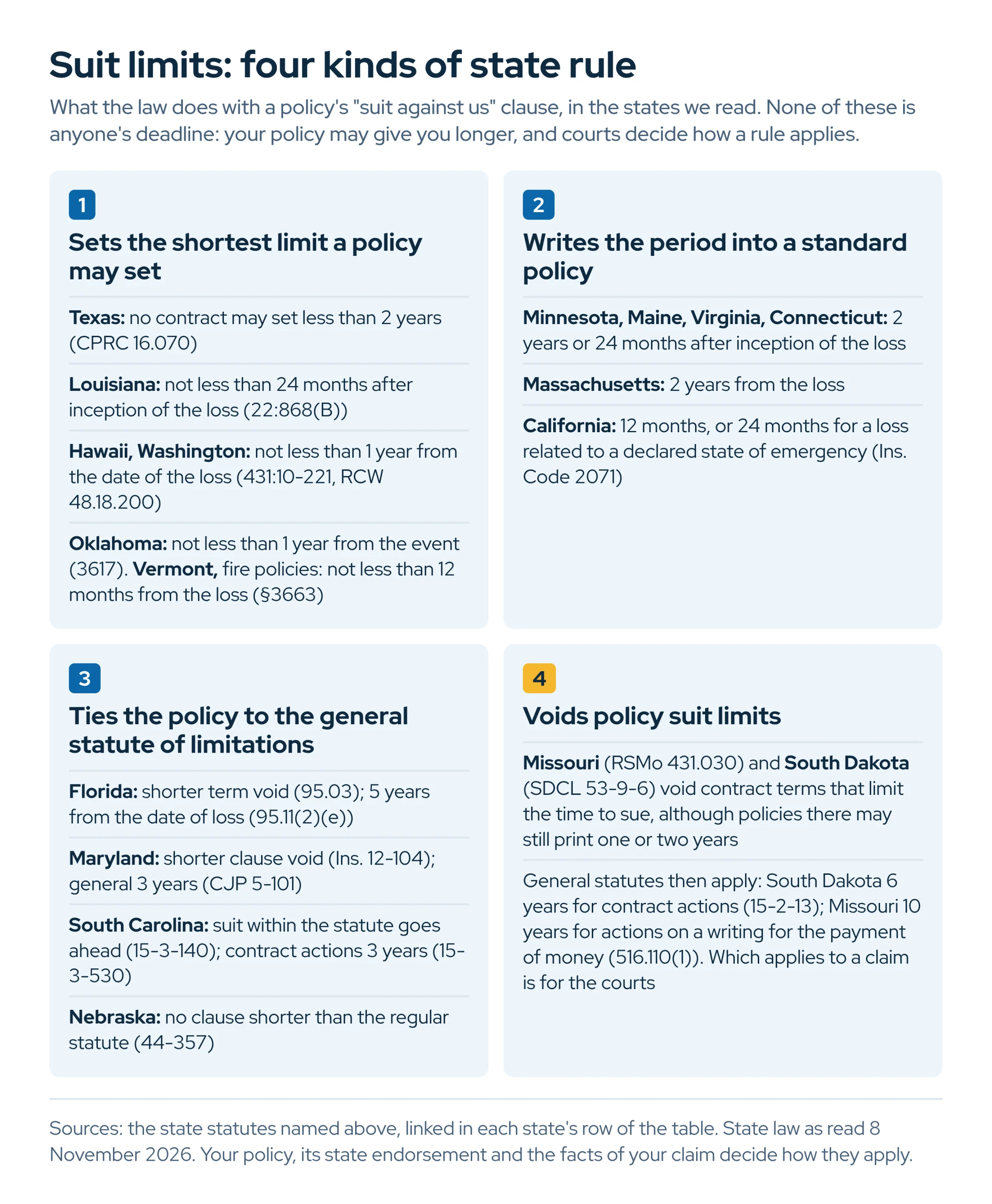
The “suit against us” clause is the deadline that most often ends a claim, and it’s also the one the web gets wrong most often. “You have one year to sue” is not a national rule. In the states we read, the law does one of four things.
- Sets the shortest limit a policy may set. The rule in Texas is that no contract may set less than 2 years (CPRC 16.070); in Louisiana, less than 24 months after inception of the loss (22:868(B)); in Hawaii and Washington, less than 1 year from the date of the loss (431:10-221, RCW 48.18.200); in Oklahoma, less than 1 year from the event (3617); in Vermont, for fire policies, less than 12 months from the loss (§3663). Your policy may give you longer, and the ISO specimen’s two years is longer than several of these floors.
- Writes the period into a standard policy. Minnesota, Maine, Virginia and Connecticut use 2 years or 24 months after inception of the loss; Massachusetts 2 years from the loss; California 12 months, or 24 months for a loss related to a declared state of emergency (Ins. Code 2071).
- Ties the policy to the general statute of limitations. Florida voids any contract term shorter than the applicable limit (95.03) and sets 5 years from the date of loss for property insurance contracts (95.11(2)(e)); Maryland voids a shorter clause (Ins. 12-104), leaving the general 3 years (CJP 5-101); South Carolina lets a suit go ahead within the statute despite a shorter clause (15-3-140), and contract actions there have 3 years (15-3-530); Nebraska bars clauses shorter than the regular statute of limitations (44-357).
- Voids policy suit limits. Missouri (RSMo 431.030) and South Dakota (SDCL 53-9-6) void contract terms that limit the time to sue, although policies there may still print one or two years. The general statutes then apply: in South Dakota, 6 years for contract actions (15-2-13); in Missouri, 10 years for actions on a writing for the payment of money (516.110(1)). Which general limit applies to a given claim is for the courts.
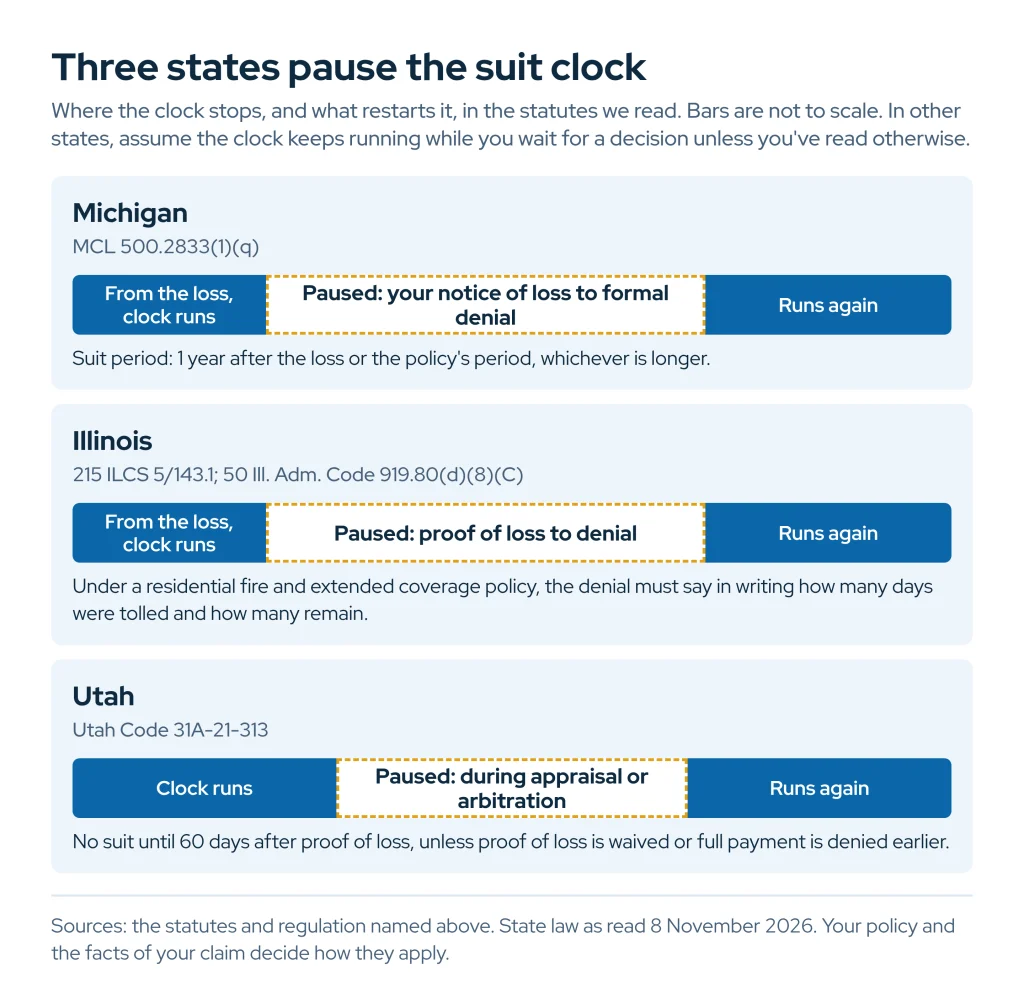
In the statutes we read, three states stop the clock while the insurer decides. Michigan tolls the suit period from your notice of loss until formal denial (500.2833(1)(q)). Illinois tolls it from proof of loss until denial (215 ILCS 5/143.1) and requires the denial letter to say how many days were tolled and how many remain (50 Ill. Adm. Code 919.80(d)(8)(C)). Utah tolls it during appraisal or arbitration and doesn’t allow suit until 60 days after proof of loss unless proof of loss is waived or full payment is denied earlier (31A-21-313). In the other states, assume the clock keeps running while you wait for a decision unless you’ve read otherwise.
Many state rules also require the insurer to warn a claimant without a lawyer before a time limit runs out: at least 60 days before in California (2695.7(f)), Alaska (26.070(c)), Nevada (686A.675(5)) and Ohio ((G)(5)); about 45 calendar days in Alabama (482-1-125-.07(4)); 30 days in Washington (284-30-380(5)), Pennsylvania (146.7(e)), Rhode Island (2.7(D)), West Virginia (6.12) and Kentucky (806 KAR 12:095 s. 6(3)). Maryland requires the insurer, on receiving a written claim from someone without a lawyer, to say in writing that a statute of limitations may apply (COMAR 31.15.07.04C). Oklahoma’s rule requires notice one year after the date of the loss (1250.7(E)). Don’t rely on that letter: it’s a duty on the insurer, not a promise of how much time is left.
Exceptions that change the count
Catastrophes and declared disasters
Big storms stretch the insurer’s clocks in several states. Texas adds 15 days to every claim-handling deadline after a weather-related catastrophe or major natural disaster as defined by the commissioner (542.059(b)). Oklahoma’s commissioner may add 20 days to the decision and investigation deadlines after a Governor-declared catastrophe (1250.7). Louisiana gives 30 days, not 14, to start adjusting a catastrophic loss, with a possible further 30 days by rule after a declared emergency (22:1892(A)(3)), and 60 days, not 30, to pay residential catastrophic losses after satisfactory proof of loss (22:1892.2(A)(2)). Florida’s Office of Insurance Regulation can extend the 60-day pay-or-deny period by no more than 30 days after a Governor’s emergency declaration (627.70131(5)). California extends the standard-form suit period to 24 months for a loss related to a declared state of emergency (Ins. Code 2071).

Your side’s clocks can move too: Florida’s notice limits run from the hurricane’s landfall or the date the National Oceanic and Atmospheric Administration verifies the weather event (627.70132(3)).
Surplus lines, wind pools and FAIR plans
Check who issued your policy. Texas gives eligible surplus lines insurers 30 business days to acknowledge and 20 business days to pay (542.055, 542.057(c)). Florida applies its claim clocks to surplus lines residential policies (627.70131(9)) and its notice limits to them too (627.70132(2)). The Texas Windstorm Insurance Association runs on its own statute: a claim within 1 year of the damage (the commissioner may extend that by up to 180 days for good cause), a decision by the later of 60 days after the claim or after the information it asked for, payment within 10 days of accepting, and suit within 2 years of the denial notice (Ins. Code 2210.205, 2210.573, 2210.5731, 2210.577). The commissioner may, for good cause and by rule, extend any deadline in that part of the chapter, the 60-day decision period included, and those extensions can reach the claimant’s deadlines as well as TWIA’s (2210.573(d), 2210.581); after a storm, check the Texas Department of Insurance for an extension rule. If you dispute only the amount TWIA will pay on an accepted claim, or on the accepted part of a claim, the route is appraisal, not a lawsuit: the demand is due within 60 days after you receive TWIA’s acceptance notice (TWIA may grant 30 more days on a written good-cause request made within 15 days after those 60 end), and a claimant who doesn’t demand appraisal in time gives up the right to contest the amount (2210.574(b), (c), (f)). Disputes over a denial need notice of intent to sue first, below. We haven’t read the rules for other states’ wind pools or FAIR plans: ask the plan or the state department for its written claim rules.
Flood policies follow federal rules
A National Flood Insurance Program policy is not governed by these state clocks. The Standard Flood Insurance Policy requires a proof of loss within 60 days after the loss, makes the loss payable 60 days after proof of loss and agreement, and limits suit to one year after the date of the written denial of all or part of the claim, in the federal district court where the property is (44 CFR part 61, appendix A(1), VII.G.4, VII.J.1, VII.O). An appeal to FEMA must be filed within 60 days of the denial and does not extend the one-year suit limit (44 CFR 62.20). FEMA sometimes extends the proof-of-loss deadline after large events; check FloodSmart or your insurer for a written extension. Our page on the NFIP flood insurance claim covers the whole process.
Reopened and supplemental claims
Damage found later has its own limits in some states. Florida bars a new or reopened claim unless notice is given within 1 year after the date of loss and a supplemental claim unless notice is given within 18 months after the date of loss (627.70132(2)); its 60-day pay-or-deny clock runs from the insurer’s receipt of notice of each initial, reopened or supplemental claim (627.70131(7)(a)). North Dakota bars a reopened claim without notice within 1 year after the date of loss, and a supplemental claim without notice within 12 months of the insurer’s last payment for that part of the loss (26.1-39-30). Both states toll these limits during combat deployment. Elsewhere, the policy’s wording and the suit clause decide.
Notice before a lawsuit
Several states require written notice before suing an insurer, which eats into the time left. Florida: notice of intent to initiate litigation to the Department of Financial Services, on its form, at least 10 business days before suit and not before the insurer’s coverage decision (627.70152(3)); serving it tolls the limit for 10 business days if the limit would otherwise expire. Texas: for property damage caused by forces of nature, written notice at least 61 days before suit, stating the specific amount alleged to be owed (542A.003). Louisiana: a 60-day “cure period notice” before suing for the catastrophe penalties in 22:1892.2(C). Washington: 20 days’ written notice to the insurer and the insurance commissioner before a suit under the Insurance Fair Conduct Act (RCW 48.30.015(8)). Texas Windstorm Insurance Association policyholders who dispute a denial must give TWIA notice of intent to sue after receiving the denial and before the 2-year limit runs out; TWIA may then require mediation or a moderated settlement conference first, and a claimant who gives no notice in time loses the right to sue over the denial (Ins. Code 2210.575). Texas also voids any policy condition requiring notice of a claim within less than 90 days as a condition of suing (CPRC 16.071). If a suit limit is close, these notices are a reason to speak to a lawyer early.
Late-payment interest and penalties the statutes name
These are what the statutes provide, not what any claim is worth. Whether one applies depends on the facts and usually on a court or the department.
- Texas: an insurer liable for a claim that doesn’t comply with the prompt-payment subchapter owes interest of 18% a year plus reasonable attorney’s fees (542.060(a)); in a weather claim under chapter 542A, the rate is the judgment rate plus 5% (542.060(c)).
- Florida: payment after the 60 days bears interest at the s. 55.03 rate from the date of notice (627.70131(7)(a)).
- Louisiana: if a failure to pay or offer on time is arbitrary, capricious or without probable cause, a penalty of 50% of the amount due or $1,000, whichever is greater, plus fees (22:1892(B)(1)); for residential catastrophic losses, 50% or $2,500, whichever is greater (22:1892.2(B)).
- Kentucky: 12% a year after 30 days if the insurer makes no good-faith attempt to settle (KRS 304.12-235).
- Michigan: 12% simple interest from 60 days after satisfactory proof of loss (MCL 500.2006(4)).
- Montana: 10% annual interest on a late claim the insurer is liable for (MCA 33-18-232(2)).
- Oklahoma: if the insured wins more than the insurer’s written offer, 15% a year interest from when the loss was payable, plus costs and fees (36 O.S. 3629(B)).
- Arizona: interest at the legal rate if a first-party claim isn’t paid within 30 days of an acceptable proof of loss (A.R.S. 20-462).
- Colorado: on claims over $100, the Commissioner may order 8% annual interest paid to the insured on benefits paid after 60 days (Reg. 5-1-14, 4.A.1.b).
- Maine: an undisputed claim not paid when due bears interest of 1½% a month after the due date (24-A §2436(3)); §2436-A also lets an insured sue its own insurer over listed claim practices.
- Nevada: interest on an accepted claim not paid within 30 days (NAC 686A.675(1)).
Whether an insurer acted in bad faith is a separate legal question that no table can answer. If a claim is denied, the denial letter should name the policy provision it relies on; most of the rules above require that.
States with their own guide
Texas and Florida have the most detailed clocks and the most exceptions. Our state guides go through each one: Texas home insurance claim rules, including TWIA and the 542A notice, and Florida home insurance claim rules, including notice limits, the pre-suit notice and mediation. Our state guides to Louisiana’s claim rules, the Oklahoma claim rules, including its 36 O.S. 3629 offer rule and North Carolina’s rules, including its three-year suit limit go through those states the same way.
What we couldn’t confirm
We left a figure off rather than repeat one we hadn’t read in official text. On 8 November 2026 these were not confirmed:
- Whole rows: Arkansas, Delaware, Georgia, Idaho, Indiana, Kansas, Mississippi, New Hampshire, New Jersey, New Mexico, Tennessee, Wisconsin, Wyoming and Washington, DC. Some state code sites refuse automated reading, and some codes are published only through a private publisher’s site; others we read only in unofficial copies, which we don’t use for a figure.
- Claim clocks only: Arizona, Missouri, Oregon, Utah and Vermont, whose claim regulations we couldn’t open in official text or read only in unofficial copies. Their suit rules are in the table.
- Suit rules only: Alabama, Alaska, Colorado, Montana, Nevada, Pennsylvania and West Virginia, and Kentucky for insurers other than foreign insurers.
- Also not read: Iowa’s 515.110, New York’s Regulation 64 section 216.5, Texas’s commissioner rules on water and mold claims, and the claim rules of state FAIR plans and wind pools other than TWIA.
New York’s Regulation 64 section 216.6 was read on 8 November 2026 on the state’s NYCRR site, which labels its text unofficial and current through 31 May 2022; the lookup uses the statute’s 30 working days for that reason, and the table gives both. California’s regulations were read the same day in the official California Code of Regulations. Rules change after each legislative session; we recheck these rows each January and July.
What to do next
- Gather: the full policy with its declarations page and every endorsement, including any state amendatory endorsement, which often changes the suit clause; photos and video of the damage before cleanup; receipts; and every letter with its date.
- Do now: report the claim in writing and keep a dated copy, stop further damage and keep the receipts, and write down every call (date, name, what was said). Our step-by-step guide on how to file a homeowners insurance claim walks through it.
- Read: your policy’s Duties After Loss and Suit Against Us conditions, then the row for your state above and its linked statute.
- Ask: the insurer, in writing, what it still needs and by when; your state insurance department’s consumer line if a clock seems to have passed; legal aid or a licensed attorney through the state bar’s lawyer referral service if a suit limit or pre-suit notice is coming up.
- What can’t wait: a proof-of-loss date your insurer has set, the NFIP’s 60 days, a notice-of-claim limit such as Florida’s 1 year, and any suit limit. Count from the policy and the statute, and don’t plan on the last day.
Sources checked on 8 November 2026. Each state row links the official statute or regulation we read; the policy clauses come from the ISO HO-3 specimen forms (2000 and 2011 editions) and the NFIP’s Standard Flood Insurance Policy at 44 CFR part 61, appendix A(1).
Formulas and sources
- Row number (Washington, DC is 51): Row lookup on the reader's choice, no outside figure
- Acknowledge: count in the rule read (0 = no day count, or not confirmed) (part 1): State statutes and regulations in the table on this page, read in official text, read dates shown per row
- Acknowledge: count in the rule read (0 = no day count, or not confirmed) (part 2): State statutes and regulations in the table on this page, read in official text, read dates shown per row
- Acknowledge: count in the rule read (0 = no day count, or not confirmed): State statutes and regulations in the table on this page, read in official text, read dates shown per row
- Acknowledge unit: 1 calendar days, 2 business days, 3 working days, 4 days as written, 0 none (part 1): State statutes and regulations in the table on this page, read in official text, read dates shown per row
- Acknowledge unit: 1 calendar days, 2 business days, 3 working days, 4 days as written, 0 none (part 2): State statutes and regulations in the table on this page, read in official text, read dates shown per row
- Acknowledge unit: 1 calendar days, 2 business days, 3 working days, 4 days as written, 0 none: State statutes and regulations in the table on this page, read in official text, read dates shown per row
- Accept or deny: count in the rule read (0 = no day count, or not confirmed) (part 1): State statutes and regulations in the table on this page, read in official text, read dates shown per row
- Accept or deny: count in the rule read (0 = no day count, or not confirmed) (part 2): State statutes and regulations in the table on this page, read in official text, read dates shown per row
- Accept or deny: count in the rule read (0 = no day count, or not confirmed): State statutes and regulations in the table on this page, read in official text, read dates shown per row
- Accept or deny unit: 1 calendar days, 2 business days, 3 working days, 4 days as written, 0 none (part 1): State statutes and regulations in the table on this page, read in official text, read dates shown per row
- Accept or deny unit: 1 calendar days, 2 business days, 3 working days, 4 days as written, 0 none (part 2): State statutes and regulations in the table on this page, read in official text, read dates shown per row
- Accept or deny unit: 1 calendar days, 2 business days, 3 working days, 4 days as written, 0 none: State statutes and regulations in the table on this page, read in official text, read dates shown per row
- Accept or deny clock starts: 1 proof of loss, 2 notice of claim, 3 all requested items, 4 other (tab (part 1): State statutes and regulations in the table on this page, read in official text, read dates shown per row
- Accept or deny clock starts: 1 proof of loss, 2 notice of claim, 3 all requested items, 4 other (tab (part 2): State statutes and regulations in the table on this page, read in official text, read dates shown per row
- Accept or deny clock starts: 1 proof of loss, 2 notice of claim, 3 all requested items, 4 other (table), 0 none: State statutes and regulations in the table on this page, read in official text, read dates shown per row
- Pay: count in the rule read (0 = no day count, or not confirmed) (part 1): State statutes and regulations in the table on this page, read in official text, read dates shown per row
- Pay: count in the rule read (0 = no day count, or not confirmed) (part 2): State statutes and regulations in the table on this page, read in official text, read dates shown per row
- Pay: count in the rule read (0 = no day count, or not confirmed): State statutes and regulations in the table on this page, read in official text, read dates shown per row
- Pay unit: 1 calendar days, 2 business days, 3 working days, 4 days as written, 0 none (part 1): State statutes and regulations in the table on this page, read in official text, read dates shown per row
- Pay unit: 1 calendar days, 2 business days, 3 working days, 4 days as written, 0 none (part 2): State statutes and regulations in the table on this page, read in official text, read dates shown per row
- Pay unit: 1 calendar days, 2 business days, 3 working days, 4 days as written, 0 none: State statutes and regulations in the table on this page, read in official text, read dates shown per row
- Pay clock starts: 1 acceptance, agreement or affirmed liability, 2 proof of loss, 3 other (table), 0 (part 1): State statutes and regulations in the table on this page, read in official text, read dates shown per row
- Pay clock starts: 1 acceptance, agreement or affirmed liability, 2 proof of loss, 3 other (table), 0 (part 2): State statutes and regulations in the table on this page, read in official text, read dates shown per row
- Pay clock starts: 1 acceptance, agreement or affirmed liability, 2 proof of loss, 3 other (table), 0 none: State statutes and regulations in the table on this page, read in official text, read dates shown per row
- Suit rule: 1 shortest a policy may set, 2 standard fire policy, 3 limits void, 4 none found, 5 parti (part 1): State statutes and regulations in the table on this page, read in official text, read dates shown per row
- Suit rule: 1 shortest a policy may set, 2 standard fire policy, 3 limits void, 4 none found, 5 parti (part 2): State statutes and regulations in the table on this page, read in official text, read dates shown per row
- Suit rule: 1 shortest a policy may set, 2 standard fire policy, 3 limits void, 4 none found, 5 partial, 0 not confirmed: State statutes and regulations in the table on this page, read in official text, read dates shown per row
- Suit limit in months where the rule gives one (0 = no single figure; read the table row) (part 1): State statutes and regulations in the table on this page, read in official text, read dates shown per row
- Suit limit in months where the rule gives one (0 = no single figure; read the table row) (part 2): State statutes and regulations in the table on this page, read in official text, read dates shown per row
- Suit limit in months where the rule gives one (0 = no single figure; read the table row): State statutes and regulations in the table on this page, read in official text, read dates shown per row
Sources
- Alabama: Ala. Admin. Code 482-1-125-.06
- Alabama: -.07
- Alabama: Code of Alabama
- Alaska: 3 AAC 26
- Alaska Statutes
- Arizona: A.R.S. 20-1115
- Arizona: 20-462
- Arkansas Legislature
- Arkansas Insurance Department
- California: Ins. Code 2071
- California Code of Regulations
- Colorado: 3 CCR 702-5
- Colorado Revised Statutes
- Connecticut: Ch. 700 (38a-307)
- Connecticut: Ch. 704 (38a-816)
- Delaware Code title 18
- Florida: 627.70131
- Florida: 627.70132
- Florida: 95.11
- Florida: 627.70152
- Georgia General Assembly
- Georgia: Ga. Comp. R. & Regs. 120-2-20
- Hawaii: HRS 431:13-103
- Hawaii: 431:10-221
- Idaho Code title 41
- Illinois: 215 ILCS 5/143.1
- Illinois: 50 Ill. Adm. Code 919.40
- Indiana General Assembly
- Iowa: 191 IAC ch. 15
- Iowa Code 515.109
- Kansas Statutes
- Kansas Administrative Regulations
- Kentucky: 806 KAR 12:095
- Kentucky: KRS 304.12-235
- Kentucky: 304.14-370
- Louisiana: 22:1892
- Louisiana: 22:1892.2
- Louisiana: 22:868
- Maine: 24-A §2436
- Maine: §2436-A
- Maine: §3002
- Maryland: COMAR 31.15.07.03
- Maryland: Ins. 12-104
- Maryland: CJP 5-101
- Massachusetts: c. 175 s. 99
- Massachusetts: c. 176D s. 3
- Michigan: MCL 500.2006
- Michigan: 500.2833
- Minn. Stat. 72A.201
- Minnesota: 65A.01
- Mississippi Legislature
- Missouri: RSMo 431.030
- Missouri: 516.110
- Montana: MCA 33-18-232
- Nebraska: 210 NAC 60
- Nebraska: 44-357
- Nevada: NAC 686A
- New Hampshire: NH Revised Statutes
- New Jersey: NJ Department of Banking and Insurance
- New Mexico Administrative Code
- New York: Ins. Law 2601
- New York: 3404
- North Carolina: G.S. 58-63-15
- North Carolina: 58-44-16
- North Dakota: N.D.C.C. ch. 26.1-39
- Ohio: OAC 3901-1-54
- Oklahoma: Title 36 (complete file)
- Oregon: ORS ch. 742
- Pennsylvania: 31 Pa. Code ch. 146
- Rhode Island: 230-RICR-20-40-2
- Rhode Island: 27-5-3
- South Carolina: Title 38 ch. 59
- South Carolina: Title 15 ch. 3
- South Dakota: SDCL 58-33-67
- South Dakota: 53-9-6
- South Dakota: 15-2-13
- Tennessee General Assembly
- Texas: Ins. Code ch. 542
- Texas: CPRC ch. 16
- Texas: ch. 542A
- Utah Code 31A-21-313
- Utah administrative rules
- Vermont: 8 V.S.A. §3663
- Virginia: 14VAC5-400-50
- Virginia: -60
- Virginia: 38.2-2105
- Washington: WAC 284-30-380
- Washington: 284-30-360
- Washington: RCW 48.18.200
- West Virginia: 114 CSR 14
- West Virginia: W. Va. Code 33-6-14
- Wisconsin: Wis. Stat. ch. 631
- Wyoming: Wyo. Stat. title 26
- D.C. Code
- Texas Ins. Code ch. 2210 (TWIA)
- NFIP Standard Flood Insurance Policy, 44 CFR part 61 appendix A(1) (eCFR)
- 44 CFR 62.20, appeals (eCFR)
- ISO HO 00 03 05 11 specimen (Maine Bureau of Insurance copy)
- ISO HO 00 03 10 00 specimen (Insurance Information Institute copy)
- Maryland: COMAR 31.15.07.04
- Montana: MCA 28-2-708
- Washington: WAC 284-30-330
- Washington: RCW 48.30.015
- Illinois: 50 Ill. Adm. Code 919.50
- Illinois: 50 Ill. Adm. Code 919.80