Usually yes, when water escapes suddenly and by accident from inside the house: a burst pipe, a split washing machine hose, a water heater that gives way. The standard form also pays to open a wall or floor to reach the pipe. Usually no for flood and surface water, for water that backs up through a sewer or drain or overflows a sump, for groundwater seeping through the foundation, and for leaks that went on for weeks or months. The part that failed, the pipe or the appliance itself, usually isn’t covered either. Those are the usual answers under the standard homeowners form, part of our Water, Mold and Flood guides; your own policy’s wording decides.
General information, not legal or insurance advice, and not a substitute for the advice of an attorney. Your policy’s wording and your state’s law decide, and both change. For help with your claim, your state insurance department’s consumer line and legal aid are free.
Below: a quick table of common cases, then the clauses behind each answer, the slow-leak clause that decides many denials, flood and sewer backup, and what to do in the first days.
Common water losses at a glance
| What happened | Usual answer under the standard form | Clause it rests on |
|---|---|---|
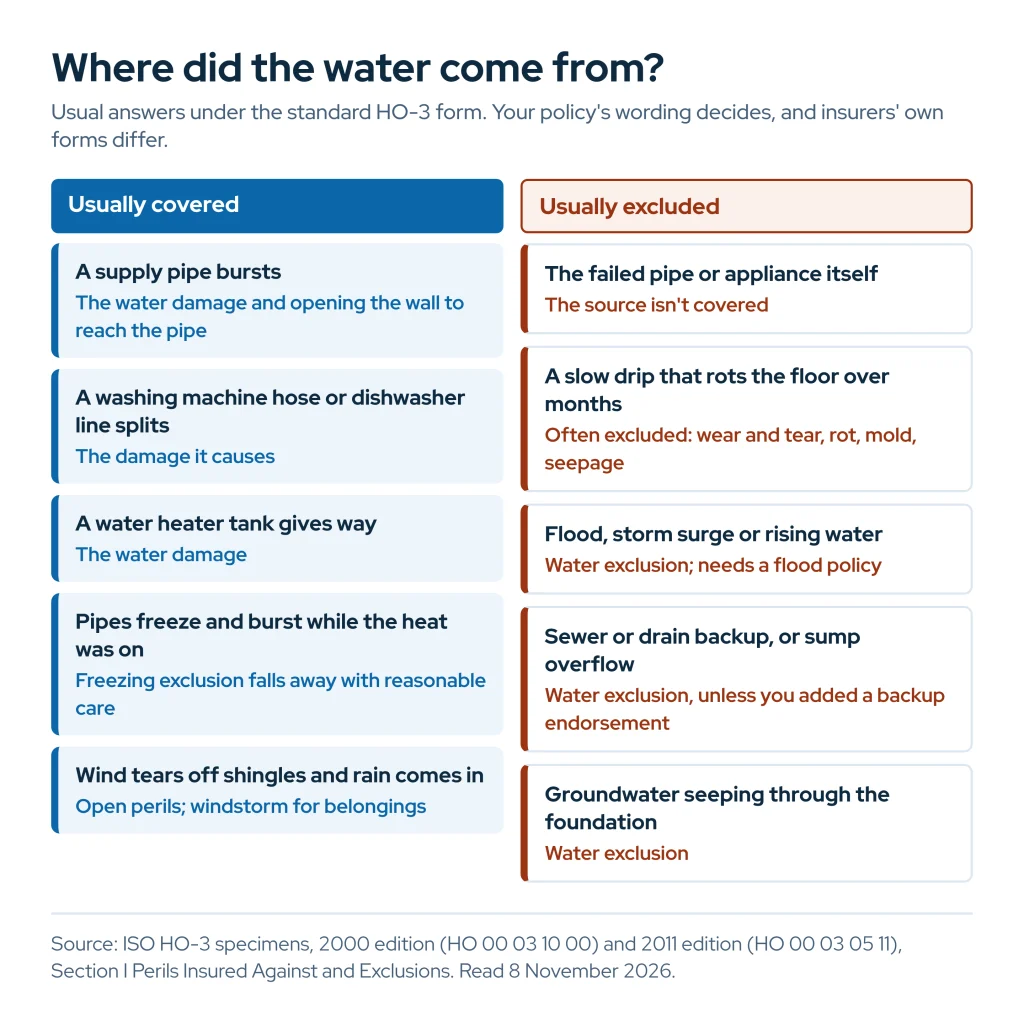
| A supply pipe bursts and soaks the floor and ceiling below | Usually covered for the water damage and for opening the wall to reach the pipe; the pipe itself usually isn’t | Open perils for the house; accidental discharge peril for belongings; exception to the wear-and-tear exclusions |
| A washing machine hose or dishwasher line splits | Usually covered for the damage it causes; the appliance itself usually isn’t | Same as above |
| A water heater tank gives way | Usually covered for the water damage; the heater usually isn’t | Same; plus the “sudden and accidental tearing apart” peril for belongings |
| A slow drip under a sink rots the cabinet floor over months | Often excluded | Wear and tear, deterioration, rot and mold exclusions; in many insurers’ forms, a separate seepage clause |
| Pipes freeze and burst while the heat was on | Usually covered | Freezing exclusion, which falls away if you used reasonable care |
| Pipes freeze in a house left unheated and not drained | Usually excluded | Freezing exclusion |
| Wind tears off shingles and rain comes in | Usually covered | Open perils; windstorm peril for belongings |
| An old, worn roof starts leaking | Usually excluded for the roof; interior damage is often disputed | Wear and tear; for belongings, rain only through an opening wind or hail made |
| Flood, storm surge or rising water | Usually excluded; flood needs a separate flood policy | Water exclusion, “whether or not driven by wind” |
| Sewer or drain backs up, or the sump overflows | Usually excluded unless you added a water backup endorsement | Water exclusion |
| Groundwater seeps through the foundation or slab | Usually excluded | Water exclusion |
| A water main or storm drain breaks off your property and the water reaches the house | For the house, the specimen’s wording points toward cover; belongings are left out; backup through drains is still excluded | Exception to the wear-and-tear exclusions; accidental discharge peril for belongings |
What the standard form actually says
Many US homeowners policies are built on standard forms from Insurance Services Office (ISO), an insurance industry organization; insurers adopt them or write their own. We read two editions of the most common one, the HO-3 or “Special Form”: the 2000 edition (HO 00 03 10 00), a specimen hosted by the Insurance Information Institute, a trade group, and the 2011 edition (HO 00 03 05 11), a copy posted by the Maine Bureau of Insurance. On water, the two say the same thing except where noted. Neither is your policy: your insurer’s form, its state endorsements and any later edition can differ, and a FAIR plan, a state wind pool or a surplus lines insurer may use a different form altogether.
The form treats the house and your belongings differently, and that matters for water.
- The house and other structures (Coverages A and B) are covered on an open-perils basis: any direct physical loss unless the policy excludes it. So the question for the house is never “is water listed?” but “does an exclusion apply?”
- Your belongings (Coverage C) are covered only for 16 named perils. One is accidental discharge or overflow of water or steam from inside a plumbing, heating, air conditioning or fire sprinkler system or a household appliance. Another is the sudden and accidental tearing apart, cracking, burning or bulging of a steam or hot water heating system, an air conditioning or sprinkler system, or a water heater. Freezing of those systems is a third.
Three details in the house coverage do most of the work on a plumbing claim:
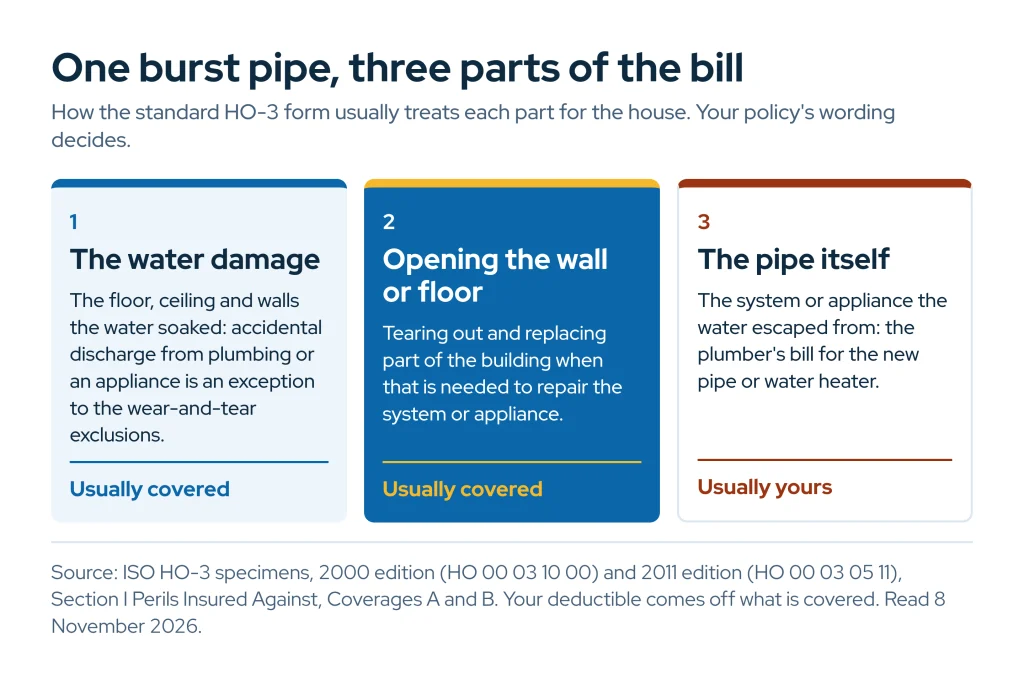
- The wear-and-tear exclusions have a water exception. The form excludes wear and tear, deterioration, mechanical breakdown, rust and corrosion, and similar causes. But it then says it does cover damage to the house from an accidental discharge or overflow of water from your plumbing, heating, air conditioning, sprinkler system or a household appliance, unless another exclusion applies. A pipe that corroded through is not covered; the floor it soaked usually is.
- Tear-out is included. The same exception covers the cost to tear out and replace part of the building when that is needed to repair the system or appliance.
- The source itself is not covered. The form says plainly that it doesn’t pay for the system or appliance the water escaped from. The plumber’s bill to replace the failed pipe or the new water heater is usually yours.
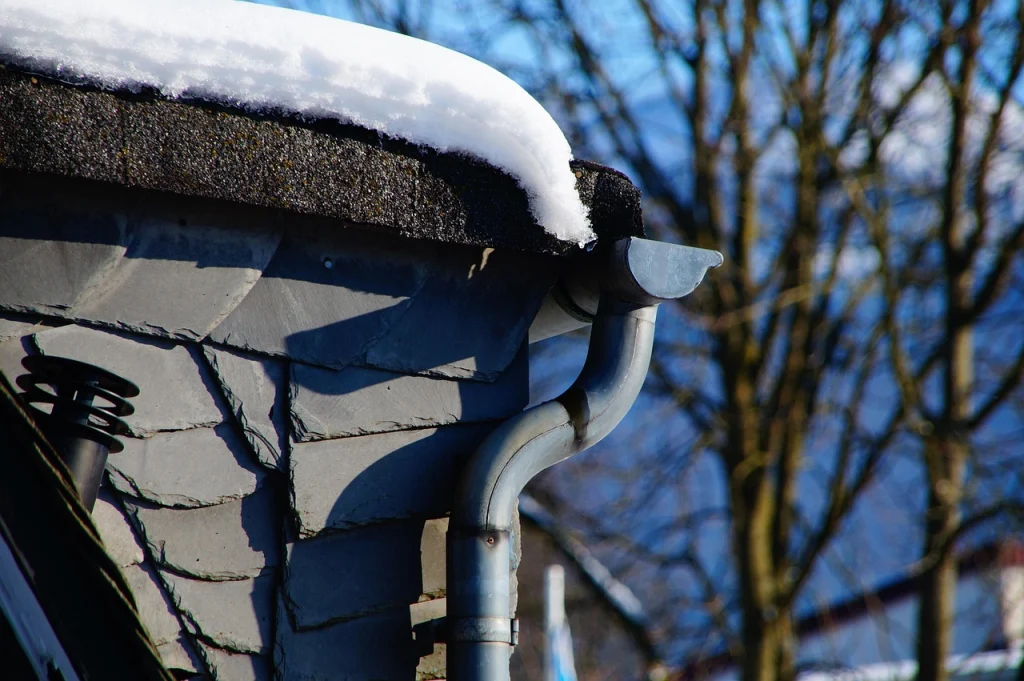
For these rules, a sump, sump pump or related equipment, and a roof drain, gutter or downspout, do not count as plumbing or a household appliance, so water from them doesn’t get the plumbing exception. Sump overflow falls under the water exclusion below.
You will often read that insurance covers “sudden and accidental” water damage. That is a fair shorthand, but it isn’t the specimen’s wording for plumbing leaks: both the water exception for the house and the water peril for belongings say “accidental discharge or overflow”, and “sudden and accidental” appears in the separate belongings peril for a heating system or water heater that tears apart or bursts. Some insurers’ own forms do use “sudden and accidental”, so look for the exact words in yours.
Slow leaks and the “14 days” clause
A slow leak is where most water claims run into trouble, and the wording varies more than anywhere else.
Neither ISO specimen we read (2000 and 2011 editions) has a separate time-based seepage clause. A leak that went on for months runs instead into the general exclusions for wear and tear, deterioration, rust or corrosion, rot, and mold. The mold exclusion has a narrow exception for mold hidden inside walls, ceilings or floors that results from an accidental discharge from your plumbing or an appliance; our mold page covers it.
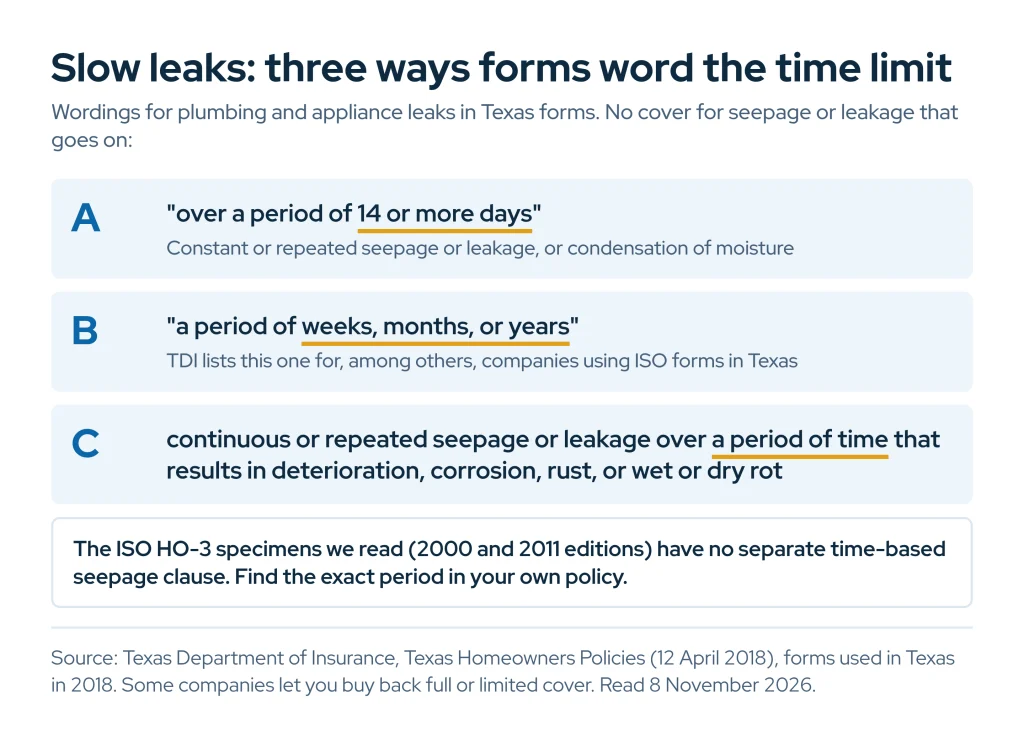
Many policies in use do have a seepage clause with a time limit, including some built on ISO forms (other editions or state versions than the two we read). The Texas Department of Insurance compared the forms used in Texas in 2018 and listed three versions for plumbing and appliance leaks (TDI, Texas Homeowners Policies, 12 April 2018):
- no cover for constant or repeated seepage or leakage, or condensation of moisture, “over a period of 14 or more days”;
- no cover for the same over “a period of weeks, months, or years” (TDI lists this one against companies using ISO policy forms in Texas, among others);
- no cover for continuous or repeated seepage or leakage over a period of time that results in deterioration, corrosion, rust, or wet or dry rot.
An insurer’s form posted by the Oklahoma Insurance Department shows the second version as a building exclusion (form HOM-7030/EP, edition 1/09). TDI also notes that some companies let you buy back full or limited cover for continuous or repeated seepage.
What this means in practice: find the seepage clause in your own policy and read its exact period. The questions that usually decide a slow-leak claim are how long the water was escaping, what caused the damage (the leak itself, or rot and mold that built up over time), and whether a covered sudden event is part of the story. How a time limit applies to a particular leak, for example to damage from the first days of a longer one, turns on your policy’s exact wording and your state’s case law; if it comes to a dispute, that is a question for an attorney rather than a general guide.
Frozen pipes
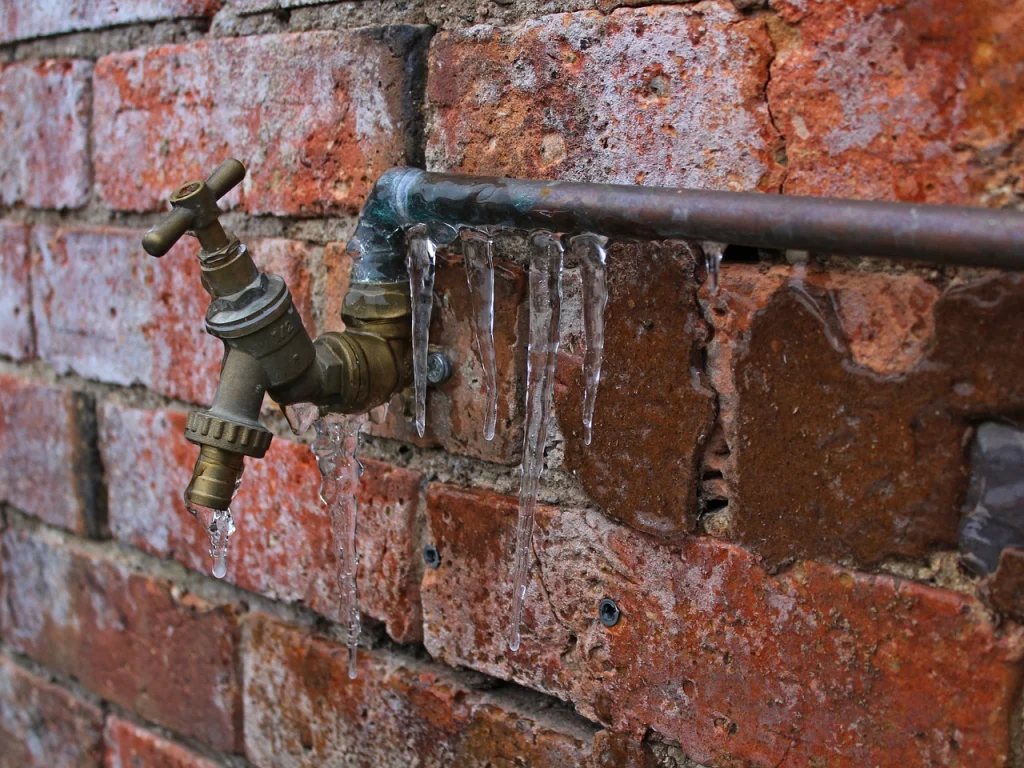
The specimen excludes freezing of a plumbing, heating, air conditioning or sprinkler system or a household appliance, and the leak it causes, unless you used reasonable care to either keep the building heated or shut off the water supply and drain the systems. If the home has a fire sprinkler system, the condition is stricter: you must use reasonable care to keep the water supply on and the heat on. Freezing, thawing, and the pressure or weight of water or ice are excluded outright for fences, pavement, patios, swimming pools, foundations, retaining walls, docks and similar structures.
Insurers’ own forms often tie this to vacancy. The Oklahoma-filed form above, for example, applies its freezing exclusion while the home is vacant, unoccupied or under construction, again unless you kept the heat on or drained the system. If you are away for the winter, read your vacancy and freezing wording before you leave. Burst pipes and other plumbing failures have their own page.
Rain, roof leaks and water from outside
Rain is not excluded for the house under the specimen, so water that comes in after a storm damages the roof is usually covered, subject to your deductible and any separate wind or hail deductible. A roof that leaks because it is old or worn is different: the wear-and-tear exclusion applies to the roof, and the interior damage is often where the dispute is.
For belongings, the windstorm peril is narrower. It doesn’t cover rain, snow or sleet that damages things inside the building unless wind or hail first damaged the building and made an opening in the roof or a wall, and the rain came in through that opening. A window left open in a storm is not that. See our page on roof leaks for the roof side.
Water from a broken pipe that isn’t yours is an odd corner. The specimen’s water exception for the house includes discharge from a storm drain, or a water, steam or sewer pipe, off your property, and the form lifts the surface water and groundwater parts of the water exclusion for that discharge. Belongings are different: the belongings peril leaves out damage on your property from a discharge that happened off it. Water backing up through your drains stays excluded either way. If a street main has flooded your basement, read your own form’s version of these clauses closely.
Flood, surface water and groundwater
The specimen’s water exclusion removes, for the house and belongings alike:
- flood, surface water, waves, tidal water, overflow of a body of water, and spray from any of these, “whether or not driven by wind” (the 2011 edition adds tsunami and storm surge, and water released from a dam, levee, seawall or other containment);
- water that backs up through sewers or drains, or overflows or is discharged from a sump, sump pump or related equipment;
- water below the surface of the ground, including water that presses on or seeps or leaks through a building, sidewalk, driveway, foundation or swimming pool (the 2011 edition adds patios).
The exclusion applies whatever caused the water, and it applies even when another cause contributed at the same time or in any sequence. A fire, explosion or theft that follows the water damage is still covered.
Flood cover comes from a separate policy: the National Flood Insurance Program (NFIP) or a private flood insurer (NAIC, A Consumer’s Guide to Home Insurance, 2022). The NFIP’s policy defines a flood mainly as a general and temporary condition of partial or complete inundation of two or more acres of normally dry land, or of two or more properties (one of them yours), from overflowing inland or tidal waters, unusual and rapid runoff of surface water, or mudflow; it also counts certain shoreline collapse caused by flood-level waves or currents (Standard Flood Insurance Policy, Dwelling Form, 44 CFR part 61 appendix A(1), II.B). New NFIP coverage usually takes effect on the 30th calendar day after you apply and pay, with exceptions such as a policy bought at a loan closing (44 CFR 61.11). Our page on the flood exclusion goes further, and NFIP flood claims covers the federal claim deadlines, which are short.
Sewer backup and sump overflow
Backup through a sewer or drain and sump overflow are excluded in the standard form. The usual fix is a water backup endorsement, which adds some cover back, usually with its own limit. The NAIC’s consumer guide says most homeowners policies offer limited or no cover for these events and that endorsements may be available. Minnesota’s Department of Commerce adds two cautions: these endorsements vary by company, and some exclude backups that happen during a flood; and a backup endorsement is not flood insurance (Minnesota Commerce, Sewer Backup Policy).
Flood insurance doesn’t fill the gap on its own either. The NFIP Dwelling Form excludes water that backs up through sewers or drains, discharges from a sump, or seeps through the property, unless there is a flood in the area and the flood is “the proximate cause”, meaning the flood is what led to the backup, discharge or seepage (44 CFR part 61 appendix A(1), V.D.5). So a backup on a dry day sits outside both policies unless you have the endorsement. Our sewer backup page goes through the endorsement wording, and our sister site CostPlain covers what sewer backup repair costs.
How common water claims are
Water is one of the biggest sources of homeowners claims. Published estimates from the Insurance Information Institute, a trade group, citing ISO/Verisk data: water damage and freezing made up 22.6% of homeowners losses incurred in 2023, with 1.50 claims per 100 insured homes a year as a weighted average for 2019 to 2023 (III, Facts and Statistics: Homeowners and Renters Insurance). Those figures cover HO-2, HO-3 and HO-5 policies, leave out Alaska, Texas and Puerto Rico, and include covered mold. They describe insurers’ totals, not what any one claim is worth.
What to do in the first days
The policy sets duties after a loss, and with water the clock on further damage runs fast. In the specimen, the insurer owes nothing if you fail a duty and that failure prejudices the insurer, so the duties are worth doing properly.
- Stop the water. Close the shut-off valve or the main. The specimen requires you to protect the property from further damage, make reasonable and necessary repairs to protect it, and keep an accurate record of what those repairs cost. When the damage comes from a covered cause, it also pays the reasonable cost of measures taken only to protect covered property from further damage, inside your limits. Separately, its neglect exclusion removes loss from failing to use all reasonable means to save property at and after the time of a loss.
- Photograph before you clean up. Wide shots and close-ups of every wet room, the source, the water line on walls, and damaged belongings. Keep the failed part, or photograph it if a plumber takes it: the form lets the insurer ask to see the damaged property.
- Report the claim promptly, and in writing. The specimen asks for “prompt” notice. Note the date, the time and the name of everyone you speak to.
- Keep every receipt: drying equipment, the plumber’s bill (even if the pipe repair itself isn’t covered, it shows the cause), hotel or meal costs if the home can’t be lived in.
- Ask what your policy says about the cause. If the insurer points to a seepage, wear-and-tear, freezing or water exclusion, ask for the exact clause in writing.
After that, the specimen gives you 60 days (it doesn’t say calendar or business days) to send a signed, sworn proof of loss, counted from the insurer’s request for one, and says a suit must start within two years after the date of loss. State law often changes that suit limit, so check the rule for your state in our claim deadlines by state table. Your deductible comes off what is covered; the deductible calculator shows the arithmetic.
Claims you may see elsewhere
You may see these on other sites. We checked each against the policy forms and official sources named above.
- “Homeowners insurance covers all water damage.” Not under the standard form: flood, surface water, backups, sump overflow and groundwater are excluded, and slow leaks often fall under wear-and-tear, rot, mold or seepage wording.
- “If the pipe burst, insurance replaces the pipe.” The specimen covers the water damage and the tear-out needed to reach the pipe, but not the system or appliance the water came from.
- “Every policy lets a leak run 14 days before cover stops.” The two ISO specimens we read have no 14-day clause, and forms that do set a time limit word it in at least three different ways, only one of them 14 days (TDI, 2018). Read yours.
- “A sewer backup endorsement covers flooding.” No: Minnesota’s regulator says it is not flood insurance, and some endorsements exclude backups during a flood.
- “Flood insurance covers any sewer backup.” Only when there is a flood in the area and it is the proximate cause of the backup, under the NFIP Dwelling Form.
Your next step
- Gather: the full policy with its declarations page and every endorsement (look for a water backup, seepage buy-back or service line endorsement), photos and video from before cleanup, the plumber’s invoice naming the cause, and every receipt.
- Read: your policy’s water exclusion, its seepage, freezing and mold wording, the Duties After Loss condition and the Suit Against Us condition.
- Do now: stop the water, dry what you can and keep the receipts, and report the claim in writing.
- Ask: the insurer, in writing, which clause it relies on if it says no. If you disagree, your state insurance department’s consumer line is free; find it through the NAIC’s list of state insurance departments or our complaint page for each state. For legal advice, contact legal aid or a licensed attorney through your state bar’s referral service.
- Don’t wait on: a proof-of-loss date the insurer gives you, the suit limit in your policy and your state, and, for a flood claim, the NFIP’s 60 days counted from the date of loss to send proof of loss (FEMA sometimes extends this after large events; check FloodSmart or your insurer for a written extension).
Sources checked on 8 November 2026: ISO HO-3 specimens (2000 edition, HO 00 03 10 00, and 2011 edition, HO 00 03 05 11, Maine Bureau of Insurance copy), Texas Department of Insurance policy comparison (12 April 2018), an Oklahoma Insurance Department copy of form HOM-7030/EP (1/09), the NFIP Standard Flood Insurance Policy Dwelling Form and 44 CFR 61.11 on eCFR, the NAIC consumer guide (2022), Minnesota Department of Commerce, and Insurance Information Institute statistics.
Sources
- ISO HO-3 Homeowners 3 Special Form specimen, 2000 edition (HO 00 03 10 00), Insurance Information Institute copy
- ISO HO-3 Homeowners 3 Special Form, 2011 edition (HO 00 03 05 11), Maine Bureau of Insurance copy
- Texas Department of Insurance, Texas Homeowners Policies (12 April 2018)
- Oklahoma Insurance Department copy of homeowners form HOM-7030/EP (edition 1/09)
- NFIP Standard Flood Insurance Policy, Dwelling Form, 44 CFR part 61 appendix A(1) (eCFR)
- 44 CFR 61.11, Effective date and time of coverage (eCFR)
- NAIC, A Consumer's Guide to Home Insurance (2022)
- Minnesota Department of Commerce, Sewer Backup Policy
- Insurance Information Institute (trade group), Facts and Statistics: Homeowners and Renters Insurance (ISO/Verisk data)
- NAIC, State insurance departments