Usually yes when a storm or another sudden event damaged the roof, and usually no when the roof simply wore out. Under the standard homeowners form, a leak that starts because wind tore off shingles, hail broke them, a tree came down or the weight of ice or snow damaged the roof is usually covered, subject to your deductible. A leak that starts because the roof is old, worn, badly installed or not maintained is usually excluded, at least for the roof itself. The water damage inside the house and the damage to your belongings follow their own rules, and your policy’s wording decides all three. This page is part of our guide to roof, hail and wind claims.
General information, not legal or insurance advice, and not a substitute for the advice of an attorney. Your policy’s wording and your state’s law decide, and both change. For help with your claim, your state insurance department’s consumer line and legal aid are free.
The usual answer, cause by cause
The question an insurer asks is what caused the leak. The table gives the usual answer under the ISO HO-3 specimen, the standard form many US homeowners policies are built on, in the two editions we read: 2000 (HO 00 03 10 00) and 2011 (HO 00 03 05 11). Your insurer’s own form, its endorsements and your state’s amendments can differ.
| What made the roof leak | The roof itself | Water damage inside the house | Your belongings |
|---|---|---|---|
| Wind lifted or tore off shingles | Usually covered | Usually covered | Usually covered: wind made the opening |
| Hail broke shingles or punctured the roof | Usually covered | Usually covered | Usually covered: hail made the opening |
| A tree or branch fell on the roof | Usually covered | Usually covered | Often covered: the Falling Objects peril needs the roof or an outside wall damaged first; check how your form treats rain that comes in afterwards |
| The weight of ice or snow damaged the roof | Usually covered | Usually covered | Depends on the wording; check the “weight of ice, snow or sleet” peril |
| Old, worn or deteriorated roof | Usually excluded (wear and tear) | Often disputed; turns on the form’s ensuing-loss and seepage wording | Usually excluded: no wind or hail opening |
| Faulty installation, materials or repair | Usually excluded (faulty workmanship) | Often disputed, as above | Usually excluded |
| A small leak left for weeks or months | Usually excluded | Often excluded: wear and tear, rot, mold, and the seepage clauses in some insurers’ forms | Usually excluded |
| Rising water or storm surge, not rain through the roof | Not a roof claim | Excluded: flood (a separate NFIP or private flood policy has its own rules) | Excluded: flood |
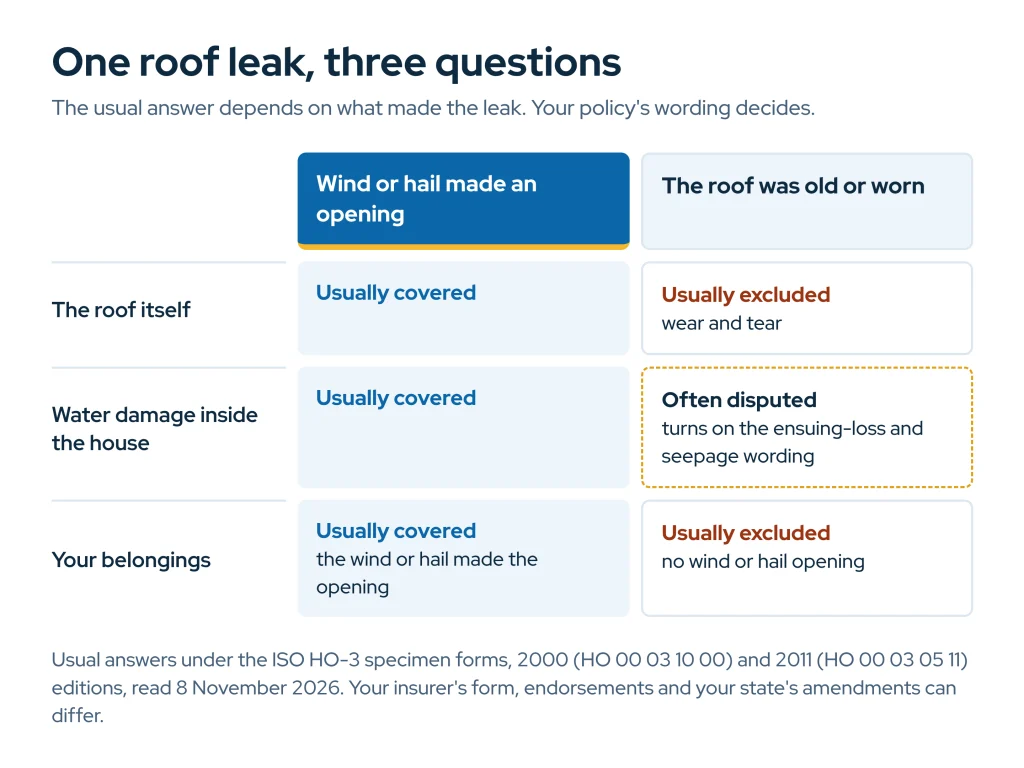
One leak, three questions
Coverage A is the house (the dwelling), Coverage B other structures such as a detached garage, and Coverage C your belongings. A roof leak can touch all three, and the HO-3 form insures them in different ways.
The house: covered unless something excludes it
For the house and other structures, the HO-3 specimen insures against “risk of direct physical loss” and then lists what it doesn’t cover. This is called open perils: the loss is covered unless an exclusion applies. (A peril is a cause of loss, such as wind, hail or fire. An exclusion is a cause or kind of loss the policy leaves out.) Wind, hail, a falling tree and the weight of ice or snow aren’t excluded, which is why storm-caused roof damage is usually covered.
The exclusions that matter for roofs, in both editions we read:
- Wear and tear, marring and deterioration, plus latent defects and property that damages itself (Section I Perils Insured Against, A.2.c.(6)).
- Faulty, inadequate or defective design, workmanship, repair, construction, materials or maintenance (Section I Exclusions, B.3).
- Mold, fungus or wet rot, with a narrow exception for mold hidden in walls, ceilings or floors that results from an accidental discharge of water from plumbing, heating or cooling systems, sprinklers or household appliances, or from certain pipes off the property (A.2.c.(5)). The form says a roof drain, gutter or downspout doesn’t count as plumbing for this exception.
- Neglect: failing to use all reasonable means to save and preserve property at and after the time of a loss (Section I Exclusions, A.5).
- Flood and surface water, “whether or not driven by wind” (Section I Exclusions, A.3).
The wear-and-tear and faulty-workmanship exclusions come with ensuing-loss wording: other damage to the house that follows from them is covered if no other part of the policy rules it out. Whether rain damage to ceilings and walls under a worn-out roof counts as covered ensuing loss is where many roof-leak disputes sit. It depends on your form’s exact words and on how your state’s courts read them. Neither ISO edition we read has a separate time-based seepage clause, but your insurer’s form may. The Texas Department of Insurance’s April 2018 comparison of homeowners policies lists continuous and repeated seepage of water among the typical exclusions, and quotes one company’s wording that excludes seepage or leakage “over a period of weeks, months, or years” (TDI, Texas homeowners policies comparison). Look for such a clause in your own policy. Our water damage page sets out the seepage wordings we found and how they work.
Your belongings: rain needs an opening
Belongings are insured differently in the HO-3. Coverage C pays only for the perils it names (named perils). The Windstorm or Hail peril says it doesn’t cover belongings inside the building damaged by rain, snow, sleet, sand or dust unless the “direct force of wind or hail” first damaged the building and made an opening in a roof or wall that the rain came through. That wording is the same in the 2000 and 2011 editions. The Falling Objects peril has a similar rule: the roof or an outside wall must be damaged first.
So a wet sofa under a hole that wind tore in the roof is usually covered; a wet sofa under a roof that leaked because it was old usually isn’t. Some policy forms cover belongings more broadly, so check which form your declarations page (the summary page of coverages, limits and deductibles) lists.
Ice dams
An ice dam is a ridge of ice at the roof edge that traps melting snow, which can back up under shingles. Neither ISO edition names ice dams, and we found no ice dam exclusion in the specimen’s house coverage. That isn’t a promise: insurers’ forms differ, and the roof’s condition is usually part of the answer. For belongings, read the “weight of ice, snow or sleet” peril in your own policy.
Old roofs, worn roofs and storm damage
Two state insurance regulators say plainly what the wear-and-tear exclusion means for roofs. The Texas Department of Insurance says your insurer “won’t pay for a new roof just because it’s old or worn out” (TDI, Insurance and your roof, updated 1 April 2026). The Maryland Insurance Administration says homeowners policies don’t pay for “maintenance”. It adds that when a covered peril such as hail damages a roof that already needed maintenance, the policy may not cover all or part of the claim, and if only part of the roof is damaged, the policy may pay to repair only that part (MIA, Consumer Advisory: Roof Replacement).
An old roof can still have a covered storm claim. The question is which damage the storm caused and which was already there. Expect the adjuster to look for signs of age and for signs of the storm. Dated photos of the roof from before the storm help here. The Maryland regulator also warns about unsolicited “free roof” offers from contractors that pass off wear and tear as storm damage.
Roof age and how the claim is paid
Even when the damage is covered, the roof’s age can change the check. Three settlement methods matter.
- Replacement cost pays what it costs to repair or replace with like kind and quality, without taking off depreciation. In the HO-3 specimen, buildings are settled this way if they are insured to at least 80% of full replacement cost; below 80%, the form pays the greater of the actual cash value or a proportion of the repair cost. It pays to replace “that part of the building damaged”, not the whole roof by default.
- Actual cash value (ACV) is replacement cost minus depreciation, the value lost to age and wear. An older roof has more depreciation, so it gets a smaller payment.
- Functional replacement cost, which the Missouri Department of Commerce and Insurance describes as replacing with a functional equivalent, for example a tile roof with shingles (Missouri DCI, Raising the Roof on Insurance Coverage).
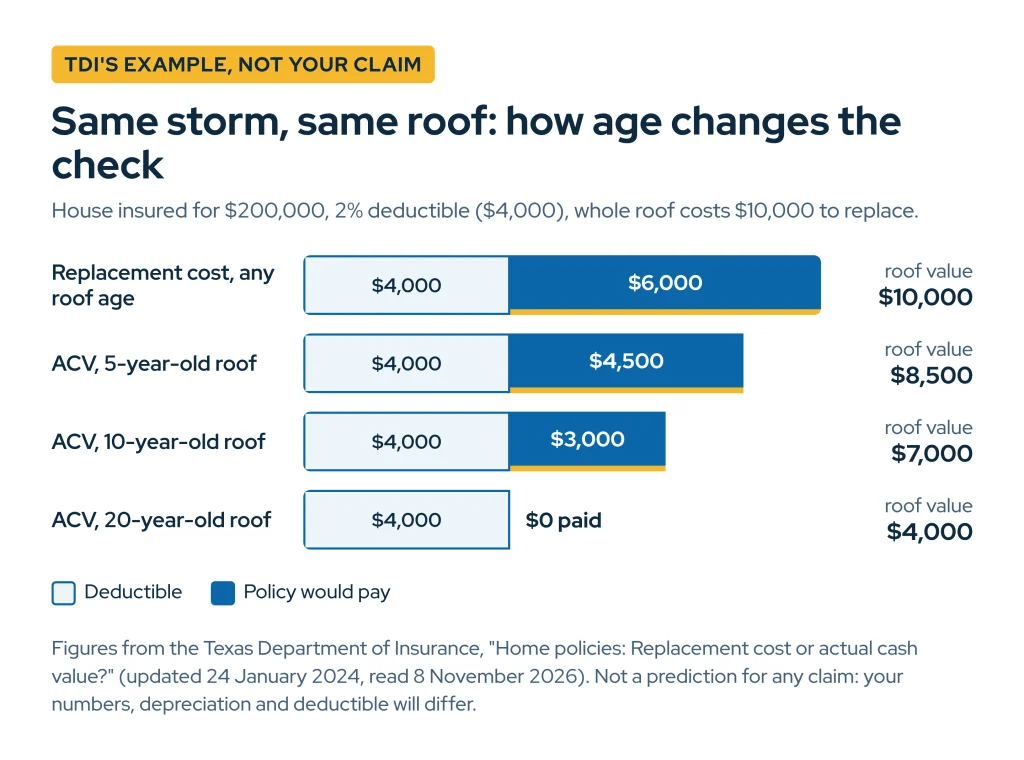
The Texas Department of Insurance gives a worked example (TDI, Replacement cost or actual cash value?, updated 24 January 2024). A house is insured for $200,000 with a 2% deductible ($4,000), and a covered storm damages the whole roof, which costs $10,000 to replace. TDI’s figures:
| TDI example | Roof value counted | Minus deductible | Policy would pay |
|---|---|---|---|
| Replacement cost, any roof age | $10,000 | $4,000 | $6,000 |
| ACV, 5-year-old roof | $8,500 | $4,000 | $4,500 |
| ACV, 10-year-old roof | $7,000 | $4,000 | $3,000 |
| ACV, 20-year-old roof | $4,000 | $4,000 | $0 |
TDI also says, on its roof page, that as roofs age, some companies switch roof coverage to actual cash value at renewal, and that your company should tell you when it changes your coverage. Check each renewal for an endorsement with “roof” in its title. An endorsement is a page added to the policy that changes its terms.
Roof payment schedules
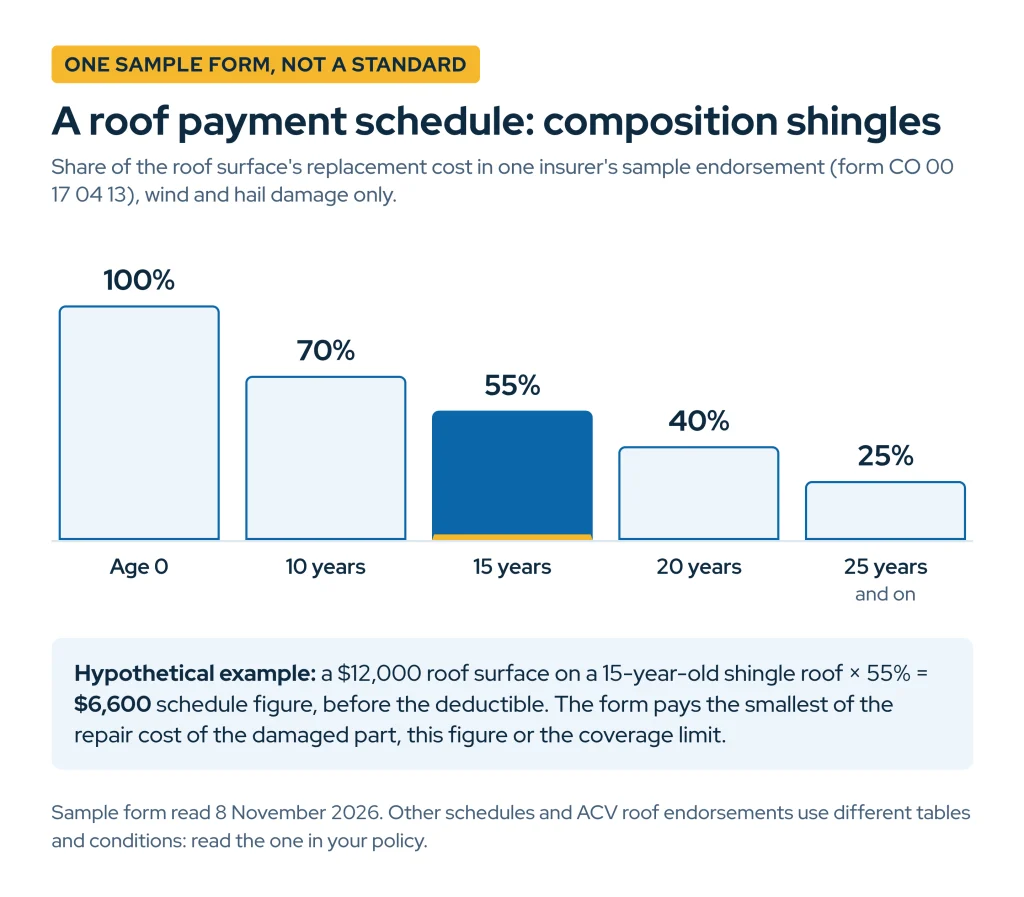
A policy may carry a roof payment schedule endorsement. It pays a set percentage of the roof surface’s replacement cost, and the percentage falls each year as the roof ages. As an example, we read one insurer’s sample roof surfaces endorsement (form CO 00 17 04 13). It applies only to wind and hail damage to the roof surface. It pays the smallest of the repair cost of the damaged part, the schedule percentage of replacement cost, or the coverage limit, and it pays nothing extra for building-code upgrades. For composition shingles its table runs from 100% at age 0 to 70% at 10 years, 55% at 15 years, 40% at 20 years and 25% from 25 years on. With a plainly hypothetical $12,000 roof surface on a 15-year-old shingle roof, that form’s schedule figure would be $6,600 before the deductible. That is one form’s arithmetic, not a standard; other schedules and ACV roof endorsements use different tables and conditions, so read the one in your policy.
The two-check payout
With replacement cost cover, the first check is often only the ACV. In the HO-3 specimen (both editions), the insurer pays no more than actual cash value until the repair is finished, unless the repair costs less than both 5% of the building’s insurance and $2,500. You may take the ACV first and claim the rest after the repair, if you notify the insurer within 180 days after the date of loss (the 2011 edition says notice of your intent to repair or replace). The money held back is often called recoverable depreciation. Our ACV vs replacement cost calculator works through the split on your own numbers. For roofs, what the repair or replacement itself tends to cost is covered on our sister site’s roof replacement cost calculator.
Deductibles on roof claims
Many policies have a separate deductible for wind and hail, or for hurricanes, sometimes a percentage of the dwelling limit instead of a flat dollar amount. The Maryland Insurance Administration’s example: $3,000 of wind damage on a home insured for $100,000. A $1,000 windstorm deductible leaves $2,000. If the same damage came from a hurricane under a 2% hurricane deductible, the deductible is $2,000 and $1,000 is left; at 5%, the deductible is $5,000, more than the damage, so nothing is paid. Your declarations page shows which deductible applies to which cause. Our deductible calculator turns a percentage into dollars. An offer from a contractor to waive or cover your deductible is a warning sign; in Florida it is barred for roof claims (below).
Florida’s roof rules
Florida has written several roof rules into statute. We read each section below in full on 8 November 2026 in the 2026 Florida Statutes. Other states’ roof rules are not covered here; where we haven’t read a state’s law, we don’t state it.
- Roof age and renewals. An insurer may not refuse to issue or renew a homeowners policy solely because the roof is less than 15 years old. For a roof at least 15 years old, the insurer must let you have it inspected by an authorized inspector, at your expense, before requiring replacement. It may not refuse solely because of age if the inspection shows at least 5 years of useful life left. The insurer may still decline for other lawful reasons, such as its underwriting criteria. This applies to policies issued or renewed on or after 1 July 2022, and not to mobile home policies (Fla. Stat. 627.7011(5)-(6)).
- Replacement cost payments. On a replacement cost dwelling claim, the insurer must first pay at least the actual cash value minus the deductible, then pay the rest as work is done and expenses are incurred; after a total loss of the dwelling, it must pay replacement cost without holding back depreciation. Where a separate roof deductible applies, the insurer may hold the roof part at actual cash value until you show the roof deductible was paid (627.7011(3)(a)).
- A separate roof deductible. A policy may include one, capped at the lesser of 2% of the Coverage A limit or 50% of the cost to replace the roof. It applies only to claims settled at replacement cost. It doesn’t apply to a total loss, a hurricane, a tree or other hazard that punctures the roof deck, or a repair of less than 50% of the roof. You may reject it on an approved form (Fla. Stat. 627.701(10)).
- Notice of the claim. A new or reopened claim is barred unless notice was given to the insurer, as the policy requires, within 1 year after the date of loss. A supplemental claim (more damage from the same peril) has 18 months. For hurricanes, tornadoes, windstorms, severe rain and other weather events, the date of loss is landfall or the date NOAA verifies the event. The limits are paused during a servicemember’s combat deployment that materially affects filing, and they apply to surplus lines policies too (Fla. Stat. 627.70132).
- Contractors. A contractor may not offer a deductible waiver, rebate, gift or anything of value for a roof inspection or a roof claim. A contractor without a public adjuster licence may not interpret your policy or adjust your claim. The fine is up to $10,000 per violation (Fla. Stat. 489.147).
Other states set their own claim clocks and suit limits. Our claim deadlines by state lookup shows the rules we have read, with the statute and the unit of each count.
What to do when you find a leak
- Stop more damage, safely. Put out buckets, move belongings, and stay off a wet or steep roof. The specimen’s Duties After Loss condition asks you to protect the property, make reasonable and necessary repairs, and keep an accurate record of what you spend. Its Reasonable Repairs coverage pays for protective steps such as a tarp, but only when the damage came from a covered peril. Water left sitting can lead to mold, which the specimen excludes apart from a narrow exception.
- Photograph before cleanup. Take photos of the ceiling stain, wet insulation in the attic, damaged belongings and, from the ground, the roof. Date them. Keep any shingles or pieces that came down.
- Write down when it started and what the weather was. The date of loss starts many clocks, including the policy’s suit limit (two years after the date of loss in the specimen; state law often changes it).
- Report it promptly, in writing. The specimen asks for “prompt” notice; some states set an outer limit, like Florida’s 1 year. Keep a note of every call: date, name, what was said.
- Read your policy before the inspection. Find the perils, the exclusions, any seepage clause, any roof endorsement and your wind or hail deductible.
- Get the estimate in writing. If the adjuster’s estimate covers only part of the roof or uses actual cash value, ask which clause or endorsement it rests on. Our step-by-step roof claim guide covers the inspection, the estimate and the second check.
Claims you may see
You may see these elsewhere. We checked each one against the policy form and the statutes named above, and none is the rule.
- “Any leak means insurance buys you a new roof.” No. The specimen pays for “that part of the building damaged”, excludes wear and tear, and caps payments at actual cash value until the repair is done, apart from small repairs.
- “We’ll cover your deductible.” In Florida, a contractor may not offer that for a roof inspection or claim (489.147), and other states may have their own rules. You owe the deductible.
Your next step
Gather the full policy with every endorsement and the declarations page, your dated photos, receipts for emergency work, and every letter from the insurer. Read the Section I exclusions, the Duties After Loss condition and the Suit Against Us condition. If you disagree with a decision, ask the insurer to name the clause in writing. Your state insurance department can take a complaint; find it in the NAIC’s directory of state insurance departments. A licensed attorney or legal aid can say how your state’s law applies to your claim.
Policy forms quoted: ISO HO-3 specimen, 2000 edition (HO 00 03 10 00), hosted by the Insurance Information Institute (a trade group), and ISO HO-3 specimen, 2011 edition (HO 00 03 05 11), Maine Bureau of Insurance copy. Neither is your policy.
Sources checked on 8 November 2026.
Sources
- ISO HO-3 specimen form, 2000 edition (HO 00 03 10 00), hosted by the Insurance Information Institute
- ISO HO-3 specimen form, 2011 edition (HO 00 03 05 11), Maine Bureau of Insurance copy
- Texas Department of Insurance, Insurance and your roof (updated 1 April 2026)
- Texas Department of Insurance, Home policies: Replacement cost or actual cash value? (updated 24 January 2024)
- Texas Department of Insurance, Texas homeowners policies comparison (April 2018)
- Maryland Insurance Administration, Consumer Advisory: Roof Replacement
- Missouri Department of Commerce and Insurance, Raising the Roof on Insurance Coverage
- Sample roof surfaces endorsement with roof surface payment schedule, form CO 00 17 04 13 (one insurer's sample form)
- Florida Statutes 627.7011 (2026)
- Florida Statutes 627.701 (2026)
- Florida Statutes 627.70132 (2026)
- Florida Statutes 489.147 (2026)
- NAIC, State insurance departments