Replacement cost is what it costs today to repair or replace damaged property with material of like kind and quality. Actual cash value (ACV) is that replacement cost less depreciation: the value lost to age, wear and use. The gap can be large on an old roof, furnace or furniture. Which one applies to your claim depends on your policy’s loss settlement wording, its endorsements and your state’s law. Under the standard form we read, the house itself is usually settled at replacement cost and your belongings at actual cash value, with conditions on both.
General information, not legal or insurance advice, and not a substitute for the advice of an attorney. Your policy’s wording and your state’s law decide, and both change. For help with your claim, your state insurance department’s consumer line and legal aid are free.
This calculator is part of our guide to how a home insurance payout is worked out. It takes a replacement cost you enter and works out an estimated actual cash value two ways: by straight-line depreciation on the item’s age and expected life, or by a depreciation percentage you already have, such as the one printed on an estimate line. It shows labor both ways, depreciated and not, because the states disagree on that. It uses only your numbers. It does not say what an insurer will pay on any claim.
How to use the calculator
- Replacement cost: what it costs to repair or replace the item now with like kind and quality. Take it from a written estimate or a current price, one item or one estimate line at a time.
- Labor included in that cost: only if your estimate splits labor from materials. If it doesn’t, leave it at 0 and the labor lines will match.
- Method: straight-line divides the item’s age by its expected life and depreciates that share. “My own percentage” uses a rate you enter instead, and ignores age and life.
- Age and expected life: age at the date of loss, in years. There is no official table of expected lives for roofs, appliances or furniture, so the 25 years filled in is only our assumption, editable. Use the life your adjuster’s estimate shows, if it shows one, or your own figure.
- Ceiling on depreciation: leave it at 100% unless your estimate shows a maximum. Straight-line reaches 100% once the age equals the expected life, which would make the ACV $0.
- Depreciate the labor too: decides which result appears first. Both the with-labor and without-labor results are always shown below it.
Every result is an estimate and shows its working. A real claim estimate usually depreciates line by line, with a different age, life or rate on each line, and some lines may not be depreciated at all. To check one, run each line through the calculator and add up the results.
A worked example
General information, not legal or insurance advice, and not a substitute for the advice of an attorney. Your policy’s wording and your state’s law decide, and both change. For help with your claim, your state insurance department’s consumer line and legal aid are free.
Example, with made-up round numbers: a repair costs $12,000 at today’s prices, of which $5,000 is labor and $7,000 is materials. The damaged part is 12 years old, and we assume an expected life of 25 years. These are the calculator’s starting numbers.
- Straight-line share used up: 12 ÷ 25 = 0.48, or 48%.
- Labor not depreciated: $7,000 of materials × 48% = $3,360 of depreciation. Estimated ACV: $12,000 − $3,360 = $8,640. The gap is 28% of the replacement cost.
- Labor depreciated too: $12,000 × 48% = $5,760 of depreciation. Estimated ACV: $12,000 − $5,760 = $6,240. The gap is 48%.
- The difference made by depreciating labor: $5,760 − $3,360 = $2,400.
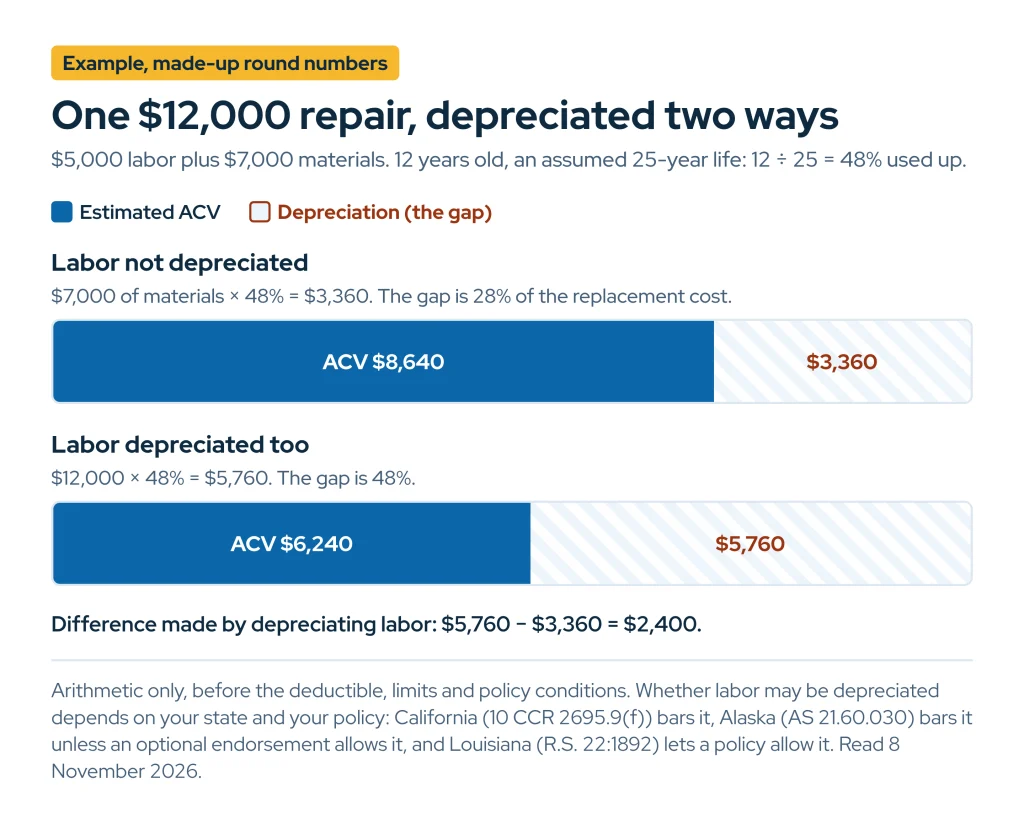
Change the expected life to 20 years and the share becomes 60%; change it to 30 and it becomes 40%. The expected life moves the answer a long way, which is why the life or rate behind an estimate’s depreciation line is worth asking about. These are estimates of the arithmetic only. The deductible, policy limits and the conditions below all come in before any payment, and our deductible calculator works through that part separately.
What the terms mean
Replacement cost is the cost to repair or replace with material “of like kind and quality and for like use”, in the words of the ISO HO-3 specimen form (2000 edition, HO 00 03 10 00), a standard homeowners form published by Insurance Services Office. Insurers’ own policies can word it differently. It is not the home’s market value. The NAIC’s consumer guide points out that market value includes the land and depends on the real estate market, while replacement cost is the cost to rebuild (NAIC, A Consumer’s Guide to Home Insurance, 2022).
Actual cash value has no single national definition for private homeowners policies. The federal flood policy defines it plainly: “The cost to replace an insured item of property at the time of loss, less the value of its physical depreciation” (Standard Flood Insurance Policy, Dwelling Form, II.C.2, 44 CFR part 61 appendix A(1)). The ISO HO-3 specimen (2000 edition) uses the term but, in the text we read, gives no formula for it. The NAIC’s consumer guide describes it as the value of your home considering its age and wear and tear, and North Carolina’s Department of Insurance calls it the cost to fix your home minus the loss in value from age or use (NCDOI). Several states write the “replacement cost less depreciation” formula into their claim rules; see the state section below.
Depreciation is the difference. When a replacement cost policy pays ACV first and the rest after the work is done, the part held back is often called recoverable depreciation. That phrase does not appear in the ISO specimen or the flood policy we read, which describe the same mechanism in their loss settlement conditions; North Carolina’s Department of Insurance uses it on the page linked above. Our recoverable depreciation calculator works through that holdback.

Which parts of a policy use which
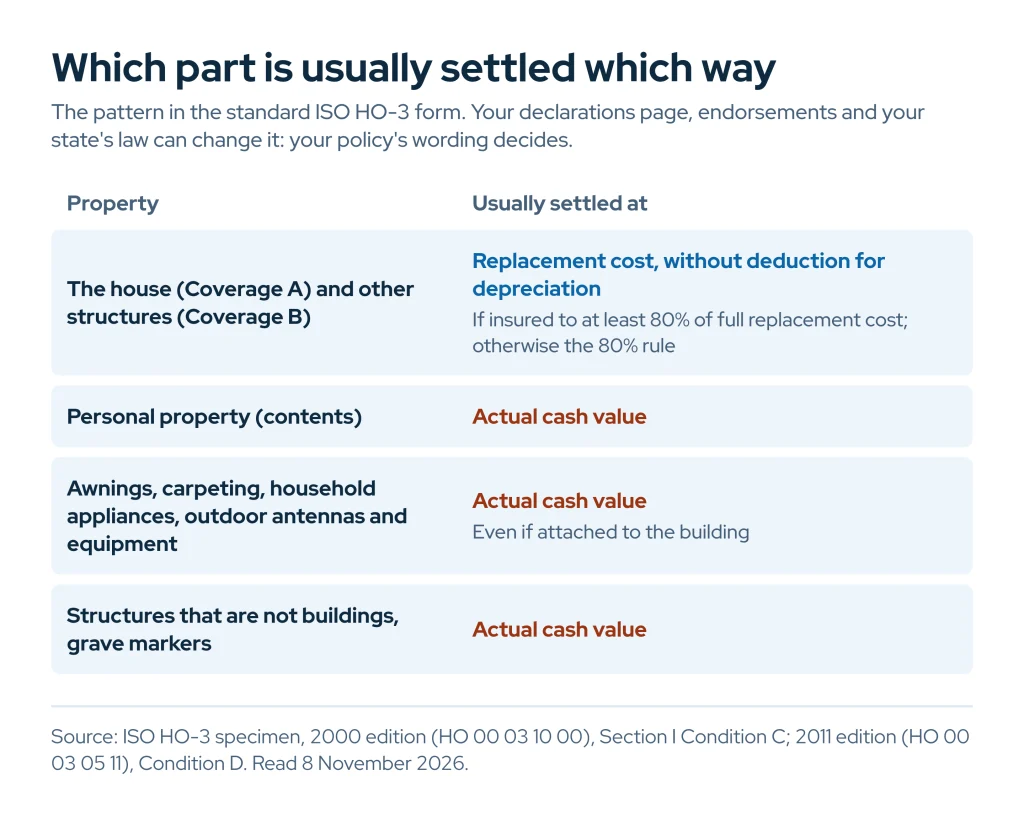
Your declarations page and the loss settlement condition in your own policy say which method applies to what. As a pattern, here is what the two standard forms we read say. Your insurer’s form, its endorsements and your state’s amendments can differ.
| Property | ISO HO-3 specimen (2000 edition, Cond. C; 2011 edition, Cond. D) | NFIP Dwelling Form (SFIP VII.R) |
|---|---|---|
| The house (Coverage A) and other structures (Coverage B) | Replacement cost without deduction for depreciation, if insured to at least 80% of full replacement cost; otherwise the 80% rule below | Replacement cost only for a single-family home that is your principal residence, insured to at least 80% of full replacement cost or to the program maximum; under that, the greater of ACV or a proportion. Manufactured homes and travel trailers have a special rule (VII.R.3) |
| Personal property (contents) | Actual cash value | Actual cash value |
| Awnings, carpeting, household appliances, outdoor antennas and equipment | Actual cash value, even if attached to the building | Appliances, carpets and pads, awnings and outdoor equipment: actual cash value |
| Structures that are not buildings, grave markers | Actual cash value | Not in this list |
| Other buildings and homes | Not separately addressed in this condition | A 2-4 family dwelling, a unit not used only as a single-family home, a detached garage, or a home that is not your principal residence: actual cash value |
Sources: ISO HO 00 03 10 00 specimen, Section I Condition C (specimen hosted by the Insurance Information Institute, a trade group); ISO HO 00 03 05 11, Condition D (Maine Bureau of Insurance copy); SFIP VII.R.1 and R.4. Endorsements can change all of this: the NAIC guide mentions a personal property replacement cost endorsement and guaranteed replacement cost coverage. Look for any endorsement that names “loss settlement”, “replacement cost” or “actual cash value”, including any that applies only to the roof. Surplus lines policies, state FAIR plans and wind pools, and the NFIP’s other forms use their own wording, and some state rules below may not reach them: read the policy you actually have.
Replacement cost usually comes in two payments
Having replacement cost coverage doesn’t mean the whole replacement cost is paid at once. Both standard forms pay ACV first on larger losses and the rest once the work is done:
- ISO HO-3 specimen (2000 edition, Cond. C.2.d and e; 2011 edition, Cond. D): the insurer pays no more than ACV until the repair or replacement is complete, unless the cost is both under 5% of the building’s insurance and under $2,500. You may claim on an ACV basis first and then claim the rest, if you notify the insurer of your intent within 180 days after the date of loss (the form says days; it does not say business days).
- NFIP Dwelling Form (SFIP VII.R.2.c and d): when the full cost of repair or replacement is more than $1,000, or more than 5% of the insurance on the dwelling, replacement cost is not paid “unless and until actual repair or replacement is completed”. You may claim ACV first and notify your intent within 180 days after the date of loss (again days, not business days). See our NFIP flood claim guide for the policy’s other dates.
State law can change this. Florida, for example, requires that when a dwelling is insured at replacement cost, the insurer initially pay at least the ACV of the insured loss less any deductible, and pay the remaining amounts needed for the repairs as the work is performed and expenses are incurred; after a total loss of the dwelling it must pay replacement cost without holding back depreciation. For personal property, Florida insurers must offer coverage that pays replacement cost without holding back depreciation, and may also offer a cheaper version that pays ACV first and the rest as receipts come in (Fla. Stat. 627.7011(3), 2026 Florida Statutes; it does not apply to mobile home policies, 627.7011(6)). If a roof deductible applies, the insurer may limit the roof payment to ACV until it receives reasonable proof the roof deductible was paid. California’s statute says that, where a policy requires the repair or replacement before paying full replacement cost, the insurer pays ACV until the work is done, and it may not give you less than 12 months from the first ACV payment to collect the rest, or less than 36 months from that first payment when the loss relates to a state of emergency as defined in Government Code 8558. It must also grant further six-month extensions for good cause when, acting in good faith and with reasonable diligence, you are held up by delays beyond your control, such as permit delays or a lack of materials or contractors (Cal. Ins. Code 2051.5(a)(2), (b), as amended effective 1 January 2026). The holdback calculator linked above works through that part.
The 80% rule: when replacement cost becomes something less
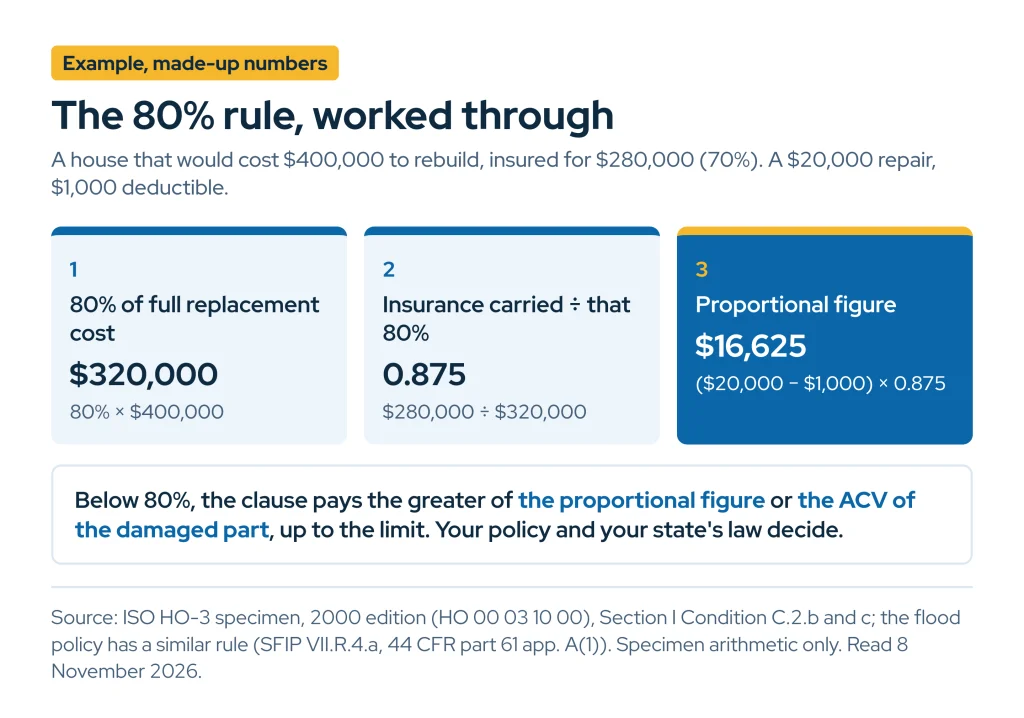
In the ISO specimen, full replacement cost on the house depends on insuring it for at least 80% of its full replacement cost immediately before the loss. Below that, the clause pays the greater of two figures, up to the limit: the ACV of the damaged part, or a proportion of the replacement cost (after the deductible) equal to the insurance you carry divided by 80% of the full replacement cost. Excavations, footings, foundations and piers below the lowest basement floor (or below ground inside the foundation walls where there is no basement), and underground flues, pipes, wiring and drains, are left out when working out the 80% (HO 00 03 10 00, Cond. C.2.b and c). The flood policy has a similar rule with the program maximum built in (SFIP VII.R.4.a). The NAIC’s guide gives the same warning in plain words: if your dwelling coverage drops below 80% of the cost to replace your home, your insurer may reduce what it pays on a claim.
Example, with made-up numbers: a house that would cost $400,000 to rebuild is insured for $280,000, which is 70%. Eighty percent of $400,000 is $320,000, so the proportion is $280,000 ÷ $320,000 = 0.875. On a $20,000 repair with a $1,000 deductible, the proportional figure is ($20,000 − $1,000) × 0.875 = $16,625. The clause compares that with the ACV of the damaged part. This is the specimen’s arithmetic only; your policy and your state’s law decide. Rebuilding costs rise, so a limit that cleared 80% when you bought the policy may not today. Our page on extended and guaranteed replacement cost explains the endorsements that add room above the limit.
How depreciation is set
We found no federal rule that sets depreciation for private homeowners policies, and no official table of expected lives. Straight-line, the method in this calculator, is the simplest: the same share of value is lost each year. On a real claim, the policy, the insurer’s estimate and state law set the method, and some states require depreciation to reflect the item’s actual condition, not just its age. An NAIC model regulation (#902, a model, not law in any state until a state adopts it) says ACV on a residential fire and extended coverage policy is replacement cost at the time of loss less depreciation, if any, and that the insurer gives the depreciation worksheets on request (NAIC Model Regulation 902, section 9). These are the state rules we read in official text on 8 November 2026:
| State | What the rule says about ACV and depreciation | Labor | Source |
|---|---|---|---|
| California | On a policy that pays ACV, the ACV recovery is the cost to repair, rebuild or replace less “a fair and reasonable deduction for physical depreciation based upon its condition at the time of the injury”, or the policy limit if less; depreciation applies only to parts of a structure normally repaired or replaced during its useful life (Ins. Code 2051(b)). Under the regulation, any depreciation adjustment must be discernable, measurable, itemized and given in dollars; it must reflect a measurable difference in market value due to the property’s condition and age, and apply only to property normally repaired or replaced during its useful life. The basis must be fully explained to the claimant in writing, and all justification kept in the claim file. | Under a policy subject to Ins. Code 2071 (California’s standard form fire policy), the labor needed to repair, rebuild or replace covered property may not be depreciated, except the labor already built into the cost of manufactured materials or goods. | 10 CCR 2695.9(f), (f)(1) (operative 30 Aug 2006); Cal. Ins. Code 2051(b) (eff. 1 Jan 2020) |
| Alaska | No ACV formula in the section read. | In a residential property policy, labor may not be depreciated, except under a stand-alone endorsement that specifically identifies the intangible items subject to depreciation; that endorsement must be optional and come with a proportionate premium reduction. | AS 21.60.030 |
| Louisiana | A policy may allow depreciation; it must give notice that depreciation may be deducted or withheld, in a form the commissioner approves. If depreciation is applied, the insurer must explain in writing how it was calculated. Depreciation must be reasonable and based on objective criteria and subjective assessment, including the property’s actual condition before the loss. Under fire and extended coverage policies, prospective contractor overhead, profit and sales tax may not be deducted when working out ACV. | “Depreciation” is defined to include labor, so a policy may depreciate labor, with the notice and explanation above. | La. R.S. 22:1892(B)(6), (F)(2) |
| Ohio | On a fire and extended coverage policy settled on an ACV basis, ACV is the replacement cost at the time of loss, including sales tax, less any depreciation; on request the insurer must provide documents detailing all depreciation deductions. An exception applies where your interest is limited because the property has nominal or no economic value, or a value out of proportion to replacement cost less depreciation; the insurer must then explain in writing, on request, why it limited the amount. | No labor rule in the section read. | Ohio Adm.Code 3901-1-54(I)(2) (eff. 14 Feb 2022) |
| Minnesota | An ACV settlement may not be less than the property’s value immediately before the loss, including applicable taxes and license fees (never more than the amount of insurance). No reduction for depreciation on items not adversely affected by age, use or obsolescence. | No labor rule in the section read. | Minn. Stat. 72A.201, subd. 5(7), (9) |
How each rule is enforced differs by state: Ohio’s rule, for example, says it creates no private cause of action (3901-1-54(A)), while Louisiana’s 22:1892 has penalty provisions of its own. Labor rules in other states, including Arkansas (often cited one way or the other), are not confirmed by us: we haven’t read them in official text. Ask your state’s insurance department, through the NAIC’s directory of state insurance departments.
Claims you may see elsewhere
You may see these on other sites. We checked them against the policy forms and the statutes, and they aren’t the rule.
- “Insurers can never depreciate labor.” It depends on the state and the policy. California’s regulation and Alaska’s statute bar it (Alaska unless an optional, premium-reducing endorsement says otherwise); Louisiana’s statute lets a policy allow it.
- “Replacement cost coverage pays the full cost up front.” Not under the standard forms we read: above the small-loss thresholds, they pay ACV until the work is done. Some states, such as Florida for a total loss of the dwelling, change that.
- “Actual cash value means what your house would sell for.” Not in the definitions we read, which start from the cost to replace and subtract depreciation. Market value includes the land.
- “An old roof is always worth nothing.” Straight-line arithmetic can reach zero, but California requires a fair and reasonable deduction based on condition and a measurable difference in market value, Louisiana requires it to consider the actual condition, and Minnesota bars depreciating items that age doesn’t affect. Your policy and state law decide. Our page on when insurance pays for a new roof goes further.
Your next step
- Gather: the full policy with its declarations page and every endorsement, the adjuster’s estimate with its depreciation lines, and every letter with its date.
- Read: the policy’s Loss Settlement condition and any endorsement that changes it, including any endorsement that applies only to the roof.
- Ask in writing: if a depreciation figure isn’t explained, ask the insurer in writing how it was calculated (the age, life or condition used, and whether labor was depreciated). California, Louisiana and Ohio require an explanation or the depreciation documents, as described above.
- Check the replacement cost: the depreciation is only as good as the figure it starts from. Our sister site CostPlain has a roof replacement cost calculator that shows its working.
- Don’t miss a date: the ISO specimen’s 180 days to give notice that you’ll claim replacement cost, and your state’s claim rules, which our claim deadline rules by state list with their sources. Your policy may differ; waiting until the last day is unsafe.
- Get help: your state insurance department’s consumer line, legal aid, or a licensed attorney.
Sources checked on 8 November 2026: the ISO HO-3 specimen (2000 edition) and the Standard Flood Insurance Policy read in full for these clauses; the 2011 ISO edition as read by our rules check the same day; California 10 CCR 2695.9 in the official California Code of Regulations and Insurance Code 2051 and 2051.5 on the Legislature’s site; Alaska, Louisiana, Florida, Ohio and Minnesota in their official codes.
Formulas and sources
- Straight-line share used up: Arithmetic on the reader's own entries, no outside figure
- Depreciation share before the ceiling: Arithmetic on the reader's own entries, no outside figure
- Depreciation rate used: Arithmetic on the reader's own entries, no outside figure
- Replacement cost without labor: Arithmetic on the reader's own entries, no outside figure
- Depreciation if labor is depreciated: Standard Flood Insurance Policy, Dwelling Form, II.C.2 (44 CFR 61 app. A(1), eCFR)
- Depreciation if labor is not depreciated: 10 CCR 2695.9(f)(1), California Code of Regulations (official)
- ACV if labor is depreciated: Standard Flood Insurance Policy, Dwelling Form, II.C.2 (44 CFR 61 app. A(1), eCFR)
- ACV if labor is not depreciated: 10 CCR 2695.9(f)(1), California Code of Regulations (official)
- Difference made by depreciating labor: Arithmetic on the reader's own entries, no outside figure
- Amount depreciated: Arithmetic on the reader's own entries, no outside figure
- Estimated depreciation: Standard Flood Insurance Policy, Dwelling Form, II.C.2 (44 CFR 61 app. A(1), eCFR)
- Estimated actual cash value: Standard Flood Insurance Policy, Dwelling Form, II.C.2 (44 CFR 61 app. A(1), eCFR)
- Gap as a share of replacement cost: Arithmetic on the reader's own entries, no outside figure
Sources
- ISO HO 00 03 10 00 Homeowners 3 specimen form (2000 edition), Section I Condition C, hosted by the Insurance Information Institute (trade group)
- ISO HO 00 03 05 11 Homeowners 3 form (2011 edition), Maine Bureau of Insurance copy
- Standard Flood Insurance Policy, Dwelling Form, 44 CFR part 61 appendix A(1) (eCFR), II.C.2 and VII.R
- 10 CCR 2695.9, California Code of Regulations (official)
- California Insurance Code 2051 (measure of actual cash value), California Legislative Information
- California Insurance Code 2051.5 (replacement cost time limits), California Legislative Information
- Alaska Statutes 21.60.030, Depreciation of labor
- Louisiana R.S. 22:1892
- Florida Statutes 627.7011 (2026)
- Ohio Administrative Code 3901-1-54
- Minnesota Statutes 72A.201
- NAIC Model Regulation 902, Unfair Property/Casualty Claims Settlement Practices (model)
- NAIC, A Consumer's Guide to Home Insurance (2022)
- North Carolina Department of Insurance, Actual Cash Value vs. Replacement Cost Value
- NAIC directory of state insurance departments