A homeowners deductible is the part of a covered loss you carry before the policy pays anything, and it is one step in how a home insurance payout is worked out. A dollar deductible is a fixed amount, such as $1,000. A percentage deductible is a share of your dwelling limit (Coverage A), not of the damage: 2% of a $300,000 dwelling limit is $6,000, whether the storm does $8,000 of damage or $80,000. Many hurricane, named-storm and wind/hail deductibles are written as percentages. When each one applies is set by your policy’s wording and, in some states, by a statute or regulation: Florida, Louisiana and Rhode Island apply a hurricane deductible once per calendar year, and several states, New Jersey and New York among them, set what triggers it. Your declarations page lists each deductible you have.
General information, not legal or insurance advice, and not a substitute for the advice of an attorney. Your policy’s wording and your state’s law decide, and both change. For help with your claim, your state insurance department’s consumer line and legal aid are free.
Enter your dwelling limit and your deductible as your declarations page shows it, then your own damage estimate. It gives the deductible in dollars and how much of your estimate sits above it. Everything it shows is an estimate on your numbers. It can’t tell you what an insurer will pay: depreciation, limits, exclusions and the adjuster’s own estimate all come before that.
What to enter
- Dwelling limit (Coverage A). The insurance amount on the house itself, printed on the declarations page, the summary sheet at the front of the policy. Maryland’s statute and the Mississippi and New Jersey rules we read figure a percentage deductible on this number. Some statutes speak of “insured value” instead (Louisiana and Rhode Island), so if your policy names a different base, enter that.
- How your deductible is written. A dollar amount, or a percentage. If you have both an ordinary deductible and a separate hurricane, named-storm or wind/hail deductible, run the calculator once for each.
- Your damage estimate. Covered damage for the one loss, all coverages together: the house, other structures, belongings. Use your own figure or a contractor’s. For repair prices, our sister site CostPlain has a roof replacement cost calculator.
- A later hurricane in the same year. Tick this only if your policy or your state applies the hurricane deductible once per calendar year and an earlier hurricane loss this year already counted toward it. Then enter how much counted and your ordinary (all-other-perils) deductible.
The tool also shows what 1%, 2%, 5% and 10% of your dwelling limit come to, so you can see what a percentage means in dollars before a storm rather than after one.
What the standard policy says
ISO, an insurance industry forms and data body, publishes standard homeowners policy forms that insurers can adapt with their own changes and state endorsements. In the ISO HO-3 specimen form (2000 edition, HO 00 03 10 00), the deductible clause says, in short: unless the policy says otherwise, the insurer pays only the part of the “total of all loss payable” under the property coverages (Section I) that is above the deductible shown in the declarations, within the policy’s limits. Two things follow from that wording.
- One deductible on the total, not one per coverage. The clause applies to the total of the loss payable across the property coverages: the dwelling (Coverage A), other structures (B), personal property (C) and loss of use (D). Damage to the roof, the fence and the sofa from one storm is added up first, then the deductible comes off once. (A few of the form’s additional coverages, such as the fire department service charge, carry no deductible at all.)
- The deductible comes off before the limit. The form’s loss settlement condition for buildings at replacement cost pays the repair cost “after application of any deductible”, up to the building’s limit and other caps (Section I Condition C.2.a).
“Unless otherwise noted” matters. A hurricane, named-storm or wind/hail endorsement usually replaces the ordinary deductible for the losses it covers, and some state rules (below) shape how it does that. Each insurer’s own form, later ISO editions and state amendatory endorsements can differ from the 2000 specimen, so read the deductible section of your own policy and each endorsement attached to it.
The deductible is not a bill you send to the insurer. It is the amount taken off the covered loss. You pay it in the sense that the repair costs that much more than the insurance money. Texas puts this in statute: a person insured under a property policy “shall pay any deductible applicable to a first-party claim” (Tex. Ins. Code 707.002, effective 1 September 2019).
Dollar and percentage deductibles side by side
A percentage deductible grows with the dwelling limit. Raise your Coverage A after a remodel, or let an inflation guard endorsement raise it each year, and the dollar amount of the deductible rises with it. Florida requires insurers that use an inflation guard to warn that the hurricane deductible may be higher at the time of a loss than the declarations page shows (Fla. Stat. 627.701(4)(c)). New York’s rule requires the same kind of notice (11 NYCRR 74.1(b)(9)).
| Dwelling limit (example) | 1% | 2% | 5% | 10% |
|---|---|---|---|---|
| $200,000 | $2,000 | $4,000 | $10,000 | $20,000 |
| $300,000 | $3,000 | $6,000 | $15,000 | $30,000 |
| $450,000 | $4,500 | $9,000 | $22,500 | $45,000 |
| $600,000 | $6,000 | $12,000 | $30,000 | $60,000 |
Several states require that dollar figure on the declarations page: Florida for hurricane deductibles (627.701(4)(b)), Texas for every deductible (Ins. Code 2301.056, effective 1 September 2013), Mississippi for percentage named-storm and hurricane deductibles (19 Miss. Admin. Code Pt. 1, R. 41.08-41.09), and New York beside the percentage (11 NYCRR 74.1(a)). If yours shows only a percentage, you can ask the insurer for the dollar amount in writing.
A worked example
General information, not legal or insurance advice, and not a substitute for the advice of an attorney. The numbers below are a made-up example, not anyone’s claim.
Example: a house insured for $300,000 under Coverage A has a $1,000 all-other-perils deductible and a 2% hurricane deductible. A hurricane damages the roof, siding and a fence, and the owner’s contractor estimates $15,000.
| Step | Hurricane deductible applies | Ordinary deductible applies |
|---|---|---|
| Deductible in dollars | 2% x $300,000 = $6,000 | $1,000 |
| Damage estimate | $15,000 | $15,000 |
| Estimate above the deductible | $9,000 | $14,000 |
| Share of the estimate the deductible takes | 40% | 6.7% |
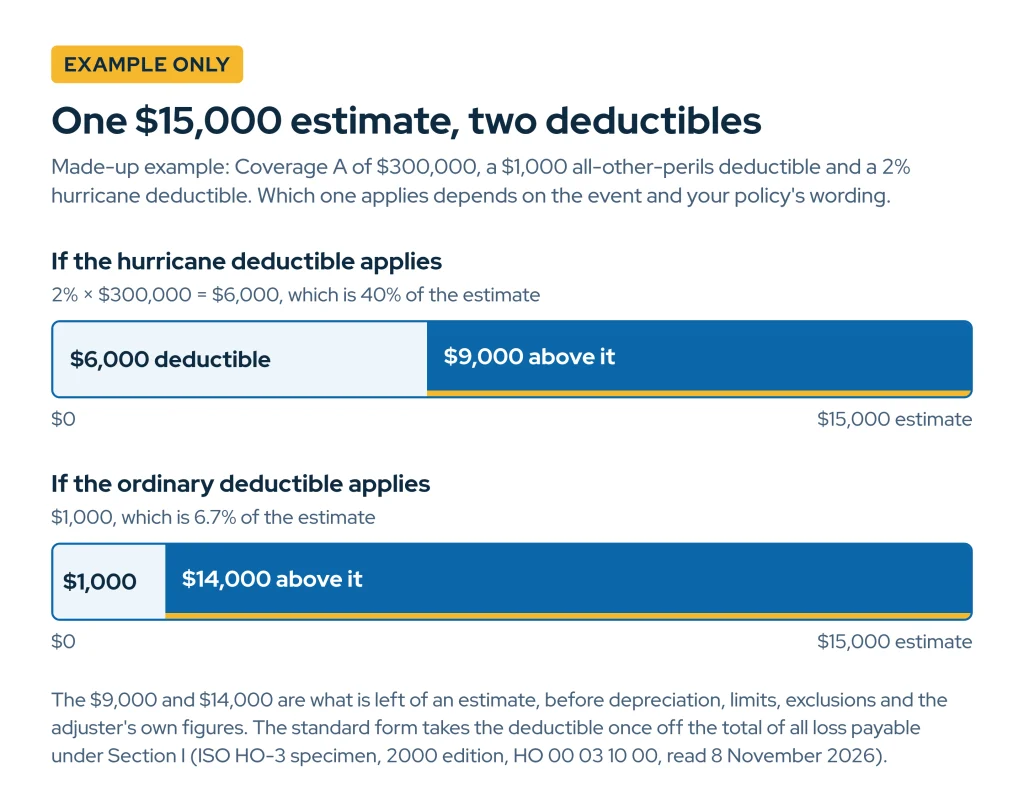
The same storm damage gives a $5,000 difference depending only on which deductible applies, and the event and your policy’s wording decide that. If the hurricane had done $5,000 of damage, the 2% deductible would take all of it and leave nothing above it, while the ordinary deductible would leave $4,000.
The amount above the deductible is still not a payout. If your policy pays replacement cost, the ISO HO-3 specimen form (2000 edition) pays no more than actual cash value until the repair is done, unless the repair costs less than both 5% of the building’s insurance and $2,500; our recoverable depreciation calculator works through that holdback, and the ACV and replacement cost calculator shows the gap between the two.
Hurricane, named-storm and wind/hail deductibles
These are separate deductibles that apply only to losses from one kind of event. The names are not interchangeable:
- Hurricane deductible: applies to damage from a storm declared a hurricane, usually by the National Hurricane Center, within a time window the policy or the state defines.
- Named-storm deductible: wider. South Carolina’s regulation counts a hurricane, tropical storm or tropical depression named by the National Weather Service or the National Hurricane Center, and says a winter storm named by the news media can’t trigger one (S.C. Code Regs. 69-56(B)(1)).
- Wind/hail deductible: wider again: wind or hail from any storm, not only tropical ones (South Carolina’s definition, 69-56(B)(2)).

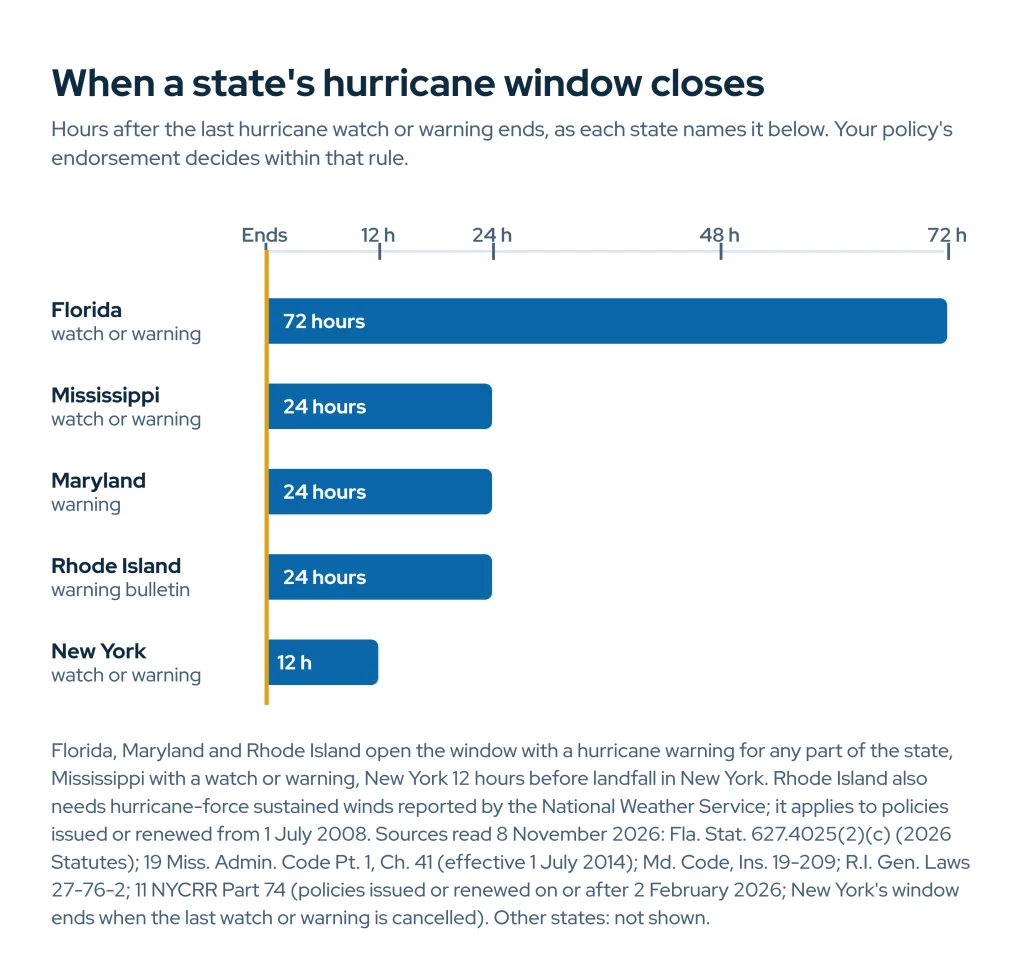
What starts and ends the window matters as much as the percentage. Wind damage two days after the last hurricane warning ended would still fall inside Florida’s 72-hour window, but outside the 24 hours that Maryland and Rhode Island set. The table below shows what we read in each state’s own statute or regulation. For more states, and the ones still unread, see our page on hurricane deductibles by state.
State rules we read
| State | What the rule says | Once a year? | Source, read 8 Nov 2026 |
|---|---|---|---|
| Florida | Before issuing a personal residential policy the insurer must offer hurricane deductibles of $500, 2%, 5% and 10% of the dwelling limit (dwellings of $250,000 or more need not be offered $500; from $1 million to under $3 million a 3% option may replace the 2%; $3 million or more need not be offered 2%; a percentage option that comes to less than $500 need not be offered; for dwellings from $100,000 to under $250,000 an insurer may instead offer up to 2% with a one-renewal guarantee; deductible programs in effect on 14 June 1995, or similar ones with at least a 2% minimum, are exempt). For homes valued under $500,000, a hurricane deductible above 10% needs a statement the policyholder writes or types out and signs (every named insured signs too), plus the lender’s written approval if there is a mortgage. The hurricane runs from a hurricane warning for any part of Florida until 72 hours after the last hurricane watch or warning for any part of Florida ends. A separate roof deductible, if the policy has one, may not exceed the lesser of 2% of Coverage A or 50% of the roof’s replacement cost, applies only to claims settled at replacement cost, and does not apply to a hurricane roof loss, a covered total loss, a tree fall or other hazard that punctures the roof deck, or a repair of less than 50% of the roof. | Yes, for policies issued or renewed from 1 May 2005: across all covered hurricane losses in a calendar year with the same insurer or insurer group | Fla. Stat. 627.701(3)-(5), (10); 627.4025(2)(c) (2026 Statutes) |
| Louisiana | A separate named-storm or hurricane deductible (a percentage of insured value or a dollar amount; storms declared by the National Hurricane Center) on homeowners or one- or two-family owner-occupied policies from authorized insurers. A commissioner’s form lists each named-storm, hurricane and wind/hail deductible; for new policies effective after 1 January 2023, and whenever the insurer changes the percentage or dollar amount, the insurer must give the form and ask the named insured to sign it. No time window found in this section. | Yes, for policies issued or renewed from 1 January 2010 | La. R.S. 22:1337 |
| Mississippi | A percentage named-storm or hurricane deductible must come with an offered buy-back provision unless the commissioner grants a waiver. The window runs from a National Hurricane Center watch or warning for any part of Mississippi, through the storm conditions, until 24 hours after the last watch or warning ends. The dollar amount must be on the declarations page. Applies to admitted insurers only: not the Mississippi Windstorm Underwriting Association or non-admitted (surplus lines) insurers. | Not in the regulation read | 19 Miss. Admin. Code Pt. 1, Ch. 41 (Mississippi Insurance Department copy; effective 1 July 2014) |
| South Carolina | Insurers, surplus lines insurers included, must show an example for a $100,000 policy with the event that triggers the deductible, and print a capitalised warning on the policy face and the declarations page. Adding or raising one at renewal needs the policyholder’s signed or initialled acknowledgment. Definitions as above. | Not in the regulation read | S.C. Code Regs. 69-56 (amended effective 26 June 2020) |
| Rhode Island | A windstorm deductible must be approved by the director and may not exceed 5% of the insured value. It applies to hurricane losses from a National Hurricane Center hurricane-warning bulletin for any part of the state until 24 hours after the last one ends, and only when the National Weather Service reports hurricane-force sustained winds (on Block Island for Block Island homes; anywhere else in the state for the rest). It may not be applied if the home has approved windstorm mitigation and the insurer inspected it or got proof. Personal lines residential policies on dwelling houses, issued or renewed from 1 July 2008. | Yes: once per calendar year | R.I. Gen. Laws 27-76-2, 27-76-3 |
| Maryland | A deductible may be a percentage of the Coverage A dwelling limit. A mandatory hurricane deductible under an insurer’s underwriting standard applies only from a National Hurricane Center hurricane warning for any part of the state until 24 hours after the last warning ends, wherever in Maryland the home is. An underwriting standard requiring a hurricane deductible of more than 5% of Coverage A must be filed with the commissioner at least 60 days before use. Policyholders get an annual statement explaining the deductible. | Not in the section read | Md. Code, Ins. 19-209 |
| New Jersey | Required policy wording: the hurricane deductible applies to a hurricane named by the National Weather Service from which sustained winds of 74 mph or more were measured in New Jersey by the Weather Service, whether or not those winds reached the insured home. The window runs from 12 hours before the first such measurement until 12 hours after the last. The percentage is applied to the Coverage A dwelling limit, the deductible is never less than the ordinary Section I deductible, and it does not apply to loss of use (Coverage D), which takes the deductible that would apply to fire. After Hurricane Irene the department told insurers (Bulletin 11-16, 29 August 2011) that no hurricane deductible should be applied, because the Weather Service hadn’t reported winds in New Jersey meeting those criteria. | Per hurricane, as worded | N.J.A.C. 11:2-42 App. Exhibit D, as restored by a notice of administrative correction, 50 N.J.R. 1279 (21 May 2018); DOBI Bulletin 11-16 |
| New York | A policy may have a hurricane deductible only if the insurer shows the superintendent enough hurricane exposure. It is triggered only when the National Weather Service determines the hurricane made landfall in New York, and covers wind damage from 12 hours before landfall until 12 hours after the last New York hurricane watch or warning for that storm is cancelled. All losses from that hurricane are added together; it doesn’t apply to loss of use; if several deductibles apply, only one is used, which may be the higher. It may vary by county or distance from the coast. Declarations show both the percentage and the dollar amount. These rules apply to policies issued or renewed on or after 2 February 2026 (an insurer may apply them at the next annual renewal); an older policy may keep its own wording until it renews. | Not addressed; one hurricane’s losses are aggregated | 11 NYCRR 74.0, 74.1, 74.4 (Third Amendment, effective 2 February 2026) |
| Texas | No percentage cap or trigger rule found in the sections read; the Texas Windstorm Insurance Association’s own deductible rules were not read (not confirmed). Each declarations page must list every type of deductible and its exact dollar amount, and identify any provision that can change it. | No rule found | Tex. Ins. Code 2301.056 |
What we could not confirm: whether Florida’s and Maryland’s sections reach surplus lines or state-run insurers (the sections don’t say, and we didn’t read the separate surplus lines law); whether New Jersey’s Exhibit D has changed since its May 2018 correction notice (the official online code is a commercial site we didn’t open); and how Mississippi’s regulation reads in the Secretary of State’s administrative code, as opposed to the department’s own copy. Insurers in other states with hurricane deductibles set their own triggers within whatever their state allows; the policy endorsement says what yours is.
Once a year: the second storm
Florida, Louisiana and Rhode Island use the same pattern. The hurricane deductible counts once across all hurricane losses in a calendar year (in Louisiana, named-storm losses too). For a later hurricane, the insurer may apply the greater of what is left of the hurricane deductible or the all-other-perils deductible (Fla. Stat. 627.701(5)(a)3; La. R.S. 22:1337(C); R.I. Gen. Laws 27-76-3(b)).
Example: a 2% hurricane deductible of $6,000 and a $1,000 ordinary deductible. A first hurricane in August does $4,000 of damage: all of it falls under the deductible, and $4,000 of the $6,000 is used. A second hurricane in October does $9,000 of damage. What’s left of the hurricane deductible is $2,000, which is greater than $1,000, so $2,000 comes off and $7,000 of the estimate is above it. Had the first storm used the full $6,000, the October deductible would be the $1,000 ordinary one.
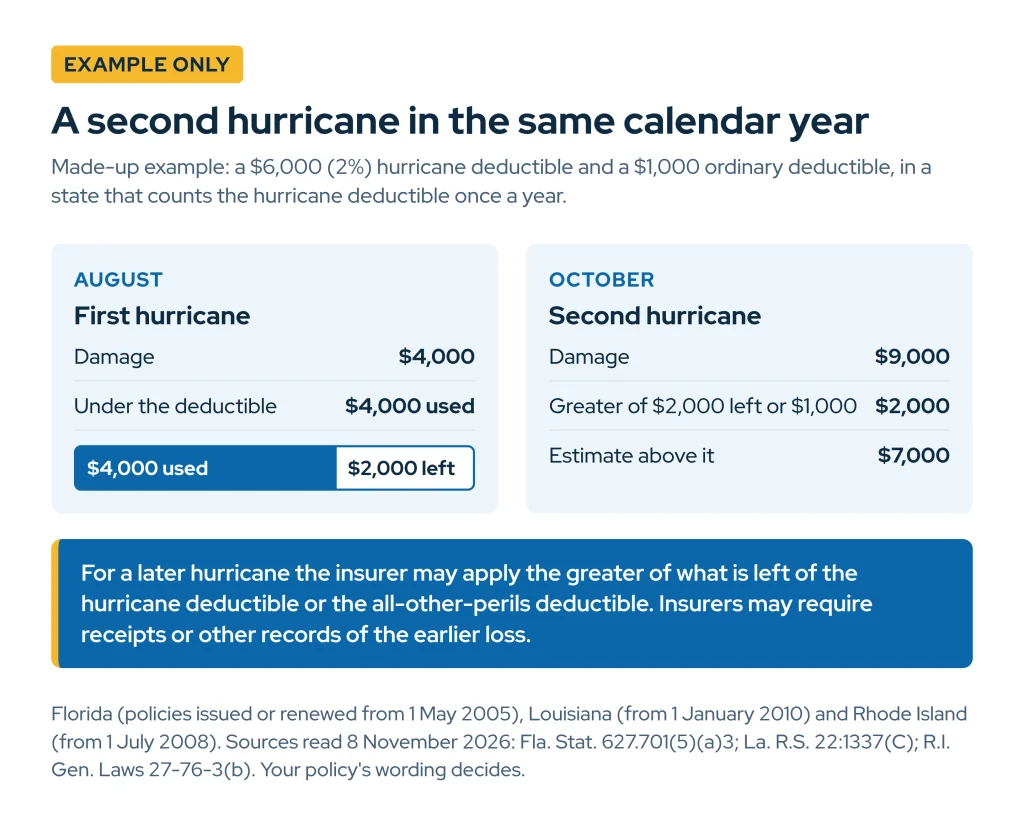
Two details catch people out. First, the earlier loss only counts if the insurer knows about it: all three statutes let insurers require receipts or other records of hurricane losses, and Florida’s also lets them require that losses below the deductible be reported. So records of a hurricane loss you paid for yourself in August can matter later in the year. Second, Florida counts the year across policies with the same insurer group, and if you change to a lower hurricane deductible after a hurricane loss, the lower one doesn’t apply until 1 January of the next year (627.701(5)(a)4).
The deductible and the rest of the payout
In Texas and Louisiana, an insurer paying replacement cost may refuse to release the withheld recoverable depreciation, or a replacement cost holdback, until it receives reasonable proof that you paid the deductible: a cancelled check, money order receipt, credit card statement, or an installment or financing contract that pays it in full over time (Tex. Ins. Code 707.004; La. R.S. 22:1892(A)(7)). Keep proof of what you paid the contractor.
If you have a mortgage, the insurance check often names your lender too, and the deductible is money you add to what the lender releases. Our mortgage check calculator shows how release rules work for some loan types.
“We’ll cover your deductible”
Some contractors advertise that they will waive, absorb or rebate your deductible. You may see this on door hangers after a storm. We read the law on this in two states, and both forbid it in the situations below:
- Texas: a seller paid from a property insurance claim commits a Class B misdemeanor by paying, waiving, absorbing or rebating the insured’s deductible, or otherwise helping the insured avoid paying it, without the insurer’s consent. Contracts of $1,000 or more paid from a claim must carry a bold notice saying so (Bus. & Com. Code 27.02).
- Florida: a contractor may not offer a deductible waiver, rebate, gift or anything of value in exchange for a roof inspection or a roof claim, with fines up to $10,000 per violation. Contractor advertising that urges a roof claim must say, among other things, that the homeowner is responsible for the deductible and that it is insurance fraud, a third-degree felony, for a contractor to knowingly or willfully, with intent to injure, defraud or deceive, pay, waive or rebate any part of a deductible (Fla. Stat. 489.147).
Other states may have similar laws; we read only these two for this page, so check your own state’s law or ask your state insurance department.
Flood has its own deductibles
A homeowners policy usually excludes flood, so a flood policy, often from the National Flood Insurance Program, has its own deductibles. FEMA must offer NFIP deductible options up to $10,000, with minimums from $1,000 to $2,000 depending on the building and its coverage amount (44 CFR 61.5, as amended 20 July 2020, 85 FR 43958). After a hurricane that brings both wind and water, you may face a hurricane deductible on the homeowners claim and a flood deductible on the flood claim. See our guide to the NFIP flood claim.
The deductible and the decision to file
Whether to file is your decision, and the deductible is only part of it. If the estimate is near or below the deductible, little or nothing is left above it. In the three once-a-year states, a hurricane loss below the deductible can still count toward that year’s deductible, and insurers may require receipts or other records of it (Florida also lets them require that it be reported). Our page on whether to file a home insurance claim sets out the arithmetic and the rules we read, without telling you what to do.
What to do next
- Find your declarations page and write down every deductible on it: all other perils, and any hurricane, named-storm, wind/hail or roof deductible, as a percentage and in dollars.
- Read the deductible endorsement itself. It defines the event, the window and which coverages it applies to. Mississippi’s regulation requires the policy to state which coverages are subject to it.
- If a dollar figure is missing or unclear, ask the insurer in writing what your deductible is for each kind of loss and how it is figured, and keep the answer.
- After a storm, take photos and video before cleanup, stop further damage and keep the receipts, and note the date and time of the damage: the hurricane window can decide which deductible applies.
- Keep records of hurricane losses you pay yourself if you live in Florida, Louisiana or Rhode Island; they may count toward a later storm the same year.
- If you disagree with how a deductible was applied, ask the insurer for the policy provision in writing, then contact your state insurance department’s consumer line. The NAIC keeps a directory of state insurance departments.
Sources checked on 8 November 2026: the ISO HO-3 specimen form (2000 edition), Florida Statutes 627.701, 627.4025 and 489.147 (2026), Louisiana R.S. 22:1337 and 22:1892, 19 Miss. Admin. Code Pt. 1, Ch. 41 (department copy), S.C. Code Regs. 69-56, R.I. Gen. Laws 27-76-1 to 27-76-3, Md. Code, Insurance 19-209, N.J.A.C. 11:2-42 Exhibit D (50 N.J.R. 1279) and DOBI Bulletin 11-16, 11 NYCRR Part 74 (Third Amendment and DFS notice of adoption), Texas Insurance Code 707 and 2301.056 and Business and Commerce Code 27.02, and 44 CFR 61.5.
Formulas and sources
- Deductible in dollars: Maryland Insurance Article 19-209, percentage of the Coverage A dwelling limit
- Hurricane deductible left this calendar year: Florida Statutes 627.701(3)-(5) (2026), hurricane deductibles
- Deductible applied to this loss in the estimate: Once-a-year rule: Fla. Stat. 627.701(5)(a)3; La. R.S. 22:1337(C); R.I. Gen. Laws 27-76-3(b)
- Part of the damage the deductible takes: ISO HO-3 specimen form (2000 edition, HO 00 03 10 00), Deductible clause and Section I Condition C
- Damage estimate above the deductible: ISO HO-3 specimen form (2000 edition, HO 00 03 10 00), Deductible clause and Section I Condition C
- Deductible as a share of the damage estimate: ISO HO-3 specimen form (2000 edition, HO 00 03 10 00), Deductible clause and Section I Condition C
- Deductible as a share of the dwelling limit: Maryland Insurance Article 19-209, percentage of the Coverage A dwelling limit
- 1% of the dwelling limit: Maryland Insurance Article 19-209, percentage of the Coverage A dwelling limit
- 2% of the dwelling limit: Florida Statutes 627.701(3)-(5) (2026), hurricane deductibles
- 5% of the dwelling limit: Florida Statutes 627.701(3)-(5) (2026), hurricane deductibles
- 10% of the dwelling limit: Florida Statutes 627.701(3)-(5) (2026), hurricane deductibles
Sources
- ISO HO-3 specimen form, 2000 edition (HO 00 03 10 00)
- Florida Statutes 627.701 (2026), coinsurance and deductibles
- Florida Statutes 627.4025 (2026), hurricane coverage defined
- Florida Statutes 489.147 (2026), prohibited property insurance practices
- Louisiana R.S. 22:1337, named storm and hurricane deductibles
- Louisiana R.S. 22:1892
- Mississippi Insurance Department, 19 Miss. Admin. Code Pt. 1, Ch. 41
- South Carolina Code of Regulations, Chapter 69 (Reg. 69-56)
- Rhode Island General Laws 27-76-1
- Rhode Island General Laws 27-76-2
- Rhode Island General Laws 27-76-3
- Maryland Code, Insurance 19-209
- New Jersey Register, 50 N.J.R. 1279 (21 May 2018), notice of administrative correction, N.J.A.C. 11:2-42 Appendix Exhibit D
- New Jersey DOBI Bulletin 11-16
- New York DFS, Third Amendment to 11 NYCRR 74 (Insurance Regulation 159), adopted text
- New York DFS, Notice of Adoption, 11 NYCRR 74 (effective 2 Feb 2026)
- Texas Insurance Code chapter 707
- Texas Insurance Code 2301.056
- Texas Business and Commerce Code 27.02
- 44 CFR 61.5, NFIP deductibles (eCFR)
- NAIC, state insurance departments