Usually only when the mold comes from a loss the policy covers, and often only up to a smaller dollar limit. The standard homeowners form lists mold, fungus and wet rot among the causes it does not insure, then makes a narrow exception for mold hidden inside walls, ceilings or floors after an accidental leak from plumbing, heating, air conditioning, a fire sprinkler or a household appliance. Mold from humidity, a slow leak left alone, flooding or a sewer backup is usually excluded. Your policy’s wording decides, and some insurers add their own mold endorsement that caps or removes this coverage. This page is part of our water, mold and flood guide.
General information, not legal or insurance advice, and not a substitute for the advice of an attorney. Your policy’s wording and your state’s law decide, and both change. For help with your claim, your state insurance department’s consumer line and legal aid are free.
Mold and the standard form at a glance
This table follows the ISO HO-3 specimen form, the industry’s standard “special form” homeowners policy. We read two editions: 2000 (HO 00 03 10 00) and 2011 (HO 00 03 05 11). Their mold wording is the same. Each insurer’s own form and each state’s amendatory endorsements can differ, so treat every row as “usually”, not as your policy.
| Where the mold came from | Under the standard form | The clause it rests on |
|---|---|---|
| A supply line, water heater or dishwasher leaked suddenly, and mold grew inside the wall or under the floor | May be covered, often up to a mold limit | The exception to the mold exclusion (Coverage A and B perils, item c.(5)); any fungi endorsement on your policy |
| Humidity, condensation, a damp bathroom, poor ventilation | Usually excluded | Mold exclusion c.(5); no water “discharge” from a system or appliance |
| A slow leak you knew about and didn’t stop | Usually excluded | Mold exclusion; Neglect exclusion; your duty to protect the property |
| Flood or surface water | Usually excluded under homeowners; flood policies have their own mold exclusion | Water exclusion; NFIP policy section V.D.4 |
| Sewer or drain backup, sump pump overflow | Usually excluded unless you added a water backup endorsement, and then subject to that endorsement’s terms (see sewer backup and homeowners insurance) | Water exclusion; a sump is not part of the “plumbing system” in this form |
| Rain through a storm-damaged roof, then mold | Depends on the wording | The mold exception names plumbing, heating, cooling, sprinklers, appliances and off-premises pipes, not rain; see below |
| Mold that was there before the policy started | Usually not covered | Policy Period condition: the policy applies to loss that occurs during the policy period |
What the standard form says
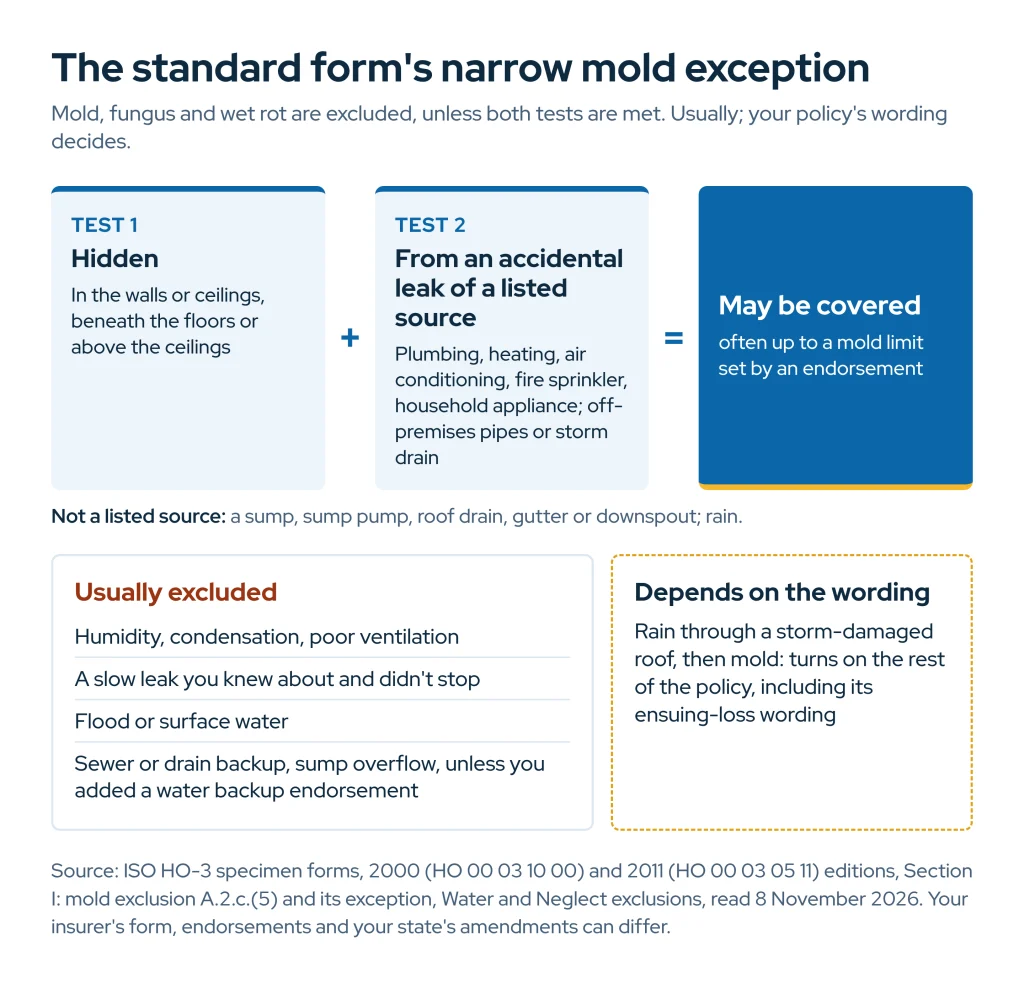
An HO-3 insures the house itself (Coverage A, the dwelling) and other structures (Coverage B) against direct physical loss (the 2000 edition says “risk of direct physical loss”), then lists what it doesn’t cover. One item on that list is “mold, fungus or wet rot”. Right after it comes the exception. In plain words, the specimen says it does insure loss from mold, fungus or wet rot that is hidden in the walls or ceilings, beneath the floors or above the ceilings, if it results from an accidental discharge or overflow of water or steam from:
- a plumbing, heating, air conditioning or automatic fire sprinkler system, or a household appliance, on the insured property; or
- a storm drain, or water, steam or sewer pipes, off the insured property.
The form adds that a sump, sump pump, roof drain, gutter or downspout doesn’t count as a plumbing system or appliance. Your belongings (Coverage C) are insured only against named perils, and the water-leak peril for them carries the same condition: no cover for mold, fungus or wet rot unless it was hidden in the walls, ceilings or floors. Sources: the 2000 specimen hosted by the Insurance Information Institute (a trade group), Section I, Perils Insured Against, A.2.c.(5) and B.12.b.(4), and the 2011 edition in the Maine Bureau of Insurance’s copy, pages 9 to 11.
Mold you can see, and mold after a storm
Two gaps in that exception catch people out. First, it speaks of hidden mold. Mold on the face of a wall after a burst pipe isn’t named. Second, it names water from household systems and off-premises pipes, not rain. If wind tears open a roof and rain soaks the attic, the wet drywall and insulation are a separate question, covered by the policy’s windstorm and water wording (see our page on roof leaks and insurance). Whether the mold that follows is paid for then turns on the rest of the policy, including its ensuing-loss wording, and, in a dispute, on your state’s courts. We don’t summarize case law here. Ask the insurer in writing which clause it is applying.
Why speed matters in the policy too
The standard form excludes loss from neglect, meaning failing to use “all reasonable means” to save and preserve property at and after a loss. Its Duties After Loss condition also requires you to protect the property from further damage, make reasonable and necessary repairs and keep a record of what they cost. Both editions also include a Reasonable Repairs additional coverage, which pays the reasonable cost of necessary steps taken only to protect covered property, damaged by a peril the policy insures, from further damage. Drying out quickly is how you meet those duties, and it is also how you stop mold. The EPA says “It is important to dry water-damaged areas and items within 24-48 hours to prevent mold growth” (page updated 18 February 2026).
Mold limits and endorsements
Your policy may not use the bare standard wording. Some insurers attach a mold or “fungi” endorsement, an add-on page that changes the policy. Some cap mold cover at a fixed dollar amount, some add testing costs, and some take mold cover away almost entirely. Two real examples, read on 8 November 2026, show the range. Neither is your policy.
| Example | What it does | Source |
|---|---|---|
| A limited fungi endorsement, as summarized for policyholders by the Massachusetts FAIR Plan (the Massachusetts Property Insurance Underwriting Association) | Covers mold, wet or dry rot or bacteria only when it results from a covered peril during the policy period. Property limit $10,000, with $25,000 or $50,000 available for an extra premium. The limit includes removal, tear-out to reach the mold, and testing when there is reason to believe mold is present, and it is the most paid for all claims together. Liability for mold-related injury or damage capped at $50,000 for the whole policy period, $100,000 available | Policyholder notice, edition HO 06 01 03 (file dated 2010). The notice says the policy itself prevails; current limits may differ |
| A homeowners endorsement from one of Nevada’s largest home insurers (form FE-3503), posted by the Nevada Division of Insurance | Defines fungus to include mold, mildew, mycotoxins and spores, and adds that the policy doesn’t pay to remove fungus, to tear out and replace parts of the house to reach it, to test or monitor the air or the property for it, or for loss of use or repair delays it causes | Nevada Division of Insurance, home insurance policy forms page |
To find yours, look on the declarations page (the summary page with your limits) and the list of endorsements for the words “fungi”, “fungus”, “mold”, “wet or dry rot” or “bacteria”. Then check four things: the dollar limit; whether it applies per loss or once for the whole policy year; whether tear-out and testing count inside it; and whether a separate mold limit applies to liability, the part of the policy that answers for injury to other people. Whether to add or raise a mold limit is your decision; the insurer or your agent can say what is available for your policy.
State rules we read
We found no state law, in the sections we read, that makes insurers cover all mold. What we did find, read in official text on 8 November 2026:
| State | Rule | Source |
|---|---|---|
| Florida | A homeowners policy must come with a checklist, on the state’s adopted form, showing whether the house, other structures and personal property are insured against mold, with the limit for each item, at issue and at each renewal. The checklist doesn’t change the policy and can’t be used in court | Fla. Stat. 627.4143(3), (4) and (6) (2026 Florida Statutes) |
| Texas | An insurer may not make an underwriting decision (such as whether to insure the home) based on earlier mold damage or a mold claim if the mold was remediated and either a certificate of mold remediation shows the underlying cause was fixed, or an independent assessor or adjuster inspected and found no evidence of mold damage. Doesn’t apply to surplus lines insurers, the Texas Windstorm Insurance Association or the Texas FAIR Plan Association | Tex. Ins. Code 544.301 and 544.303 (in force since 1 September 2005, amended 2007) |
| Texas | A licensed remediator must give the owner a certificate of mold remediation no later than the 10th day after the date it finishes the remediation (the statute says “day”, not calendar or business days). An owner who sells must give the buyer a copy of each certificate issued in the 5 years before the sale | Tex. Occ. Code 1958.154 |
| Texas | The insurance commissioner may adopt faster claim-handling rules for water damage claims, including mold claims. Whether such rules are in force: not confirmed (the rules themselves were not read) | Tex. Ins. Code 542.251 to 542.253 |
| Illinois | A 2002 Department of Insurance bulletin told insurers that property policies covering fire or lightning must cover mold resulting from a covered fire or lightning loss, up to the full policy limit; that any mold exclusion or limit must come with a separate written notice; and, under the heading “Claims Recommendations”, that insurers must endeavor to contact policyholders within 24 to 48 hours of a report of loss where water damage may be involved. The bulletin says it lasts until withdrawn. It is still posted on the department’s site but isn’t in its current bulletin list, and the department’s bulletins page says bulletins aren’t updated when the underlying rules change and shouldn’t be relied on as the current source of law, so whether it is still applied is not confirmed | Illinois Company Bulletin 2002-07 (5 December 2002) |
Other states: not read for this page. Your state insurance department can tell you whether it has a mold rule; the NAIC keeps a directory of state insurance departments. State claim clocks and suit limits, which apply to mold claims like any other, are in our claim deadlines by state tool.
Mold after a flood
Homeowners policies exclude flood. Flood damage is insured separately, most often through the National Flood Insurance Program (NFIP), and its policy has its own mold rule. The Standard Flood Insurance Policy, a federal regulation, says the policy does not insure “Water, moisture, mildew, or mold damage that results primarily from any condition: a. Substantially confined to the dwelling; or b. That is within your control”, including “Failure to inspect and maintain the property after a flood recedes” (44 CFR part 61, appendix A(1), section V.D.4, read on eCFR 8 November 2026). So mold is not excluded in every flood case, but drying out and keeping records after the water goes down are part of protecting the claim. The NFIP’s proof of loss and appeal clocks are on our NFIP flood claims page.
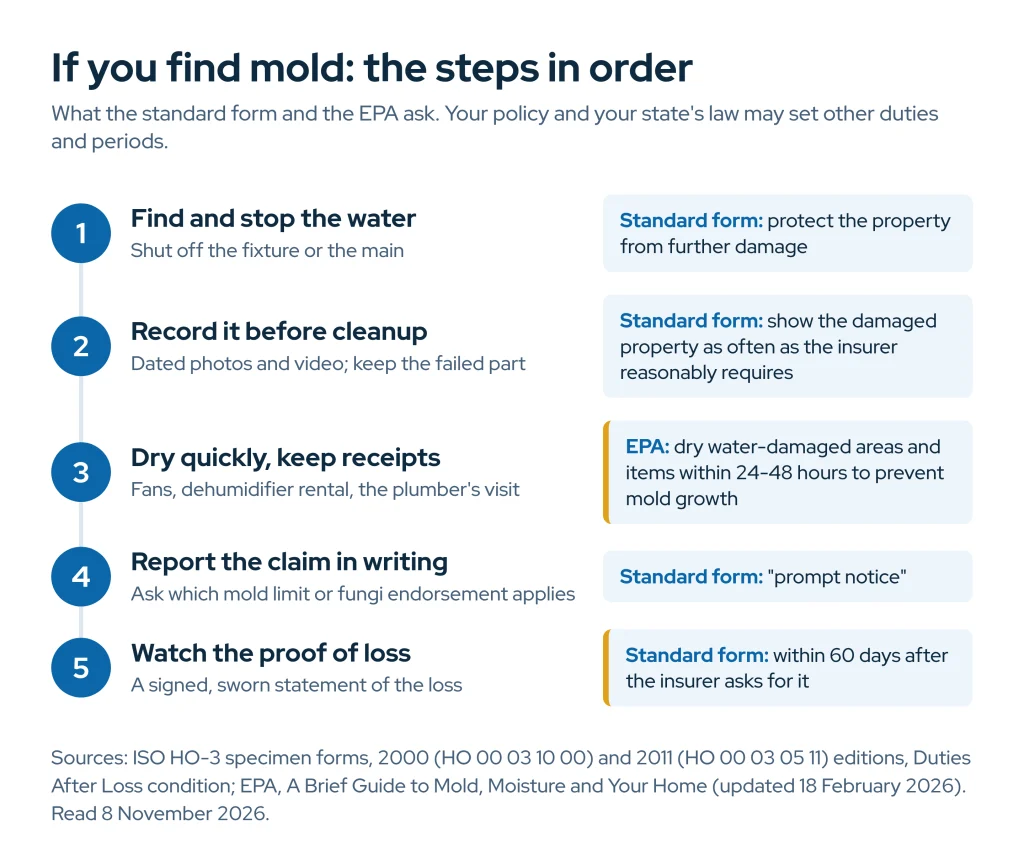
If you find mold
- Find and stop the water. Shut off the supply to a leaking fixture or the main if you need to. The policy expects you to prevent further damage.
- Record it before cleanup. Photos and video of the mold, the stain, the leak and the source, with the date. Keep the failed part (the burst hose, the cracked fitting) if you can.
- Dry quickly and keep receipts. Fans, dehumidifier rental, a plumber’s emergency visit. Keep every receipt and note what each one was for.
- Report the claim promptly, in writing. The standard form asks for “prompt notice”. Ask the insurer, in writing, whether a mold limit or fungi endorsement applies and whether tear-out and testing count inside it. Write down every call: date, name, what was said.
- Keep damaged material for the insurer to see where you can. The form’s duties include showing the damaged property as often as the insurer reasonably requires. If wet material has to come out to stop further damage, photograph it first, keep a sample if you can, and tell the insurer in writing.
- Testing. The EPA says “In most cases, if visible mold growth is present, sampling is unnecessary.” Some mold endorsements pay for testing only when there is reason to believe mold is present.
- Watch the proof of loss. The standard form asks for a signed, sworn proof of loss within 60 days after the insurer asks for it. Your policy and state law may set other periods.
On cleanup itself, the EPA says that if the moldy area is less than about 10 square feet (roughly a 3 by 3 foot patch), in most cases you can handle the job yourself following its guidelines; for more than that, or after a lot of water damage, it points to its remediation guide. For the water claim behind the mold, see does homeowners insurance cover water damage.
Claims you may see, checked
- “Black mold is treated differently.” The standard form’s wording is “mold, fungus or wet rot”, with no mention of color or species. A mold endorsement may define fungi broadly, as the Nevada example does.
- “Mold from a burst pipe is always covered.” Not as a general rule. The standard exception covers hidden mold from listed sources, and many policies cap it or exclude it by endorsement.
- “Florida, New Jersey, New York, North Carolina and South Carolina require $5,000 to $50,000 of mold cover regardless of cause.” You may see this on other sites. We could not confirm it. A search of Florida’s insurance chapter (627, 2026 statutes) for “mold” found only the checklist rule above. The other four states weren’t read for this page.
- “A mold claim can’t be held against you.” In Texas, 544.303 limits underwriting decisions based on past mold only in the circumstances it lists, and not for every insurer. We didn’t read other states’ rules on this.
Your next step
Get the full policy, not just the declarations page: every endorsement, including any fungi or mold endorsement, and any water backup endorsement. Read its mold exclusion, the Duties After Loss and Suit Against Us conditions, and its Neglect exclusion. Gather your dated photos, receipts, the plumber’s or remediator’s written findings and every letter from the insurer. Ask the insurer in writing which clause and which limit it is applying. If you disagree with the answer, your state insurance department’s consumer line is free; our pages on a denied home insurance claim and the complaint links by state explain the process. What can’t wait: drying the house, written notice of the claim, any proof-of-loss date in a letter from your insurer, and your state’s suit-limit floor.
Sources checked on 8 November 2026: the ISO HO-3 specimen form (2000 edition, HO 00 03 10 00, Insurance Information Institute copy; 2011 edition, HO 00 03 05 11, Maine Bureau of Insurance copy), 44 CFR part 61 appendix A(1) on eCFR, Fla. Stat. 627.4143, Tex. Ins. Code 542.251-.253 and 544.301-.305, Tex. Occ. Code 1958.154, Illinois Company Bulletin 2002-07, the Massachusetts FAIR Plan mold notice, the Nevada Division of Insurance policy forms page and the EPA’s mold guide.
Sources
- ISO HO-3 specimen form, 2000 edition (HO 00 03 10 00), Insurance Information Institute copy (trade group)
- ISO HO-3 specimen form, 2011 edition (HO 00 03 05 11), Maine Bureau of Insurance copy
- 44 CFR part 61, appendix A(1): Standard Flood Insurance Policy, Dwelling Form, section V.D.4 (eCFR)
- Florida Statutes 627.4143, outline of coverage and checklist (2026)
- Texas Insurance Code chapter 544, subchapter G (544.301-.305), mold claim or damage
- Texas Insurance Code chapter 542, subchapter F (542.251-.253), water damage claims
- Texas Occupations Code 1958.154, certificate of mold remediation
- Illinois Department of Insurance, Company Bulletin 2002-07 (5 Dec 2002), mold exclusions and limitations
- Massachusetts FAIR Plan (MPIUA): Homeowners policyholder notice, limited fungi, wet or dry rot, or bacteria coverage (HO 06 01 03)
- Nevada Division of Insurance: home insurance policy forms of the 10 largest groups (endorsement FE-3503)
- EPA: A Brief Guide to Mold, Moisture and Your Home (updated 18 Feb 2026)
- NAIC: state insurance departments directory