Usually no. The standard homeowners form excludes flood, surface water, waves, tidal water and the overflow of a body of water, “whether or not driven by wind”, and its 2011 edition names storm surge outright. It also excludes water that backs up through drains and groundwater that seeps through the foundation. Flood cover comes from a separate flood policy: the federal National Flood Insurance Program (NFIP) or a private flood insurer. When a storm brings both, the homeowners policy usually still pays for the wind damage, and it covers a fire, explosion or theft that follows the water. That is the usual answer under the standard form; your own policy’s wording decides. This guide is part of our Water, Mold and Flood section.
General information, not legal or insurance advice, and not a substitute for the advice of an attorney. Your policy’s wording and your state’s law decide, and both change. For help with your claim, your state insurance department’s consumer line and legal aid are free.
Below: the exclusion’s wording, the cases at the edges, what an NFIP flood policy covers, the 30-day wait, private flood policies, and what to do if water is already in the house.
Flood and homeowners insurance at a glance
| What happened | Homeowners policy (standard form) | NFIP flood policy (Dwelling Form) |
|---|---|---|
| A river or lake overflows into the house | Usually excluded (water exclusion) | Usually covered, if the water meets the policy’s definition of flood |
| Storm surge from a hurricane | Usually excluded, “whether or not driven by wind” | Usually covered as flood |
| Wind tears off the roof in the same storm and rain pours in | Usually covered, subject to any wind or hurricane deductible | Excluded: the flood policy doesn’t cover wind, windstorm or rain |
| Heavy rain runs off the street and pools against the house | Usually excluded (surface water) | Covered only if it is a “general and temporary condition” covering two or more acres or two or more properties |
| The sewer backs up during a neighborhood flood | Usually excluded unless you added a water backup endorsement | Covered only if the flood in the area is the direct cause |
| Groundwater seeps through the basement wall | Usually excluded (water below the surface) | Excluded unless a flood in the area is the direct cause; basement cover is a fixed list |
| A mudflow reaches the house | Usually excluded (earth movement) | Covered as flood; landslides are not |
| Floodwater causes a fire | The fire damage is usually covered | Excluded: the flood policy doesn’t cover fire |
| You can’t live in the house while it dries out | Usually no living expenses, because the cause isn’t covered | Excluded: no living expenses |
What the flood exclusion says
Many US homeowners policies are built on standard forms from Insurance Services Office (ISO), an insurance industry organization. We read two editions of the most common one, the HO-3: the 2000 edition (HO 00 03 10 00), a specimen hosted by the Insurance Information Institute, a trade group, and the 2011 edition (HO 00 03 05 11), a copy posted by the Maine Bureau of Insurance. Neither is your policy: your insurer’s form and its state endorsements can differ, so use this as a map of where to look in your own.
The water exclusion in the 2011 edition (Section I Exclusion A.3) removes four groups of loss:
- Flood and moving water from outside: flood, surface water, waves (including tidal wave and tsunami), tides, tidal water, overflow of any body of water, and spray from any of these, “whether or not driven by wind, including storm surge”.
- Backup: water that backs up through sewers or drains, or overflows or is discharged from a sump, sump pump or related equipment.
- Groundwater: water below the surface of the ground, including water that presses on, seeps, leaks or flows through a building, sidewalk, driveway, patio, foundation, swimming pool or other structure.
- What the water carries: waterborne material moved by any of the above.
The 2011 edition adds that the exclusion applies whether the water comes from an act of nature or is “otherwise caused”, and that it includes water released, for any reason, from a dam, levee, seawall or other containment system. So under this form a levee failure is still flood. The 2000 edition has the same three main groups and the same “whether or not driven by wind”, but doesn’t name tsunami, storm surge or levees.

Both editions put this exclusion under a lead-in that matters in storms. It says the listed causes stay excluded even when another cause contributes at the same time or in any order, and whether or not the event causes widespread damage. In plain terms, the wording says a loss caused by flood stays excluded even if a covered cause, such as wind, contributed. How courts apply this kind of wording can depend on your state’s law. If an insurer relies on this lead-in to deny a mixed wind-and-water loss, how it applies to your wording is a question for a licensed attorney in your state.
One exception runs the other way. Both editions say that direct loss by fire, explosion or theft resulting from the excluded water is covered. If floodwater shorts the wiring and starts a fire, the fire damage is usually a homeowners claim even though the water damage is not. For theft claims in general, see whether homeowners insurance covers theft.
The cases at the edges
Hurricanes: wind on one policy, water on the other
A hurricane often does both kinds of damage, and each policy excludes the other’s. The homeowners form usually covers wind, including rain that comes in through an opening the wind made, but excludes storm surge and rising water. The NFIP Dwelling Form covers flood but excludes “theft, fire, explosion, wind, or windstorm” and “rain, snow, sleet, hail, or water spray” (section V.D). With both policies, you usually file two claims, and each insurer decides which damage its own policy covers. With only one policy, the damage on the other side of the line is usually not covered.
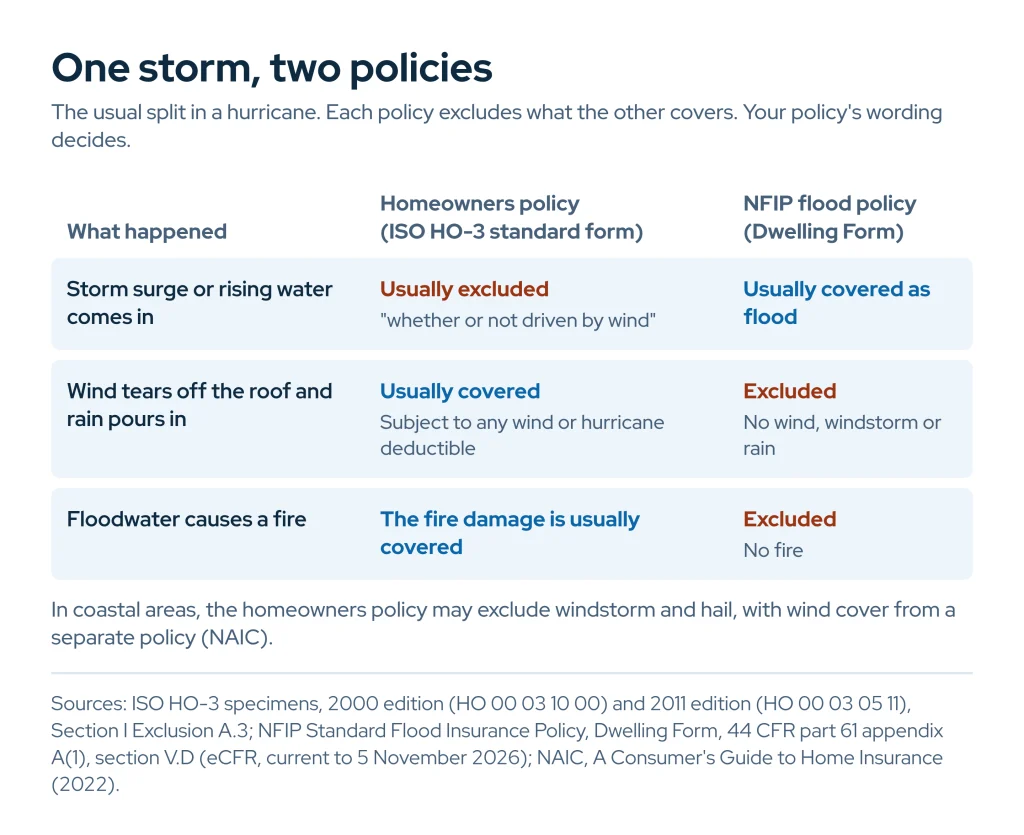
Wind isn’t always in the homeowners policy either. The NAIC, the national association of state insurance regulators, notes that policies in coastal areas often exclude windstorm and hail, so wind cover may come from a separate policy (A Consumer’s Guide to Home Insurance, 2022), in some states a wind pool or FAIR plan with its own form; we haven’t read those forms for this page. Wind claims may carry their own deductible: see hurricane deductibles by state.
Water that floods only your lot
This case can sit between the two policies. A cloudburst overwhelms the gutters and the grading, and water runs across your yard and in under the back door. The homeowners form usually excludes it as surface water. But the NFIP only covers “flood” as its policy defines it: a general and temporary condition of partial or complete inundation of two or more acres of normally dry land, or of two or more properties (one of them yours), from overflowing inland or tidal waters, unusual and rapid accumulation or runoff of surface waters from any source, or mudflow (Dwelling Form, II.B.1). Water confined to one lot of less than two acres may not meet that definition. In that case, it can fall outside both policies. Ask both insurers to put their answer in writing, quoting the clause.
Mudflow, landslides and erosion
Both homeowners editions exclude landslide, mudslide and mudflow as earth movement, though a fire, explosion or theft that follows is covered. The NFIP treats mudflow, “a river of liquid and flowing mud on the surface of normally dry land areas”, as flood, but not landslides, slope failure or gradual erosion (II.C.20, V.C). Its flood definition does include the collapse or subsidence of land along the shore of a lake or similar body of water from erosion by waves or currents above anticipated cyclical levels, when that results in a flood (II.B.2).
A broken water main or storm drain
The homeowners form has a narrow opening here. Its plumbing exception for the house includes an accidental discharge from a storm drain, or a water, steam or sewer pipe, off your property, and it lifts the surface water and groundwater parts of the water exclusion for that discharge. Belongings are treated differently, and water backing up through your own drains stays excluded. If the main break floods the neighborhood, FloodSmart, the NFIP’s consumer site, lists “a broken water main” among causes of flooding that flood insurance covers, as long as the water meets the policy’s flood definition. Our water damage coverage page goes through the plumbing clauses in detail.
Living somewhere else while the house dries
The homeowners form pays additional living expenses (Coverage D) only when “a loss covered under Section I” makes the home unfit to live in. A flood that isn’t covered usually doesn’t trigger it. Its civil authority cover, up to two weeks when officials bar you from the home, needs direct damage to a neighboring property by a covered peril, so a flood-only evacuation usually doesn’t trigger that either. The NFIP Dwelling Form excludes “any additional living expenses” outright (V.A.5). Where a disaster is declared, FEMA housing help may fill part of the gap (see FEMA aid below). If wind or fire also damaged the house, ask the homeowners insurer whether that covered damage alone makes the home unfit; our additional living expenses guide covers how that coverage works.
What an NFIP flood policy covers
The NFIP’s Standard Flood Insurance Policy is a federal regulation, printed in full at 44 CFR part 61 appendix A(1) for homes of one to four families. Policies sold by private “Write Your Own” insurers under the program use the same form, and its terms can be changed only by FEMA in writing (44 CFR 61.13(d)). The policy says it is governed exclusively by FEMA’s regulations, the National Flood Insurance Act and federal common law, not state insurance law (section X). It pays for “direct physical loss by or from flood”, and there must be evidence of physical change to the property.
| Part of the policy | What it does | Limit |
|---|---|---|
| Coverage A, building | The house, attached additions, built-in appliances, fixtures, furnaces, water heaters, cabinets and permanently installed carpet over unfinished flooring; a detached garage up to 10% of the building limit, which reduces the building limit | Up to $250,000 for a single-family or 2-4 family building in the regular program (44 CFR 61.6) |
| Coverage B, contents | Belongings inside a building, bought separately; $2,500 per loss for artwork and collectibles, jewelry and precious metals, furs, rare books and business property combined | Up to $100,000 for residential contents (61.6) |
| Coverage C, other | Debris removal; up to $1,000 for sandbags, supplies and your own labor (at the federal minimum wage) when flood is imminent and either there is general flooding near the home or officials have issued an evacuation or other flood order; up to $1,000 to move belongings to safety, covered there for 45 days | Inside the building and contents limits; no deductible on loss avoidance |
| Coverage D, Increased Cost of Compliance | Elevating, floodproofing, moving or demolishing a flood-damaged building when a local floodplain law requires it, after a substantial or repetitive loss | Up to $30,000, on top of the building amount but within the program maximum; no separate deductible |

Deductibles. Building and contents each have their own deductible, applied separately in each flood (VI.B). FEMA must offer deductible options up to $10,000, with minimums from $1,000 to $2,000 depending on the building’s age, rating and coverage amount (44 CFR 61.5).
How it pays. A single-family home that is your principal residence, insured to at least 80% of its full replacement cost or to the program maximum, is paid at replacement cost. When the repair is over $1,000 or over 5% of the building’s insurance, the replacement cost is paid only after the repair is done; you can take actual cash value (replacement cost minus depreciation) first and claim the rest if you notify the insurer within 180 days after the date of loss (VII.R). If a single-family dwelling is insured for less than both 80% of its replacement cost and the program maximum, the policy pays the greater of actual cash value or a proportion of the repair cost. A home that isn’t your principal residence, a 2-4 family building, detached garages, appliances, carpets and all contents are paid at actual cash value (VII.R.4); manufactured homes have their own rule (VII.R.3). The recoverable depreciation calculator does the arithmetic for both kinds of policy.
The basement list
The NFIP defines a basement as any area with its floor below ground level on all sides, sunken rooms included. Below that floor (and below the lowest elevated floor of some elevated buildings in high-risk zones), building cover is limited to a list: central air conditioners, cisterns, unfinished drywall and the labor to nail it up, electrical boxes, outlets and switches, fuel tanks, furnaces, water heaters, heat pumps, nonflammable insulation, solar pumps and tanks, attached stairs, sump pumps, water softeners and filters, well tanks and pumps, required utility connections, the foundation itself, and clean-up (III.A.8). Contents there are limited to window or portable air conditioners, clothes washers and dryers, and food freezers with the food in them (III.B.5). Finished walls, floors, carpet, furniture and other belongings in a basement are not on the list.
What the flood policy leaves out
- Outside the walls: land, lawns, trees and plants; walks, decks, driveways and patios outside the building’s perimeter; fences, retaining walls, seawalls, docks; swimming pools, and hot tubs and spas that aren’t bathroom fixtures; wells and septic systems (IV).
- Money and vehicles: cash, securities and valuable papers; cars and other self-propelled vehicles, with narrow exceptions (IV).
- Costs that aren’t physical damage: living expenses, loss of use or access, and other economic loss (V.A).
- Mold and moisture you could control: water, moisture, mildew or mold damage that results mainly from a condition confined to the dwelling or within your control, including failure to inspect and maintain the property after the flood recedes (V.D.4). FloodSmart’s claim page tells policyholders to do all they can to stop mold spreading and says NFIP policies don’t cover mold damage, so drying out fast matters.
- Backup and seepage without a flood: sewer or drain backup, sump overflow and seepage are covered only when there is a flood in the area and it is the proximate (direct) cause (V.D.5). Our sewer backup page covers the homeowners endorsement for the rest.
- A flood already under way: a loss from a flood that was already going on when you applied and paid is excluded (V.B).
Renters can buy contents cover on its own; it also covers the renter’s own improvements up to 10% of the contents limit (III.B.6). Condominium unit owners have separate rules, including a combined $250,000 cap for one unit across the unit owner’s policy and the association’s NFIP building policy (I.G).
The 30-day wait, and its exceptions
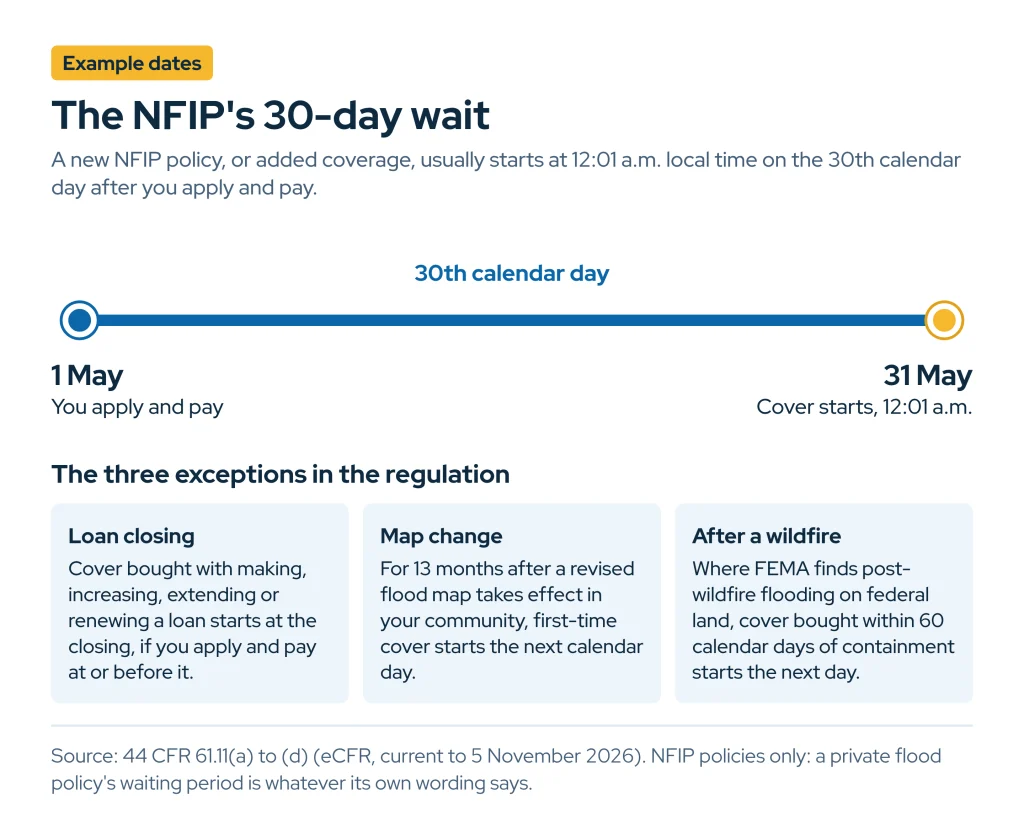
A new NFIP policy, or added coverage, usually starts at 12:01 a.m. local time on the 30th calendar day after you apply and pay: apply and pay on 1 May and cover starts on 31 May (44 CFR 61.11(d)). The regulation sets three exceptions:
- Loan closing: cover bought in connection with making, increasing, extending or renewing a loan starts at the closing, if you apply and pay at or before it (61.11(b)).
- Map change: for 13 months after a revised flood map takes effect in your community, first-time cover starts the next calendar day (61.11(a)). Ask the agent or insurer to confirm in writing which start date applies to your policy.
- After a wildfire: where FEMA finds a property is affected by flooding on federal land caused or made worse by post-wildfire conditions, cover bought within 60 calendar days of the fire’s containment starts the next day (61.11(c)).
Paying an agent doesn’t count as paying the NFIP. The wait runs from the application date only if the application and the full amount due reach the NFIP or the Write Your Own insurer within 10 calendar days, or are sent by certified mail within 4 calendar days; otherwise it runs from the day they arrive (61.11(f), (g)). In practice, flood cover has to be in place well before a storm is forecast. The NFIP also depends on Congress renewing its authority, which it has often done in short extensions; FloodSmart carries the program’s current notices.
When your lender requires flood insurance
If a home is in a special flood hazard area on FEMA’s maps and the loan comes from a federally regulated lender, a federal agency lender, or is bought by Fannie Mae or Freddie Mac, and NFIP insurance is available in the community, federal law requires flood insurance for the term of the loan. The amount must be at least the outstanding loan balance or the maximum available for that type of building, whichever is less (42 U.S.C. 4012a(b)). If the lender finds the cover missing or too low, it must tell you, and if you don’t buy it within 45 days, the lender must buy it and may charge you (4012a(e)). Detached structures that aren’t a residence are exempt from the requirement (4012a(c)(3)). The NAIC’s guide puts it simply: if your home is in a floodplain, your lender will usually require flood insurance.
The federal requirement applies only in mapped special flood hazard areas, but flooding doesn’t stop at the map line: FloodSmart says that over the past 10 years (2014 to 2024), nearly a third of NFIP claims (29%) came from outside high-risk flood areas.
Private flood insurance
The NFIP writes most flood policies, but some insurance companies sell their own (NAIC consumer guide, 2022). A private flood policy is not the federal form. Its definition of flood, basement cover, living expenses, contents settlement, waiting period and claim deadlines are whatever its own wording says, and the federal rules quoted above for the NFIP don’t bind it.
Lenders subject to the federal requirement must accept private flood insurance that meets the law’s definition (42 U.S.C. 4012a(b)(1)(B)). To qualify, the policy must come from an insurer licensed, admitted or otherwise approved in your state, give coverage at least as broad as the NFIP policy “including when considering deductibles, exclusions, and conditions”, give 45 days’ written notice of cancellation or non-renewal to you and the lender, include a mortgage clause, and require any suit within one year after a written denial (4012a(b)(7)). A private policy bought for other reasons doesn’t have to meet that standard. Read the declarations page and the flood definition before relying on one, and compare the same points you would check in an NFIP policy.
FEMA aid is not flood insurance
FEMA’s Individuals and Households Program helps only after a presidential disaster declaration, and FloodSmart notes that most flood events don’t get one. It covers uninsured or underinsured necessary expenses and won’t duplicate insurance: an insured household qualifies only in set cases, such as a denied claim or insurance money that is significantly delayed or falls short (44 CFR 206.110(a), (h); 206.113(a)). For disasters declared on or after 1 October 2026, the maximums are $46,400 for housing and $46,400 for other needs (91 FR 70094), adjusted each October. A household that gets flood-related repair help for property in a special flood hazard area must then buy and keep flood insurance, or it can be refused aid after a later flood (206.110(k); 206.113(b)(8)).
If water is already in the house
- Find out which policies you have. Look for a separate NFIP or private flood declarations page. If the home has a mortgage and sits in a mapped high-risk area, the lender may be collecting flood premiums through escrow (42 U.S.C. 4012a(d)), so check your escrow statement.
- Report in writing to every insurer that may be involved. The NFIP form asks for “prompt written notice”. If wind or a fire also hit the house, report to the homeowners insurer too.
- Photograph first, then dry out. Wide shots, close-ups, the waterline on the walls, and model and serial numbers of appliances. FloodSmart says to keep samples of carpet, flooring and curtains, and to ask the adjuster for a Flood Control Number card.
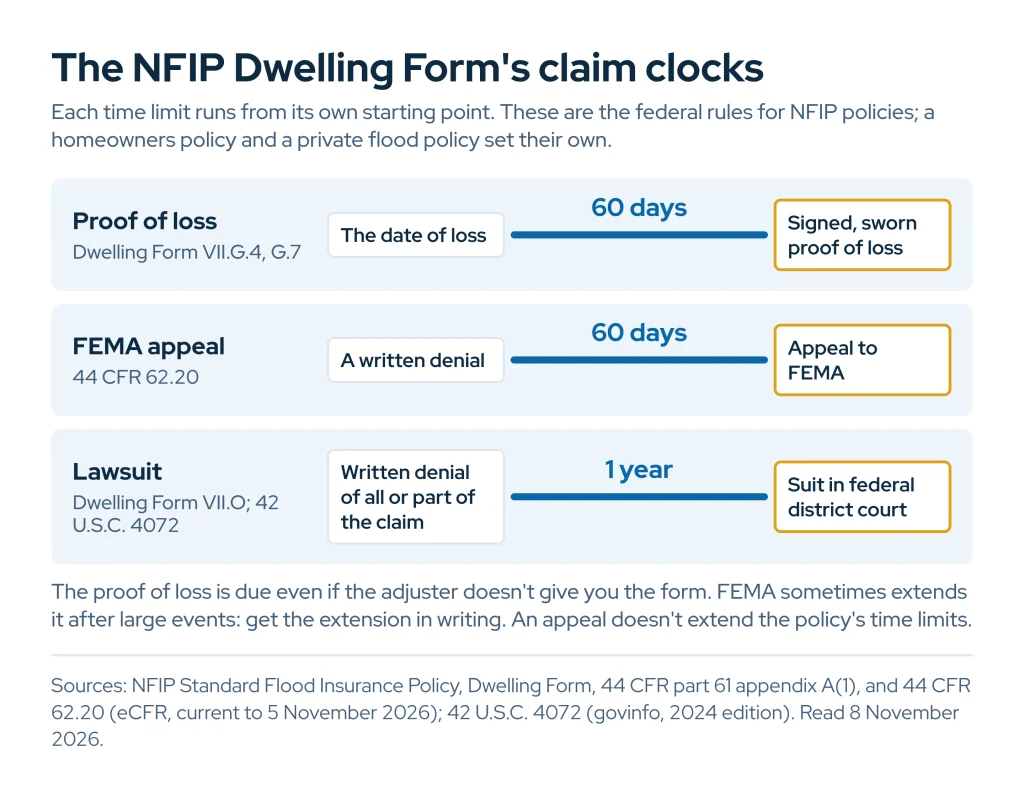
- Mind the 60 days. Under the NFIP form, a signed and sworn proof of loss is due within 60 days after the loss, even if the adjuster doesn’t give you the form (VII.G.4, G.7). FEMA sometimes extends this after large events; check FloodSmart or your insurer for a written extension.
After that, the federal clock is short. You can appeal a written denial to FEMA within 60 days of the decision, but the appeal doesn’t extend the policy’s time limits (44 CFR 62.20). A lawsuit must be filed in federal district court within one year after the written denial of all or part of the claim (VII.O; 42 U.S.C. 4072). Our NFIP flood claims guide goes through proof of loss, appeals and the one-year suit rule step by step.
Claims you may see elsewhere
You may see these on other sites. We checked each against the policy forms and federal rules named above.
- “Homeowners insurance covers flooding if the wind pushed the water in.” Not under the standard form: the exclusion applies “whether or not driven by wind”, and the 2011 edition names storm surge.
- “Flood insurance covers your finished basement.” No: the NFIP’s basement cover is a fixed list, and finished floors, walls and furniture aren’t on it.
- “You can buy flood insurance when the storm is on the way.” NFIP cover usually starts on the 30th calendar day, and a flood already under way when you apply is excluded.
- “FEMA will pay whatever insurance doesn’t.” No: FEMA aid needs a declared disaster, has set maximums and won’t duplicate insurance.
Your next step
- Gather: the homeowners policy with its declarations page and endorsements, any flood policy’s declarations page, photos and video from before cleanup, receipts, and every letter with its date.
- Read: the homeowners water and earth movement exclusions, any water backup endorsement, and the flood policy’s definition of flood and basement list.
- Do now: report in writing to each insurer, stop further damage where it is safe, keep the receipts, and dry out quickly.
- Ask: each insurer, in writing, which clause it relies on if it says no. Your state insurance department’s consumer line is free; find it through the NAIC’s list of state insurance departments or our complaint page for each state. For legal advice, contact legal aid or a licensed attorney through your state bar’s referral service.
- Don’t wait on: the NFIP’s 60 days from the date of loss for proof of loss, 60 days from a written denial for a FEMA appeal, one year from a written denial to sue, and the homeowners suit limit in your policy and state (claim deadlines by state).
Sources checked on 8 November 2026: ISO HO-3 specimens (2000 edition, HO 00 03 10 00, Insurance Information Institute copy, and 2011 edition, HO 00 03 05 11, Maine Bureau of Insurance copy); NFIP Standard Flood Insurance Policy, Dwelling Form, 44 CFR part 61 appendix A(1), and 44 CFR 61.5, 61.6, 61.11 and 61.13, on eCFR (current to 5 November 2026); 44 CFR 62.20 and 206.110 and 206.113 on eCFR; 42 U.S.C. 4012a and 4072 (govinfo, 2024 edition); 91 FR 70094 (6 November 2026); FloodSmart home page and pages “What is a flood?”, “What is my flood risk?” and “Start a claim”; NAIC, A Consumer’s Guide to Home Insurance (2022).
Sources
- ISO HO-3 Homeowners 3 Special Form specimen, 2000 edition (HO 00 03 10 00), Insurance Information Institute copy
- ISO HO-3 Homeowners 3 Special Form, 2011 edition (HO 00 03 05 11), Maine Bureau of Insurance copy
- NFIP Standard Flood Insurance Policy, Dwelling Form, 44 CFR part 61 appendix A(1) (eCFR)
- 44 CFR 61.5, Deductibles (eCFR)
- 44 CFR 61.6, Maximum amounts of coverage available (eCFR)
- 44 CFR 61.11, Effective date and time of coverage (eCFR)
- 44 CFR 61.13, Standard Flood Insurance Policy (eCFR)
- 44 CFR 62.20, Claims appeals (eCFR)
- 44 CFR 206.110, Federal assistance to individuals and households (eCFR)
- 44 CFR 206.113, Eligibility factors (eCFR)
- 42 U.S.C. 4012a, Flood insurance purchase and compliance requirements (govinfo, 2024 edition)
- 42 U.S.C. 4072, Adjustment and payment of claims; judicial review (govinfo, 2024 edition)
- FEMA, Notice of Maximum Amount of Assistance Under the Individuals and Households Program, 91 FR 70094 (6 November 2026)
- FloodSmart (FEMA/NFIP), What is a flood?
- FloodSmart (FEMA/NFIP), What is my flood risk?
- FloodSmart (FEMA/NFIP), How to start a flood insurance claim
- NAIC, A Consumer's Guide to Home Insurance (2022)
- NAIC, State insurance departments
- FloodSmart (FEMA/NFIP), home page