Usually not, when the foundation cracked, sank or shifted on its own: settling, shrinking or swelling soil, poor compaction, groundwater pressure or frost. The standard homeowners form excludes those causes by name, and it excludes earthquake, sinkholes and other earth movement too. Tree roots aren’t named, but an insurer may point to the same clauses. Usually yes when something sudden that the policy covers damaged the foundation: a fire, an explosion, a car hitting the house. A sudden plumbing leak under the slab sits in between: the form covers water damage from it and the cost of opening the slab to reach the pipe, but whether it covers foundation movement the leak caused can turn on the earth movement exclusion. Those are the usual answers under the standard form; your own policy’s wording decides.
General information, not legal or insurance advice, and not a substitute for the advice of an attorney. Your policy’s wording and your state’s law decide, and both change. For help with your claim, your state insurance department’s consumer line and legal aid are free.
Below: the usual answer for common foundation problems, the six clauses behind them, the plumbing-leak question, driveways and detached structures, earthquake cover, and the state rules we read that change the picture: Florida’s sinkhole law, mine subsidence cover in Ohio and Illinois, and Connecticut’s crumbling-foundation suit rule. It is part of our Water, Mold and Flood section.
Foundation problems at a glance
| What happened | Usual answer under the standard form | Clause it rests on |
|---|---|---|
| Cracks from the house settling over the years | Usually excluded | Settling, shrinking, bulging or expansion exclusion; wear and tear |
| Clay soil swells and shrinks, or the ground sinks | Usually excluded | Earth movement exclusion (“earth sinking, rising or shifting”) |
| Earthquake | Excluded under the standard form; fire or explosion that follows is usually covered | Earth movement exclusion; needs an earthquake endorsement or policy |
| Sinkhole | Excluded under the standard form; Florida law requires cover for a “catastrophic ground cover collapse” and an offer of sinkhole cover | Earth movement exclusion; Fla. Stat. 627.706 |
| Collapse of an old underground mine | Excluded under the standard form; some states build mine subsidence cover into policies in certain counties | Earth movement exclusion; Ohio Rev. Code 3929.56; 215 ILCS 5/805.1 |
| Groundwater or hydrostatic pressure cracks or pushes in a basement wall | Usually excluded | Water exclusion for water below the surface of the ground |
| Frost heave, or ice and water pressure against a footing or foundation | Usually excluded | Freezing, thawing, pressure or weight of water or ice exclusion |
| Tree roots lift or crack the slab | Unclear under the standard form; an insurer may rely on the settling or earth movement wording | No clause names roots in the ISO specimen |
| Poor design, grading, compaction or workmanship | Usually excluded; a loss that follows may be covered | Faulty workmanship exclusion, with its ensuing-loss sentence |
| A supply line under the slab bursts suddenly | Water damage and the tear-out to reach the pipe usually covered; foundation movement from the leak can be disputed; the pipe itself not covered | Exception for accidental discharge from plumbing, “unless the loss is otherwise excluded”; earth movement exclusion |
| A car or truck hits the house | Usually covered | Open perils for the house |
| A detached garage slab, driveway, patio or retaining wall cracks from settling, soil movement or frost | Usually excluded; a detached garage is “other structures” (Coverage B), with its own limit | Same settling, earth movement and freezing exclusions, which name pavements, patios, footings and foundations |
| Fire or explosion damages the foundation | Usually covered | Open perils; fire and explosion carved out of the earth movement exclusion |
| Flood undermines or cracks the foundation | Not under homeowners; a flood policy covers foundations damaged by flood, but not earth movement even when flood causes it | Homeowners water exclusion; NFIP Dwelling Form |
The six clauses that decide most foundation claims
Most US homeowners policies are built on standard forms from Insurance Services Office (ISO), an insurance industry organization, or on an insurer’s own form modelled on them. We read the foundation wording in the ISO HO-3 specimen form, 2000 edition (HO 00 03 10 00), a copy hosted by the Insurance Information Institute, a trade group (archived copy of 2 September 2026, re-read 18 November 2026). We did not read the 2011 edition, and your insurer’s form, its state endorsements and any later edition can differ. Neither is your policy.
The house itself (Coverage A, the dwelling) is covered on an open-perils basis: any direct physical loss unless the policy excludes it. So the question for a foundation is rarely “is this listed?” and almost always “does an exclusion apply?” Six parts of the form answer that.
- Settling and cracking. Among the causes the form does not cover for the house is settling, shrinking, bulging or expansion, including the cracking that results, of footings, foundations, walls, floors, roofs, ceilings, patios and pavements. The same list holds wear and tear, deterioration, latent defects and dry rot. This is the clause ordinary foundation cracks most often run into.
- Earth movement. A general exclusion covers earthquake, landslide, mudslide or mudflow, subsidence or sinkhole, and “any other earth movement”, including the earth sinking, rising or shifting, whether caused by nature or by people. The form’s general exclusions apply “regardless of any other cause or event” contributing at the same time or in any order, so a second cause contributing to the loss does not by itself bring it back into cover. Fire or explosion that follows earth movement is covered, and the exclusion does not apply to theft.
- Water below ground. The water exclusion includes water below the surface of the ground, including water that presses on or seeps or leaks through a building, sidewalk, driveway, foundation, swimming pool or other structure. It applies whether the water got there by nature or by people’s actions. A fire, explosion or theft that follows is covered, and the exclusion does not apply to water covered under the plumbing-leak exception below.
- Freezing, thawing and ice. The form excludes freezing, thawing, pressure or weight of water or ice on a footing, foundation, wall or other structure that supports the building, and on fences, patios, pools and retaining walls.
- Faulty work. Faulty or defective planning, siting, design, workmanship, grading, compaction, materials or maintenance is excluded, but a loss that follows from it is covered if nothing else in the policy excludes it. Poorly compacted fill under a slab falls here.
- Collapse. Collapse is excluded except under a narrow additional coverage, explained below.
The form also says that an ensuing loss to the house, one that follows from causes in its own list such as settling, is covered if no other provision excludes it. Whether a particular loss “ensues” or is part of the excluded cause depends on the facts and the wording, and insurers and policyholders can read it differently. The Texas Department of Insurance’s home insurance guide (last updated 1 June 2026) puts it more simply: most policies don’t cover earthquakes or earth movement, and damage to foundations or slabs is one of the add-ons (endorsements) companies commonly offer.
A plumbing leak under the slab
This is a common case, and the form handles it in three steps.

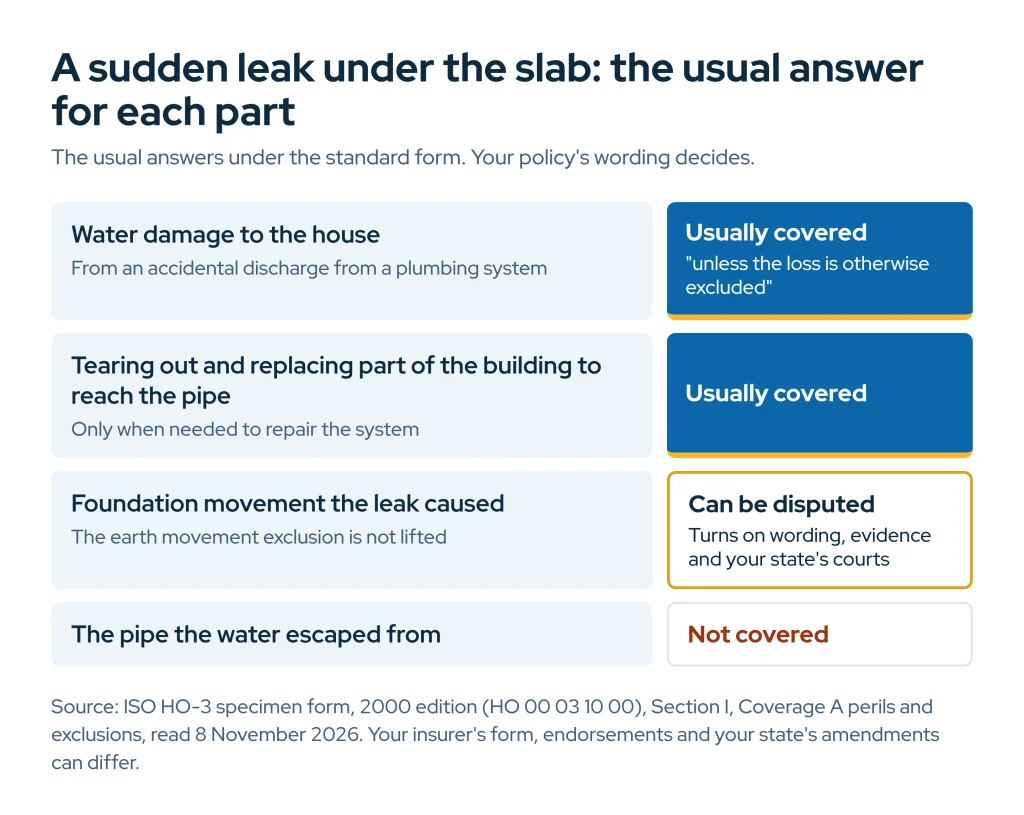
- The water damage is usually covered. Right after the list that holds the settling exclusion, the form adds an exception: unless the loss is otherwise excluded, it covers loss to the house from an accidental discharge or overflow of water or steam from a plumbing, heating, air conditioning or fire sprinkler system or a household appliance.
- So is opening the slab to reach the pipe. The exception includes the cost to tear out and replace any part of the building, but only when that is needed to repair the system. The pipe, system or appliance the water escaped from is not covered.
- Foundation movement from the leak is the open question. The exception lifts the settling exclusion for discharge losses, but only “unless the loss is otherwise excluded”. The 2000 specimen also says the exclusion for water below the surface of the ground does not apply to water covered under this exception. The earth movement exclusion is not lifted, and it applies whatever else contributed. An insurer may say the slab moved because the soil under it shifted, which is earth movement. You may say the loss came from the accidental discharge. Which reading controls on your facts turns on your policy’s exact wording, the cause the evidence shows and your state’s courts.
Two more points. A leak that ran for weeks or months raises other clauses, such as the wear and tear and deterioration wording and the mold, fungus or wet rot exclusion, and your insurer’s own form may add a separate clause on continuous or repeated seepage; our water damage guide sets out those wordings. And the Texas guide above lists damage to foundations or slabs among the endorsements companies commonly offer. If your declarations page shows one, read what causes it covers. Our page on whether homeowners insurance covers plumbing goes through the pipe side of the claim.
When the foundation is part of a collapse
The form’s collapse coverage is narrow. Collapse means an “abrupt falling down or caving in” of a building or part of one, so that it can’t be used for its current purpose. A building that is in danger of collapse, or is standing but cracked, bulging, sagging, leaning or settling, is not in a state of collapse.
When a collapse does happen, the form covers it if it was caused by a peril named for personal property (fire, windstorm, vehicles and the rest), by decay or insect damage hidden from view that no insured knew about, by the weight of contents, people or rain collected on the roof, or by defective methods or materials used during construction or renovation, if the collapse happens during that work. A foundation, retaining wall, patio or underground pipe is covered under the hidden-decay, insect, weight and construction causes only if its loss is a direct result of the building’s collapse.
Driveways, patios, retaining walls and detached structures
The same questions come up for the slab under a detached garage, a driveway, a patio or a retaining wall, and the standard form answers them in much the same way. In the ISO HO-3 specimen, 2000 edition (HO 00 03 10 00), re-read on 18 November 2026:
- Which coverage part. Coverage A (the dwelling) includes structures attached to the house, so an attached garage’s foundation is part of the dwelling. Coverage B (other structures) covers structures on the premises “set apart from the dwelling by clear space”, including ones connected only by a fence, utility line or similar connection, for example a detached garage or a shed (Section I, Coverage B.1; the examples are ours, not the form’s).
- Its own limit. The specimen sets Coverage B at no more than 10% of the Coverage A limit, and using it does not reduce Coverage A (B.3). Your declarations page, the summary page at the front of the policy, shows the limit you have, which can differ.
- What it leaves out. Coverage B does not cover land, other structures rented to someone who is not a tenant of the house (unless used only as a private garage), or structures used for a business or to store business property, with a narrow exception (B.2).
- The same exclusions. The open-perils test and the exclusions above apply to Coverage A and B alike. The settling exclusion names pavements, patios, footings, foundations and bulkheads; the freezing and thawing exclusion names fences, pavements, patios, footings, foundations and retaining walls; and the water exclusion for water below ground names sidewalks and driveways. So a driveway or detached slab that cracks from settling, soil movement or frost usually runs into the same clauses as the house.
- Collapse. Under the collapse coverage, loss to a patio, deck, pavement, foundation, retaining wall, underground pipe or septic tank caused by hidden decay, insects, weight or faulty construction during the work is covered only if it is a direct result of the collapse of a building or part of a building (Additional Coverage E.8.c).
The land is not covered. Coverage A and Coverage B both say “We do not cover land”, including the land the buildings stand on (A.2 and B.2.a). Where a covered event damages a foundation, the claim is about the structure; work to the soil itself is a separate question your policy’s wording decides. Some endorsements and state programs (the Illinois mine subsidence cover below names driveways, sidewalks and septic systems) reach further, so read any endorsement you have. Condo (HO-6) and renters (HO-4) forms differ from the HO-3 and we did not read them; in a condo, the association’s governing documents and master policy say who insures the foundation. If the association bills owners for damage to common property, the loss assessment coverage in a homeowners or condo policy is usually the part that speaks to your share, up to its limit; your policy’s wording decides.
Earthquake cover
Earthquake is excluded from the standard form, apart from a fire or explosion that follows. Cover comes from an earthquake endorsement or a separate earthquake policy, and terms, deductibles and limits vary. Check what yours says about the foundation, the land and any separate deductible before relying on it.
California is the best-known example of a state rule. The California Department of Insurance’s earthquake insurance guide (Form 925, October 2024) says a homeowners insurer must offer earthquake insurance every other year, in writing, with the limits, deductible and premium; you have 30 days from the date the company mails the offer to accept, and not replying is a rejection. Most California earthquake policies come from the California Earthquake Authority, sold through its participating insurers. The guide adds that California law requires homeowners and renters policies to cover fire caused by or following an earthquake, with or without earthquake insurance.
Florida: sinkholes and catastrophic ground cover collapse
Florida sets sinkhole cover by a detailed statute. We read sections 627.706 to 627.7074 of the 2026 Florida Statutes on the Legislature’s site on 8 November 2026. Where a count below is in days, the statute says only “days”, not calendar or business days.
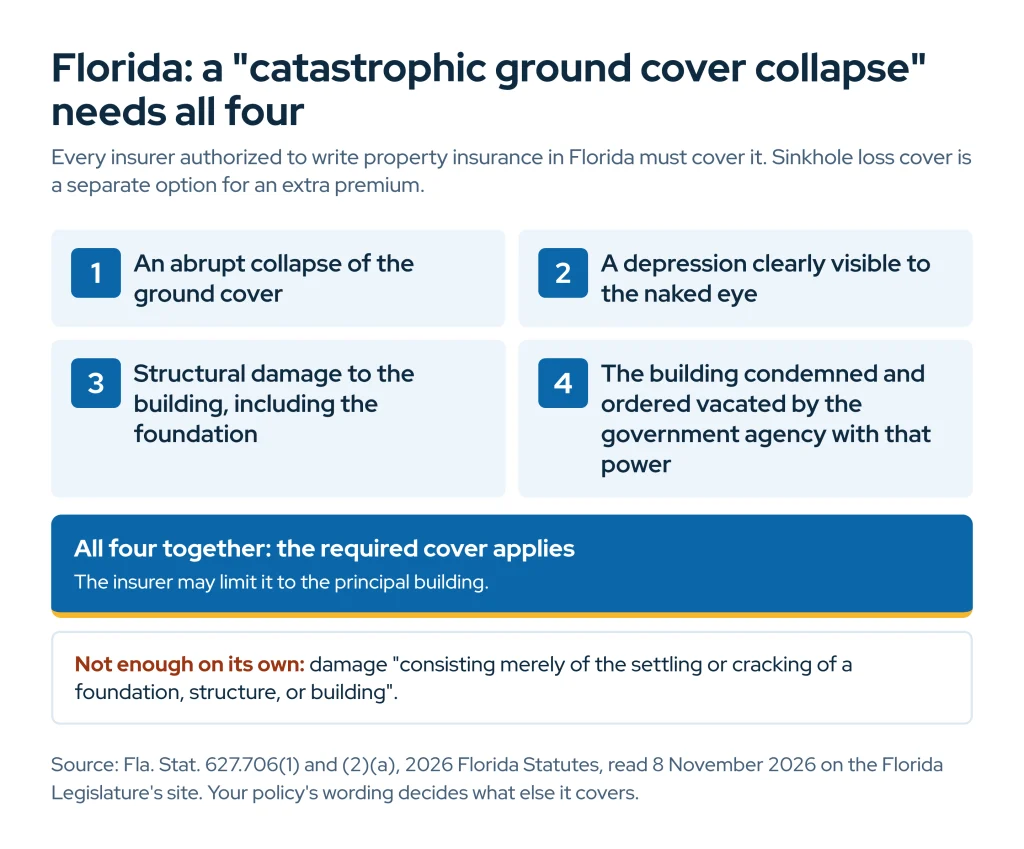
- Two kinds of cover. Every insurer authorized to write property insurance in Florida must cover a catastrophic ground cover collapse, and must make sinkhole loss cover available for an extra premium (Fla. Stat. 627.706(1)). The insurer may require an inspection before it adds sinkhole loss cover, and may limit both to the principal building. A policy without sinkhole cover must say so in bold type of at least 14 points (627.706(3)).
- Catastrophic ground cover collapse needs all four: an abrupt collapse of the ground cover, a depression clearly visible to the naked eye, structural damage to the building including the foundation, and the building condemned and ordered vacated by the government agency with that power. The statute says damage “consisting merely of the settling or cracking of a foundation, structure, or building” does not qualify (627.706(2)(a)).
- Sinkhole loss means structural damage, including to the foundation, caused by sinkhole activity, and “structural damage” is defined by engineering criteria in the statute. Contents and living-expense cover apply only if there is such structural damage (627.706(2)(j) and (k)).
- Deductible. A residential policy may carry a sinkhole deductible of 1%, 2%, 5% or 10% of the dwelling limit (627.706(1)(b)). Example, hypothetical numbers: a 10% sinkhole deductible on a $300,000 dwelling limit is $30,000. Our deductible calculator does this arithmetic with your own figures.
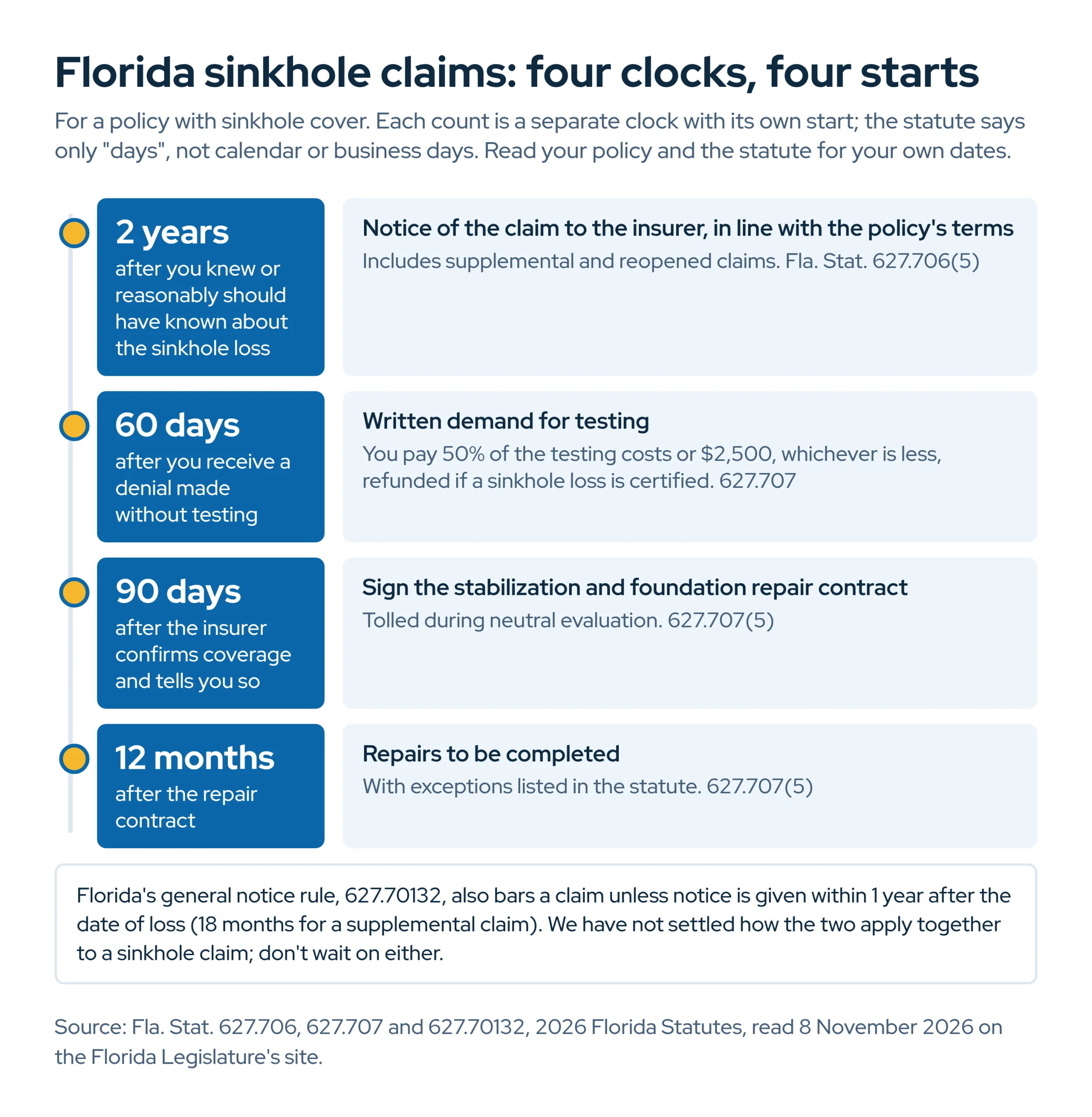
- Notice. A claim under a policy with sinkhole cover, including a supplemental or reopened claim, is barred unless notice is given within 2 years after you knew or reasonably should have known about the sinkhole loss (627.706(5)). Florida’s general notice rule, 627.70132, bars a claim for loss “caused by any peril” unless notice is given within 1 year after the date of loss (18 months for a supplemental claim; the limits are paused during a servicemember’s deployment to a combat zone that materially affects their ability to file). We have not settled how the two apply together to a sinkhole claim; don’t wait on either.
- Testing. The insurer must inspect, and if it finds structural damage it can’t explain, or damage consistent with sinkhole loss, it must hire a professional engineer or geologist to test, at its own cost, when the policy covers sinkhole loss. If it denies without testing, you may demand testing in writing within 60 days after you receive the denial; you then pay 50% of the testing costs or $2,500, whichever is less, refunded if the insurer’s engineer or geologist certifies a sinkhole loss (627.707(2)-(4)). If you asked for the testing, the insurer warned you in writing beforehand and let you withdraw, and its engineer or geologist then finds no sinkhole loss, you must repay 50% of the testing costs, up to $2,500, when the claim was made without good-faith grounds (627.707(6)). The insurer’s engineer’s or geologist’s findings are presumed correct (627.7073(1)(c)).
- Repairs and payment. If the loss is verified, the insurer pays to stabilize the land and building and repair the foundation as its engineer recommends, and the repairs must follow those recommendations. Until you sign a repair contract, it may limit payment to actual cash value, leaving out underpinning, grouting and other work below the foundation. You must sign that contract within 90 days after the insurer confirms coverage and tells you so (tolled during neutral evaluation); the insurer then pays as the work is done and may not make you advance the cost; repairs are due within 12 months of the contract, with listed exceptions. If its engineer finds the repair can’t be done within the policy limits, the insurer must pay to complete it or tender the limits (627.707(5)). You may not accept a rebate from whoever does the repairs: if you do, the statute voids the coverage and you must refund the rebate to the insurer, and a repairer who offers one commits insurance fraud (627.707(5)(f)).
- Disputes. Either side may ask the Department of Financial Services for neutral evaluation once a sinkhole report has been issued. It is nonbinding but mandatory if either party requests it, the insurer pays its reasonable costs, and filing a request tolls the time to sue until 60 days after it ends or the period in Florida’s statute of limitations, whichever is later (627.7074). It does not cancel the policy’s appraisal clause.
- On the record. When an insurer pays a sinkhole claim, it files the engineer’s report and the payment amount with the county clerk. Before accepting payment, you must file any sinkhole report prepared for you, at your cost. A seller whose sinkhole claim was paid must tell a buyer before closing, including whether all the money went into the repair (627.7073(2)).
Section 627.706 speaks of insurers authorized in Florida; we did not check how it applies to a surplus lines policy, so read yours. Citizens Property Insurance Corporation, the state-created insurer, has its own rules: its policies issued or renewed from 1 January 2012 that cover sinkhole loss leave out sinkhole damage to appurtenant structures, driveways, sidewalks, decks and patios (627.351(6)(c)19). The general notice rule in 627.70132 does name surplus lines property policies. Florida’s other claim clocks are on our Florida claim rules page.
Mine subsidence: Ohio and Illinois
Where old underground mines lie beneath homes, some states attach mine subsidence cover to homeowners policies through a state fund. We read two of them on 8 November 2026. Other states with mining areas may have their own rules; we did not read them.
- Ohio. In 26 listed counties, including Athens, Belmont, Jefferson, Mahoning, Muskingum, Stark, Trumbull and Tuscarawas, every basic property and homeowners policy must include mine subsidence cover provided through the Ohio Mine Subsidence Insurance Underwriting Association. In 11 more, including Licking, Medina, Portage and Summit, insurers must offer it as an option, and a county’s commissioners can make it mandatory there (Ohio Rev. Code 3929.56, in effect since 3 October 2023). The deductible must be at least $250 and no more than $500, and the association reinsures up to $300,000 of insured value. “Mine subsidence” means damage from the caving in of underground mines (coal, clay, limestone, salt); it does not include earthquake, landslide, volcanic eruption, or collapse of strip mines, storm and sewer drains or rapid transit tunnels (3929.50).
- Illinois. Every policy insuring a home must include mine subsidence cover at a separately stated premium unless you waive it in writing (215 ILCS 5/805.1). The Director of Insurance exempts counties of 1,000,000 or more people and the counties next to them, and may exempt others at the Illinois Mine Subsidence Insurance Fund’s request (807.1). Cover for a home includes its basement, footings, foundation, driveway, sidewalks, septic system and the underground pipes serving it, but not the land. Mine subsidence means ground movement from a failure at the mine level of a man-made underground mine; soil conditions, erosion, freezing and thawing, poorly compacted soil, construction defects and tree roots are expressly left out (802.1). If the insurer decides in writing that your home was not damaged by mine subsidence, you may start arbitration on that question within 60 days after you receive the notice (the statute says only “days”); the losing party pays the arbitration costs (809.1).
- Illinois changes from 1 January 2027. Under Public Act 104-519, policies issued or renewed on or after 1 January 2027 carry no deductible for mine subsidence damage, insurers in exempt counties must make the cover available on request, and an insurer must remind a policyholder who waived it that the cover is available at renewal (805.1 and 807.1 as amended).
Connecticut: crumbling foundations
Connecticut has a rule for one specific foundation problem: deterioration caused by pyrrhotite, a mineral found in some concrete. It sets how long a policy must allow you to sue on those claims: a homeowners or other personal risk policy, and certain condominium master policies, must allow a suit against the insurer up to one year after the date the insured receives a written denial of all or part of a claim for foundation deterioration due to pyrrhotite (Conn. Gen. Stat. 38a-688c, for policies issued, renewed or in force on or after 31 October 2017). That is a time limit on suing, not a rule that the damage is covered; whether it is covered still depends on the policy’s wording.
Flood and the foundation
The standard homeowners form excludes flood and surface water, so a foundation damaged by a flood is a flood insurance question. The NFIP’s Standard Flood Insurance Policy Dwelling Form (44 CFR part 61, appendix A(1)) covers footings, foundations, posts, pilings, piers and other foundation walls that support the building, and lists them among the few items it covers in a basement (III.A.8). But it does not cover loss “caused directly by earth movement even if the earth movement is caused by flood”, naming landslide, land subsidence, sinkholes, gradual erosion and land destabilized by water collecting underground. It does pay for mudflow and for collapse or subsidence of land along a lake or similar body of water from erosion by waves or currents above their usual cyclical levels, when that results in a flood as the policy defines it (V.C and II.B). Our flooding guide and NFIP claim guide explain the rest, including the 60 days from the date of loss to send proof of loss.
If the damage is covered: how the payout works
- Deductible. Your deductible comes off the covered amount; an earthquake endorsement or a Florida sinkhole policy may carry its own percentage deductible.
- Repair first, then full replacement cost. The ISO specimen pays replacement cost for the house only if it is insured to at least 80% of its full replacement cost; below that, it pays the greater of actual cash value or a proportional share of the repair cost. In working out that 80%, it leaves out excavations, footings, foundations and other supports below the lowest basement floor (or below ground inside the foundation walls where there is no basement), and underground pipes, flues, wiring and drains. It pays no more than actual cash value (replacement cost less depreciation) until the repair is complete, unless the repair costs less than both 5% of the dwelling limit and $2,500. You may take actual cash value first and claim the rest if you tell the insurer within 180 days after the date of loss that you intend to do so. The form says “days” without saying calendar or business days. Our actual cash value calculator shows how depreciation changes the first check.
- Building code costs. Foundation repairs can trigger code requirements. The 2000 specimen’s Ordinance or Law additional coverage lets you use up to 10% of the dwelling limit for the extra cost of meeting codes when repairing damage from a covered peril. Check your own limit, which some policies raise by endorsement.
If you find foundation damage

- Photograph and date it. Close-ups and wide shots of every crack, gap, sticking door and sloping floor, with a tape measure in frame, and again over the following weeks if it changes.
- Look for a cause you can show. A sudden event (a vehicle strike, a burst pipe, a fire) and its date matter more than anything else, because the clauses turn on cause. If you suspect a leak, a plumber’s written findings on where and when the pipe failed are worth keeping.
- Stop further damage and keep receipts. The policy expects you to make reasonable repairs to protect the property, such as shutting off the water.
- Report promptly, in writing, if you think a covered event caused the damage. The specimen asks for prompt notice and a signed, sworn proof of loss within 60 days after the insurer asks for one. State law sets its own notice rules in some states (Florida’s are above).
- Ask for the reasons in writing. If the insurer refuses, ask which clause it relies on and for a copy of any engineer’s report it used. Our page on a denied claim covers appraisal, complaints and the other routes.
Suit limits are set by your policy and your state, not by one national rule: the specimen says two years after the date of loss, and state law can set a different period. See the row for your state in our claim deadlines by state table.
Claims you may see elsewhere
You may see these on other sites. We checked each against the policy form and the statutes named above.
- “A slab leak means insurance pays for the foundation.” Not as a rule. The standard form covers water damage and tear-out from a sudden plumbing leak, but foundation movement can still fall under the earth movement exclusion, and the pipe itself isn’t covered.
- “Florida homeowners policies cover sinkholes.” Only a catastrophic ground cover collapse is required cover, and it needs the home condemned and ordered vacated. Sinkhole loss cover is an option for extra premium, and settling or cracking alone is not a collapse under the statute.
- “Flood insurance covers the foundation if the ground washes out.” The NFIP form covers foundations damaged by flood but excludes earth movement even when flood causes it, with narrow exceptions for mudflow and shoreline erosion.
- “A cracked foundation is a collapse.” Not under the standard form: a standing building that is cracked, bulging, sagging or settling is not in a state of collapse.
Your next step
- Gather: the full policy with its declarations page and every endorsement (look for earthquake, sinkhole, mine subsidence, foundation or slab, and ordinance or law cover), dated photos, any plumber’s or engineer’s findings, and every letter with its date.
- Read: your policy’s earth movement, water and settling exclusions, the collapse additional coverage, the Duties After Loss condition and the Suit Against Us condition.
- Do now: stop any leak, protect the property and keep the receipts; report a suspected covered loss in writing and write down every call.
- Ask: the insurer, in writing, which clause it relies on. If you disagree, your state insurance department’s consumer line is free; find it through the NAIC’s list of state insurance departments or our complaint page for each state. For legal advice, contact legal aid or a licensed attorney through your state bar’s referral service.
- Don’t wait on: a proof-of-loss date the insurer gives you, the suit limit in your policy and your state, Florida’s notice limits, Illinois’s 60 days to start mine subsidence arbitration, and, for a flood claim, the NFIP’s 60 days from the date of loss.
Sources checked on 8 November 2026, with the ISO specimen re-read on 18 November 2026: ISO HO-3 specimen form (2000 edition, HO 00 03 10 00, Insurance Information Institute copy, archived 2 September 2026); Texas Department of Insurance home insurance guide (updated 1 June 2026); California Department of Insurance earthquake insurance guide (Form 925, October 2024); Florida Statutes 627.351(6)(c)19, 627.706, 627.70132, 627.707, 627.7073 and 627.7074 (2026); Ohio Revised Code 3929.50 to 3929.61; 215 ILCS 5/802.1, 805.1, 807.1 and 809.1, including the text after Public Act 104-519; Conn. Gen. Stat. 38a-688c; the NFIP Standard Flood Insurance Policy Dwelling Form on eCFR.
Sources
- ISO HO-3 Homeowners 3 Special Form specimen, 2000 edition (HO 00 03 10 00), Insurance Information Institute copy, archived 2 Sep 2026
- Texas Department of Insurance, Home insurance guide (last updated 1 June 2026)
- California Department of Insurance, Earthquake Insurance (Form 925, October 2024)
- Fla. Stat. 627.706, Sinkhole insurance; catastrophic ground cover collapse; definitions (2026)
- Fla. Stat. 627.351(6)(c)19, Citizens Property Insurance Corporation sinkhole policies (2026)
- Fla. Stat. 627.70132, Notice of property insurance claim (2026)
- Fla. Stat. 627.707, Investigation of sinkhole claims; insurer payment; nonrenewals (2026)
- Fla. Stat. 627.7073, Sinkhole reports (2026)
- Fla. Stat. 627.7074, Alternative procedure for resolution of disputed sinkhole insurance claims (2026)
- Ohio Rev. Code 3929.50, Mine subsidence insurance definitions
- Ohio Rev. Code 3929.56, Mine subsidence coverage for homeowners in designated counties (eff. 3 Oct 2023)
- 215 ILCS 5/802.1, Mine subsidence definitions (before and after P.A. 104-519)
- 215 ILCS 5/805.1, Mine subsidence coverage (before and after P.A. 104-519)
- 215 ILCS 5/807.1, Exemption of certain counties
- 215 ILCS 5/809.1, Arbitration
- Conn. Gen. Stat. 38a-688c (chapter 701)
- NFIP Standard Flood Insurance Policy, Dwelling Form, 44 CFR part 61 appendix A(1) (eCFR)
- NAIC, State insurance departments