Usually no, unless you added cover for it. The standard homeowners form excludes water that backs up through a sewer or drain or overflows a sump, so a backup is usually covered only if your policy carries a water backup endorsement, and then only up to that endorsement’s limit. The broken pipe in the yard is a second, separate gap: the sewer or water line you own is usually not covered when it wears out, cracks or fills with roots, and what can change that is a service line endorsement on the policy or a separate line protection plan. Those are the usual answers; your own policy’s wording decides. This guide is part of our Water, Mold and Flood section.
General information, not legal or insurance advice, and not a substitute for the advice of an attorney. Your policy’s wording and your state’s law decide, and both change. For help with your claim, your state insurance department’s consumer line and legal aid are free.
Below: the two problems side by side, the clause behind the exclusion, what to check in a backup endorsement, where flood insurance fits, who owns the sewer line, service line cover and line protection plans, and what to do after a backup.
Two different problems: water coming in, and the pipe itself
“Water and sewer line insurance” gets used for two things that a policy treats very differently. One is damage inside the house when sewage or drain water comes up through a floor drain, toilet or tub. The other is the underground pipe itself: the sewer line (often called the lateral) that carries waste from the house to the public sewer, and the water service line that brings water in. Each has its own exclusion and its own add-on.
| What happened | Usual answer under the standard form | What can change it |
|---|---|---|
| Sewage or drain water backs up into the basement during a heavy storm | Usually excluded | A water backup endorsement; flood insurance only if a flood in the area caused the backup |
| The sump pump fails or can’t keep up and the basement takes water | Usually excluded | A water backup endorsement that includes sump overflow and discharge |
| A main line clog backs up into a ground-floor shower on a dry day | Usually excluded | A water backup endorsement |
| The sewer lateral cracks with age or fills with roots and needs digging up | Usually not covered for the pipe | A service line or utility line endorsement, or a line protection plan, each on its own terms |
| The buried water service line breaks and must be replaced | Usually not covered for the pipe | Same as above |
| A city water main breaks off your property and the water runs into the house | For the house, the standard form’s wording points toward cover; belongings are treated differently | Your form’s version of the off-premises discharge clause |
| A fire starts after the water shorts out the wiring | The ensuing fire is usually covered | The exclusion’s own carve-back for fire, explosion or theft |
Why the standard form leaves out backups
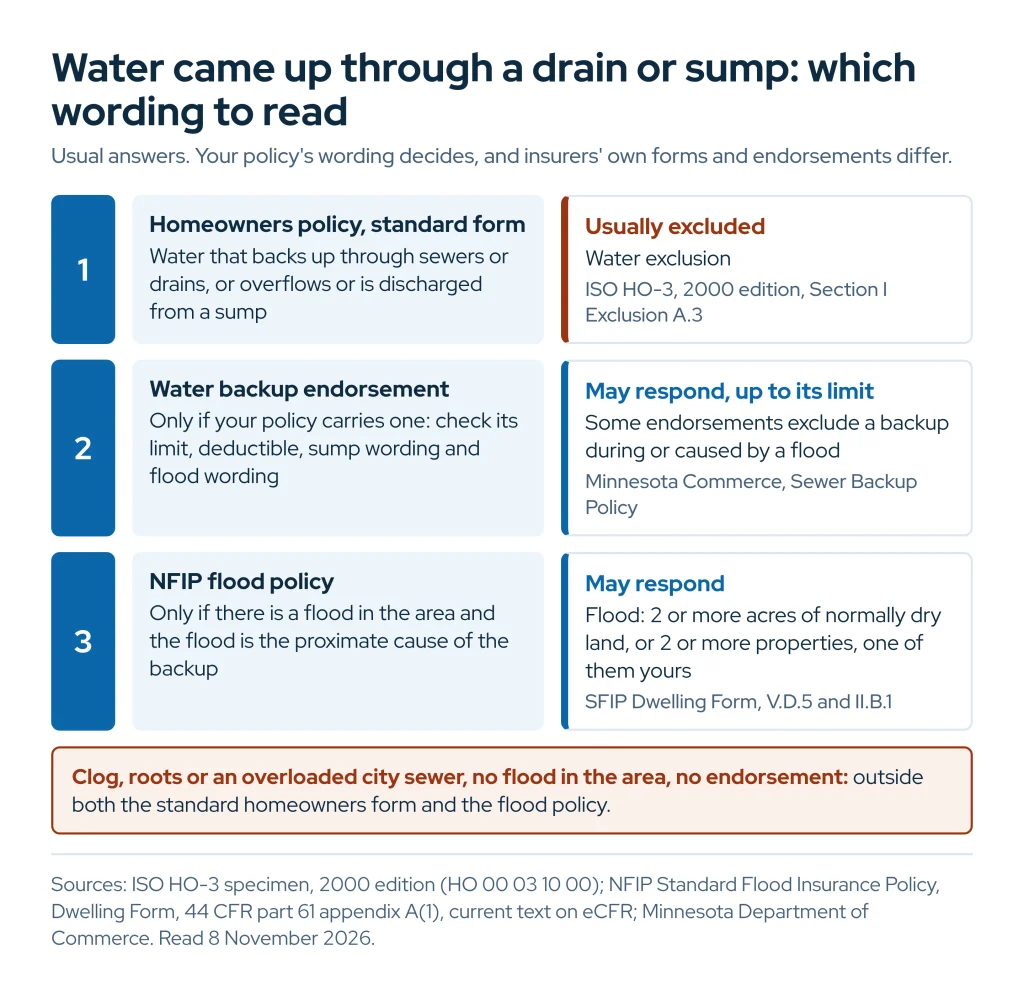
The ISO HO-3 specimen form (2000 edition, HO 00 03 10 00), a standard form published by ISO, an insurance forms and rating organization, lists water damage among its general exclusions (Section I, Exclusion A.3). It names three kinds of water: flood and surface water; water or water-borne material that “backs up through sewers or drains” or overflows or is discharged from a sump, sump pump or related equipment; and water below the ground that seeps through a foundation or other structure (ISO HO-3 specimen, 2000 edition, copy hosted by the Insurance Information Institute, a trade group). An exclusion is a cause of loss the policy won’t pay for, even where the peril would otherwise be covered.
Three details in the same form matter for a backup claim:
- A sump is not plumbing. Where the form covers water escaping from a plumbing system or household appliance, it says a sump, sump pump or related equipment, and a roof drain, gutter or downspout, don’t count. So sump water is judged under the water exclusion, not under the burst-pipe cover. Our page on what homeowners insurance covers for plumbing goes through the burst-pipe side.
- Fire, explosion or theft that follows is covered. If backed-up water leads to a fire, the fire is treated as its own loss.
- Later editions differ. ISO has revised the form since 2000, insurers write their own versions, and states require amendments. Read the water exclusion in your own policy, not ours.
State regulators say the same in plain words. Wisconsin’s insurance office says sewer and sump backup losses are not covered under a homeowners policy and are “probably not covered” by flood insurance, and that backup cover is an endorsement available through most companies but may not be offered unless you ask (Wisconsin OCI, Consumer’s Guide to Homeowners Insurance, PI-015, revised July 2026). Missouri’s guide lists sewer and drain backup under “what is not covered” and as an add-on to ask about (Missouri DCI, Consumer Guide to Homeowners Insurance, updated March 2025). The NAIC’s consumer guide says most homeowners policies offer limited or no cover for these events and that endorsements may be available (NAIC, A Consumer’s Guide to Home Insurance, 2022).
The water backup endorsement: what to check
An endorsement is a page added to the policy that changes it, here by giving back some of what the water exclusion takes away. Minnesota’s regulator says backup endorsements vary from company to company, so look for the endorsement’s name on your declarations page (the summary page listing your limits and add-ons), then read the endorsement itself with these questions:
- What is the limit? Look for the endorsement’s own dollar limit, on the endorsement or the declarations page. It is the most the endorsement pays, however large the loss.
- Is there a separate deductible? Some endorsements carry their own deductible. Our deductible calculator shows a dollar or percentage deductible worked through on your own numbers.
- Does it name sump overflow and sump discharge, as well as sewer and drain backup? And does it pay for the pump itself, or only for the water damage?
- What happens during a flood? Minnesota’s Department of Commerce says some insurers cover a backup even during a flood, some exclude a backup that happens at the same time as a flood, and some exclude it if flood caused the backup directly or indirectly. It also says a backup endorsement should not be seen as flood insurance (Minnesota Commerce, Sewer Backup Policy).
- What does it cover? The house, your belongings, a finished basement’s flooring and walls, and living expenses while the home can’t be lived in, or only some of these. If it includes loss of use, our page on additional living expenses explains how that part usually works.
- Is mold left out? Backups often leave damp walls. The standard form generally excludes mold, with a narrow exception; see whether homeowners insurance covers mold.
If you are adding the endorsement now, ask your insurer or agent in writing which form and edition it is, the date it takes effect, and for a copy.
Flood insurance and sewer backup
A flood policy covers a backup only in one situation. The National Flood Insurance Program’s Standard Flood Insurance Policy, Dwelling Form, excludes water or water-borne material that backs up through sewers or drains, discharges or overflows from a sump, sump pump or related equipment, or seeps through the property, “unless there is a flood in the area and the flood is the proximate cause” of the backup, discharge or seepage (SFIP Dwelling Form, 44 CFR part 61 appendix A(1), V.D.5). A flood, in that policy, means a general and temporary condition of inundation of two or more acres of normally dry land, or of two or more properties, one of them yours, from overflowing inland or tidal waters, unusual and rapid runoff of surface water, or mudflow (II.B.1).
So a backup caused by a clog, a tree root or an overloaded city sewer on a day with no flood in the area falls outside both the homeowners form and the flood policy, unless you have the backup endorsement. When a real flood does push sewage into the house, the flood policy may respond, and its own clock is strict: proof of loss within 60 days after the loss under the SFIP (VII.G.4). A term of the flood policy can be waived only in writing by FEMA’s Federal Insurance Administrator (44 CFR 61.13(d)), so don’t count on more time unless your insurer confirms an extension in writing. Our pages on flood and homeowners insurance and filing an NFIP flood claim cover that side, including what a flood policy pays for in a basement.
When a pipe off your property breaks
Water that comes from a broken city main or storm drain is a different case from water backing up through your drains. The 2000 ISO specimen covers damage to the house and other structures from an accidental discharge from a storm drain, or a water, steam or sewer pipe, off the insured property, and says the surface-water and groundwater parts of the water exclusion don’t apply to that discharge. The backup part still does: water that comes into the house up through your drains stays excluded either way. Belongings are treated differently, because the belongings peril for water discharge leaves out damage on your property from a discharge that happened off it. Our water damage guide walks through those clauses in more detail.
The sewer line itself: who owns it
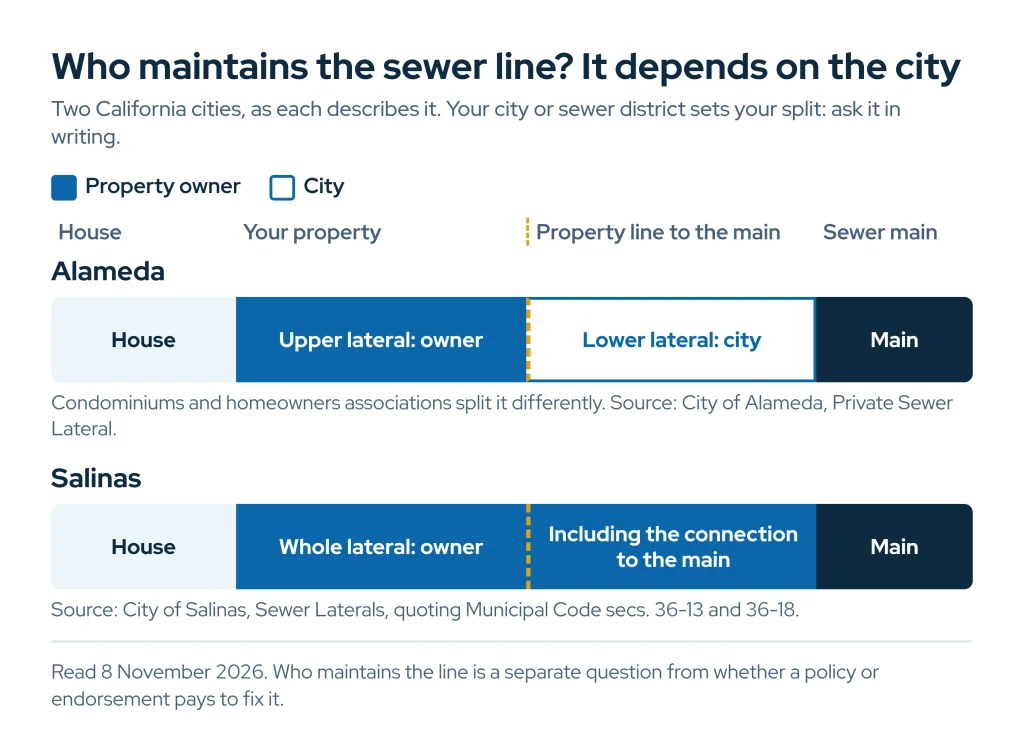
Before asking whether insurance pays to fix the line, find out whose line it is. That is set by your city or sewer district, not by any national rule, and it varies a lot. Two California cities show the range:
- Alameda says the property owner maintains and replaces only the upper lateral, the part on private property, and the city handles the lower lateral from the property line to the sewer main; condominiums and homeowners associations split it differently (City of Alameda, Private Sewer Lateral).
- Salinas says the owner is responsible for the whole lateral, including the connection to the city main in the street, and its ordinance presumes that tree roots in a building sewer come from improper installation, to be repaired by the owner “regardless of whether the building sewer is located on public or private property” (City of Salinas, Sewer Laterals, quoting Municipal Code secs. 36-13 and 36-18).
Water lines split differently again. Indiana’s Office of Utility Consumer Counselor says a water, gas or electric line on the customer’s side of the meter is typically the customer’s responsibility (Indiana OUCC, Line Protection Programs, updated October 2020). Your sewer utility or public works department can tell you where your part begins; ask in writing and keep the answer. If you rent, the same Indiana fact sheet says landlords are typically responsible for utility lines on rental property; check your lease.
Does homeowners insurance pay to fix the sewer line?
Usually not when the pipe simply fails. In the 2000 ISO specimen, the cover for the house excludes wear and tear, deterioration, mechanical breakdown, latent defect, and rust or other corrosion, and where it covers water escaping from a system, it doesn’t pay for the system the water came from. An old clay line worn through with age or a cast iron pipe that corroded is the kind of loss those words describe. The form’s collapse cover also leaves out an underground pipe, drain, cesspool or septic tank when the collapse comes from hidden decay, hidden insect damage, weight or defective construction, unless the loss is a direct result of the collapse of a building. A sudden event that is a covered peril, such as an explosion, can be a different answer; your form’s wording decides.
What can change the answer is an endorsement for underground lines, offered under names such as service line or utility line coverage. ISO announced its standard version on 16 July 2020: an optional homeowners endorsement for underground pipes, wires and some buried equipment, that can be used to cover causes including explosions, tree root growth, and wear and tear, with some cover for living expenses and lost rent; ISO began filing it state by state in June 2020, so whether it is offered depends on your state and insurer (ISO, announcement of 16 July 2020). Insurers that offer this kind of cover may use their own forms. Check which lines it names (sewer, water, gas, electric, septic), whether it pays for digging up and restoring the yard, driveway or sidewalk, its limit and deductible, and whether it leaves out a line that was already failing when you added it.

Line protection plans and warranties
Many households get mail offering a monthly “line protection” or service line plan, sometimes from a utility, sometimes from another company. These plans are separate from your homeowners policy, and how they are regulated depends on the state. Indiana’s utility consumer counselor says such plans are voluntary, are not regulated by the state utility commission there, and that no one has to buy or keep one as a condition of utility service. Its list of questions to ask before signing up, from the same fact sheet, is a useful one anywhere:
- Does your homeowners policy already cover line replacement? Read the policy or ask.
- Does the plan exclude pre-existing conditions, and how does it define them?
- Are there sign-up fees or early cancellation penalties?
- Is there a deductible, a maximum on what the plan will pay for repairs, and what is left out?
- Who does the work, and how much say do you have?
If you have both a plan and a policy, read the policy’s other insurance condition. The 2000 ISO specimen makes the homeowners policy excess over any service agreement, and counts a service plan, home warranty or similar service warranty agreement as one “even if it is characterized as insurance” (Section I, Condition F). In plain terms, under that wording the plan is expected to pay first, and the policy covers only what is left within its own terms.
When the city’s sewer caused it
A backup from an overloaded or blocked public sewer raises two separate questions. The first is your own policy: the exclusion and the endorsement work the same way whatever caused the backup, unless your endorsement’s wording says otherwise. The second is whether the city or sewer district is responsible, which depends on state law and the local ordinance, and claims against a local government can have their own forms and time limits under state and local law. Ask the city clerk or the sewer utility in writing how to file and by when, keep a copy, and tell your insurer if you file: under the standard form, an insurer that pays can require you to assign it your right to recover from whoever caused the loss, to the extent it paid (2000 ISO specimen, Sections I and II Conditions, F. Subrogation). For advice on a claim against a city, a licensed attorney or legal aid can help.
After a backup: the first days
- Stay safe. The CDC says to wear rubber boots, rubber gloves and goggles if sewage is involved, and to remove and discard drywall and insulation contaminated with sewage or floodwater (CDC, Guidelines for Cleaning Safely After a Disaster). Keep children and pets out of the area.
- Record before cleanup. Take photos and video of the water line on the walls, the drain or fixture it came from, and every damaged item, before anything is thrown out. Keep a small sample of carpet or drywall if you can do so safely.
- Get the cause in writing. Ask the plumber for a written note of what backed up and why: a main line clog, roots, a failed sump pump, a city sewer surcharge. The cause decides which clause applies.
- Stop further damage and keep the receipts. The standard form’s duties after loss include protecting the property from further damage and keeping records of what you spend doing it.
- Report the claim in writing, even if you’re unsure of cover, and ask the insurer which clause it relies on if it says no. Our guide to filing a homeowners claim goes step by step.
- Weigh the numbers. With a low backup limit and a deductible, compare the loss with what the endorsement could pay after the deductible, and note that the NAIC’s consumer guide says how often you claim, and the kind of claim, often affect your premium and whether your insurer renews; our page on whether to file a home insurance claim sets out what that choice involves.
Claims you may see
You may see these on other sites or in mailers. We checked them against the policy forms and official pages, and they aren’t the rule.
- “Homeowners insurance covers sewer backup.” Not under the standard form: the 2000 ISO specimen excludes it, so cover usually comes only from an endorsement, and then only up to its limit. Your policy’s wording decides.
- “Flood insurance covers any sewage backup.” Only when a flood in the area is the proximate cause, under the NFIP Dwelling Form.
- “A backup endorsement is flood insurance.” No: Minnesota’s regulator says it should not be seen as flood insurance, and some endorsements exclude backups during a flood.
- “The city owns the sewer line to your house.” It depends on the city. Some split the line at the property line; some make the owner responsible all the way to the main in the street.
- “Your utility requires this line protection plan.” Indiana’s consumer counselor says such plans are voluntary and not a condition of service there; ask your utility directly, using the number on your bill, not the one on the mailer.
Your next step
- Gather: the full policy with its declarations page and every endorsement (look for water backup, sump overflow, service line or utility line cover), photos and video from before cleanup, the plumber’s written cause, receipts, and any letter from the city or sewer district.
- Read: your policy’s water exclusion, the backup endorsement’s limit, deductible and flood wording, the Duties After Loss condition and the Suit Against Us condition. The 2000 ISO specimen sets suit within two years after the date of loss, and state law often changes that; our claim deadlines by state shows the rule in each state we have read.
- Do now: make the area safe, stop further damage and keep the receipts, and report the claim in writing.
- Ask: your sewer utility, in writing, where your part of the line begins; your insurer, in writing, which clause it relies on if it says no. If you disagree, your state insurance department’s consumer line is free: find it through the NAIC’s list of state insurance departments or our complaint links for each state. For legal advice, contact legal aid or a licensed attorney through your state bar’s referral service.
- Don’t wait on: a proof-of-loss date your insurer gives you, the suit limit in your policy and your state, any time limit for a claim against the city, and, for a flood claim, the NFIP’s 60 days from the date of loss to send proof of loss.
Sources checked on 8 November 2026: ISO HO-3 specimen (2000 edition, HO 00 03 10 00, Insurance Information Institute copy), the NFIP Standard Flood Insurance Policy Dwelling Form on eCFR, Wisconsin OCI PI-015 (revised July 2026), Missouri DCI consumer guide (March 2025), NAIC consumer guide (2022), Minnesota Department of Commerce, ISO’s announcement of 16 July 2020, the Cities of Alameda and Salinas, the Indiana Office of Utility Consumer Counselor (October 2020) and the CDC (reviewed 26 August 2026).
Sources
- ISO HO-3 Homeowners 3 Special Form specimen, 2000 edition (HO 00 03 10 00), Insurance Information Institute copy
- NFIP Standard Flood Insurance Policy, Dwelling Form, 44 CFR part 61 appendix A(1) (eCFR)
- Wisconsin Office of the Commissioner of Insurance, Consumer's Guide to Homeowners Insurance, PI-015 (R 07/2026)
- Missouri Department of Commerce and Insurance, Consumer Guide to Homeowners Insurance (updated 03/2025)
- NAIC, A Consumer's Guide to Home Insurance (2022)
- Minnesota Department of Commerce, Sewer Backup Policy
- ISO (Verisk), ISO Introduces Optional Endorsement for Damage to Underground Utility Lines (16 July 2020)
- City of Alameda, Private Sewer Lateral
- City of Salinas, Sewer Laterals: What Are They and Who Is Responsible for Maintenance? (Municipal Code secs. 36-13, 36-18)
- Indiana Office of Utility Consumer Counselor, Line Protection Programs (updated 10/2020)
- CDC, Guidelines for Cleaning Safely After a Disaster (reviewed 26 August 2026)
- NAIC, State insurance departments