Additional living expenses (ALE) are the extra costs of living somewhere else while your home can’t be lived in after a covered loss: a hotel or rental, meals out, a longer drive to work. In the standard homeowners form they sit under Coverage D, Loss of Use. The form pays the increase over what your household normally spends, not your whole budget, for the shortest time required to repair the home or settle somewhere else, up to the dollar limit on your declarations page. It usually applies only when the damage itself is covered, so a flood or earthquake that your policy excludes usually brings no ALE either. Your policy’s wording decides, and some states add their own rules after a declared emergency. This guide is part of our fire, smoke and theft section.
General information, not legal or insurance advice, and not a substitute for the advice of an attorney. Your policy’s wording and your state’s law decide, and both change. For help with your claim, your state insurance department’s consumer line and legal aid are free.
We read the rules here in the standard homeowners form itself: the ISO HO-3 specimen form in its 2011 edition (HO 00 03 05 11, the copy published by the Maine Bureau of Insurance) and its 2000 edition (HO 00 03 10 00, a sample copy from the Insurance Information Institute, a trade group, archived 2 September 2026). The Coverage D wording is the same in both. Many insurers write their own forms or add state endorsements, so treat this as the common pattern, not as your policy.
What Coverage D says in the standard form
Coverage D has three parts that share one limit, plus one thing it never pays for. The ISO form’s wording is copyrighted, so the table paraphrases it.
| Part | What it usually pays | For how long |
|---|---|---|
| 1. Additional Living Expense | Any necessary increase in living expenses so your household can keep its normal standard of living, when a covered loss makes the part of the home you live in not fit to live in | The shortest time needed to repair or replace the damage, or, if you move for good, the shortest time for your household to settle elsewhere |
| 2. Fair Rental Value | The fair rental value of a part of the home you rent out or hold for rent, when a covered loss makes it not fit to live in, less any expenses that don’t continue while it isn’t fit to live in | The shortest time needed to repair or replace that part |
| 3. Civil Authority Prohibits Use | Parts 1 and 2, when a civil authority bars you from your home because a covered peril directly damaged a neighboring property | No more than two weeks |
| Not covered | Loss or expense from cancelling a lease or agreement | n/a |
Two more lines in the form matter. First, these time periods are not cut short when the policy itself expires: a loss in the last week of the policy year doesn’t end the living-expense payments at renewal. Second, the limit for Coverage D is the total for all three parts. The form sets no percentage; the dollar amount is printed on your declarations page, the summary page at the front of the policy that lists each coverage and limit.
When it applies, and when it usually doesn’t
Two things have to be true under the standard wording: the loss is one the policy covers (a “loss covered under Section I”, the property part of the policy), and it makes the part of the home where you live not fit to live in. Whether a home is fit to live in is judged under your policy’s wording: a damaged kitchen in a house you can still sleep in safely may or may not meet the test, so ask for the adjuster’s view in writing.
- A house fire, a burst pipe, a tree through the roof: usually covered perils in the standard form, so ALE usually follows if the home can’t be lived in. Our fire damage claims guide covers the rest of a fire claim.
- Flood: the standard homeowners form excludes flood (2000 edition, Section I Exclusion A.3), so its ALE usually doesn’t apply. The federal flood policy doesn’t fill the gap: the NFIP’s Standard Flood Insurance Policy lists “any additional living expenses incurred while the insured building is being repaired or is unable to be occupied for any reason” among the things it does not pay (Dwelling Form, 44 CFR part 61 appendix A(1), section V.A.5). More in our NFIP flood claims guide.
- Earthquake: excluded in the standard form (2000 edition, Section I Exclusion A.2), except for fire or explosion that follows, and the exclusion doesn’t apply to theft; so usually no ALE unless you carry earthquake coverage that includes it.
- Smoke from a fire next door or a wildfire: in the 2000 edition, sudden and accidental damage from smoke is a named peril for your belongings (Coverage C, peril 7, which includes puffback from a furnace or boiler), and the open-perils cover for the house lists smoke from agricultural smudging or industrial operations among the losses it does not cover (Section I Perils Insured Against, A.2.c(6)(d)). The same list leaves out the release of pollutants, which the form defines to include smoke and soot, unless a peril named under Coverage C, such as fire or smoke, caused it (A.2.c(6)(e)). So when smoke damage is a covered loss and leaves the home not fit to live in, ALE usually follows; your policy’s wording decides, and whether, and until when, a smoky home is unfit is often the point the two sides discuss. The EPA explains wildfire smoke and indoor air on its wildfires and indoor air quality page (last updated 16 November 2026). California adds a wildfire smoke rule from 1 January 2027; see below.
- A power outage with no damage to the home: the Texas Department of Insurance says plainly that if you left because of a power outage and the home wasn’t damaged, your policy won’t cover ALE (TDI, last updated 10 April 2025).
- An evacuation order before a storm or fire arrives: the standard Civil Authority part needs direct damage to a neighboring property by a covered peril. A precautionary order with no such damage usually doesn’t meet it. Some states change this; see California below.
It pays the increase, not your whole budget
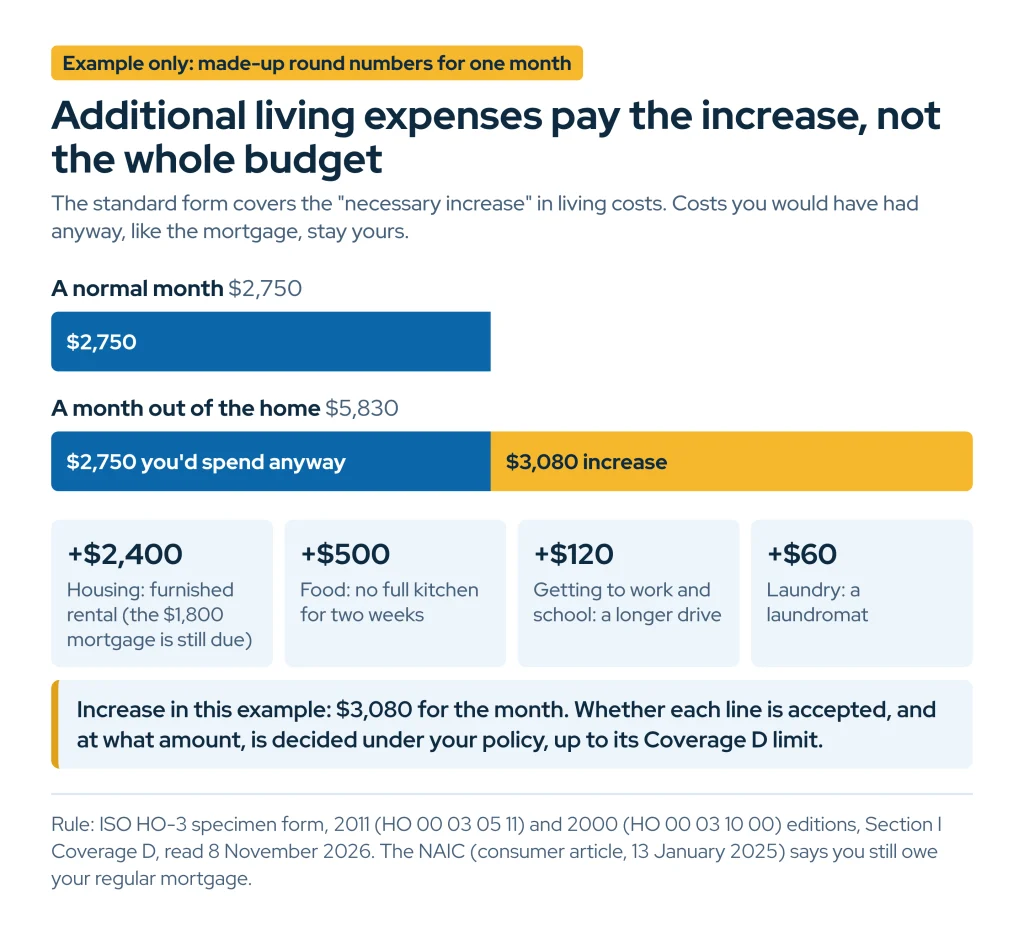
The form covers a “necessary increase” in living expenses. Costs you would have had anyway are not part of it, and costs that stop while you are away reduce the increase. The NAIC, the national body of state insurance regulators, puts it the same way: ALE covers the difference between your usual living costs and your temporary ones, and you still owe your regular mortgage (NAIC consumer article, 13 January 2025).
Here is how that arithmetic works, line by line, with made-up round numbers for one month. This is an example only, not what any insurer will pay.
| Line (example) | A normal month | A month out of the home | Increase |
|---|---|---|---|
| Housing | $1,800 mortgage | $1,800 mortgage (still due) + $2,400 furnished rental | $2,400 |
| Food | $800 | $1,300 (no full kitchen for two weeks) | $500 |
| Getting to work and school | $150 | $270 (a longer drive) | $120 |
| Laundry | $0 (own machine) | $60 (laundromat) | $60 |
| Total | $2,750 | $5,830 | $3,080 |
“Normal standard of living” cuts both ways. The form’s words point to keeping your household at the level it had: not less, and not an upgrade. What counts as comparable housing for your household is worked out with the adjuster under your policy’s wording, so agree on it in writing before you sign a lease.
What kinds of costs qualify? The policy doesn’t list them. The California Department of Insurance gives this list as examples: emergency shelter such as hotel bills, food and housing costs, telephone or utility installation at the temporary home, extra transportation to work or school, relocation and storage, and furniture rental for the temporary home (CDI consumer alert, 2025). Insurers differ on the edges, such as pet boarding or the extra cost of a second trip each day. Ask your insurer in writing before you spend on anything unusual.
How long it lasts, and how much
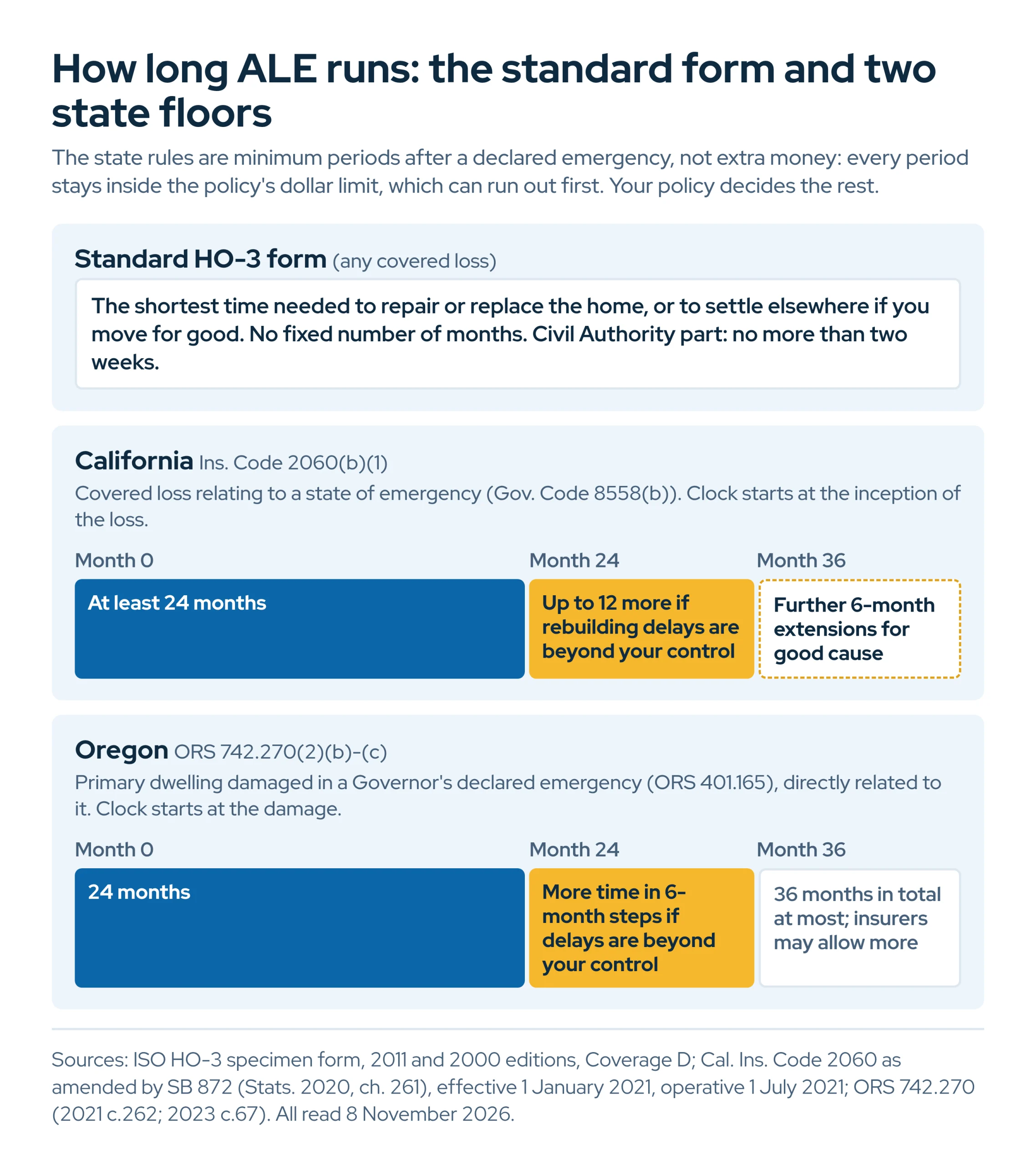
Under the standard wording, ALE ends at the first of two points: the shortest time required to repair or replace the home (or to settle elsewhere if you move for good), or when the Coverage D dollar limit runs out. Neither is a fixed number of months in the form. If repairs stall, the question becomes what the shortest time required really was, so keep the dates of permits, contractor bids and delays.
The dollar limit is the one to watch. The ISO form sets no percentage; the amount is on your declarations page. The Texas Department of Insurance says most policies pay 10% to 20% of what the house is insured for, and usually up to 12 months or until that amount is used, whichever comes first; it gives the example of 10% on a $200,000 house, or $20,000 (TDI). That describes policies sold in Texas, not a national rule: your own figure, and any time cap, are on your declarations page and in your policy. If the limit runs out before the home is ready, the rest is yours to pay, so track spending against it from the first week.
The deductible. In both editions, the deductible applies once to the total of all property loss payable in any one loss, not separately to each coverage (2011 edition, Section I Condition B; 2000 edition, the Deductible provision). Read plainly, that wording means one deductible for the whole loss: when the building damage is larger than the deductible, the deductible is not taken a second time from the living-expense part. Some insurers’ own forms and endorsements handle this differently, so check yours; the deductible calculator shows how a dollar or percentage deductible works on your own numbers.
Civil Authority: when officials keep you out
Sometimes your house is fine but you can’t go home: the street is closed after a fire next door or a gas explosion down the block. The standard form’s Civil Authority part pays ALE (and fair rental value) when a civil authority bars you from using your home because a covered peril directly damaged a neighboring property, for no more than two weeks. Three limits are built into that wording: there has to be physical damage nearby, it has to be from a peril your policy covers, and the two weeks are a ceiling. Policies written on other forms can be broader or narrower.
Hurricane and wildfire evacuation orders
A mandatory evacuation before a hurricane makes landfall, or before a wildfire reaches a neighborhood, is usually ordered before anything nearby is damaged. Under the standard wording, Civil Authority is tied to direct damage to a neighboring property by a covered peril, so a purely precautionary order usually doesn’t meet it; if a covered peril has damaged property nearby and officials then keep you out, the two-week ceiling applies. If a covered loss damages your own home and it can’t be lived in, the ordinary ALE part applies instead, with no two-week limit. Your policy’s wording decides, and state wind pools, FAIR plans and surplus lines insurers use their own forms. California’s 2060(c) gives at least two weeks during a declared state of emergency when a civil authority order restricts access to the home and relates to a covered peril (see California).
Hurricane deductibles and ALE. Many coastal policies carry a separate hurricane or windstorm deductible, which may be a percentage of the dwelling limit. In New York, a hurricane deductible may not apply to loss-of-use coverage, which the rule says is also called additional living expense or loss of rental income coverage (11 NYCRR 74.4(b)(5), Third Amendment to Regulation 159, in force since 2 February 2026; under Insurance Law 3445(b) the change may be applied to a policy at its initial or next annual renewal after that date, so a policy that has not renewed since may still carry its earlier wording; both read 18 November 2026). Whether other states have a rule on this is not confirmed in the sections we read; check your declarations page and the hurricane deductible endorsement, and ask your state insurance department.
If you rent out part of the home
Fair Rental Value covers a part of the home you rent to others or hold for rent, such as a basement apartment or the other side of a duplex you live in. It pays the fair rental value of that part while it isn’t fit to live in, less any expenses that don’t continue while it isn’t fit to live in (for example, a utility bill you no longer pay for that unit). The time limit is the shortest time to repair or replace it.
State rules after a declared emergency
Some states set minimum ALE periods after a declared state of emergency. These are floors on time, not extra money: the California and Oregon laws below keep the policy’s dollar limit. We read California and Oregon in their official statute text on 8 November 2026, and California’s 2026 changes in the chaptered bills on 18 November 2026. A Minnesota notice rule that applies to any uninhabitable home follows at the end. Other states may have rules we haven’t read; ask your state insurance department.
California (Insurance Code 2060 and 2061)
- A list of what’s covered, any ALE claim. When you claim ALE under a homeowners policy, the insurer must give you a list of items it believes may be covered as ALE (Ins. Code 2060(a)).
- At least 24 months after a state of emergency. For a covered loss relating to a state of emergency (one duly proclaimed under Government Code 8558(b)), ALE coverage runs for no less than 24 months from the inception of the loss, “but shall be subject to other policy provisions”, which includes the dollar limit. The insurer must grant up to 12 more months, for a total of 36, if you act in good faith and with reasonable diligence and meet delays in rebuilding beyond your control, such as permit delays, lack of materials or no available contractors. Further six-month extensions must be given for good cause (2060(b)(1)).
- When a covered peril makes the home unlivable, in these state-of-emergency losses. A policy covered by subdivision (b) may not limit your recovery if a covered peril makes the home uninhabitable, but instead of paying living expenses the insurer may offer a reasonable alternative remedy that addresses the condition keeping you out (the CDI’s example is a generator when there is no electricity); a utility’s planned wildfire-prevention power shutoff is not covered by this part (2060(b)(2)).
- Evacuation orders. For other losses in a state of emergency where a civil authority order restricts access to the home and relates to a covered peril, ALE is provided for at least two weeks, with further two-week extensions for good cause, subject to other policy provisions (2060(c)). These amendments came in with SB 872 (Stats. 2020, ch. 261), effective 1 January 2021 and operative 1 July 2021.
- An advance after a total loss. For a total loss related to a state of emergency, the insurer must, on your request, advance no less than four months of living expenses; more is paid on proper proof after that period (Ins. Code 2061(a)(1), claims arising on or after 1 January 2021).
- Wildfire smoke, from 1 January 2027. AB 1795, the Smoke Damage Recovery Act (Stats. 2026, ch. 240), adds Insurance Code 2060.1. For a covered smoke damage claim on a home in the “wildfire impact zone” (a ZIP Code within or partly within the mapped fire perimeter), the insurer may not end living-expense coverage until the home has been restored to its condition before the fire and cleared for people to live in under the state’s cleanup rules or guidance, subject to the policy limit; payments are not required after that point (2060.1(b)-(c), chaptered text, read 18 November 2026). Smoke, soot or ash from agricultural, industrial or commercial operations, or from routine household activity unrelated to a covered wildfire, is not wildfire smoke damage under it (2060.1(e)(4)). The act takes effect 1 January 2027 (it depended on AB 1642, also chaptered on 15 September 2026); its companion section 2060.2, on sampling, testing and inspection, applies to claims that occur on or after that date, and whether 2060.1 reaches claims from earlier fires is not confirmed. Until the state adopts its fuller cleanup regulations and guidance (the lead and asbestos regulations and the indoor air guidance are due by 31 December 2028, the guidance on other contaminants by 31 December 2029), interim standards set clearance for wildfire-caused lead and asbestos only (Health and Safety Code 25402.3 to 25402.5, added by AB 1642, read 18 November 2026).
The California Department of Insurance summarizes the time rule as 36 months plus six-month extensions for good cause, and warns that a policy’s dollar limit can run out before those periods end (CDI consumer alert). It also says most renters’ policies pay ALE only until you can move back or for a reasonable time to find another place to rent, whichever is less.
Coming on 1 January 2028, not before. SB 876 (Stats. 2026, ch. 656, signed 27 September 2026) repeals today’s 2060 on 1 January 2028 and replaces it with a new 2060 operative that day (chaptered text, read 18 November 2026). From then, for a primary home made uninhabitable by a covered peril: the list of covered items must be written (it may be sent electronically); ALE must include all reasonable extra expenses to keep a comparable standard of living, naming temporary housing, furniture rental, food, transportation, storage and boarding of pets, up to the policy’s limits; an insurer may offer the monthly fair rental value of the home instead of itemized expenses; after a state-of-emergency loss the 24-month floor and extensions stay, and coverage runs 15 calendar days past the date the home is deemed habitable, to allow the move back; and a policy with a dollar limit on ALE may not be issued or renewed unless the buyer is offered extended ALE of at least 50% above that limit, with its premium. Until 1 January 2028, the rules in the list above apply.
Oregon (ORS 742.270)
For a homeowner policy that requires you to repair, rebuild or replace damaged property to collect the full replacement cost, and where damage to your primary dwelling happened in a place under a Governor’s state of emergency declaration (ORS 401.165) and is directly related to that emergency, the insurer must provide ALE for 24 months after the damage, subject to the policy’s ALE limits. It must add time in six-month steps, to a total of no more than 36 months, if you act in good faith and with reasonable diligence and meet unavoidable permit delays, a lack of materials or contractors, or other circumstances beyond your control (ORS 742.270(2)(b)-(c), added 2021, ch. 262; amended 2023, ch. 67). Insurers may allow more time (742.270(3)).
Minnesota (Statutes 72A.201)
Minnesota lists as an unfair settlement practice failing to tell the insured that additional living expense coverage exists when a homeowners policyholder has a loss from a covered occurrence and the damage leaves the dwelling not habitable (Minn. Stat. 72A.201, subd. 4(13), 2026 Minnesota Statutes, last amended 2012, read 18 November 2026). It is a duty to tell you the coverage exists, not a minimum period or amount; no declared emergency is needed.
What we did not confirm. Whether these laws reach surplus lines policies and the state FAIR plans is not something we confirmed in the sections read; ask the insurer or the department if your policy is one of those. None of them applies to an NFIP flood policy, which follows federal law and pays no ALE. Texas coastal homes insured by the Texas Windstorm Insurance Association: TDI says to ask whether your TWIA policy has the extra ALE coverage, which is available for a primary residence only.
FEMA housing help when insurance doesn’t cover it
After a federally declared disaster, FEMA’s Individuals and Households Program can help with temporary housing, but it won’t duplicate insurance. If you are insured, FEMA may help only in set cases: your claim was denied, your insurance money is significantly delayed through no fault of yours (and you agree to repay FEMA from it later), housing isn’t available on the private market, or you have accepted all the insurance and other help you qualify for and it still doesn’t cover the need (44 CFR 206.113(a)(2)-(5)). People who evacuated only as a precaution and can safely return right away don’t qualify for housing help (206.113(b)(4)). For disasters declared on or after 1 October 2026, the most FEMA may give an individual or household in housing assistance for any single disaster is $46,400, adjusted each year; disasters declared earlier have lower maximums (91 FR 70094, 6 November 2026).
Getting paid: receipts, proof and the mortgage company

- Keep every receipt from the first night. The standard form’s Duties After Loss condition lists “receipts for additional living expenses incurred” among what goes into a sworn proof of loss, which is due within 60 days after the insurer asks for it; the form doesn’t say calendar or business days (2011 edition, Condition C.8.g; 2000 edition, Condition B.8.g). Your policy or state law may set a different time; our proof of loss guide explains the form.
- Write down your normal costs too. Because the payment is the increase, a one-page note of your usual monthly housing, food, utility and commuting costs, with a few old bills, makes the arithmetic easier for both sides.
- Ask in writing whether the insurer will pay a hotel or landlord directly, whether it will advance money, what the Coverage D limit is and how much is left, and how often to send receipts.
- The mortgage company. Insurance checks are often made out to you and your lender together. For loans owned by Fannie Mae, the servicer must immediately issue the borrower a check for any proceeds designated for contents or living expenses (Fannie Mae Servicing Guide B-5-01). Ask your servicer which investor owns your loan and what its process is; our mortgage check tool sets out the release rules we read.
Are ALE payments taxable?
Only the part above your actual increase, and none if the casualty is in a federally declared disaster area. The IRS says insurance payments for living expenses after you lose the use of your main home (or are kept out of it by government authorities because of a casualty or the threat of one) are taxable only to the extent they are more than the temporary increase in your living expenses, measured as your actual living expenses while displaced minus your normal ones. If the casualty is in a federally declared disaster area, none of these payments are taxable (IRS Publication 547, 2025). Any taxable part goes in the year you regain use of the home, or the year you receive it if later. More in our guide to taxes, casualty losses and insurance claims.
A separate federal rule covers money from sources other than insurance after a wildfire. From tax years beginning after 31 December 2025, “qualified wildfire relief payments” are left out of income: compensation for losses, expenses or damages, including additional living expenses, from a federally declared disaster caused by a forest or range fire and declared after 31 December 2014 and before 1 January 2027, but only to the extent the loss was not compensated by insurance or otherwise (26 U.S.C. 139M, added by P.L. 119-108, approved 11 September 2026, read 18 November 2026). A fire disaster declared on or after 1 January 2027 is outside it as enacted, unless Congress extends it. Insurance ALE payments follow the IRS rule above.
Things you may read elsewhere, checked
- “Loss of use is always 20% (or 30%) of your dwelling coverage.” Not in the standard form, which sets no percentage. Your declarations page shows your limit; TDI’s 10% to 20% is its description of most policies, on a Texas consumer page.
- “ALE pays your mortgage while you’re out.” No. The NAIC says you still owe your regular mortgage; ALE pays the extra costs.
- “ALE lasts until your house is rebuilt, however long that takes.” Not under the standard wording: the shortest time required, and never past the dollar limit. California’s and Oregon’s longer periods apply after a declared emergency and still sit inside the dollar limit.
- “An evacuation order means your insurer pays for the hotel.” Not as a general rule. The standard Civil Authority part needs direct damage nearby from a covered peril and stops at two weeks; California’s 2060(c) is broader in a state of emergency.
- “California now pays ALE until a smoke-damaged home is cleared, on any claim.” Not as written. Insurance Code 2060.1 takes effect 1 January 2027, applies to covered wildfire smoke claims on homes in the wildfire impact zone, and still sits inside the policy limit; whether it reaches claims from fires before that date is not confirmed.
- “Flood insurance covers your hotel.” The NFIP’s Dwelling Form excludes additional living expenses.
You may see these on other sites. We checked them against the policy form and the official sources, and they aren’t the rule.
Your next step
- Gather: the full policy with its declarations page and endorsements; find Coverage D, its limit and any time cap. Start a folder for every lodging, meal, mileage, laundry and storage receipt, and a note of your normal monthly costs.
- Do now: report the claim in writing, say you need to live elsewhere, and ask the insurer in writing what living expenses it treats as covered (in California it must give you a list), how it pays, and how much of the limit is left. Write down every call with the date and name.
- Read: your policy’s Coverage D, Duties After Loss and Suit Against Us conditions, and, after a declared emergency, your state’s rules (in California, Ins. Code 2060 and 2061, and 2060.1 for wildfire smoke from 1 January 2027; in Oregon, ORS 742.270).
- Ask: your insurer in writing first. If you disagree about how long ALE should last or what it covers, your state insurance department’s consumer line is free; find it with our complaint links by state or the NAIC’s directory of state insurance departments. Legal aid or a licensed attorney can advise on your specific policy.
- What can’t wait: a request for a sworn proof of loss (60 days after the request in the standard form; your policy or state law may differ), and any time cap on Coverage D printed in your policy. If the limit is running low, tell the insurer in writing before it runs out, not after.
Sources checked on 8 November 2026; the smoke, evacuation, New York, Minnesota, California 2027 and 2028 and wildfire tax additions read 18 November 2026.
Sources
- ISO HO-3 Homeowners 3 – Special Form, HO 00 03 05 11 (2011 edition), Maine Bureau of Insurance copy, Coverage D, Section I Conditions B and C.8.g, read 8 Nov 2026
- ISO HO-3 Homeowners 3 – Special Form, HO 00 03 10 00 (2000 edition), Insurance Information Institute (trade group) copy, archived 2 Sep 2026: Coverage D, Deductible, Section I Perils Insured Against A.2.c(6)(d)-(e), Coverage C peril 7 (Smoke), Exclusions A.2 and A.3, Condition B.8.g, read 8 and 18 Nov 2026
- California Insurance Code 2060 (amended Stats. 2020, ch. 261, SB 872), official text, read 8 Nov 2026
- California Insurance Code 2061 (added Stats. 2020, ch. 261, SB 872), official text, read 8 Nov 2026
- California Government Code 8558 (state of emergency defined), official text, read 8 Nov 2026
- California Department of Insurance, Insurance coverage for additional living expenses if the home is not habitable due to a wildfire (consumer alert, 2025)
- Oregon Revised Statutes 742.270 (2021 c.262; 2023 c.67), Oregon Legislature, read 8 Nov 2026
- NFIP Standard Flood Insurance Policy, Dwelling Form, 44 CFR part 61 appendix A(1), section V.A.5 (eCFR, current to 5 Nov 2026)
- 44 CFR 206.113, FEMA Individuals and Households Program eligibility factors (eCFR)
- 91 FR 70094 (6 Nov 2026), FEMA IHP maximum amounts for disasters declared on or after 1 Oct 2026
- Texas Department of Insurance, When do policies pay for additional living expenses? (last updated 10 Apr 2025)
- NAIC, What are Additional Living Expenses and How Can Insurance Help? (consumer insight, 13 Jan 2025)
- IRS Publication 547 (2025), Casualties, Disasters, and Thefts: insurance payments for living expenses
- Fannie Mae Servicing Guide B-5-01, Insured Loss Events (dated 07/12/2023; Guide published 14 Oct 2026)
- NAIC, State insurance departments directory
- California AB 1795, Smoke Damage Recovery Act (Stats. 2026, ch. 240), Insurance Code 2060.1 and 2060.2, chaptered text, operative 1 Jan 2027, read 18 Nov 2026
- California AB 1642 (Stats. 2026, ch. 239), Health and Safety Code 25402.3-25402.5, chaptered text, read 18 Nov 2026
- California SB 876 (Stats. 2026, ch. 656), new Insurance Code 2060 operative 1 Jan 2028, chaptered text, read 18 Nov 2026
- Minnesota Statutes 72A.201, subd. 4(13) (2026 edition), read 18 Nov 2026
- New York DFS, Third Amendment to 11 NYCRR 74 (Insurance Regulation 159), section 74.4(b)(5), adopted text, effective 2 Feb 2026, read 18 Nov 2026
- New York Insurance Law 3445(b), read 18 Nov 2026
- P.L. 119-108 (approved 11 Sep 2026), 26 U.S.C. 139M qualified wildfire relief payments, govinfo, read 18 Nov 2026
- EPA, Wildfires and Indoor Air Quality (last updated 16 Nov 2026)