Fire is one of the clearest cases in a homeowners policy, and the core of our Fire, Smoke and Theft section. Under the standard form, fire or lightning is the first of the named perils that cover your belongings, and it isn’t excluded for the house. Sudden smoke damage is usually covered too. What decides most fire claims is not whether fire is covered but how much is paid and when: your limits, replacement cost against actual cash value, the inventory of what you lost, how long living expenses run, and the deadlines in your policy and your state. The usual exceptions are narrow: a fire an insured person set on purpose, smoke from farm smudging or industrial operations, neglect after the loss, and fraud in the claim. Those are the usual answers under the standard form; your own policy’s wording decides.
General information, not legal or insurance advice, and not a substitute for the advice of an attorney. Your policy’s wording and your state’s law decide, and both change. For help with your claim, your state insurance department’s consumer line and legal aid are free.
Below: common fire and smoke situations at a glance, the first days, what each part of the policy pays, smoke damage, the contents inventory, how the money arrives, the wildfire rules in California and Oregon, and the deadlines. Break-ins and stolen belongings are covered in does homeowners insurance cover theft.
Fire and smoke losses at a glance
| What happened | Usual answer under the standard form | Clause it rests on |
|---|---|---|
| A kitchen or electrical fire damages part of the house | Usually covered, up to your limits and after the deductible | Open perils for the house; “Fire or Lightning” peril for belongings |
| A wildfire destroys the house | Usually covered; limits, the 80% rule and state wildfire rules shape the payout | Same; Loss Settlement condition; state law |
| Smoke and soot from a fire nearby, without flames reaching the house | Usually covered when the damage is sudden and accidental; often disputed on how much cleaning or replacement is needed | Open perils for the house; “Smoke” peril for belongings |
| A furnace puffs back soot through the house | Usually covered | “Smoke” peril, which names puffback from a boiler or furnace |
| Smoke from farm smudging or an industrial operation | Usually excluded | Coverage A and B’s carve-out for smudging and industrial smoke, and the “Smoke” peril’s own carve-out |
| You can’t live at home while it’s repaired | Usually covered: extra living costs for the shortest time needed to repair or relocate | Coverage D, Additional Living Expense |
| An evacuation order keeps you out after a fire damaged neighboring homes | Usually covered for up to two weeks | Coverage D, Civil Authority Prohibits Use |
| The fire department bills you for the call-out | Up to $500 in the 2000 specimen, no deductible, for charges you agreed by contract to pay, but not if you’re inside the area that provides the service | Additional Coverage, Fire Department Service Charge |
| Rebuilding must meet newer building codes | Only up to the Ordinance or Law limit (10% of the dwelling limit in the 2000 specimen) unless you added more | Additional Coverage, Ordinance or Law |
| Cash burns in the fire | Covered only up to the special limit ($200 in the specimens) | Coverage C special limits |
| Someone insured on the policy set the fire on purpose | Excluded, in the specimen even for insureds who had no part in it | Intentional Loss exclusion |
Most US homeowners policies are built on standard forms from Insurance Services Office (ISO), an insurance industry organization. We read two editions of the HO-3 “Special Form”: the 2000 edition (HO 00 03 10 00), a specimen hosted by the Insurance Information Institute, a trade group, and the 2011 edition (HO 00 03 05 11), a copy posted by the Maine Bureau of Insurance. The fire and smoke wording quoted here is from the 2000 edition. Neither is your policy: your insurer’s form, its state endorsements and later editions can differ. “Dwelling fire” policies and state FAIR Plan policies use different forms again, so read your own.
The first days after a fire
The U.S. Fire Administration’s booklet After the Fire (FA-46, January 2019) and the policy’s Duties After Loss condition point the same way. In the specimen, the insurer owes nothing if you fail a duty and that failure prejudices the insurer, so these steps are worth doing properly.
- Stay out until the fire department says it is safe. USFA warns that floors and walls may not be as safe as they look, that soot and the water left behind can make you sick, and that you shouldn’t turn utilities back on yourself if firefighters shut them off.
- Get the fire department’s details. USFA’s checklist asks for the department’s name and non-emergency number, the incident report number and the fire marshal or investigator’s name. Keep them with your claim papers.
- Tell the insurer promptly, and in writing. The specimen asks for “prompt” notice; some state standard fire policies say written notice “without unnecessary delay”. Write down the date, time and name of everyone you speak to.
- Protect the property and keep the receipts. The specimen requires reasonable and necessary repairs to protect the property, such as boarding up openings or tarping the roof, and an accurate record of what they cost. Its neglect exclusion removes loss from failing to use all reasonable means to save property at and after the time of a loss. USFA also suggests telling the police the home will be empty.
- Photograph and film everything before cleanup: every room, every wall and ceiling, inside cupboards and closets, and damaged belongings, including things that look fine but smell of smoke.
- Tell your mortgage company, and report credit cards lost in the fire. USFA lists both.
- Keep every receipt for hotel, meals, clothing, toiletries, mileage and storage. They support a living-expense claim and, USFA notes, may be needed for your tax return.
Burnt money is a special case: USFA says bills that are at least half intact can be exchanged through a regional Federal Reserve Bank or sent to the Bureau of Engraving and Printing, so handle them as little as possible.
What each part of the policy pays
A fire claim usually draws on several coverages at once, each with its own limit on the declarations page (the summary page of your policy).
- Coverage A, the house. Covered on an open-perils basis: any direct physical loss unless excluded, and fire isn’t excluded. Paid at replacement cost (the cost to repair or rebuild with like materials, without deducting for age) if your limit was at least 80% of the full cost to rebuild just before the loss. Below 80%, the specimen pays the greater of actual cash value (replacement cost minus depreciation) or a proportion of the repair cost.
- Coverage B, other structures: a detached garage, shed or fence, on the same basis.
- Coverage C, belongings. Covered for named perils, the first of which is fire or lightning; smoke is another. The specimen settles belongings at actual cash value. Some policies add an endorsement that pays replacement cost for belongings; your declarations page says whether you have one. Special limits apply to some property, for example $200 for money and $1,500 for securities and passports in the specimens.
- Coverage D, loss of use. Additional living expense covers the necessary increase in your living costs so your household can keep its normal standard of living, for the shortest time needed to repair or replace the damage or, if you move permanently, to settle elsewhere. Fair rental value covers rent you lose on a part of the home you rent out. Our page on additional living expenses goes through what usually counts.
The 2000 specimen also has additional coverages that matter after a fire:
- Debris removal: inside the limit for the damaged property, plus an extra 5% of that limit when the damage and the debris together exceed it.
- Fire department service charge: up to $500, no deductible, when you are liable under a contract or agreement for the fire department’s charges, but not if the property is within the city, municipality or district that provides the fire service.
- Property removed: belongings you move out of a home threatened by a covered peril are covered against any cause for up to 30 days.
- Trees, shrubs and plants: up to 5% of the dwelling limit, $500 per tree or plant, for listed perils that include fire.
- Ordinance or law: up to 10% of the dwelling limit for the extra cost of meeting building codes when you repair or rebuild.
If you suspect the house limit is too low to rebuild, look for an extended or guaranteed replacement cost endorsement; our page on extended dwelling coverage explains how those work.
Smoke damage
Our smoke damage insurance claim page has the full rules, including smoke that drifts in from a fire next door or a wildfire. For belongings, the 2000 specimen’s smoke peril means sudden and accidental damage from smoke, and it names the “puffback” of smoke, soot, fumes or vapors from a boiler, furnace or related equipment. Damage to the furnace itself is a separate question, set out in does homeowners insurance cover HVAC. It leaves out smoke from agricultural smudging or industrial operations, and the house coverage excludes those two sources as well. Smoke from a house fire next door or a wildfire is not in either carve-out.
Once smoke damage is accepted, the questions are usually about how much work is needed: whether walls, insulation, ductwork and fabrics can be cleaned or must be replaced, whether odor counts as damage, and whether testing is needed. The specimen’s pollutant wording counts smoke and soot as pollutants, and its Ordinance or Law cover won’t pay to test for or clean up pollutants when a law requires it. The house coverage’s separate pollutant exclusion does not apply when the release is itself caused by one of the named perils for belongings, such as fire or smoke. Ask the insurer to put in writing what it will clean, what it will replace and why, and keep samples or photos of anything thrown away.
California has gone further. Its Smoke Damage Recovery Act, AB 1795 (Stats. 2026, ch. 240, signed 15 September 2026), adds Insurance Code sections 2060.1 and 2060.2 for wildfire smoke claims on homes in a “wildfire impact zone” (a ZIP Code within or partly within the mapped fire perimeter). As we read the chaptered text, it creates a rebuttable presumption that smoke damage in a surviving home there, where wildfire smoke, ash, soot or char is present, came from the wildfire; bars ending living-expense cover until the home is restored and cleared for occupancy, within the policy limit; makes the insurer cover the sampling and testing needed for that, subject to the policy’s terms; requires an insurer that chooses to inspect to do so within 30 calendar days of notice of the claim (or of access being granted); sets 30-calendar-day payment clocks for undisputed amounts (the actual cash value of restoring damaged personal property within 30 calendar days of the inspection, and, under a replacement cost policy, the replacement cost of restoring the home within 30 calendar days of the restoration being finished, unless you agreed to let the insurer or its contractor do the restoration; separate 30-day clocks apply to personal property that is a total loss and to replaced items once a receipt is given), with interest on late payments under section 2057; requires an insurer that settles on its own scope or estimate to give you a copy of each document the settlement rests on, and that estimate must aim at restoring the home to its preloss condition and clearing it for occupancy (2060.2(d)-(e)); lets the policyholder pick the restoration contractor; and treats recontamination after clearance as a new claim with a new deductible. It applies to claims that occur on or after its operative date (2060.2(j)). The act becomes operative only if a companion bill, AB 1642, is enacted and takes effect on or before 1 January 2027 (section 10 of the act); AB 1642 was chaptered on 15 September 2026, so in our reading of the chaptered text, read again on 18 November 2026, the new rules reach smoke claims that occur on or after 1 January 2027, and claims that occurred before then stay under the earlier rules. Its cleaning and testing rules point to state standards issued under the Health and Safety Code, which we have not checked. Check the California Department of Insurance for how it applies to your claim.
The contents inventory
The belongings claim usually asks the most of you. The specimen’s duties include an inventory of damaged personal property showing quantity, description, actual cash value and amount of loss, with bills, receipts and related documents attached, and showing the damaged property as often as the insurer reasonably asks. California’s standard fire policy, the form fire cover there must match or improve on, asks for a complete inventory of destroyed, damaged and undamaged property and for damaged and undamaged property to be separated (Cal. Ins. Code 2071; 2070).
Ways people rebuild a list when the receipts burned: go room by room, drawer by drawer; use photos and videos from phones and social media, bank and card statements, online order histories, and store loyalty records; ask family for photos of rooms. Ask the insurer which form it wants and whether it accepts a spreadsheet.
Two states cut the inventory burden after a declared disaster, as read in their codes on 8 November 2026:
- California: after a covered total loss of a furnished primary home from a state of emergency, the insurer must offer a contents payment of at least 60% of the contents limit, up to $350,000, without an itemized claim, and tell you that you can still itemize to claim more, up to the limit (Ins. Code 10103.7(b), as amended by SB 495, effective 1 January 2026). The insurer may ask you to sign an attestation that the home was furnished. On a total loss of a primary residence in a state of emergency, it must accept an inventory on a form other than its own if it carries substantially the same information, and must accept groupings such as clothing, shoes or books (2061(a)(2)-(3), claims arising on or after 1 January 2021).
- Oregon: after a total loss of a home’s contents in a major disaster the Governor declares under ORS 401.165, the insurer must offer at least 70% of the contents coverage without a written inventory, if you document that the home was furnished; you can submit a full inventory for more (ORS 742.053(3)).
Whether these rules reach every kind of policy, such as a FAIR Plan or surplus lines policy, depends on each statute’s scope, which we haven’t confirmed for each type; ask the insurer or the state department.
How the money arrives
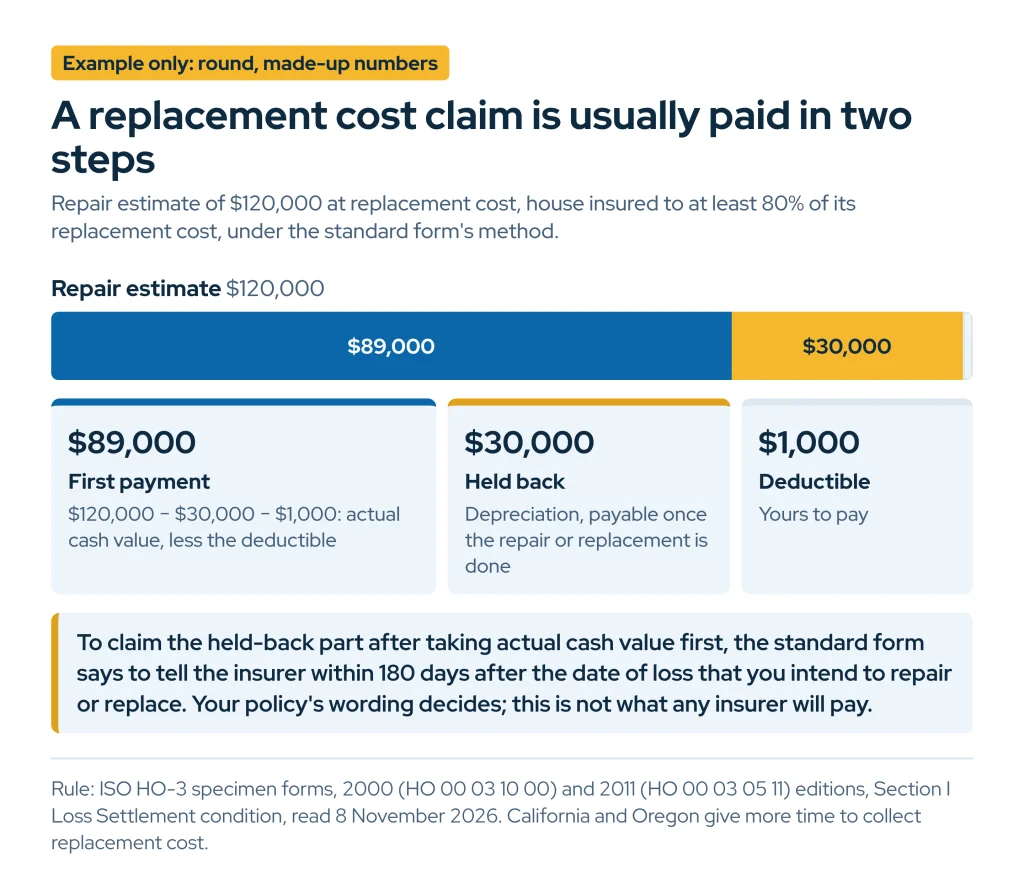
Replacement cost is usually paid in two steps. The specimens pay no more than actual cash value until repair or replacement is complete, unless the repair costs less than both 5% of the building’s insurance and $2,500. You may take actual cash value first and claim the rest later if you tell the insurer within 180 days after the date of loss that you intend to repair or replace. The amount held back is often called recoverable depreciation.
An example with round, made-up numbers: a repair estimate of $120,000 at replacement cost, $30,000 of depreciation and a $1,000 deductible. If the house was insured to at least 80% of its replacement cost, then under the specimen’s method the first payment is $120,000 − $30,000 − $1,000 = $89,000, and the $30,000 difference becomes payable once the work is done. This is arithmetic on example figures, not what any insurer will pay on a claim. Our recoverable depreciation calculator runs the same sum on your own numbers, and the actual cash value calculator shows how depreciation is worked out.
California gives more time to collect the difference: at least 12 months from the first actual cash value payment, or 36 months for a loss related to a state of emergency, with six-month extensions for good cause such as permit delays or a shortage of contractors. After a total loss you may rebuild elsewhere or buy an existing home without losing replacement cost, measured as if you had rebuilt at the original site, with no deduction for land value (Ins. Code 2051.5(b)-(c); policy forms must comply from 1 July 2026). In a state of emergency, California also lets you combine the dwelling and other-structures limits to rebuild the home if the dwelling limit falls short (10103.7(a)); Oregon has a similar rule for losses tied to a declared emergency (ORS 742.273). Oregon also sets time to collect replacement cost where a homeowners policy requires you to repair or rebuild first: at least 12 months after the first actual cash value payment, and at least 24 months for the primary home after a loss tied to a declared emergency or to a fire under a state conflagration order, with six-month extensions for delays beyond your control up to 24 and 36 months in all; it also protects replacement cost if you rebuild or buy elsewhere after a total loss (ORS 742.270).
The mortgage company on the check. Under the specimen’s mortgage clause, house and other-structure payments go to you and the lender “as interests appear”, so the check often names both. For loans owned by Fannie Mae, money for belongings and living expenses goes to the borrower at once, and for a loan that is current or less than 31 days delinquent, the servicer’s first release is up to the greater of $40,000, 33% of the proceeds, or the amount the proceeds exceed the debt (Servicing Guide B-5-01). FHA servicers must promptly release money for personal property and temporary housing (HUD fact sheet, revised 18 October 2023). For other loans, ask the servicer for its written process. Our mortgage check tool shows the release arithmetic. The FTC’s advice after disasters: never sign an insurance check over to a contractor (FTC).
Wildfires and declared emergencies
After a large fire, some states change the rules for claims tied to a declared emergency. The two western states we have read on these points:
| Rule | California (loss related to a state of emergency, Gov. Code 8558(b)) | Oregon |
|---|---|---|
| Living expenses | At least 24 months from the inception of the loss, subject to other policy terms; up to 12 more months (36 in all) for delays beyond your control; then six-month extensions for good cause (Ins. Code 2060(b)). With a civil authority order restricting access: at least two weeks, plus two-week extensions for good cause (2060(c)) | For the primary home after a loss tied to a declared emergency: 24 months after the date of loss, subject to the policy’s living-expense limit; six-month extensions for delays beyond your control, up to 36 months in all (ORS 742.270(2)(b)-(c)) |
| Living-expense advance | On a total loss, at least four months on request (2061(a)(1)) | No rule found in the sections read |
| Contents without an inventory | At least 60% of the contents limit, up to $350,000, furnished primary home, total loss (10103.7(b)) | At least 70% of contents coverage after a declared major disaster, total contents loss (ORS 742.053(3)) |
| Proof of loss | The insurer may not require it sooner than 100 days after the loss; three-month extensions for good cause (2051.5(b)(3)) | For fire insurance, 90 days after you receive the insurer’s form, even if the policy sets a shorter time (742.053(2)) |
| Collecting replacement cost | At least 36 months from the first actual cash value payment, plus six-month extensions (2051.5(b)(1)-(2)) | For the primary home after a loss tied to a declared emergency or a fire under a state conflagration order: at least 24 months from the first actual cash value payment, with six-month extensions up to 36 months in all (742.270(2)(a)(B), (c)) |
| Debris and landscaping | No special rule found in the sections read | In the same case (total contents loss in a declared major disaster): covered debris removal paid within 60 days of the invoice (longer if a government agency is involved); covered trees and landscaping within 30 days of documentation, unless disputed (742.053(3)(b)) |
| Time to sue in the standard fire policy | 24 months after inception of the loss (12 months otherwise) (2071) | 24 months after inception of the loss (742.240) |
| Appraisal | After a government-declared disaster, either side may request it but it can’t be compelled (2071) | No special rule found in the sections read |
| Renewal after a total loss | Total loss of the primary home caused by a disaster, not also by the insured’s negligence: offer to renew for at least the next two annual renewal periods, no less than 24 months of coverage from the date of loss, until 31 December 2026; from 1 January 2027, three periods and no less than 36 months (Ins. Code 675.1(a)(3), as amended by AB 2038). “Disaster” as in Civil Code 1689.14(b); not if later losses make the property uninsurable, and the reasons in section 676(a)-(e) still apply | Not confirmed in official text |
| No cancellation for being near the fire | For a home in a ZIP Code within or next to the fire perimeter, no cancellation or nonrenewal based solely on the wildfire having occurred there, for one year after the state of emergency is declared until 31 December 2026, and for two years from 1 January 2027; the ZIP Codes are listed in a Department of Insurance bulletin, and the bar covers residential policies in force when the emergency was declared; exceptions in 675.1(c). How the longer period applies to an emergency declared before 2027 is not confirmed; ask the Department of Insurance | Not confirmed in official text |
More California changes are coming. SB 876, the Disaster Recovery Reform Act, was signed in September 2026. The Department of Insurance’s announcement says it takes effect 1 January 2027; in the chaptered text, the changes listed here become operative on 1 January 2028. Among them: living-expense cover for the primary home after a declared emergency that runs until 15 calendar days after the home is deemed habitable; the option, if the insurer offers it, of taking the home’s monthly fair rental value instead of itemized living expenses; a primary point of contact assigned within 30 calendar days after notice of a claim tied to a state of emergency; and a written status report within 15 calendar days when a new contact is assigned. We will update this page when those rules apply.
When a federal disaster declaration includes help for individuals, FEMA’s Individuals and Households Program can help with uninsured or underinsured needs, but it won’t duplicate what insurance pays. For disasters declared on or after 1 October 2026 the maximums are $46,400 for housing assistance and $46,400 for other needs (91 FR 70094; 44 CFR 206.113).
Deadlines that can’t wait
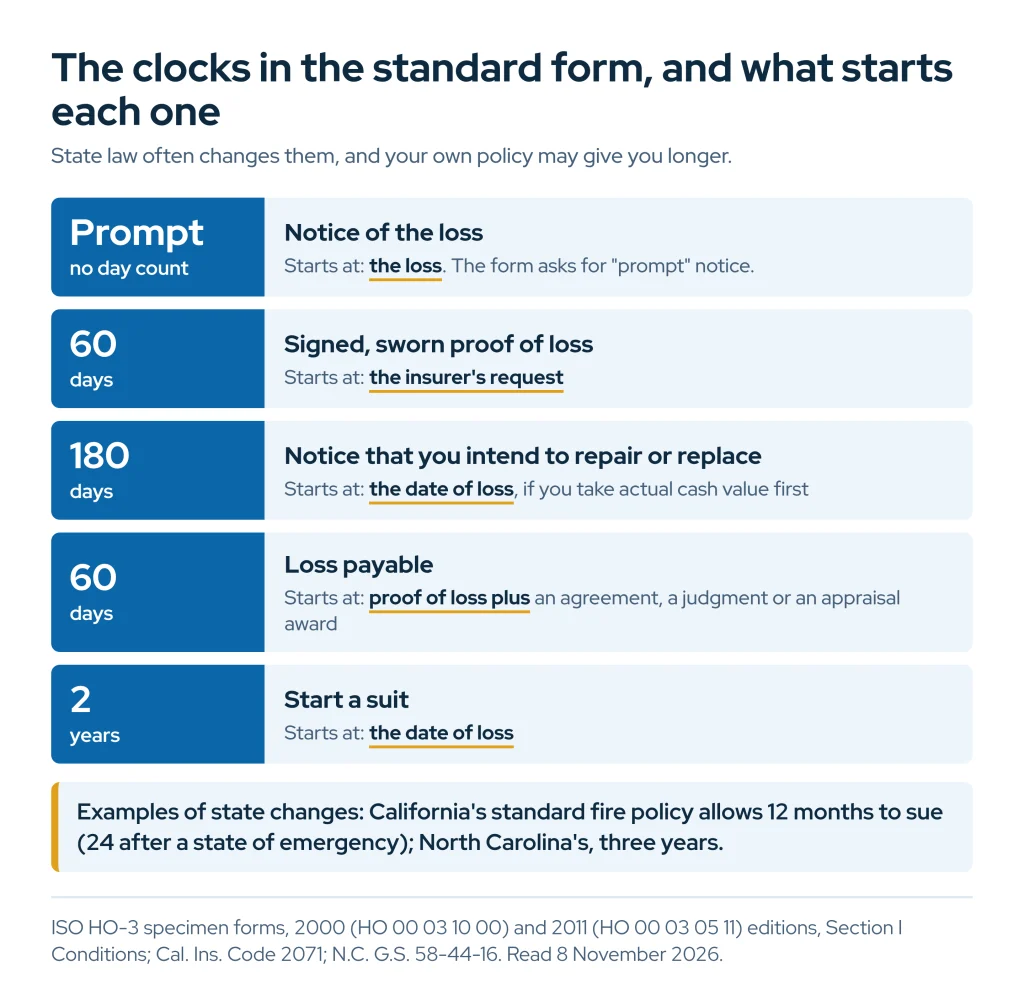
The 2000 and 2011 specimens give you 60 days after the insurer asks to send a signed, sworn proof of loss (a formal statement of what was lost and what you claim), and say a suit must start within two years after the date of loss. State law often changes both. Some examples read in official text:
- California: the standard fire policy sets proof of loss within 60 days after the loss unless extended in writing and suit within 12 months after inception of the loss, 24 months if related to a state of emergency (Ins. Code 2071). In a state of emergency the insurer may not require proof of loss sooner than 100 days after the loss (2051.5(b)(3)).
- Oregon: for fire insurance, proof of loss 90 days after you receive the insurer’s form; 24 months after inception of the loss to sue (ORS 742.053(2), 742.240).
- North Carolina: the standard fire policy allows three years after inception of the loss to sue (G.S. 58-44-16). Our North Carolina claim rules page covers the rest of that policy’s terms.
- Florida: a claim or reopened claim is barred unless notice is given within one year after the date of loss, and a supplemental claim within 18 months after the date of loss (s. 627.70132).
- Texas: the insurer normally has 15 business days after receiving all the items it required to secure final proof of loss to accept or reject a claim in writing, but until the 30th day if it has a reasonable basis to believe the loss resulted from arson. If it needs more time, it must say why within that period and then decide by the 45th day after that notice, and after a weather-related catastrophe or major natural disaster the commissioner defines, these deadlines run 15 days longer (Ins. Code 542.056, 542.059).
These are the rules in those states; your policy may give you longer, so check its Duties After Loss and Suit Against Us conditions too. Every state’s claim clocks and suit-limit rule, where we have read them, are in our claim deadlines by state table, and proof of loss explains the form. Waiting until the last day is never safe.
When the cause is investigated
Insurers look into the cause of a fire because it matters for coverage and for recovering money from whoever caused it. Three clauses in the specimen apply. The intentional loss exclusion removes any loss arising from an act an insured commits or conspires to commit with intent to cause a loss, and says no insured is covered, even one who took no part; if you are a co-insured who had nothing to do with the fire, how that applies to you is a question for a licensed attorney in your state. The concealment or fraud condition removes coverage for all insureds if any insured, before or after a loss, intentionally concealed or misrepresented a material fact, engaged in fraudulent conduct or made false statements relating to the insurance. And the duties condition lets the insurer ask you to show the damaged property, hand over records and sit for an examination under oath, apart from any other insured.
An investigation of the cause is not an accusation. If you’re asked for an examination under oath or many documents, ask in writing what is needed and why, keep copies of everything you send, and consider a licensed attorney. Our page on dealing with the adjuster covers the day-to-day contact.
Taxes
Living-expense payments are taxable only to the extent they exceed your temporary increase in living expenses, and none is taxable if the casualty is in a federally declared disaster area. To deduct a casualty loss on insured property, you have to file a timely insurance claim; otherwise you can deduct only the part the policy doesn’t cover, such as the deductible. For tax years 2018 through 2025, personal casualty losses were deductible, with narrow exceptions, only for federally declared disasters, after $100 per casualty and 10% of adjusted gross income ($500 and no 10% reduction for a qualified disaster loss) (IRS Publication 547, 2025); from 2026 state-declared disasters also count (IRS, updated 15 September 2026). A law approved on 11 September 2026, P.L. 119-108, keeps the $500, no-10% rule for tax years beginning after 2024, deductible without itemizing, but only for presidentially declared major disasters whose incident period began on or after 28 December 2019 and before 1 January 2027 (26 U.S.C. 165(h)(6), 63(b)(8)). A fire in a disaster whose incident period begins on or after 1 January 2027 falls outside that window as the law stands on 18 November 2026, so the $100 and 10% rules apply, unless Congress extends it. The same law adds 26 U.S.C. 139M: for federally declared disasters caused by a forest or range fire and declared after 31 December 2014 and before 1 January 2027, a “qualified wildfire relief payment” received in a tax year beginning after 31 December 2025 is not income, but only to the extent the losses or expenses it compensates were not compensated by insurance or otherwise, and no deduction is allowed for what it covers. A tax professional can say how these apply to you. More on our page is homeowners insurance tax deductible?
Claims you may see elsewhere
You may see these on other sites. We checked each against the policy forms and statutes named above.
- “Smoke damage without flames isn’t covered.” Not under the specimen: the house is covered for direct physical loss unless excluded, and belongings are covered for sudden and accidental smoke damage. The exclusions are narrow (farm smudging, industrial operations).
- “You have one year to sue after a fire.” Not as a national rule: the specimen says two years after the date of loss, and state law varies: for example, 12 months in California’s standard fire policy (24 after a state of emergency) and three years in North Carolina’s.
- “Sign the check over and the restoration company will handle everything.” The FTC says never sign an insurance check over to a contractor.
- “Fire claims are paid within a few months.” No national rule says so: each state sets its own clocks, and the specimen makes a loss payable 60 days after proof of loss plus an agreement, a judgment or an appraisal award.
Your next step
- Gather: the full policy with its declarations page and every endorsement (look for replacement cost on belongings, extended replacement cost and ordinance or law), the fire department’s incident report number, photos and video from before cleanup, every receipt, and every letter from the insurer with its date.
- Read: your policy’s Duties After Loss, Loss Settlement, Loss of Use and Suit Against Us conditions, and the smoke wording for belongings.
- Do now: report the claim in writing, protect the property and keep the receipts, start the room-by-room inventory, and tell your mortgage servicer.
- Ask: the insurer, in writing, for any form it wants, what it will clean or replace, and the clause behind any refusal. If you disagree, your state insurance department’s consumer line is free: find it through the NAIC’s list of state insurance departments or our complaint page for each state. In California, the Department of Insurance’s consumer hotline is 800-927-4357, and its Getting Help page takes complaints. For legal advice, contact legal aid or a licensed attorney through your state bar’s referral service.
- Don’t wait on: a proof-of-loss date the insurer gives you, the 180-day notice in the standard form if you take actual cash value first, any notice-of-claim limit in your state, and the suit limit in your policy and state law.
Sources checked on 8 November 2026: ISO HO-3 specimens (2000 and 2011 editions); California Insurance Code 2051.5, 2060, 2061, 2070, 2071 and 10103.7 (Legislative Counsel data file of 2 November 2026) and the chaptered AB 1795 and SB 876 (AB 1795 read again on 18 November 2026); California Department of Insurance; ORS 742.053, 742.240, 742.270 and 742.273 (2025 edition); N.C. G.S. 58-44-16; Fla. Stat. 627.70132; Tex. Ins. Code 542.056 and 542.059; 44 CFR 206.113; U.S. Fire Administration FA-46; Fannie Mae B-5-01; HUD; FTC; 91 FR 70094; IRS Publication 547 (2025). Read on 18 November 2026: Cal. Ins. Code 675.1 as amended by AB 2038 (chaptered 30 September 2026) and P.L. 119-108 (26 U.S.C. 165(h)(6) and 139M).
Sources
- ISO HO-3 Homeowners 3 Special Form specimen, 2000 edition (HO 00 03 10 00), Insurance Information Institute copy
- ISO HO-3 Homeowners 3 Special Form, 2011 edition (HO 00 03 05 11), Maine Bureau of Insurance copy
- U.S. Fire Administration, After the Fire (FA-46, January 2019)
- California Insurance Code 2051.5 (as amended by SB 495, Stats. 2025 ch. 542)
- California Insurance Code 2060
- California Insurance Code 2061
- California Insurance Code 2070
- California Insurance Code 2071 (standard form fire policy)
- California Insurance Code 10103.7 (as amended by SB 495)
- California AB 1795, Smoke Damage Recovery Act (Stats. 2026, ch. 240), chaptered text
- California AB 2038 (2026, chaptered 30 September 2026), amending Insurance Code 675.1, chaptered text
- California SB 876, Disaster Recovery Reform Act (Stats. 2026, ch. 656), chaptered text
- California Department of Insurance, release on SB 876 and AB 1795 (28 September 2026)
- California Department of Insurance, consumer alert on AB 1795 (15 September 2026)
- California Department of Insurance, Getting Help
- Oregon Revised Statutes chapter 742, 2025 edition (742.053, 742.240, 742.270, 742.273)
- North Carolina G.S. 58-44-16 (standard fire policy)
- Florida Statutes 627.70132 (2026)
- Texas Insurance Code chapter 542 (542.056, 542.059)
- Fannie Mae Servicing Guide B-5-01, Insured Loss Events
- HUD, FHA hazard and flood insurance servicing fact sheet (revised 18 October 2023)
- FTC, How to avoid scams after weather emergencies and natural disasters
- Federal Register 91 FR 70094 (6 November 2026), IHP maximum amounts
- 44 CFR 206.113 (eCFR)
- IRS Publication 547 (2025), Casualties, Disasters, and Thefts
- IRS, Casualty loss deduction expanded and made permanent (updated 15 September 2026)
- NAIC, State insurance departments
- Public Law 119-108, Doug LaMalfa Federal Disaster Tax Relief Certainty Act (11 September 2026): 26 U.S.C. 165(h)(6) and 139M