Recoverable depreciation is the part of a replacement cost claim that is usually held back at first and paid once the work is done. Under the ISO HO-3 specimen homeowners form, the insurer pays the actual cash value (the replacement cost minus depreciation, less your deductible) first. Once the work is complete, it pays the rest, up to the least of the replacement cost, the amount actually spent and the policy limit, if the home was insured to at least 80% of replacement cost. Your policy’s Loss Settlement condition and some state laws decide when the holdback is paid.
General information, not legal or insurance advice, and not a substitute for the advice of an attorney. Your policy’s wording and your state’s law decide, and both change. For help with your claim, your state insurance department’s consumer line and legal aid are free.
From our guide to how a home insurance payout is worked out. The calculator below does that arithmetic on your estimate. The result is an estimate of how the payment splits under the wording of a standard form we read. It does not say what any insurer will pay on your claim.
How to use the calculator
Most of the numbers are on the adjuster’s estimate. It usually lists each line with a replacement cost (often labelled RCV), the depreciation taken, and the actual cash value (ACV). The totals are at the end, sometimes per coverage.
- Replacement cost on the estimate: the total cost to repair or replace with materials of like kind and quality, before depreciation and before the deductible.
- Depreciation: the total taken off for age, wear and condition. Many estimates split it into recoverable and non-recoverable. Enter only the recoverable part, because the other part isn’t paid later.
- Deductible: the amount on your declarations page. If it is a percentage deductible, turn it into dollars first with the deductible calculator.
- Dwelling limit: Coverage A on the declarations page (or the building limit on a flood policy). The calculator uses it as a ceiling and for the small-loss test explained below.
- Payments already received: any advance or earlier payment for the same damage.
- Amount actually spent: leave at 0 until the work is finished. Then enter the final invoices to see the second payment on the form’s “amount actually spent” rule.
- Policy wording: the ISO HO-3 specimen homeowners form, or the NFIP flood policy. Your own policy may differ from both. A FAIR plan, a surplus lines policy or a dwelling fire policy uses its own form, and some settle only at actual cash value, so read that form’s Loss Settlement wording.
How the two payments work in the standard form
ISO, an insurance industry organisation, publishes standard homeowners forms that insurers may use or adapt. We read two editions of its HO-3 (special form) specimen: the 2000 edition (HO 00 03 10 00) and the 2011 edition (HO 00 03 05 11, the copy published by Maine’s Bureau of Insurance). Insurers use their own versions and state endorsements, so treat this as how the standard form works, not as your policy. In both editions the Loss Settlement condition (C in 2000, D in 2011) does four things that matter here.
- Buildings are settled at replacement cost “without deduction for depreciation”, if the home was insured to at least 80% of its full replacement cost just before the loss. The payment is capped at the least of three amounts: the limit for the building, the replacement cost of the damaged part with like kind and quality, and the amount “actually spent” to repair or replace it.
- Until the repair or replacement is complete, the insurer pays no more than the actual cash value. That is the holdback. Once the work is complete, the loss is settled at replacement cost.
- Small repairs are the exception. If the cost to repair or replace is both less than 5% of the insurance on the building and less than $2,500, replacement cost is paid whether or not the work is done.
- You may take the actual cash value first and claim the rest later, if you tell the insurer of your intent within 180 days after the date of loss. The 2011 edition says intent “to repair or replace the damaged building”.
Two limits sit around this. If the home was insured for less than 80% of its replacement cost, the form pays the greater of the actual cash value or a proportion of the replacement cost, and anything above the actual cash value still waits for the repair, so the full holdback may never be reached. The calculator assumes the home meets the 80% test and doesn’t model that case. And in both editions the terms “replacement cost” and “cost to repair or replace” leave out the extra cost of meeting building codes, except as the separate Ordinance or Law coverage provides.
The deductible comes off once. The 2000 edition’s deductible clause pays only the part of the loss over the deductible, subject to the limits. The calculator takes it off the first payment. If the deductible is larger than the actual cash value, the first payment is zero and the rest of the deductible comes off the second. When the small-loss test is met, the calculator shows the whole amount after the deductible as the first payment and no holdback, because the form settles those repairs at replacement cost whether or not the work is done.
What isn’t recoverable in the standard form
“Recoverable depreciation” is industry shorthand, not a term in either ISO edition we read. It only exists where the policy settles that property at replacement cost. In both specimen editions, these are settled at actual cash value, with no second payment:
- personal property (your belongings);
- awnings, carpeting, household appliances, outdoor antennas and outdoor equipment, whether or not attached to the building;
- structures that are not buildings, such as fences;
- grave markers.
Some policies add an endorsement that settles belongings at replacement cost, and some endorsements change how a building or roof is settled. An endorsement can set its own conditions for when the rest is paid, so read every endorsement listed on your declarations page. Depreciation on anything settled at actual cash value is non-recoverable: it is not paid later, whatever you spend. Our actual cash value vs replacement cost calculator shows that gap for a single item.
Worked example
General information, not legal or insurance advice, and not a substitute for the advice of an attorney. The figures below are made up for the example; they are not typical costs, depreciation or payments.
Example: a covered roof loss on a home with a $350,000 dwelling limit and a $2,500 deductible, settled on the ISO HO-3 specimen’s terms. The estimate shows $24,000 replacement cost and $9,000 of recoverable depreciation.
| Step | Arithmetic | Example result |
|---|---|---|
| Actual cash value | $24,000 − $9,000 | $15,000 |
| First payment | $15,000 − $2,500 deductible | $12,500 |
| Held back until the work is complete | ($24,000 − $2,500) − $12,500 | $9,000 |
| Total if the repair costs the full estimate | $12,500 + $9,000 | $21,500 |
| Second payment if the repair costs $21,000 | ($21,000 − $2,500) − $12,500 | $6,000 |
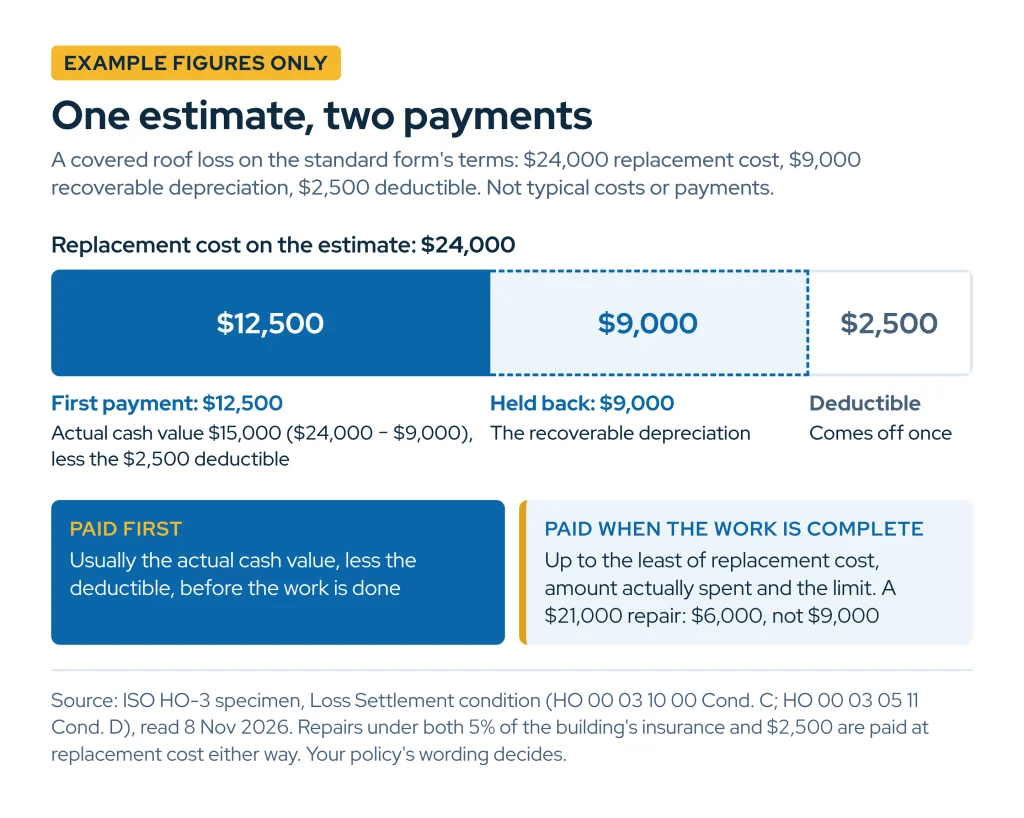
The last row matters. The form pays the least of the replacement cost and the amount actually spent. If the finished job costs less than the estimate, the part of the holdback above the actual cost isn’t paid. The reverse doesn’t follow: if the job costs more, the extra isn’t paid automatically, because the form also caps the payment at the replacement cost of like kind and quality. Whether the estimate was too low is settled with the insurer, through a supplemental claim, or through the policy’s appraisal clause where it applies.
What releases the holdback
Under the standard form, the trigger is that “actual repair or replacement is complete”. The form doesn’t list the papers that prove it, and insurers set their own requirements. Keep these: they show the work is finished and what it cost, which is what the “amount actually spent” test measures:
- the signed contract and the final, itemized invoice;
- proof of what you paid (cancelled checks, bank or card statements);
- photos of the finished work;
- any permit and final inspection, where one was needed;
- for belongings on a replacement cost endorsement, receipts for what you bought.

Send them in writing and keep a copy with the date you sent them. If the check is made out to you and your mortgage company, the lender’s process can add a step before the money reaches the contractor: see the mortgage company and your insurance check.
Proof that you paid the deductible. Two states we read let insurers hold the depreciation until you show it. Texas Insurance Code 707.004 and Louisiana R.S. 22:1892(A)(7) both say an insurer with replacement cost coverage may refuse to pay “withheld recoverable depreciation or a replacement cost holdback” until it receives reasonable proof that you paid the deductible. Both statutes list a cancelled check, money order receipt, credit card statement, or an installment or financing agreement that requires full payment over time. Texas also says the policyholder “shall pay” any deductible (707.002; both sections in force since 1 September 2019). And in Texas a contractor paid from claim money who waives, absorbs or rebates your deductible without the insurer’s consent commits a Class B misdemeanor (Business and Commerce Code 27.02).
How long you have: the form and state law
Two different clocks get mixed up. The standard form’s 180 days is a window to tell the insurer you intend to claim replacement cost after taking the actual cash value. It is counted from the date of loss. In the clause we read, it isn’t a date by which the repair must be finished. Your insurer’s own form, or an endorsement, may set a completion deadline, and some states set the shortest one a policy may use. These are the rules we read in full on 8 November 2026. Check the date your own policy gives before you rely on any of them.
| Policy or state | Rule | Counted from | Source, read 8 Nov 2026 |
|---|---|---|---|
| ISO HO-3 specimen (2000 and 2011 editions) | Notify intent to claim replacement cost within 180 days; replacement cost paid once repair is complete, unless under both 5% of the building’s insurance and $2,500 | Date of loss | HO 00 03 10 00 Cond. C.2.d-e; HO 00 03 05 11 Cond. D.2.d-e |
| NFIP flood policy (Dwelling Form) | Notify intent within 180 days; if the repair costs more than $1,000 or more than 5% of the dwelling’s insurance, nothing beyond actual cash value until the repair is complete | Date of loss | 44 CFR 61 app. A(1), VII.R.2.c-d |
| California | A policy may not give less than 12 months to collect full replacement cost; 36 months for a loss relating to a declared state of emergency; further six-month extensions for good cause (permit delays, lack of materials or contractors) when you act in good faith | The first payment toward actual cash value | Ins. Code 2051.5(b), as amended by SB 495 (Stats. 2025, ch. 542), eff. 1 Jan 2026; policy forms must comply from 1 Jul 2026 |
| Oregon | If a homeowner policy requires repair or replacement before it pays full replacement cost, it must allow at least 12 months to repair, rebuild or replace; 24 months for a primary dwelling damaged or lost in a declared emergency or a fire under a conflagration order; extensions in six-month steps to a total of 24 or 36 months for delays beyond your control | The insurer’s first payment toward cash value | ORS 742.270(2), 2025 edition |
| Texas | Insurer may hold recoverable depreciation until reasonable proof the deductible was paid; no time limit for the holdback found in chapter 707 | Not applicable | Ins. Code 707.002, 707.004 |
| Louisiana | Same deductible-proof rule; a policy may allow depreciation (defined to include labor), with notice on a commissioner-approved form and a written explanation of how it was calculated | Not applicable | R.S. 22:1892(A)(7), (B)(6) |
| Other states | Not confirmed. Some states have their own rules; we haven’t read them yet | — | Ask your state insurance department |
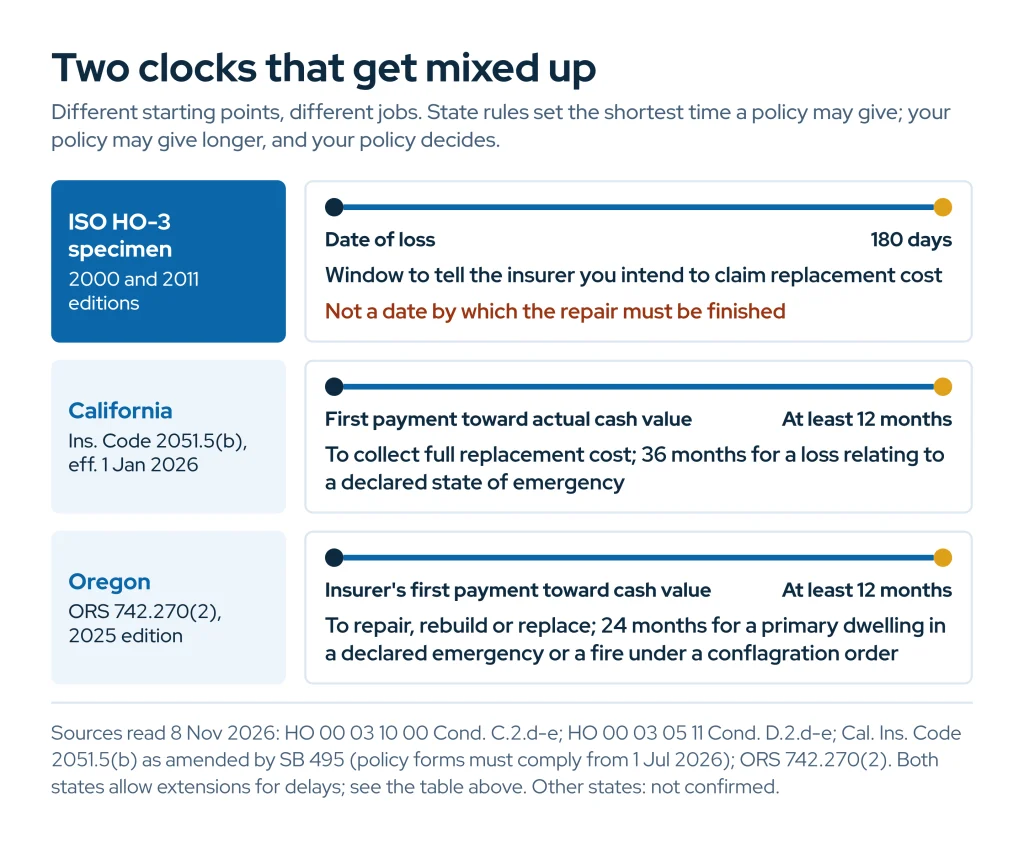
California’s rule counts from the first actual cash value payment, not the date of loss. It applies to any time limit a policy puts on collecting full replacement cost; the longer 36 months applies only when the loss relates to a state of emergency. California and Oregon also stop a policy refusing replacement cost on a total loss because you rebuild or buy elsewhere, capped at what rebuilding at the original site would have cost (Ins. Code 2051.5(c); ORS 742.270(4)). The holdback window is separate from the time to sue. For that, see claim deadlines by state; the standard form’s Suit Against Us condition counts two years from the date of loss, and state law often changes it.
Flood claims under the NFIP
The federal flood policy has its own version of the holdback, and it is narrower. Replacement cost applies only to a single-family dwelling that is your principal residence, insured to at least 80% of its full replacement cost or to the NFIP maximum (Art. VII.R.1). If that home is insured for less than both, the policy pays the greater of the actual cash value or a proportion of the replacement cost, and the proportional part also waits for the repair (VII.R.4.a, R.2.c). These are settled at actual cash value: two- to four-family buildings, a unit not used only as a single-family home, detached garages, personal property, appliances, carpets and carpet pads, outdoor awnings, antennas and other outdoor equipment, insured property abandoned as debris after a loss, and a home that isn’t your principal residence (VII.R.4). Manufactured or mobile homes and travel trailers that are your principal residence and meet the policy’s minimum size have their own special loss settlement (VII.R.3), which this calculator doesn’t model. The policy defines actual cash value as the cost to replace at the time of loss “less the value of its physical depreciation” (II.C.2).
The small-loss line is also lower than in the homeowners form. “When the full cost of repair or replacement is more than $1,000, or more than 5 percent of the whole amount of insurance that applies to the dwelling”, nothing beyond actual cash value is paid “unless and until actual repair or replacement is completed” (VII.R.2.c). The 180-day notice of intent counts from the date of loss (VII.R.2.d). The flood policy’s other clocks (proof of loss within 60 days after the loss, VII.G.4, and suit within one year after the written denial, VII.O) are on our NFIP flood claims page.
Questioning the depreciation figure
The holdback is only as right as the depreciation behind it, and we found no official table of how much a roof or a floor depreciates per year. Two rules we read help you see how it was worked out:
- Louisiana requires a written explanation of how depreciation was calculated whenever it is applied, and says depreciation must be reasonable, based on a combination of objective criteria and subjective assessment, including the property’s actual condition before the loss (R.S. 22:1892(B)(6)(d)-(e)). Our guide to Louisiana home insurance claim rules covers the state’s other claim clocks.
- The NAIC’s model claims regulation (Model 902, a template written by the national association of state insurance regulators; it is not law in any state until that state adopts it) says depreciation deductions should be itemized and specified by dollar amount in the claim file and, for losses settled at actual cash value, that the insurer give the depreciation worksheets on request. Whether your state adopted that wording is something your state insurance department can tell you.
Whether labor can be depreciated at all differs by state and by policy wording; Louisiana’s statute expressly allows a policy to include it. The arithmetic of the holdback is the same either way, but the depreciation figure you enter changes.
Claims you may see on other sites
- “You have 180 days to finish the repairs.” Not in the standard form we read: its 180 days is for telling the insurer you intend to claim replacement cost. Your own policy may set a completion date, and California and Oregon set minimums counted from the first payment.
- “Recoverable depreciation is paid automatically.” Not under the form: it is paid once the repair or replacement is complete, and on the amount actually spent.
- “Any replacement cost policy pays back all depreciation.” Not for items the policy settles at actual cash value. In the standard form that includes belongings, carpeting and appliances.
- “We’ll cover your deductible.” Some contractors offer this. In Texas and Louisiana an insurer may hold your depreciation until you show the deductible was paid, and in Texas a contractor who waives it without the insurer’s consent commits a misdemeanor (Bus. & Com. Code 27.02).
What to do next
- Read your Loss Settlement condition and every endorsement on the declarations page. Note what is settled at replacement cost, any completion deadline, and how it is counted.
- Ask for the estimate line by line, with the depreciation on each line, and keep every letter with its date.
- If you mean to repair or replace, say so in writing within your policy’s window: 180 days from the date of loss in the standard form.
- Keep the contract, final invoice, proof of payment and photos, and in Texas and Louisiana proof that you paid the deductible.
- If the work will take longer than the policy allows, ask the insurer in writing for more time, and say why. In California and Oregon, the statutes above list the reasons that qualify for an extension.
- If you disagree with the estimate or the depreciation, your state insurance department’s consumer line is free. If a lot is at stake, a licensed attorney can advise on your policy.
Sources checked on 8 November 2026: the ISO HO-3 specimen form (2000 and 2011 editions), the NFIP Standard Flood Insurance Policy Dwelling Form on eCFR (current to 5 November 2026), Texas Insurance Code chapter 707, Louisiana R.S. 22:1892, California Insurance Code 2051.5, ORS 742.270 (2025 edition) and NAIC Model Regulation 902.
Formulas and sources
- Actual cash value on the estimate (RCV minus depreciation): NFIP Standard Flood Insurance Policy, Dwelling Form, 44 CFR part 61 app. A(1), Art. II.C.2 and VII.R
- Small-loss test met: replacement cost without waiting for repair (1 yes, 0 no): ISO HO-3 specimen Cond. C.2.d (2000) / D.2.d (2011): under both 5% of the building's insurance and $2,500; SFIP VII.R.2.c: over $1,000 or over 5% waits for repair
- First payment: ACV after the deductible, or full replacement cost after it if the small-loss test is met: ISO HO-3 specimen form, Section I Conditions, Loss Settlement and Deductible (2000 edition HO 00 03 10 00, Cond. C.2; 2011 edition HO 00 03 05 11, Cond. D.2)
- First payment still to come after payments already received: Arithmetic on the reader's own entries, no outside figure
- Replacement cost after the deductible, at the estimate: ISO HO-3 specimen form, Section I Conditions, Loss Settlement and Deductible (2000 edition HO 00 03 10 00, Cond. C.2; 2011 edition HO 00 03 05 11, Cond. D.2)
- Held back until repair or replacement is complete: ISO HO-3 specimen form, Section I Conditions, Loss Settlement and Deductible (2000 edition HO 00 03 10 00, Cond. C.2; 2011 edition HO 00 03 05 11, Cond. D.2)
- Replacement cost after the deductible, at the amount spent: ISO HO-3 specimen form, Section I Conditions, Loss Settlement and Deductible (2000 edition HO 00 03 10 00, Cond. C.2; 2011 edition HO 00 03 05 11, Cond. D.2)
- Second payment if the repair cost what you entered: ISO HO-3 specimen form, Section I Conditions, Loss Settlement and Deductible (2000 edition HO 00 03 10 00, Cond. C.2; 2011 edition HO 00 03 05 11, Cond. D.2)
- Depreciation not released because less was spent: Arithmetic on the reader's own entries, no outside figure
- Left to be paid in all after payments already received: Arithmetic on the reader's own entries, no outside figure
- Days after the date of loss to notify intent to claim replacement cost: ISO HO-3 specimen form, Section I Conditions, Loss Settlement and Deductible (2000 edition HO 00 03 10 00, Cond. C.2; 2011 edition HO 00 03 05 11, Cond. D.2)
Sources
- ISO Homeowners 3 Special Form specimen, HO 00 03 10 00 (2000 edition), hosted by the Insurance Information Institute
- ISO Homeowners 3 Special Form, HO 00 03 05 11 (2011 edition), Maine Bureau of Insurance copy
- NFIP Standard Flood Insurance Policy, Dwelling Form, 44 CFR part 61 appendix A(1), eCFR
- Texas Insurance Code chapter 707, Payment of Insurance Deductible
- Texas Business and Commerce Code 27.02
- Louisiana R.S. 22:1892
- California Insurance Code 2051.5
- Oregon Revised Statutes chapter 742 (ORS 742.270), 2025 edition
- NAIC Unfair Property/Casualty Claims Settlement Practices Model Regulation (Model 902)
- NAIC directory of state insurance departments