Usually, yes. A standard homeowners policy usually covers your belongings when they are stolen, at home or away from home, and usually covers the damage a burglar does to the house, such as a forced door or a broken window. But theft has its own rules: lower dollar limits for jewelry, watches, furs, firearms, silverware and cash, no cover for theft by a relative who lives with you, gaps for property kept at a second home, and your deductible comes off first. Your policy’s wording decides, so read its theft peril and its special limits before you count on a figure. This page is part of our fire, smoke and theft guide.
General information, not legal or insurance advice, and not a substitute for the advice of an attorney. Your policy’s wording and your state’s law decide, and both change. For help with your claim, your state insurance department’s consumer line and legal aid are free.
Theft and the standard form at a glance
This table follows the ISO HO-3 specimen form, the industry’s standard “special form” homeowners policy. We read two editions: 2011 (HO 00 03 05 11, in the Maine Bureau of Insurance’s copy) and 2000 (HO 00 03 10 00, in a copy published by the Insurance Information Institute, a trade group, archived 2 September 2026). Neither is your policy. Insurers use their own forms and state endorsements, and the figures and exceptions can differ, so read every row as “usually”. If your policy isn’t an HO-3 style homeowners policy, for example a dwelling fire policy on a home you rent out, a FAIR plan policy or a surplus lines form, its list of perils may be different: check whether theft is on it at all. Renters (HO-4) and condo (HO-6) policies also insure belongings, but we have not read those specimen forms, so this page doesn’t say how their theft wording or limits compare; read your own form.
| What happened | Under the standard form | The clause it rests on |
|---|---|---|
| Burglary at home: TV, laptop and bikes taken | Usually covered, after the deductible | Coverage C (personal property), Theft peril |
| The burglar broke the back door and a window | Usually covered as damage to the house | Coverage A (dwelling), which insures against direct physical loss unless excluded |
| Jewelry, watches or furs stolen | Covered only up to a special theft limit unless you insured them separately | Coverage C special limits |
| Laptop stolen from your car or a hotel room | Usually covered; the car itself is not | Coverage C covers property “anywhere in the world”; motor vehicles are property not covered |
| Belongings stolen from your vacation home | Usually not, unless you were staying there at the time | Theft peril exclusion b.(4)(c) |
| Theft by a relative who lives with you | Usually not covered | Theft peril exclusion b.(1), theft “committed by an insured” |
| Copper, fixtures or materials taken from a house still being built | Usually not covered until the house is finished and lived in | Theft exclusions for a dwelling under construction |
| A ring you simply can’t find | Usually not, unless it is likely that it was stolen | The Theft peril’s own definition |
| Someone runs up charges on a stolen credit card | A small additional coverage, separate from the theft peril | Additional Coverage E.6, up to $500, no deductible |
What the standard form says about theft
An HO-3 insures your house in one way and your belongings in another. The house (Coverage A) and detached structures such as a garage or shed (Coverage B) are insured against direct physical loss (the 2000 edition says “risk of direct physical loss”), with a list of exclusions. Your belongings (Coverage C, personal property) are insured only against named perils, and Theft is number 9 on that list. Your Coverage C limit, shown on the declarations page (the summary page of your policy with your limits and deductible), is usually the most the policy pays for your belongings in any one loss (a few additional coverages, such as debris removal, can add to it), and the special limits below sit inside it (2000 edition, Section I Condition A, page 12). In the 2000 edition, after a loss and at your request, Coverage C can also cover property owned by others while it is in the part of the residence premises an insured lives in, and a guest’s property while it is in any residence an insured occupies, so a visitor’s stolen bag may fall under your policy if you ask (2000 edition, Coverage C.1, page 3). The overview of what homeowners insurance covers walks through all four parts of the policy.
Three parts of the wording matter most:
- Attempted theft counts. The peril includes attempted theft, so a damaged safe or a pried-open cabinet is part of the theft loss even if nothing was taken.
- Missing is not the same as stolen. The peril also includes loss of property from a known place when it is likely that it has been stolen. Something left in a locked shed that is gone the next morning fits that wording more easily than a ring you lost somewhere on a walk.
- Anywhere in the world. Coverage C covers personal property owned or used by an insured while it is anywhere in the world, so a theft from your car, your office or a hotel room can fall under the same policy, subject to the exceptions below.
Damage to the house from a break-in is a Coverage A question, not a theft-peril question. The specimen’s open-peril wording doesn’t list break-in damage among its exclusions (apart from the vacancy rule for vandalism, below), so a forced door frame or a smashed window is usually covered as damage to the dwelling. Items stolen from the structure itself, such as an outdoor air conditioning unit or copper pipe, usually fall under the dwelling coverage rather than Coverage C; our page on HVAC and AC units covers that case. Sources: 2011 edition, Section I, Perils Insured Against, A.1 (page 9 of the Maine copy) and B.9 (page 11); 2000 edition, same clauses.
Break-in damage: glass, locks and vandalism
A break-in often brings three kinds of loss at once, and each sits under a different part of the form. The things taken fall under the Theft peril in Coverage C. Damage the burglar does to your belongings, such as a smashed television or slashed furniture, falls under Vandalism or Malicious Mischief, which is peril 8 on the Coverage C list; the 2000 edition puts no vacancy condition on that peril for belongings. Damage to the house itself, such as a forced lock, a split door frame or a broken window, is a Coverage A question, as above. The 2000 edition also has an additional coverage, Glass or Safety Glazing Material, for the breakage of glass that is part of a covered building, storm door or storm window, and for damage that broken glass fragments cause to covered property. It doesn’t apply on the residence premises if the dwelling has been vacant for more than 60 consecutive days immediately before the loss, except when the glass was broken directly by earth movement (a dwelling being built is not counted as vacant), and it doesn’t raise the limit that applies to the damaged property. Your policy’s wording decides which clause your insurer applies, and the deductible applies to the total of the Section I loss. Sources: 2000 edition (HO 00 03 10 00), Section I, Additional Coverage E.9 (pages 7 and 8) and Coverage C perils 8 and 9 (page 10), archived copy read 18 November 2026.
The special theft limits
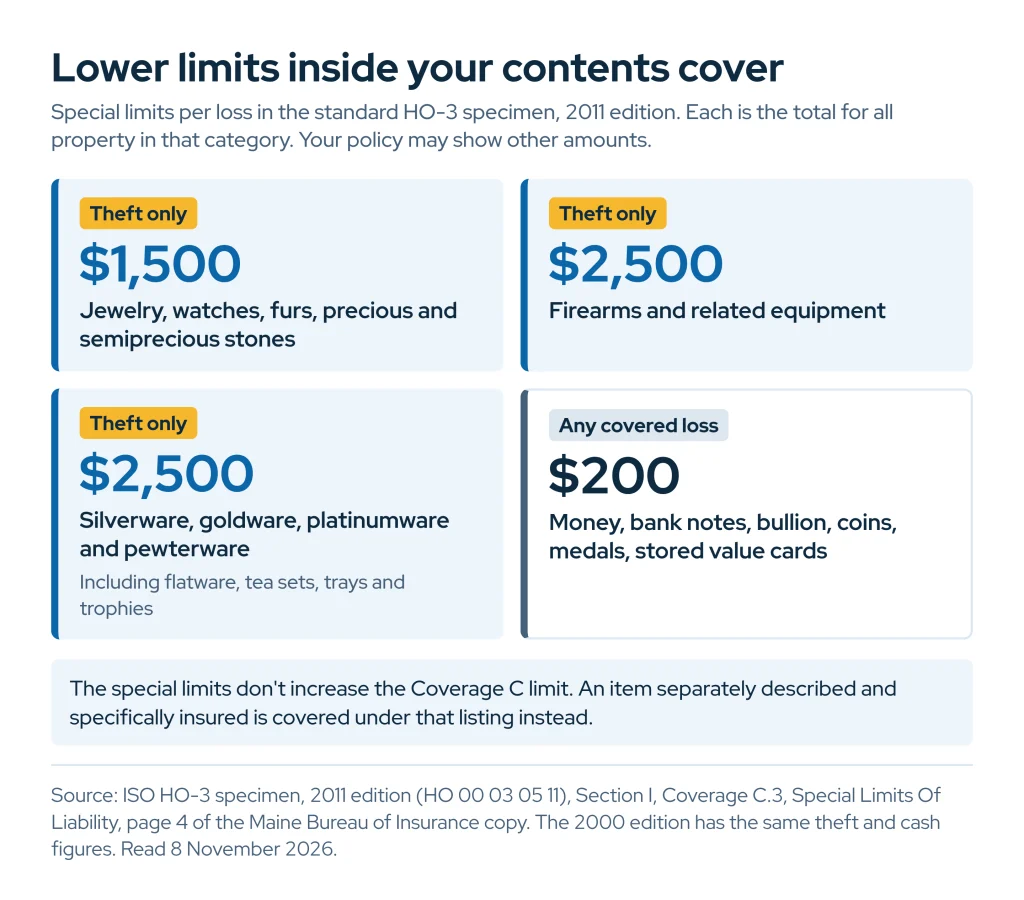
Your Coverage C limit is the most the policy pays for all your belongings. Inside it, the standard form sets lower “special limits” for some kinds of property. The form says each special limit is the total for each loss for all property in that category, and that the special limits don’t increase the Coverage C limit. Three of them apply only to theft:
| Category | Special limit per loss (2011 edition) | Applies to |
|---|---|---|
| Jewelry, watches, furs, precious and semiprecious stones | $1,500 | Loss by theft only |
| Firearms and related equipment | $2,500 | Loss by theft only |
| Silverware, goldware, platinumware and pewterware, including flatware, tea sets, trays and trophies | $2,500 | Loss by theft only |
| Money, bank notes, bullion, coins, medals, stored value cards | $200 | Any covered loss |
| Securities, deeds, personal records, passports, tickets, stamps | $1,500 | Any covered loss |
| Property used mainly for business, at home | $2,500 | Any covered loss |
| Property used mainly for business, away from home | $1,500 (the 2000 edition shows $500) | Any covered loss |
| Portable electronics in or on a motor vehicle, designed to run on more than one power source, one of which is the vehicle’s electrical system | $1,500 | Any covered loss |
| Antennas, tapes, records, discs used with vehicle electronics, in or on a motor vehicle | $250 | Any covered loss |
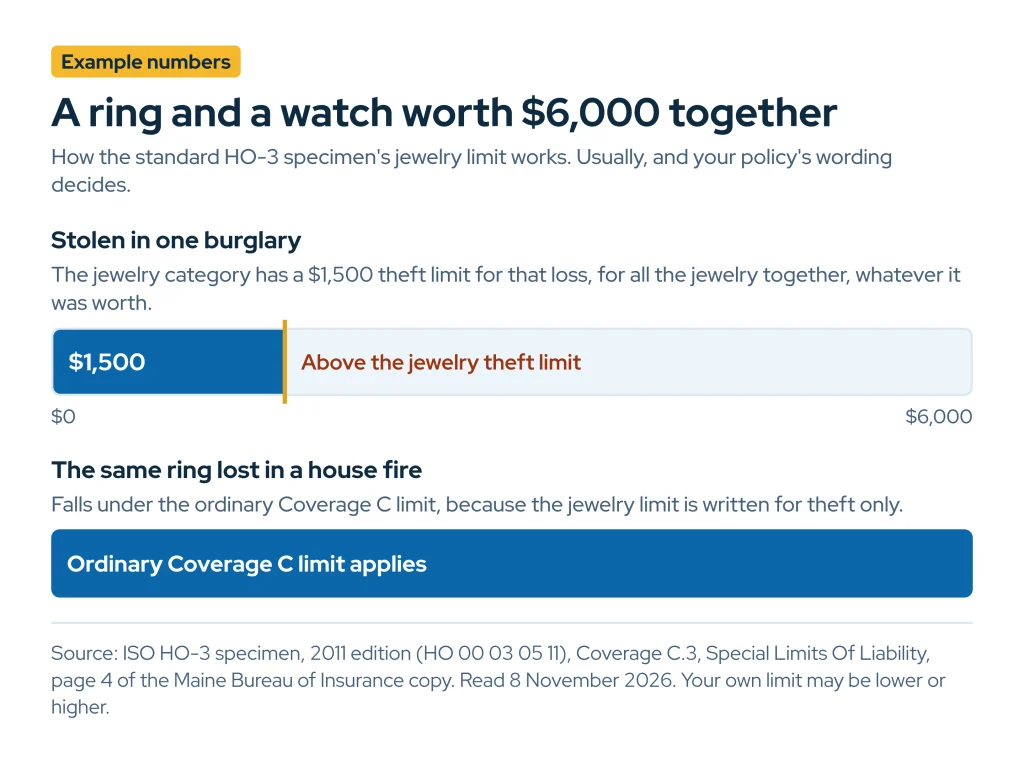
Example: in one burglary, a ring and a watch worth $6,000 together are taken. Under the specimen, the jewelry category has a $1,500 theft limit for that loss, for all the jewelry together, whatever it was worth. The same ring lost in a house fire would fall under the ordinary Coverage C limit, because the jewelry limit is written for theft only.
Your own figures may be lower or higher. The NAIC, the association of state insurance regulators, says on its homeowners insurance consumer page that “most policies limit their coverage for the theft of furs or jewelry to $500”, a lower figure than the ISO specimen’s. That difference is the point: check the special limits in your own policy, not a number from a website, including this one.
Insuring valuables separately
The standard form’s list of property not covered starts with “articles separately described and specifically insured”, in this policy or any other. That is the way around the special limits: an item listed on its own, through a scheduled personal property endorsement or a separate policy, is insured under that listing and its terms instead of under Coverage C. The NAIC’s page on insuring expensive jewelry and gifts says that “In many cases, insurers will require an appraisal” and that some policies ask for periodic reappraisals. It is something to ask about before a loss. After a theft, it can’t be added for the item already taken.
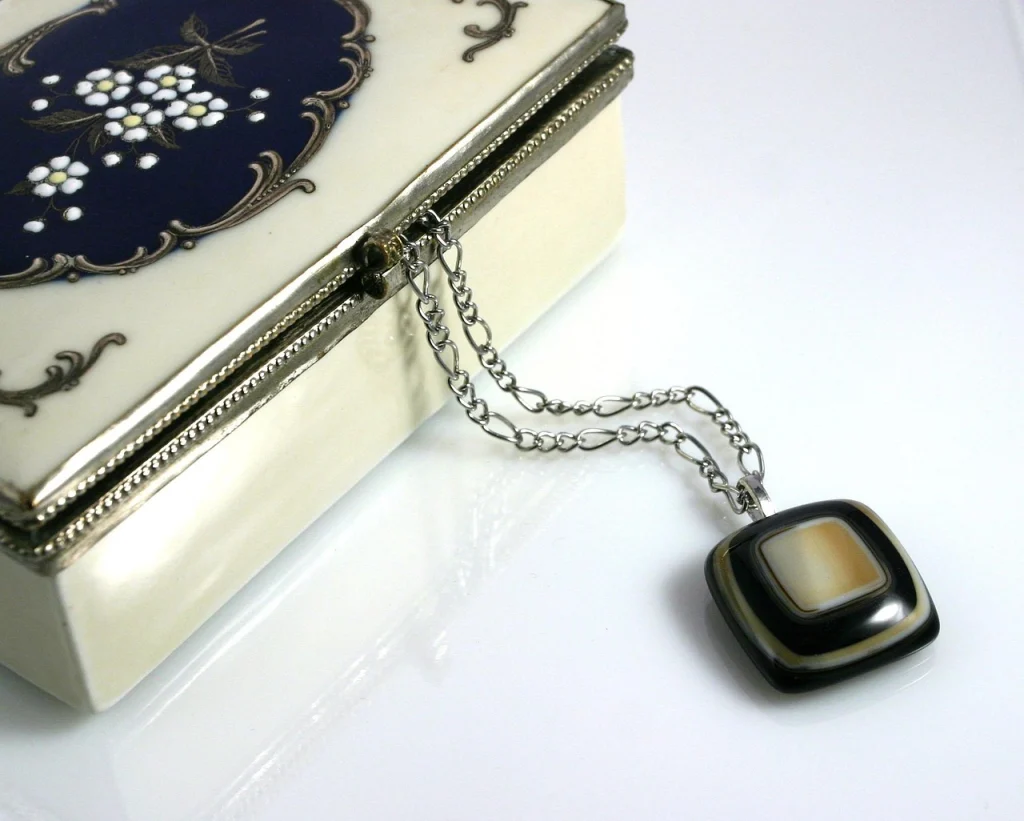
One earring of a pair
When part of a pair or set is stolen, the specimen’s Loss To A Pair Or Set condition lets the insurer choose to repair or replace a part to restore the set’s value, or pay the difference between the set’s actual cash value before and after the loss. It doesn’t have to pay for the whole set. Source: 2011 edition, Section I, Condition E (page 15 of the Maine copy); 2000 edition, Condition D.
Theft away from home
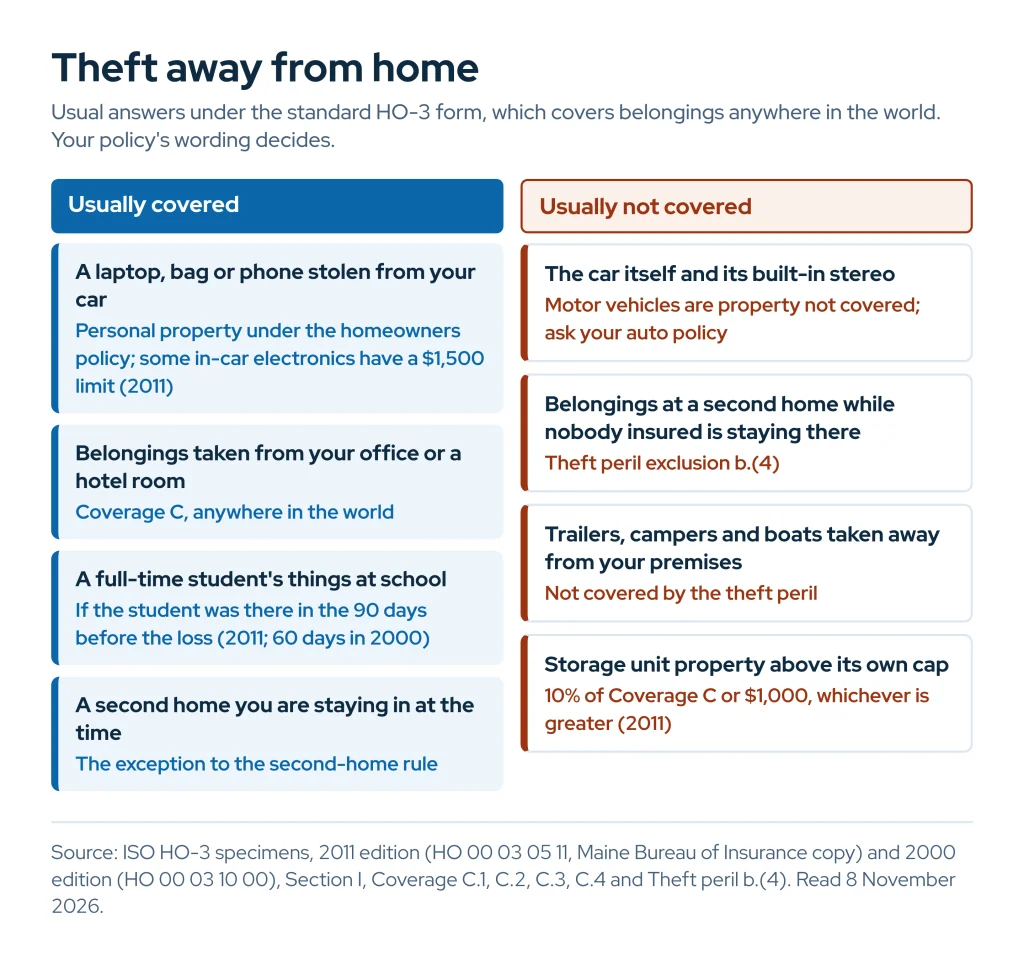
Because Coverage C follows your belongings anywhere in the world, theft away from home is usually covered. The exceptions are specific:
- From your car. Motor vehicles, and their equipment and parts, are property not covered, so the car and its built-in stereo are outside the homeowners form; that is a question for your auto policy. A laptop, a bag or a phone stolen from the car is personal property under the homeowners policy. In the 2011 edition, portable electronics are carved back in from the vehicle exclusion, and those that are in or on a motor vehicle and designed to run on more than one power source, one of which is the vehicle’s, carry the $1,500 special limit above.
- At a second home you own or rent. The theft peril doesn’t cover theft, off your residence premises, of property while it is at any other residence owned by, rented to or occupied by an insured, except while an insured is temporarily living there. A separate rule caps property usually kept at another residence at 10% of the Coverage C limit or $1,000, whichever is greater, with exceptions for property moved out while your home is being repaired and for property in a newly acquired main home, for 30 days from when you begin to move it there.
- A student away at school. A full-time student who lived with you before leaving for school is covered for theft at the student’s school residence if the student was there at any time during the 90 days before the loss in the 2011 edition. The 2000 edition said 60 days. Your policy may say something else, and its definition of “insured” sets age limits for students.
- Trailers, campers and boats. Theft away from the residence premises of trailers, semitrailers and campers, and of watercraft with their furnishings, equipment and motors, isn’t covered by the theft peril.
- A storage unit. The 2011 edition adds a separate limit for property in a self-storage facility: 10% of the Coverage C limit or $1,000, whichever is greater. It doesn’t apply to property moved out of your home because the home is being repaired, renovated or rebuilt and isn’t fit to live in or store property in, or to property usually kept at another residence of yours (the other-residence limit above covers that). The 2000 edition has no such clause. Your insurer’s own form may say something else; check it.
Sources: 2011 edition, Section I, Coverage C.1 and C.2.a and b (page 3 of the Maine copy), C.4.c (page 4) and Theft peril b.(4) (page 11); 2000 edition, Coverage C.1, C.2 and C.4.c and Theft peril b.(4).
What the theft peril leaves out
- Theft by an insured. “Insured” in the form means you and resident relatives, others under 21 in your household’s care, and some students, so theft by someone in that circle isn’t covered. Theft by a house cleaner, a contractor, a guest or a burglar is not caught by this exclusion.
- Rented-out space. Theft from the part of your home that you rent to someone other than an insured isn’t covered. The belongings of roomers, boarders and other tenants (other than those related to an insured) aren’t covered property at all, which is why a tenant needs their own renters policy.
- A house being built. Theft in or to a dwelling under construction, or of materials and supplies for it, isn’t covered until the house is finished and occupied. The same exclusion appears on the Coverage A and B side, so stolen lumber or appliances waiting to be installed fall outside the standard form’s cover.
- Intentional loss and fraud. The form excludes loss an insured causes or conspires to cause, and its Concealment Or Fraud condition takes away coverage for every insured if any insured intentionally conceals or misrepresents a material fact, engages in fraudulent conduct or makes false statements about the insurance, before or after a loss.
An empty house
You may read that theft cover stops once a home has been empty for a while. In the specimen, the 60-day vacancy wording sits in the vandalism and malicious mischief exclusion for the house (and, in the 2000 edition, in the glass breakage coverage too), not in the theft peril itself: vandalism is excluded if the dwelling has been vacant for more than 60 consecutive days before the loss, and a house being built doesn’t count as vacant. Your insurer’s own form or endorsements may add vacancy or unoccupancy conditions of their own. If a home will sit empty, during a sale, a probate or a long stay elsewhere, ask the insurer in writing what its form says before it happens. Source: 2011 edition, Section I, Perils Insured Against, A.2.c.(4) (page 9).
Theft after a storm, flood or earthquake
Homes left damaged or empty after a disaster are sometimes looted, and the standard form treats that theft differently from the damage that came before it. In the 2000 edition, the Earth Movement exclusion (earthquake, landslide, sinkhole and the like) says it “does not apply to loss by theft”, and the Water Damage exclusion (flood, surface water, sewer backup, water below the ground) says that direct loss by fire, explosion or theft resulting from water damage is covered. So belongings stolen from a house a flood or an earthquake damaged usually fall under the Theft peril, with its usual limits, exclusions and deductible, even though the flood or earthquake damage itself is excluded. The flood damage is a matter for a separate flood policy, such as one from the National Flood Insurance Program, which runs on federal rules, not state law. Two parts of the theft wording still matter here: theft from a second home is usually not covered unless an insured is staying there, and your insurer’s own form may add vacancy or unoccupancy conditions of its own. A condo (HO-6), renters (HO-4) or dwelling fire form, a FAIR plan or state wind pool policy and a surplus lines form can word theft and these exclusions differently; we have not read them for this page. A catastrophe can also bring state emergency orders that change claim clocks for a time; check your state insurance department’s page. Your policy’s wording decides. Source: 2000 edition, Section I, Exclusions A.2 and A.3 (pages 11 and 12), archived copy read 18 November 2026.
Stolen cards, checks and identity theft
The standard form has a small additional coverage, Credit Card, Electronic Fund Transfer Card Or Access Device, Forgery And Counterfeit Money. It pays up to $500 for an insured’s legal obligation from theft or unauthorized use of credit cards in an insured’s name, loss from theft or unauthorized use of a bank card, forgery or alteration of a check, and counterfeit US or Canadian paper money accepted in good faith. A series of acts by one person counts as one loss, and no deductible applies. It doesn’t cover use by a resident of your household, by someone you entrusted the card to, or where an insured didn’t comply with the card’s terms, and it excludes loss from business use or an insured’s dishonesty. Source: 2011 edition, Additional Coverage E.6 (pages 6 and 7); 2000 edition, same.
Federal rules usually limit what you owe on the card itself, which is often the bigger protection:
- Credit cards: a cardholder’s liability for unauthorized use “shall not exceed the lesser of $50” or what was obtained before you notified the issuer, if the card was an accepted card and the issuer met the rule’s notice and identification conditions (12 CFR 1026.12(b)).
- Debit and ATM cards: if you tell the bank within two business days after learning the card was lost or stolen, liability is capped at the lesser of $50 or the transfers before notice; later than that, at up to $500 under the rule’s conditions; and an unauthorized transfer on a statement must be reported within 60 days of the bank sending that statement to avoid liability for later transfers. The bank must extend these times for extenuating circumstances, and state law or your account agreement can give you more (12 CFR 1005.6(b)).
Identity theft itself, such as accounts opened in your name, isn’t a named peril in the standard form. Some policies carry an identity theft or identity fraud endorsement; look for one on your declarations page rather than assume it. For the recovery steps, the Federal Trade Commission runs IdentityTheft.gov, where a report gives you a personal recovery plan.
How a theft claim is valued
In the specimen, personal property is settled at actual cash value at the time of loss, but not more than the cost to repair or replace. The specimen doesn’t define actual cash value; it is usually worked out as replacement cost minus depreciation for age and wear, so a five-year-old laptop is not valued as a new one. Some policies add a replacement cost endorsement for personal property, which changes this; your declarations page shows whether you have one. Our actual cash value vs replacement cost calculator shows the arithmetic with your own numbers.
The deductible comes off the total of all loss payable under Section I. The form’s wording is that the insurer pays only the part of the total that exceeds the deductible shown in the declarations. Example: if $700 of tools are taken from a garage and the deductible is $1,000, the loss is below the deductible, so nothing is payable under that clause. Source: the Deductible provision at the start of Section I (2000 edition). Work through your own numbers with the home insurance deductible calculator. Whether a small theft claim is worth filing involves your claims history too; see should you file a home insurance claim.
If stolen property turns up after the insurer has paid for it, the Recovered Property condition says each side tells the other. At your option, you get the property back and the payment is adjusted for what you received, or it becomes the insurer’s. Source: 2011 edition, Section I, Condition O (page 16); 2000 edition, Condition N.
After a theft: what the policy asks of you
The specimen’s Duties After Loss condition lists what you must do. The form says the insurer has no duty to provide coverage if failing to do these things is prejudicial to it, roughly meaning the failure harmed the insurer’s position on the claim. In short:
- Notify the police. The form names this duty for theft losses. Ask for the report or case number and keep a copy.
- Give prompt notice to the insurer or agent. The form says “prompt”, not a number of days. Some states set notice-of-claim limits in statute; our claim deadlines by state show the ones we have read.
- Notify the card company or bank if cards or bank access devices were taken, both for the policy’s card coverage and for the federal limits above.
- Protect the property from further damage. Secure a broken door or window and keep the receipts.
- Prepare an inventory of what was taken, with quantity, description, actual cash value and amount of loss, and attach the bills, receipts and related documents that support the figures. Bank and card statements, photos, manuals, boxes with serial numbers and appraisals all help.
- Cooperate, and show records when asked. The insurer may ask for records and documents and, as often as it reasonably requires, an examination under oath, which is sworn questioning about the claim.
- Send a signed, sworn proof of loss within 60 days after the insurer asks for it. That is the specimen’s clock; your policy or state law may set another. Our page on proof of loss explains what goes in it.
Sources: 2011 edition, Section I, Condition C, Duties After Loss (page 14 of the Maine copy); 2000 edition, Condition B. The specimen’s Suit Against Us condition requires any lawsuit to start within two years after the date of loss; state law often changes this, and in most states we read the law sets the shortest limit a policy may give, not your deadline. The full sequence is on our page on how to file a homeowners insurance claim.
How often theft claims happen
Theft is a small share of homeowners claims. The Insurance Information Institute, a trade group, publishes ISO/Verisk figures showing theft at 0.6% of homeowners losses incurred in 2023 and 0.12 theft claims per 100 house-years on average over 2019 to 2023, for HO-2, HO-3 and HO-5 policies (and North Carolina’s HE-7), excluding renters and condo policies and Alaska, Texas and Puerto Rico (published estimate (trade group), read 8 November 2026). These describe the industry, not any one claim.
Claims you may see, checked
- “Homeowners insurance pays if your car is stolen.” Not under the standard form: motor vehicles and their parts are property not covered. Belongings inside the car are a different matter, as above.
- “Your landlord’s insurance covers your things.” Not under the standard form: the property of roomers, boarders and other tenants is listed as not covered, except roomers and boarders related to an insured.
- “Lost jewelry is covered as theft.” Only where the policy’s theft wording fits. The specimen’s peril reaches loss from a known place when theft is likely, not every lost item; the NAIC’s jewelry page notes that most policies protect against theft but that “you may need additional coverage to protect your jewelry against damage or loss”.
- “Cash is covered up to your contents limit.” Not in the specimen: money, bank notes and coins share a $200 special limit per loss.
Your next step
Report the theft to the police and get the report number. Then get the full policy, not just the declarations page: the Coverage C special limits, the theft peril with its exclusions, any scheduled personal property or replacement cost endorsement, and the Duties After Loss and Suit Against Us conditions. Gather what proves ownership and value: receipts, card and bank statements, photos, serial numbers and appraisals. Report the claim to the insurer in writing, keep a dated note of every call, and ask the insurer in writing which limit and which clause it is applying to each item. If you disagree with the answer, our page on a denied home insurance claim and the complaint links by state explain the next stage, and your state insurance department’s consumer line is free. What can’t wait: telling the police, your card issuer and your bank, written notice of the claim, any proof-of-loss date in a letter from your insurer, and your state’s suit-limit rule.
Sources checked on 8 November 2026, and the 2000 edition re-read on 18 November 2026 for the glass, vandalism, guest property and disaster-theft clauses: the ISO HO-3 specimen form (2011 edition, HO 00 03 05 11, Maine Bureau of Insurance copy, pages 3, 4, 6, 7, 9, 11, 14, 15, 16 and 17; 2000 edition, HO 00 03 10 00, Insurance Information Institute copy, archived 2 September 2026), 12 CFR 1026.12 and 1005.6 on eCFR, the NAIC’s homeowners insurance and jewelry consumer pages, the FTC’s IdentityTheft.gov and the Insurance Information Institute’s homeowners statistics page.
Sources
- ISO HO-3 specimen form, 2011 edition (HO 00 03 05 11), Maine Bureau of Insurance copy
- ISO HO-3 specimen form, 2000 edition (HO 00 03 10 00), Insurance Information Institute copy (trade group), archived 2 Sep 2026
- 12 CFR 1026.12(b), Regulation Z: liability of cardholder for unauthorized use (eCFR)
- 12 CFR 1005.6(b), Regulation E: liability of consumer for unauthorized transfers (eCFR)
- NAIC: Homeowners insurance consumer page
- NAIC: Learn how to insure expensive jewelry and gifts
- FTC: IdentityTheft.gov (report identity theft and get a recovery plan)
- Insurance Information Institute (trade group): Facts and statistics, homeowners and renters insurance (ISO/Verisk data, published estimate)