A flood claim under the National Flood Insurance Program (NFIP) runs on federal clocks, not your state’s. The policy gives you 60 days from the date of loss to send a signed, sworn proof of loss, unless FEMA extends that in writing. If the insurer denies all or part of the claim, you have 60 days from that written denial to appeal to FEMA. You have one year from the insurer’s first written denial to sue, and only in federal district court. An appeal does not pause that year. Those dates come from the Standard Flood Insurance Policy and FEMA’s appeal rule, both federal regulations, so every NFIP policyholder has the same rules. Your declarations page and any FEMA notice for your event still matter. This guide is part of our Water, Mold and Flood section.
General information, not legal or insurance advice, and not a substitute for the advice of an attorney. Your policy’s wording and your state’s law decide, and both change. For help with your claim, your state insurance department’s consumer line and legal aid are free.
This page covers the claim itself: the four dates, what the proof of loss must contain, how and when payment comes, and what to do with a denial letter. If you’re still asking whether flood is covered at all, start with the flood exclusion in a homeowners policy. Both pages sit in the same section.
The four dates at a glance
| Step | Time limit | What starts the clock | Source |
|---|---|---|---|
| Tell the insurer | “Prompt written notice”; no day count | The flood loss | SFIP Dwelling Form VII.G.1 |
| Send a signed, sworn proof of loss | Within 60 days | The date of loss | SFIP VII.G.4; FEMA can extend it in writing (44 CFR 61.13(d)) |
| Appeal a denial to FEMA | Within 60 calendar days | The date of the insurer’s written denial | 44 CFR 62.20(e)(1); FloodSmart appeal page |
| Sue | Within one year, in the US District Court where the property is | The insurer’s first written denial of all or part of the claim | SFIP VII.O; 42 U.S.C. 4072; 44 CFR 62.22; NFIP Claims Manual (June 2025) |
Which policy this page is about
NFIP flood insurance uses one federal policy, the Standard Flood Insurance Policy (SFIP), printed in full in the Code of Federal Regulations. The Dwelling Form is the one for a one- to four-family home or a single condominium unit, and for the belongings in it (SFIP I.A). Private companies, called Write Your Own insurers, sell and service it under their own names, but the wording is FEMA’s. The rules say no provision may be “altered, varied, or waived” except with the Federal Insurance Administrator’s express written consent (44 CFR 61.13(d); SFIP VII.C). Your agent can’t change the dates, and neither can the adjuster or the insurer.
Three things follow:
- Federal law, not state law. The policy says that it, and every dispute arising from how a claim is handled, is “governed exclusively” by FEMA’s flood insurance regulations, the National Flood Insurance Act and federal common law (SFIP X, What Law Governs). The state claim clocks and suit-limit rules in our claim deadlines by state are written for homeowners policies. They are not the clock for an NFIP claim.
- Other NFIP forms match on these dates. The General Property Form and the Residential Condominium Building Association Policy carry the same 60-day proof of loss and one-year suit wording, under different article numbers (appendices A(2) and A(3)).
- Private flood policies are different. A flood policy not issued under the NFIP usually follows its own wording and your state’s law. Nothing on this page applies to it.
After a hurricane you may have two claims for one storm: a flood claim under the SFIP and a wind claim under your homeowners policy. Each runs on its own clocks, even when one company handles both. The standard homeowners form (the ISO HO-3 specimen, 2000 edition) excludes flood “whether or not driven by wind,” and the SFIP excludes wind (V.D.8). Your homeowners policy’s own wording decides its side. Our page on wind damage roof claims covers the wind side.
The first days: notice, photos, cleanup
Under “Requirements in Case of Loss” (SFIP VII.G), the policy asks you to:
- give the insurer “prompt written notice.” FloodSmart, FEMA’s consumer site, says to start your claim as soon as possible after a flood by notifying your insurer;
- separate damaged from undamaged property, as soon as reasonably possible, so it can be inspected;
- prepare an inventory of damaged property with the quantity, description, actual cash value and amount of loss, and attach bills, receipts and related papers;
- cooperate with the adjuster.
FloodSmart adds practical steps: photograph or film everything before you throw it out, note the make, model and serial numbers of appliances and electronics, and keep samples of carpet and flooring. It also suggests talking to your agent or adjuster before signing a contract with a cleaning or maintenance contractor.
Don’t put off drying out the house while you wait for the adjuster. The SFIP excludes water, moisture, mildew or mold damage that results primarily from a condition within your control, and the policy’s list includes “failure to inspect and maintain the property after a flood recedes” (V.D.4). FloodSmart puts it more bluntly: “Standard NFIP policies do not cover mold damage.” The policy’s own exclusion is worded around conditions within your control, so how mold is treated on a claim turns on that wording and the facts; drying out promptly and keeping the receipts is what the policy asks of you. Two smaller coverages help: the policy pays up to $1,000 for sandbags, pumps, sheeting and similar supplies when flood is imminent, and up to $1,000 to move insured property to safety. The sandbag coverage also needs flooding in the area near the home or an official evacuation or similar order. No deductible applies to either (III.C.2; VI.C).
Advance payments. FloodSmart says that during major flood events your insurer “may offer up to $5,000 without an adjuster’s visit, official documentation or FEMA’s authorization,” and up to $20,000 with authorization and documentation. Any advance comes off the final payment. FEMA’s claims manual treats advances as available when FEMA authorizes them, and says that in a large flooding event FEMA generally does so by bulletin, so ask the insurer whether one is open for your event.
The proof of loss: 60 days from the date of loss
Of the four dates, this one comes first and is the easiest to miss. The policy says (VII.G.4):
“Within 60 days after the loss, send us a proof of loss, which is your statement of the amount you are claiming under the policy signed and sworn to by you…”
SFIP Dwelling Form, 44 CFR part 61, appendix A(1), VII.G.4
A proof of loss is your sworn statement of what you are claiming and why. The policy says it must give the date and time of loss, a brief explanation of how the loss happened, your interest in the property and anyone else’s, any other insurance, changes in title or occupancy during the policy term, specifications of damaged buildings with detailed repair estimates, mortgage holders and other lienholders, who occupied the building and for what, and the inventory of damaged belongings. It is your figure, not the adjuster’s: “you must use your own judgment concerning the amount of loss and justify that amount” (VII.G.5). For how a proof of loss works on any kind of claim, see our proof of loss guide.

Four parts of the policy wording are easy to miss:
- The adjuster’s help is a courtesy. The adjuster may give you the form and help you fill it in, “However, this is a matter of courtesy only,” and you must still send the proof of loss within 60 days even if they don’t (VII.G.7). The adjuster also has no authority to approve or deny the claim (VII.G.8).
- The adjuster’s report can stand in, at the insurer’s option. The insurer may accept the adjuster’s report in place of your proof of loss. You must sign it, and the insurer may ask you to swear to it (VII.G.9). It is the insurer’s choice, not a substitute you can count on.
- Amended proofs have the same deadline. If the insurer rejects your proof of loss in whole or in part, you may file an amended one “as long as it is filed within 60 days of the date of the loss” (VII.J.2.c).
- So do later requests for more money. FEMA’s NFIP Claims Manual (June 2025) says the policyholder must submit additional proofs of loss for additional payment “within the same time constraints.” The insurer has no authority to extend the deadline. For a late proof of loss, it must ask FEMA for a waiver and get approval before it pays. The manual adds that forms need no notary and electronic signatures are accepted.
Extensions are per event, in writing, from FEMA. After large floods FEMA sometimes extends the 60 days by bulletin, for listed events and dates of loss only. One example we read: for Hurricane Helene, bulletin W-24018 (19 December 2024) set the deadline at 180 calendar days from the date of loss for claims in seven states with dates of loss in late September and early October 2024. An earlier bulletin had set 120 days. That extension applied to Helene alone. FEMA’s bulletins are listed on its bulletin page. If you can’t find one for your flood, assume the policy’s 60 days and ask the insurer in writing.
Why this date matters so much. The policy says you may not sue unless you have “complied with all the requirements of the policy” (VII.O), and the proof of loss is one of them. FEMA’s suit rule, 44 CFR 62.22, describes suits after a claim is disallowed “on grounds other than failure to file a proof of loss.” The appeal rule also requires that you have met the policy’s requirements (62.20(b)). Read together, that wording means a missed proof-of-loss date can close off both routes, unless FEMA grants a waiver; the claims manual says a late proof of loss can be paid only after the insurer gets FEMA’s approval. If you disagree with the adjuster’s figure, the policy still expects your own sworn figure within the 60 days.
When the money comes, and how
- Timing. Loss is “payable 60 days after we receive your proof of loss,” or within 90 days after a signed adjuster’s report used in its place, once one of three things happens: you and the insurer agree, a court enters final judgment, or an appraisal award is filed (VII.J.1). FloodSmart says it “can take four to eight weeks” for a claim to be finalized and paid. FEMA’s claims manual expects insurers to accept or reject a proof of loss within seven to ten business days of receipt. That is FEMA’s guidance to insurers, not a term of your policy.
- Deductibles. Building and contents each have their own deductible in each flood (VI.B). Both amounts are on your declarations page.
- The mortgage company. Building payments go to you and any mortgagee “as interests appear” (VII.N.2). FEMA’s claims manual says the lender isn’t required on contents, other-coverage or ICC payments unless a loan is tied to that coverage, such as an SBA loan. Our mortgage check tool explains how lenders release the money.
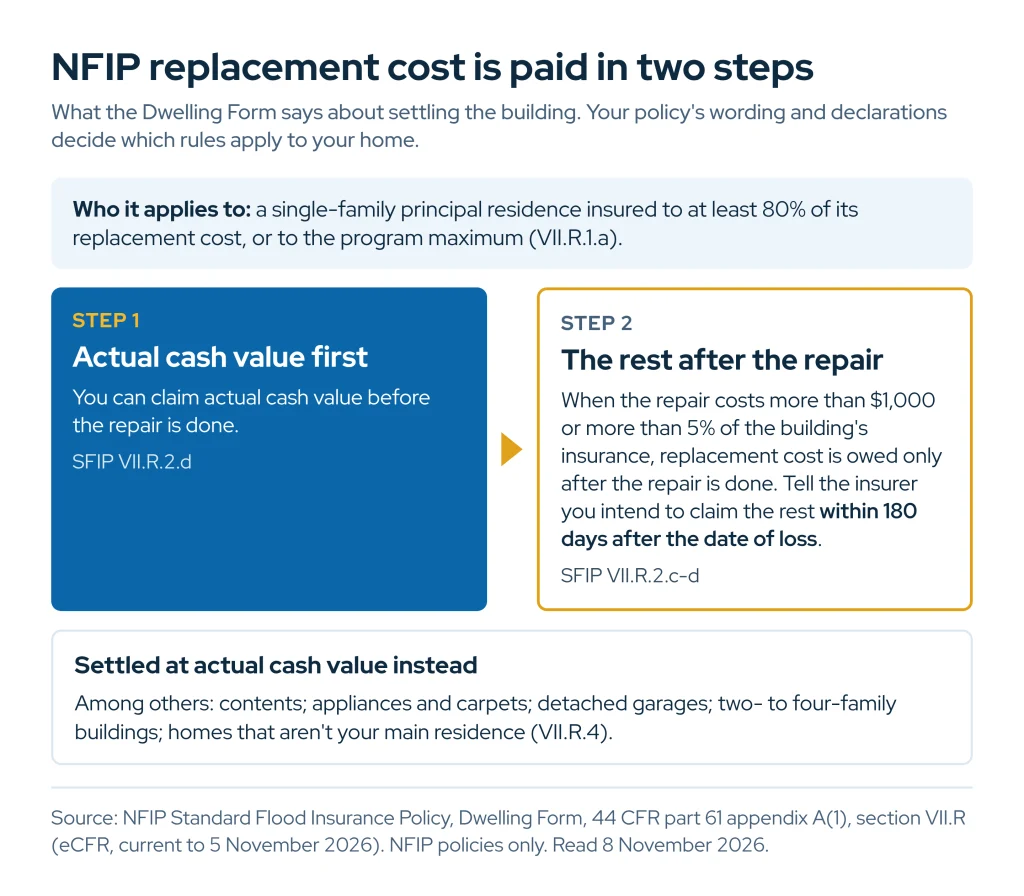
- Replacement cost is paid in two steps. For a single-family principal residence insured to at least 80% of its replacement cost (or to the program maximum), the building is settled at replacement cost (VII.R.1.a). When the repair costs more than $1,000 or more than 5% of the building’s insurance, the insurer owes the replacement cost only after the repair is done. You can claim actual cash value first and the rest later if you tell the insurer you intend to within 180 days after the date of loss (VII.R.2.c-d). Contents, appliances and carpets, detached garages, two- to four-family buildings and homes that aren’t your main residence are among the property settled at actual cash value (VII.R.4). For the two-check arithmetic, see our recoverable depreciation calculator.
- Limits. Under the regular program, the most you can buy is $250,000 for a one- to four-family building and $100,000 for residential contents (44 CFR 61.6). Increased Cost of Compliance coverage adds up to $30,000 toward elevating, floodproofing, moving or demolishing a building to meet local floodplain rules, within the statutory maximum. It applies only to a building that meets the policy’s substantial-damage or repetitive-loss test where the community enforces that rule (III.D). FEMA’s claims manual requires a separate signed ICC proof of loss.
The denial letter starts both clocks
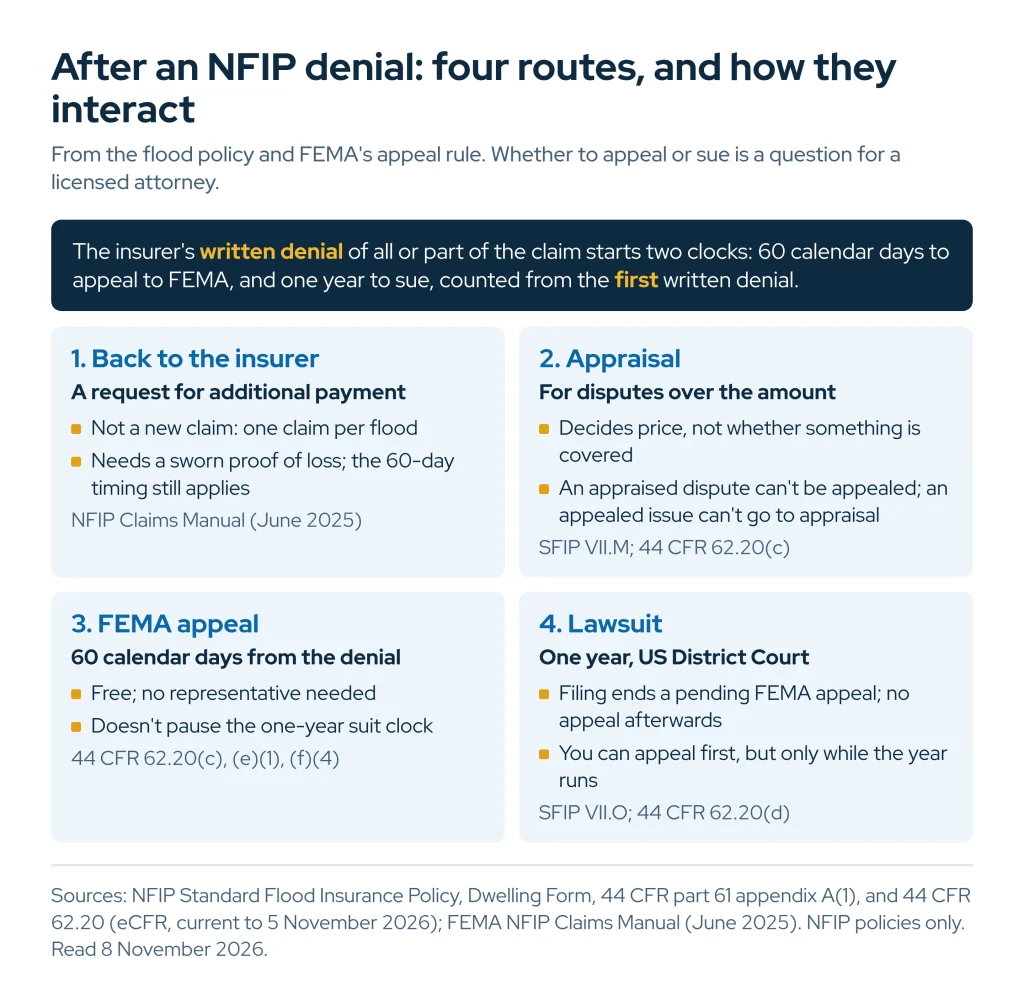
If the insurer won’t pay all or part of what you claimed, it must say so in writing. FEMA’s claims manual says the letter must give its date, the date of loss, the items denied with dollar amounts where possible, a plain-language reason with the policy section, and an attachment called Policyholder Rights. The manual says the date of the denial letter “begins the 60-day period to file an appeal” and the one-year period to sue. FEMA expects denial letters within ten business days of claim closure. Like the seven-to-ten-day guidance above, that is guidance to insurers.
Two details about the one-year clock matter:
- The first denial counts. The manual says the one-year period “begins with the insurer’s first written denial of the claim” and “Subsequent denial letters do not re-start” it. FloodSmart says the same: within one year of the date your insurer “first denied all or part of your claim.” If you got a partial denial in October and a second letter in January, the October letter starts the year.
- Letter date or mailing date. The policy counts from “the date of the written denial.” The statute, 42 U.S.C. 4072, and FEMA’s rule, 44 CFR 62.22, count from the date the notice of disallowance was mailed. These are usually the same day. If they differ, the safe reading is the earlier one. Keep the envelope.
Your options after a denial
FEMA’s Policyholder Rights sheet lists working with the insurer, a FEMA appeal and a lawsuit, and mentions appraisal; the policy sets out appraisal in full. The routes interact, so read all four before choosing.
1. Go back to the insurer
FEMA suggests starting with the adjuster and the insurer. If something was left off the estimate or priced at a lower quality than what you had, the manual describes a “request for additional payment.” It is not a new claim, since there is one claim per flood. It needs a sworn proof of loss and documents, and the timing rules above still apply to it. The manual says the insurer may not deny such a request only because repairs aren’t finished.
2. Appraisal, for disputes over price
If you and the insurer agree the flood damaged something but disagree on its actual cash value or replacement cost, either side may demand appraisal (VII.M). Each side picks an appraiser within 20 days of the other’s written request. If the two appraisers can’t agree on an umpire within 15 days, a judge in your state can choose one. Each side pays its own appraiser and splits the umpire’s cost and the other appraisal expenses. Appraisal decides the amount, not whether something is covered. It also shuts the FEMA appeal door: a dispute that has gone through appraisal can’t be appealed, and once you appeal an issue, it can no longer go to appraisal (44 CFR 62.20(c)). Our appraisal clause page explains the process in more detail.
3. Appeal to FEMA: 60 days, free
- Deadline. “Submit a written appeal to FEMA within 60 days from the date of the decision,” meaning the insurer’s written denial (62.20(a), (e)(1)). FloodSmart’s appeal page says FEMA counts calendar days, not business days. If the 60th day is a Saturday, Sunday or federal holiday, the window runs to the next day that isn’t one. A mailed appeal needs a postmark within the window, and an emailed one needs a time stamp within it.
- What to send. A written explanation of what you disagree with, a copy of the denial letter, your policy and claim details, and supporting documents (62.20(e)). The rule lists examples, including your proof of loss, room-by-room estimates, contents inventories with approximate ages, photos and engineering reports. FEMA has an appeal form, and the Policyholder Rights sheet gives the email address [email protected]. FEMA says emailed appeals are processed faster.
- Cost and help. No fee, and you don’t need a representative. If you use one, FEMA won’t pay for it and can’t discuss your claim with them without your written authorization (Policyholder Rights; FloodSmart).
- What happens next. FEMA acknowledges the appeal in writing. If it needs more information, it gives you at least 14 calendar days to send it. It decides in writing within 90 days after all the information is in. There is no further administrative review (62.20(f)).
- What an appeal can’t do. It can’t grant coverage or limits the policy doesn’t provide, and it “does not waive any of the requirements for perfecting a claim” or “extend any of the time limitations” (62.20(c)). The one-year suit clock keeps running, and “is not extended by the appeals process” (62.20(f)(4)).
4. A lawsuit: one year, federal court
The policy says: “If you do sue, you must start the suit within one year after the date of the written denial of all or part of the claim, and you must file the suit in the United States District Court of the district in which the insured property was located at the time of loss” (VII.O). This covers disputes about claim handling too. You sue the insurer that issued your policy. You sue FEMA only if NFIP Direct is your insurer (Policyholder Rights). Filing suit ends any pending FEMA appeal, and you can’t appeal afterwards (62.20(d)). You can appeal first and still sue, but only while the year is still running. FEMA’s manual says neither FEMA nor the insurer can extend that year. Whether to sue is a question for a licensed attorney. Your state bar’s lawyer referral service or legal aid can help you find one; ask early, not in month eleven.
Worked example: the dates on a calendar
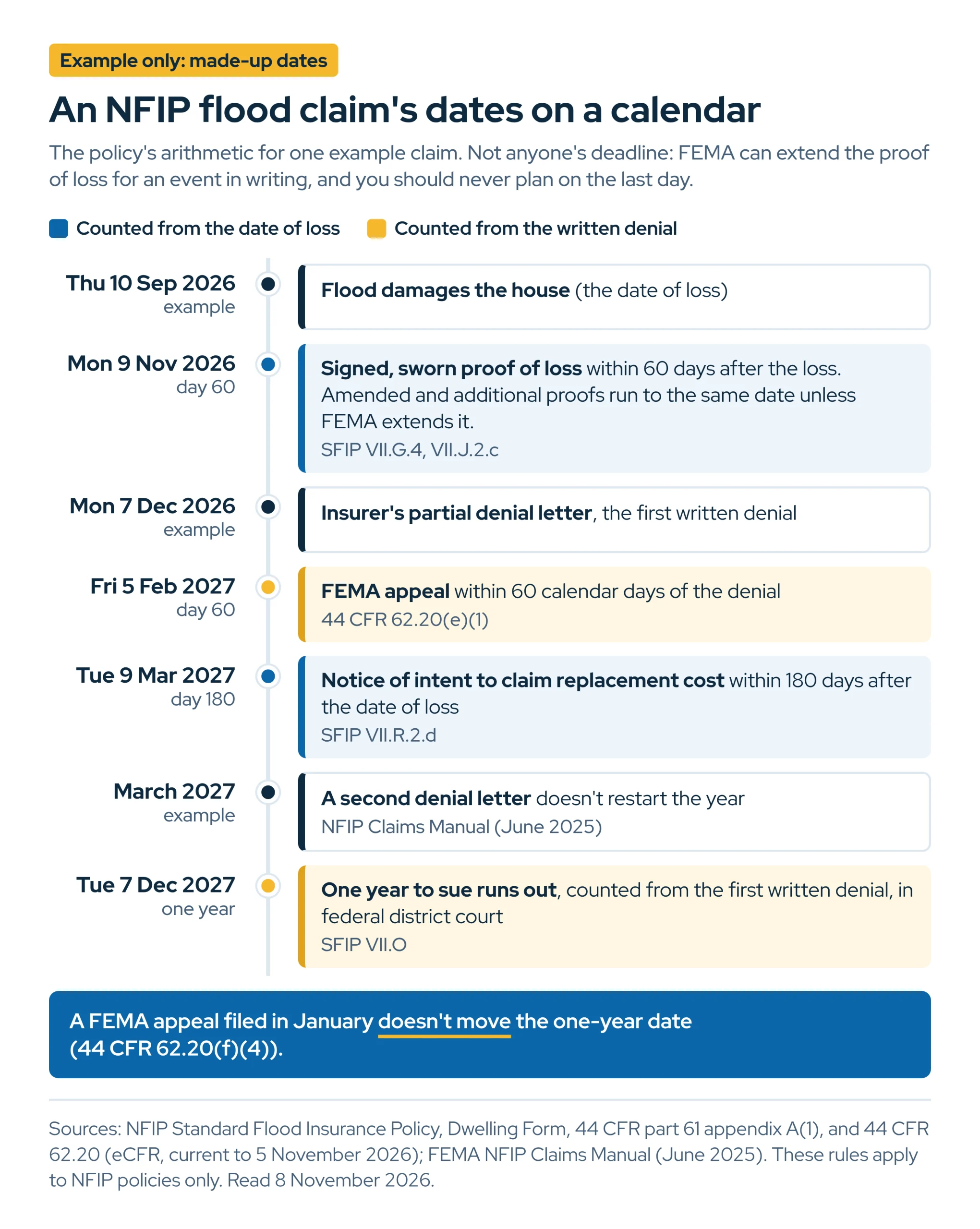
Example only, with made-up dates: the policy’s arithmetic from the dates below. Check for a FEMA extension for your event, and never plan on the last day.
| Example event | Rule | Arithmetic |
|---|---|---|
| Flood damages the house on Thursday 10 September 2026 | Proof of loss within 60 days after the loss (VII.G.4) | Day 60 is Monday 9 November 2026. Amended and additional proofs of loss run to the same date unless FEMA extends it. |
| Same date of loss | Notify intent to claim replacement cost within 180 days after the date of loss (VII.R.2.d) | Day 180 is Tuesday 9 March 2027 |
| Insurer’s partial denial letter dated Monday 7 December 2026 | FEMA appeal within 60 calendar days of the denial (62.20(e)(1)) | Day 60 is Friday 5 February 2027 |
| Same letter, the first written denial | Suit within one year of the written denial (VII.O) | The year runs out on Tuesday 7 December 2027. A FEMA appeal filed in January doesn’t move it. |
| A second denial letter arrives in March 2027 | Later letters don’t restart the year (NFIP Claims Manual, June 2025) | Still 7 December 2027, counted from the first letter |
Things you may read elsewhere
You may see these on other sites. We checked each one against the policy and FEMA’s rules.
- “You have 60 days to file a flood claim.” Not quite. Notice must be “prompt,” with no day count. The 60 days are for the signed, sworn proof of loss, counted from the date of loss.
- “Appealing to FEMA stops the clock on a lawsuit.” No. 44 CFR 62.20 says the appeal does not extend any time limit, and the year runs from the first written denial.
- “Your state’s prompt-payment law applies.” The SFIP says disputes are governed exclusively by federal law (X). Your homeowners policy for the same storm is a different matter.
- “The adjuster will take care of the proof of loss.” The policy calls the adjuster’s help “a matter of courtesy only.” The deadline stays yours.
- “Flood insurance covers everything in the basement.” No. In a basement, the policy covers a fixed list of items, mostly equipment such as furnaces, water heaters and sump pumps, plus cleanup (III.A.8, III.B.5). Our flood exclusion page, linked at the top, goes through the list.
If the NFIP’s authority lapses
Congress extends the NFIP’s authority in short steps. In guidance issued before a possible lapse in December 2024 (bulletin W-24020), FEMA told insurers that claims on policies already in force are “processed and paid as usual,” while new policies can’t be issued and renewals are limited. It added that during a lapse FEMA couldn’t borrow from the Treasury, so claims would be paid from money in the National Flood Insurance Fund and the Reserve Fund. That bulletin was written for the December 2024 deadline; guidance for any later lapse may differ. Check FloodSmart for the program’s current status. A lapse doesn’t change the policy’s 60-day and one-year dates.
Where to get help
- FEMA’s Office of the Flood Insurance Advocate, for questions the usual NFIP channels haven’t answered. FEMA’s bulletin W-26001 (2 June 2026) says it advocates “for the fair treatment of policyholders and property owners” and is reached through the “Ask the Advocate” button on its fema.gov page.
- Your state insurance department’s consumer line, for questions about an insurer’s conduct. Find it through the NAIC’s list of state departments or our complaint links by state.
- Legal aid or your state bar’s lawyer referral service for advice on a denial or a lawsuit. Our guide to a denied claim sets out the general options.
- Public adjusters are licensed by the states, and some states cap their fees; see our public adjuster rules by state. FEMA won’t pay for any representative on an appeal.
- FEMA disaster assistance is separate from flood insurance and available only after a presidential disaster declaration (FloodSmart). Our storm damage claims guide covers the first weeks after a large storm.
Your next step
- Write down the date of loss and count 60 days from it. That’s the policy’s proof-of-loss date unless FEMA has extended it for your event in writing.
- Gather: your declarations page, photos and video from before cleanup, the room-by-room inventory with ages and receipts, contractor estimates, and every letter from the insurer with its envelope.
- Read: the SFIP Dwelling Form, sections VII.G (Requirements in Case of Loss), VII.J (Loss Payment), VII.M (Appraisal) and VII.O (Suit Against Us).
- Do now: report the loss in writing, dry out the house and keep the receipts, and ask the insurer in writing whether an advance payment or a proof-of-loss extension applies to your event.
- Don’t wait on: the 60-day proof of loss, the 60-day appeal window after a written denial, and the one year to sue counted from the first written denial, which an appeal doesn’t pause.
Sources checked on 8 November 2026: the NFIP Standard Flood Insurance Policy, Dwelling Form (44 CFR part 61, appendix A(1)), with appendices A(2) and A(3), and 44 CFR 61.6, 61.13, 62.20 and 62.22 on eCFR (current to 5 November 2026); 42 U.S.C. 4072 (govinfo); FEMA’s NFIP Claims Manual (June 2025) and its Policyholder Rights attachment (Appendix F); FEMA bulletins W-24018, W-24020 and W-26001; FloodSmart’s start-a-claim and appeal pages.
Sources
- NFIP Standard Flood Insurance Policy, Dwelling Form, 44 CFR part 61 appendix A(1) (eCFR, current to 5 Nov 2026)
- 44 CFR 61.13, Standard Flood Insurance Policy (waivers only by the Federal Insurance Administrator)
- 44 CFR 61.6, Maximum amounts of coverage available
- 44 CFR 62.20, Claims appeals
- 44 CFR 62.22, Judicial review
- 42 U.S.C. 4072, Adjustment and payment of claims; judicial review; limitations; jurisdiction (govinfo)
- FEMA, NFIP Claims Manual (June 2025)
- FEMA, Policyholder Rights (NFIP Claims Manual Appendix F)
- FEMA bulletin W-24018, Hurricane Helene Proof of Loss Deadline Extension (19 Dec 2024)
- FEMA bulletin W-24020, Guidance on Potential Expiration in NFIP Authority (20 Dec 2024)
- FEMA bulletin W-26001, NFIP Program Changes Effective December 1, 2026 (2 Jun 2026; Office of the Flood Insurance Advocate text)
- FEMA Write Your Own bulletins index
- FloodSmart (FEMA), Start a claim
- FloodSmart (FEMA), Appeal a claim
- ISO HO-3 Homeowners 3 Special Form specimen, 2000 edition (HO 00 03 10 00), Insurance Information Institute copy
- NAIC, State insurance departments