A public adjuster is a licensed claims adjuster you hire and pay, usually a percentage of each insurance payment, to prepare and negotiate your property claim with your insurer. The insurer’s own adjuster costs you nothing; a public adjuster does. You don’t have to hire one; our guides to adjusters, disagreements and disputes cover the other routes. Whether there is a cap on the fee is state law, and it differs widely: Texas, South Carolina, Kentucky and Washington, DC cap it at 10% of the payment (Illinois too, on a personal residence), Florida at 20% on home and condo unit-owner policies (10% after a Governor’s emergency), New York at 12.5%, and several states, North Carolina, Oklahoma and Virginia among them, cap it only after a declared disaster. Most states we read also give you a short window to cancel the contract after you sign, from 2 business days in Maine to 10 business days in Maryland, and longer after a Governor’s emergency in Florida.
General information, not legal or insurance advice, and not a substitute for the advice of an attorney. Your policy’s wording and your state’s law decide, and both change. For help with your claim, your state insurance department’s consumer line and legal aid are free.
This lookup is part of those guides. Pick the state where the home is, enter an insurance payment and say whether the claim comes from a declared disaster. It shows the fee cap we read in that state’s statute or regulation, what the cap comes to in dollars on your number, the cancellation window and its unit. It is arithmetic on your numbers and the rule as we read it on 8 November 2026. It doesn’t say what your claim is worth, whether a public adjuster would change the outcome, or whether to hire one. Where we could not read a state’s law, it says “not confirmed”: that never means the state has no rule.
What a public adjuster is, and isn’t
Three kinds of adjuster can turn up on a home insurance claim. Several states make a public adjuster hand you a written disclosure before you sign that sets them out, in words like North Carolina’s (G.S. 58-33A-65(f)):
- Company adjuster: an employee of the insurance company, paid by it. “They will not charge you a fee.”
- Independent adjuster: hired on contract by the insurance company to represent its interest. Also paid by the insurer, also no fee to you.
- Public adjuster: works for you, “to assist in the preparation, presentation, and settlement of the claim”, and is paid by you under a signed contract, usually “a fee or commission based on a percentage of the settlement or other method of compensation”.
The same disclosure says you are not required to hire a public adjuster to meet your duties under the policy, that you can still talk directly to your insurer, its adjuster and its lawyer, and that the fee is your obligation, not the insurer’s. Louisiana, Maryland, Nebraska, Idaho, Virginia and South Carolina require much the same document (see the table for each statute).
What a public adjuster does in practice: documents the damage, writes an estimate, assembles the claim and the proof of loss (the sworn statement of what you are claiming), and negotiates with the insurer’s adjuster. What the laws we read bar them from doing:
- Practicing law. Public adjusters may not give legal advice (Florida 626.854(3); Texas Ins. Code 4102.156; New Mexico 13.4.8.14, and 13.4.8.17(B)(9) on the unauthorized practice of law). A lawyer acting for you is a different thing: Florida and Arizona leave licensed attorneys out of their definition of a public adjuster (626.854(1); A.R.S. 20-321), and Texas exempts a licensed attorney who meets a filing condition from its license requirement (4102.051(b)).
- Fixing what they adjust. Texas bars a contractor from acting as a public adjuster on property it works on, licensed or not, even with a power of attorney (4102.163). Florida bars contractors from public adjusting unless licensed (626.854(16)). Arizona (20-321.02(C)), Kentucky (304.9-4331(6)) and Oklahoma (36 O.S. 6220.1, with a small-town exception) keep adjusters out of the repair work.
- Acting unlicensed. In Texas a contract with an unlicensed person can be voided by the homeowner, who then owes nothing for the services (4102.207). Florida’s law says no one but a lawyer or a licensed public adjuster may, for pay, prepare or file a claim for you or negotiate it (626.854(20)).
Some states set out what the insurer must do in return. Florida’s law says an insurer may not exclude your public adjuster from its in-person meetings with you, and the public adjuster may not block the insurer’s inspection (626.854(15)). Texas says a residential policy may not forbid you from hiring a licensed public adjuster, including a surplus lines policy where Texas is your home state (4102.007). For how the insurer’s own adjuster works, see our guide to dealing with the insurance adjuster.
How the fee works
Many contracts charge a percentage of what the insurer pays. Some states also allow an hourly rate or a flat fee (Texas 4102.104(a); Kentucky 304.9-4333(2); Iowa 522C.10). The rules below come up again and again in the statutes we read. Each one applies only in the states named; check your own state’s row.

- The percentage must be written down. If the fee is a share of the settlement, the contract must state the exact percentage (Maryland 10-411(b)(2), North Carolina 58-33A-65(b)(1), Oklahoma 6216.2(D), where both sides initial it, Nebraska 44-9214(2)(b)).
- Paid as each check comes, not up front. No fee or retainer before the claim settles (South Carolina 38-92-120(E), Virginia 38.2-1845.14(A), New Mexico 13.4.8.17(D)(2), North Carolina in a catastrophe). Many states bar taking the whole fee out of the first check “rather than as a percentage of each check”, or collecting a fee on money the insurer owes but hasn’t paid (Louisiana 22:1704(D)(1), Maryland 10-411(e), Virginia 38.2-1845.14(E)).
- No fee on money paid before you signed. Florida sets the fee at 0% on any coverage the insurer paid or agreed in writing to pay before the contract (626.854(11)(b)4). Virginia (38.2-1845.14(D)) and Kentucky (304.9-4333(2)(b)) bar fees on earlier payments, and New York computes the fee on money paid after you retained the adjuster (11 NYCRR 25.7(a)).
- The policy-limits rule. If the insurer pays or commits in writing to pay the full policy limit soon after the loss is reported, the public adjuster may not take a percentage, only reasonable pay for time spent and expenses. The window is 72 hours in Texas, Maryland, North Carolina, Idaho, Nebraska, Montana, Oklahoma, Virginia and Louisiana; 5 business days in South Carolina and Illinois; 5 calendar days in Iowa; 3 days in North Dakota. Connecticut bars any fee when, within 30 days of a loss to a structure covered by a fire insurance policy, the insurer offers in writing to pay the full policy limits (38a-726(a)). Florida caps the fee at 1% on a coverage paid at its limit within 14 days of the loss or 10 days after the contract, whichever is later (626.854(11)(b)3).
- Florida’s other limits (residential and condo unit-owner policies only, 626.854(19)): no fee on the deductible; no fee on additional living expenses unless you sign a separate agreement for it; the rate may not go up because the claim goes to court; on a reopened or supplemental claim, no more than 20% of the new payments, and nothing on earlier payments (626.854(11)).
- Your name stays on the check. Texas requires the insured as a payee and the insured’s own signature and endorsement on every claim check (4102.104(c), (e)); Oklahoma requires the insured as joint payee on any payment to a public adjuster (6216.1). Several states bar contracts that make the insurer pay the adjuster alone.
If you have a mortgage, the lender is usually also on the check. Fannie Mae’s Servicing Guide tells servicers not to pay public adjuster or other third-party fees out of insurance proceeds unless Fannie Mae agrees in writing (B-5-01, read 8 November 2026). Your contract may still require you to pay the fee. Our mortgage check release tool shows how Fannie Mae and FHA loans release the money.
Fee caps and cancellation windows by state
Every row was read in the state’s own statute or regulation on 8 November 2026 unless it says otherwise. “No cap found” means no percentage limit appeared in the sections we read: an absence, not a rule that any fee is allowed. Fees must still be “reasonable” or “fair and reasonable” in several of those states. “Declared disaster” means what that state’s law says, and the triggers differ: the Governor in Florida, the President or the Governor in North Carolina and Virginia, the Insurance Commissioner in Oklahoma. “Not confirmed” means we could not read the law: the link goes to the state’s official code or regulations, and the state insurance department can tell you the rule.
| State | Fee cap | Cancel within |
|---|---|---|
| Alabama | – | – |
| Alaska | – | – |
| Arizona | None found | None found |
| Arkansas | – | – |
| California | None found | 3 bus. days* |
| Colorado | – | – |
| Connecticut | None found* | 4 days |
| Delaware | 2.5%, then 12% | 3 bus. days |
| District of Columbia | 10% | 3 bus. days |
| Florida | 20%; 10% emergency | 10 days* |
| Georgia | – | – |
| Hawaii | None found* | 3 bus. days |
| Idaho | None found* | 3 bus. days |
| Illinois | 10% on homes | 5 bus. days |
| Indiana | – | – |
| Iowa | 15%; 10% disaster | 3 bus. days |
| Kansas | 10% | 3 bus. days |
| Kentucky | 10%* | 5 bus. days* |
| Louisiana | – | 3 bus. days |
| Maine | None found | 2 bus. days |
| Maryland | None found* | 10 bus. days |
| Massachusetts | None found | 3 days |
| Michigan | 10% | 10 days* |
| Minnesota | None found | 72 hours |
| Mississippi | – | – |
| Missouri | None found | 3 bus. days |
| Montana | None found* | – |
| Nebraska | None found* | 3 bus. days |
| Nevada | None found | None found |
| New Hampshire | – | – |
| New Jersey | – | – |
| New Mexico | None; 10% disaster | 3 bus. days |
| New York | 12.5%* | 3 bus. days |
| North Carolina | None; 10% disaster | 3 bus. days |
| North Dakota | None; under 10% disaster | 3 days* |
| Ohio | None found | None found |
| Oklahoma | None; 10% disaster | 3 bus. days |
| Oregon | None found* | 3 bus. days |
| Pennsylvania | None now* | 4 days now* |
| Rhode Island | – | – |
| South Carolina | 10% | 5 bus. days |
| South Dakota | – | – |
| Tennessee | – | – |
| Texas | 10%* | 72 hours |
| Utah | 20%; 10% disaster* | 10 days |
| Vermont | – | – |
| Virginia | None; 10% disaster | 3 bus. days* |
| Washington | None found | None found |
| West Virginia | None; 10% catastrophe* | 3 bus. days* |
| Wisconsin | – | – |
| Wyoming | – | – |
Each state in full
Tap a state to open its full rules: the fee cap and its conditions, the cancellation window and what starts it, and the law we read.
Alabama: not confirmed
- Fee cap: Not confirmed. We found no public adjuster license in the Code of Alabama: its adjuster chapter licenses independent adjusters who work for insurers, and says it doesn’t let anyone who isn’t a lawyer practice law (Ala. Code 27-9A-3(a)). We found no text that bans or allows public adjusters outright, so ask the Alabama Department of Insurance before you sign anything
- Cancel the contract: Not confirmed
- Law read (11 Nov 2026): Ala. Code 27-9A-3, after a search of the Code of Alabama for “public adjuster”
Alaska: not confirmed
- Fee cap: Not confirmed
- Cancel the contract: Not confirmed
- Law read (8 Nov 2026 unless noted): Alaska Statutes (AS 21.27)
Arizona: fee cap none found · cancel window none found
- Fee cap: No cap found. “Adjuster” includes anyone adjusting for the insured, and needs a license
- Cancel the contract: No window found in the sections read
- Law read (8 Nov 2026 unless noted): A.R.S. 20-321, 20-321.01, 20-321.02
- The rest of the claim, from notice to the suit limit, is on our page on Arizona’s claim rules.
Arkansas: not confirmed
- Fee cap: Not confirmed
- Cancel the contract: Not confirmed
- Law read (8 Nov 2026 unless noted): Arkansas General Assembly
California: fee cap none found · cancel within 3 bus. days
- Fee cap: No percentage cap found; the contract must state the percentage and what it applies to
- Cancel the contract: 3 business days; 5 calendar days for a catastrophic disaster contract. No residential catastrophe solicitation until 7 calendar days after the loss-producing occurrence ends, unless you make contact
- Money held for you: until 31 December 2026, fiduciary funds go into an escrow or trust account within 15 business days of receipt. From 1 January 2027, within 15 calendar days of receipt (7 calendar days where the loss is in a catastrophic disaster, state of emergency or local emergency area), with a written statement to you, and the money is passed on to you within 30 calendar days of receipt (15 calendar days in those areas). The escrow rules don’t apply if the adjuster can’t get every payee’s endorsement after reasonable diligence or you say in writing that you don’t want an escrow account (Ins. Code 15028.7(c), (d), (f), as amended by SB 1206, Stats. 2026, ch. 685, read 18 Nov 2026)
- Law read (6 Nov 2026 unless noted): Ins. Code 15027, 15027.1 in the Legislative Counsel’s official text; SB 1206 (ch. 685) and its Legislative Counsel’s Digest on 18 Nov 2026
- The rest of the claim, from notice to the suit limit, is on our page on California’s public adjuster and claim rules.
Colorado: not confirmed
- Fee cap: Not confirmed
- Cancel the contract: Not confirmed
- Law read (8 Nov 2026 unless noted): Colorado Revised Statutes (10-2-417)
Connecticut: fee cap none found · cancel within 4 days
- Fee cap: No percentage cap found. No fee at all if, within 30 days of a loss to a structure covered by a fire insurance policy, the insurer offers the full policy limits in writing; fee only on money you actually receive
- Cancel the contract: Until midnight of the 4th calendar day after you sign (signed Friday to Sunday: midnight of the next Thursday)
- Law read (8 Nov 2026 unless noted): C.G.S. 38a-724, 38a-726
Delaware: fee cap 2.5%, then 12% · cancel within 3 bus. days
- Fee cap: 2.5% of the first $25,000 of the total recovery, plus up to 12% of the recovery above $25,000
- Cancel the contract: Until midnight of the 3rd business day after you sign
- Law read (8 Nov 2026 unless noted): 18 Del. C. 1756(b), (e)
District of Columbia: fee cap 10% · cancel within 3 bus. days
- Fee cap: 10% of the total insurance recovery
- Cancel the contract: Until midnight of the 3rd business day after you sign
- Law read (8 Nov 2026 unless noted): D.C. Code 31-1631.08(b), (e)
Florida: fee cap 20%; 10% emergency · cancel within 10 days
- Fee cap: Residential and condo unit-owner policies: 20%; 10% for claims from an event under a Governor’s emergency declaration, made in the year after it; 1% and 0% tiers (see above)
- Cancel the contract: 10 days after the contract is signed; emergency: 30 days after the loss or 10 days after signing, whichever is longer. Also if no written estimate within 60 days
- Law read (8 Nov 2026 unless noted): Fla. Stat. 626.854(7), (11), (12), (19) (2026 Statutes, through ch. 2026-174)
Georgia: not confirmed
- Fee cap: Not confirmed
- Cancel the contract: Not confirmed
- Law read (8 Nov 2026 unless noted): Georgia General Assembly (O.C.G.A. 33-23-43.x)
Hawaii: fee cap none found · cancel within 3 bus. days
- Fee cap: No percentage cap found, but the commissioner can rule a fee unreasonable, and a percentage fee must be stated exactly in the contract. No percentage fee if the insurer pays or commits in writing to pay the coverage limits within 72 hours after the loss is reported
- Cancel the contract: 3 business days after the date the contract was signed, in writing; anything of value you gave must be returned within 15 business days
- Law read (11 Nov 2026): HRS 431:9-244(c), (d), (f), (g)
Idaho: fee cap none found · cancel within 3 bus. days
- Fee cap: No cap found; no percentage fee if limits are paid or committed within 72 hours
- Cancel the contract: 3 business days after you sign
- Law read (8 Nov 2026 unless noted): Idaho Code 41-5814, 41-5815
Illinois: fee cap 10% on homes · cancel within 5 bus. days
- Fee cap: Personal residence: 10% of the amount paid, on any claim. Other property: 10% on catastrophic-event claims unless the Director approves more
- Cancel the contract: Voidable for 5 business days after the insurer receives the contract
- Other rules: if the insurer pays or commits in writing to pay the policy limit within 5 business days after the loss is reported, no percentage fee, only reasonable pay for time and expenses (1575(c)); no services other than emergency services before a written contract on a Director-approved form; no proposal to represent you while the loss is still happening, while the fire department is at the premises, or between 7:00 p.m. and 8:00 a.m. (1590(b)). License fee $250 for a resident, $500 for a non-resident, every 2 years, from 1 January 2026 (1563, P.A. 104-334)
- Law read (18 Nov 2026): 215 ILCS 5/1570(d), (e) (P.A. 103-216, effective 1 Jan 2024); 1575(c), (j); 1590(b); 1563
- The rest of the claim, from notice to the suit limit, is on our page on Illinois claim rules.
Indiana: not confirmed
- Fee cap: Not confirmed
- Cancel the contract: Not confirmed
- Law read (8 Nov 2026 unless noted): Indiana Code (IC 27-1-27)
Iowa: fee cap 15%; 10% disaster · cancel within 3 bus. days
- Fee cap: 15% of claim payments; 10% for a catastrophic disaster (includes a President’s major disaster or Governor’s disaster proclamation)
- Cancel the contract: The contract must give the rescission process and notice of your rights under Iowa’s door-to-door sales law (522C.10(1)(a)(14)), which lets you cancel until midnight of the 3rd business day after the date of the transaction (Iowa Code 555A.2, 555A.3, read 11 Nov 2026)
- Law read (8 Nov 2026 unless noted): Iowa Code 522C.2(4), 522C.10 (2026 Code); ch. 555A, 11 Nov 2026
Kansas: fee cap 10% · cancel within 3 bus. days
- Fee cap: 10% of any insurance settlement or proceeds; no fee, retainer or deposit before the claim is settled. Kansas’s Public Adjusters Licensing Act defines a public adjuster by claims “limited to commercial lines insurance contracts”, so for a homeowners policy ask the Kansas Insurance Department whether anyone may act as your public adjuster
- Cancel the contract: In writing within 3 business days after the contract was signed; anything of value you gave is returned within 15 business days
- Law read (11 Nov 2026): K.S.A. 40-5513, 40-5502(l), 40-5514
Kentucky: fee cap 10% · cancel within 5 bus. days
- Fee cap: 10% of settlement proceeds actually received. No new public adjuster licenses for 2 years from 13 April 2026 (holders of a temporary or apprentice license on that date may still apply; existing licenses can be renewed), and for 2 years from 15 July 2026 a public adjuster may not negotiate with an insurer for you
- Cancel the contract: 5 business days after you get a physical copy of the contract (an emailed copy doesn’t count); for a contract based on events under a state of emergency declared by the Governor or a local chief executive or local government, 10 days after signing (the statute doesn’t say calendar or business days). Rescind in writing, mailed or delivered to the address in the contract, postmarked or received within the window; anything of value you gave comes back within 15 business days
- Other rules: the fee is based only on proceeds you actually received and is collected after you receive them; nothing on money received before the contract or before the rescission period ends; no services before the rescission period ends unless the contract is on an approved emergency form; a contract that breaks the chapter isn’t enforceable. These versions apply to contracts entered into on or after 15 July 2026
- Law read (18 Nov 2026): KRS 304.9-4333, 304.9-433(1), (8)-(11), 304.9-430(1), 304.9-4331(7) (2026 Ky. Acts ch. 141)
- The rest of the claim, from notice to the suit limit, is on our page on Kentucky claim rules under the 2026 law.
Louisiana: fee cap not confirmed · cancel within 3 bus. days
- Fee cap: Not confirmed. 22:1703(A) as printed bars fees “contingent upon, or calculated as a percentage of” the claim, while 22:1704(D)(1) speaks of a fee taken “as a percentage of each check”. Ask the Louisiana Department of Insurance
- Cancel the contract: 3 business days after you sign, in writing
- Law read (8 Nov 2026 unless noted): La. R.S. 22:1703, 22:1704(H)
Maine: fee cap none found · cancel within 2 bus. days
- Fee cap: No cap found in the adjuster subchapter (24-A §§1471 to 1477, read 11 Nov 2026); the Superintendent’s rules under §1473 were not read. No contract may be offered for 36 hours after the loss
- Cancel the contract: 2 business days after signing, printed on page 1 of the contract
- Law read (8 Nov 2026 unless noted): 24-A M.R.S. §1476; §§1471 to 1477, 11 Nov 2026
Maryland: fee cap none found · cancel within 10 bus. days
- Fee cap: No percentage cap found; no percentage fee if limits are paid or committed within 72 hours
- Cancel the contract: 10 business days after signing
- Law read (8 Nov 2026 unless noted): Md. Code, Ins. 10-411(c), (h)
Massachusetts: fee cap none found · cancel within 3 days
- Fee cap: No cap found
- Cancel the contract: 3 calendar days after you receive a copy of the contract; later revocation is subject to the adjuster’s lien for the agreed fee
- Law read (8 Nov 2026 unless noted): M.G.L. c. 175, s. 172
Michigan: fee cap 10% · cancel see conditions
- Fee cap: 10% of the amount the insurer pays in settlement of the loss
- Cancel the contract: A contract signed within 48 hours after the loss-producing occurrence ends is voidable at your option for 10 days after signing. The contract must be on a form approved by the commissioner, and you get a copy
- Law read (11 Nov 2026; 500.1226(4) re-read 18 Nov 2026): MCL 500.1226(3), (4)
- The rest of the claim, from notice to the suit limit, is on our page on Michigan claim rules.
Minnesota: fee cap none found · cancel within 72 hours
- Fee cap: No cap found
- Cancel the contract: 72 hours after the contract is signed
- Law read (8 Nov 2026 unless noted): Minn. Stat. 72B.135
- The rest of the claim, from notice to the suit limit, is on our page on Minnesota’s claim rules.
Mississippi: not confirmed
- Fee cap: Not confirmed in official text on 8 Nov 2026; ask the state insurance department
- Cancel the contract: Not confirmed
- Law read (8 Nov 2026 unless noted): Mississippi Insurance Department regulations
Missouri: fee cap none found · cancel within 3 bus. days
- Fee cap: No cap found in the public adjuster chapter, RSMo ch. 325 (read 11 Nov 2026). The Department of Commerce and Insurance’s rules (20 CSR) could not be opened from any route we tried, so ask the department
- Cancel the contract: Until midnight of the 3rd business day after signing
- Law read (8 Nov 2026 unless noted): RSMo 325.050; ch. 325, 11 Nov 2026
Montana: fee cap none found · cancel window not confirmed
- Fee cap: No percentage cap found; no percentage fee if limits are paid or committed within 72 hours
- Cancel the contract: Not confirmed
- Law read (8 Nov 2026 unless noted): MCA 33-17-302 (read 6 Nov 2026 in official text; the site refused us on 8 Nov)
Nebraska: fee cap none found · cancel within 3 bus. days
- Fee cap: No cap found; no percentage fee if limits are paid or committed within 72 hours
- Cancel the contract: 3 business days after signing
- Law read (8 Nov 2026 unless noted): Neb. Rev. Stat. 44-9214
Nevada: fee cap none found · cancel window none found
- Fee cap: No cap found in NRS 684A or NAC 684A
- Cancel the contract: No window found in the sections read
- Law read (11 Nov 2026): NRS ch. 684A, NAC ch. 684A
New Hampshire: not confirmed
- Fee cap: Not confirmed in official text on 8 Nov 2026; ask the state insurance department
- Cancel the contract: Not confirmed
- Law read (8 Nov 2026 unless noted): RSA (RSA 402-D)
New Jersey: not confirmed
- Fee cap: Not confirmed
- Cancel the contract: Not confirmed
- Law read (8 Nov 2026 unless noted): Department of Banking and Insurance
New Mexico: fee cap None; 10% disaster · cancel within 3 bus. days
- Fee cap: No cap found for ordinary claims; 10% of any settlement or proceeds in a catastrophic disaster (declared by the President, the Governor or the superintendent of insurance). No fee before settlement
- Cancel the contract: 3 business days after the date the contract was signed, in writing, mailed or delivered to the address in the contract; anything of value you gave must be returned within 15 business days (59A-13-15(M), (N)). The contract must state the exact percentage, and no percentage fee is allowed if the insurer pays or commits in writing to pay the policy limit within 72 hours after the loss is reported (59A-13-15(C), (F))
- Law read (8 Nov 2026 unless noted): 13.4.8.17 NMAC; NMSA 1978, 59A-13-15 (read 11 Nov 2026)
New York: fee cap 12.5% · cancel within 3 bus. days
- Fee cap: 12.5% of the recovery; up to 20% on a supplemental claim if the total fee stays at or under 12.5% of the full claim payment. Referral payments count toward the cap
- Cancel the contract: The compensation agreement notice set out in DFS’s amended Regulation 10 says you may cancel before midnight of the 3rd business day after you sign. Insurance Law 2108(p) also applies the state’s door-to-door sales law, whose required notice gives the same window: cancel before midnight of the 3rd business day after the transaction (Personal Property Law 428, read 11 Nov 2026)
- Law read (8 Nov 2026 unless noted): Ins. Law 2108(p); 11 NYCRR 25.7 as amended (DFS Seventh Amendment to Regulation 10, read in DFS’s own text; the compiled regulation was not opened)
- The rest of the claim, from notice to the suit limit, is on our page on New York claim rules.
North Carolina: fee cap None; 10% disaster · cancel within 3 bus. days
- Fee cap: No cap found for ordinary claims; 10% in a catastrophic incident declared by the President or the Governor, and no fee before settlement
- Cancel the contract: 3 business days after signing
- Law read (8 Nov 2026 unless noted): G.S. 58-33A-5(2), -60(d), -65(i)
North Dakota: fee cap None; under 10% disaster · cancel within 3 days
- Fee cap: No cap found for ordinary claims; in a catastrophic disaster the fee must be less than 10%
- Cancel the contract: “Within three days after the claim is submitted to the insurer”; the same sentence calls it a “three business-day period”
- Law read (8 Nov 2026 unless noted): N.D.C.C. 26.1-26.8-13(12), -16(3)
Ohio: fee cap none found · cancel window none found
- Fee cap: No cap found. The fee must be set out conspicuously in the contract, and the contract form is filed with the superintendent before use
- Cancel the contract: No window found in the sections read
- Law read (11 Nov 2026): Ohio Rev. Code ch. 3951, Ohio Adm. Code 3901-1-24
Oklahoma: fee cap None; 10% disaster · cancel within 3 bus. days
- Fee cap: No cap found for ordinary claims; 10% on claims from a catastrophe the Insurance Commissioner declares an emergency (not for a for-profit commercial client)
- Cancel the contract: Until midnight of the 3rd business day after you are given the signed agreement
- Law read (8 Nov 2026 unless noted): 36 O.S. 6216.2, 6218(C) (compiled through the 2025 session)
Oregon: fee cap none found · cancel within 3 bus. days
- Fee cap: No cap found; the contract must state the exact percentage, and no percentage fee is allowed if the insurer pays or commits to pay the policy limits within 72 hours
- Cancel the contract: 3 business days after signing; anything of value you gave is returned within 15 business days
- Law read (11 Nov 2026): OAR 836-071-1100 to 836-071-1195 (836-071-1165, effective 1 Aug 2025); ORS 744.505 ff.
Pennsylvania: fee cap None now · cancel within 4 days now
- Fee cap: Now: no cap found in 31 Pa. Code 115.2. Act 77 of 2026 sets 10% for catastrophic claims and 20% for others once it takes effect, 180 days after 22 October 2026 (our count: 20 April 2027)
- Cancel the contract: Now: before midnight of the 4th calendar day after signing. Under Act 77: 3 business days; 5 business days if signed within 48 hours of the loss after in-person solicitation at the scene; 10 business days for catastrophic claims (the Act’s text we read does not say what starts the count)
- Law read (8 Nov 2026 unless noted): 31 Pa. Code 115.2; HB 1972, Act 77 of 2026 (PN 3550)
Rhode Island: not confirmed
- Fee cap: Not confirmed
- Cancel the contract: Not confirmed
- Law read (8 Nov 2026 unless noted): R.I. Gen. Laws ch. 27-10
South Carolina: fee cap 10% · cancel within 5 bus. days
- Fee cap: 10% of any insurance settlement or proceeds, ordinary or catastrophe; no fee before settlement
- Cancel the contract: 5 business days after the date you signed, in writing, mailed, emailed or delivered to the address in the contract; anything of value you gave comes back within 15 business days of the adjuster receiving the notice
- Other rules: if the insurer pays or commits in writing to pay the full policy limit within 5 business days after the loss is reported, no percentage fee, only reasonable pay for time and expenses, never more than 10% (130(C)); no taking the whole fee from the first check or a fee on money owed but not yet paid (130(E)); funds held for you go into an escrow or trust account in South Carolina (150); no soliciting you while the loss-producing occurrence is in progress, no advertising damage before an inspection, and no offer to pay or waive your deductible (170(C)-(E))
- Law read (18 Nov 2026): S.C. Code 38-92-120(E), 38-92-130, 38-92-150, 38-92-170 (Act 209 of 2026, approved and effective 19 May 2026)
- The rest of the claim, from notice to the suit limit, is on our page on South Carolina claim rules under Act 209.
South Dakota: not confirmed
- Fee cap: Not confirmed
- Cancel the contract: Not confirmed
- Law read (8 Nov 2026 unless noted): South Dakota Codified Laws
Tennessee: not confirmed
- Fee cap: Not confirmed. Tennessee licenses public adjusters (T.C.A. 56-6-901 and following); the department’s public adjuster rules cover licensing, exams and complaints, with no fee cap
- Cancel the contract: Not confirmed: the rules have no cancellation clause, and the statute is not on a free official site we could open
- Law read (11 Nov 2026): Tenn. Comp. R. & Regs. 0780-01-91 (Public Adjusters)
Texas: fee cap 10% · cancel within 72 hours
- Fee cap: 10% of the settlement, whatever the method (hourly, flat or percentage); no percentage fee if limits are paid or committed within 72 hours of the loss report
- Cancel the contract: 72 hours after signing, by written notice
- Law read (8 Nov 2026 unless noted): Tex. Ins. Code 4102.103(b), 4102.104
Utah: fee cap 20%; 10% catastrophic · cancel within 10 days
- Fee cap: 20% of a non-catastrophic claim settlement, 10% of a catastrophic one; no fee or deposit before the claim is settled, and no percentage fee if the insurer pays or commits in writing to pay the policy limit within 72 hours after the loss is reported
- Cancel the contract: Written notice within 10 days of signing, unless the adjuster has already got an acceptable settlement; anything of value is returned within 15 business days
- Law read (11 Nov 2026): Utah Code 31A-26-402 (amended 2026), 31A-26-311, 31A-26-401
Vermont: not confirmed
- Fee cap: Not confirmed
- Cancel the contract: Not confirmed
- Law read (8 Nov 2026 unless noted): Vermont Statutes
Virginia: fee cap None; 10% disaster · cancel within 3 bus. days
- Fee cap: Ordinary claims: “fair and reasonable”, no percentage set. Catastrophic disaster (a President’s or Governor’s state of emergency): 10% of settlement proceeds, expenses included
- Cancel the contract: 3 business days after signing; 5 business days in a catastrophic disaster
- Law read (8 Nov 2026 unless noted): Va. Code 38.2-1845.1, 1845.13(A)(12), 1845.14 (as amended 2026, c. 142)
- The rest of the claim, from notice to the suit limit, is on our page on Virginia’s claim rules.
Washington: fee cap none found · cancel window none found
- Fee cap: No cap found in RCW 48.17 or WAC 284-17
- Cancel the contract: No window found in the sections read
- Law read (11 Nov 2026): RCW ch. 48.17, WAC ch. 284-17
- The rest of the claim, from notice to the suit limit, is on our page on Washington’s claim rules.
West Virginia: fee cap none; 10% catastrophe · cancel within 3 bus. days
- Fee cap: Any fee must be reasonable. In a catastrophe, no more than 10% of any settlement or proceeds, and no fee or deposit before the claim is settled (the rule doesn’t define “catastrophe”). No percentage fee if the insurer pays or commits in writing to pay the policy limit within 72 hours after the loss is reported
- Cancel the contract: 3 business days after the date you signed, in writing; a letter postmarked inside the 3 days counts. Separately, a contract signed within 48 hours after the loss-causing event ends is voidable at your option for 10 days after signing
- Law read (11 Nov 2026): W. Va. Code R. 114-25 (effective 8 April 2026), 114-25-11.3, -11.6.8, -12.1, -12.4 and -15.4; the statute is W. Va. Code ch. 33, art. 12B
Wisconsin: not confirmed
- Fee cap: Not confirmed in official text on 8 Nov 2026; ask the state insurance department
- Cancel the contract: Not confirmed
- Law read (8 Nov 2026 unless noted): Wisconsin Statutes ch. 628
Wyoming: not confirmed
- Fee cap: Not confirmed
- Cancel the contract: Not confirmed
- Law read (8 Nov 2026 unless noted): Wyoming Statutes
Model law, for context only: the National Association of Insurance Commissioners’ Public Adjuster Licensing Model Act (#228, 2025 version) suggests 10% on catastrophic claims and 15% on any claim, a 3-business-day rescission and no fee before settlement. Several statutes in the table use its wording; a model is not any state’s law until that state passes it.
A worked example
General information, not legal or insurance advice, and not a substitute for the advice of an attorney. The numbers below are a made-up example, not anyone’s claim.
Example: a homeowner signs with a public adjuster after a kitchen fire, and the insurer later pays $40,000 under the policy. Here is the most the fee could be under the cap in five places, as we read them. The contract can set a lower percentage, and the cap is a ceiling, not a price.
| State (example) | Rule read | Most the fee could be on $40,000 |
|---|---|---|
| Texas | 10% of the settlement | $4,000 |
| Florida, ordinary claim | 20% | $8,000 |
| Florida, Governor’s emergency, first year | 10% | $4,000 |
| Delaware | 2.5% of $25,000 ($625) plus up to 12% of $15,000 ($1,800) | $2,425 |
| New York | 12.5% of the recovery | $5,000 |
| North Carolina, ordinary claim | No cap found | No statutory figure |
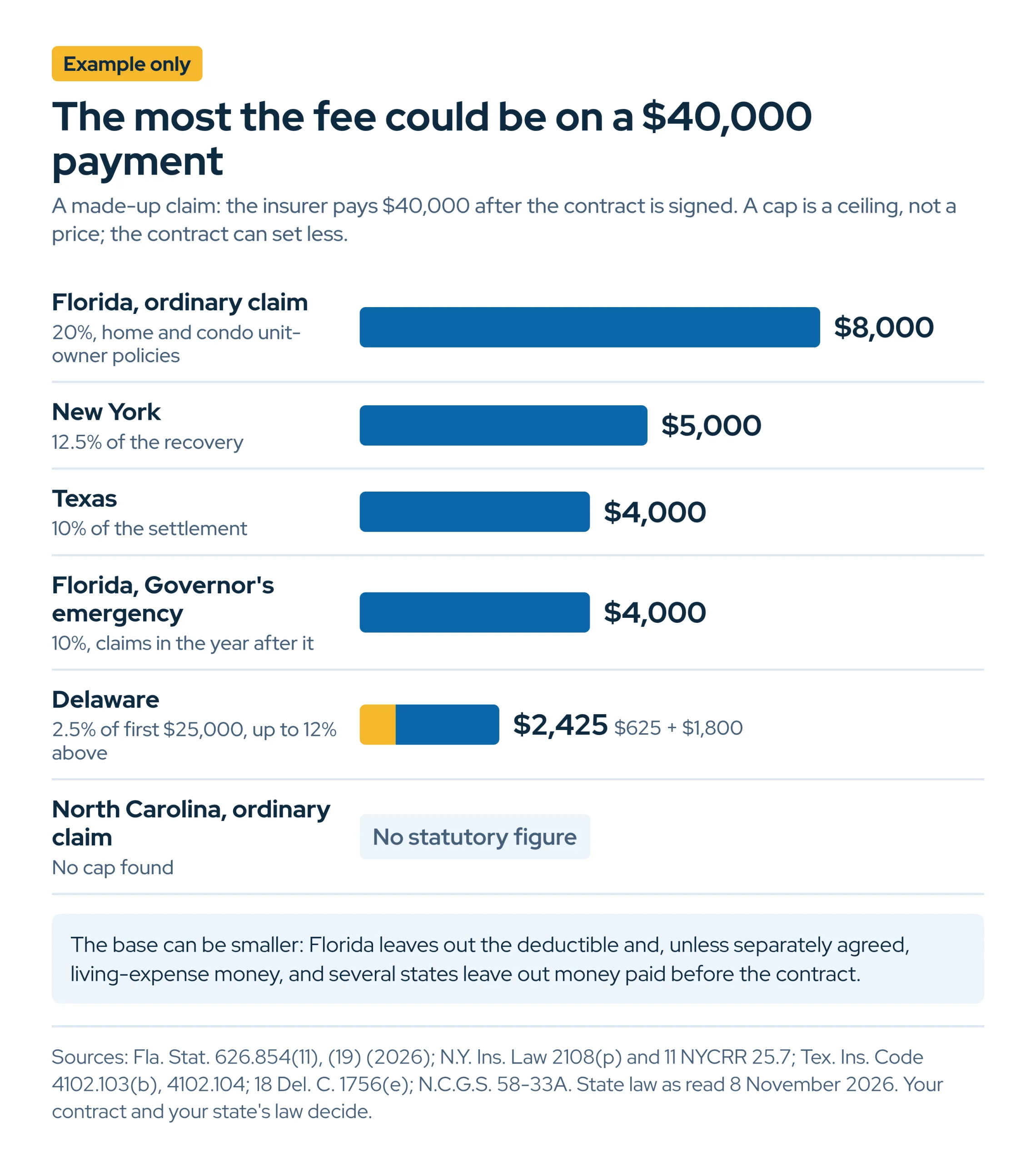
Two things change the base the percentage works on. If the insurer had already paid $10,000 before the contract was signed, Florida’s 0% tier, Virginia, Kentucky and New York leave that money out, so the cap works on the later payments only. And if the insurer pays or commits to the full limit within the state’s short policy-limits window, the percentage falls away in the states listed above under the policy-limits rule.
The cancellation window: what starts the clock
The window is short, and the unit and the trigger matter as much as the number. Texas gives 72 hours from signature; Minnesota 72 hours after the contract is signed. Business days skip weekends and holidays: 3 business days in Louisiana, North Carolina, Nebraska and Idaho, 5 in South Carolina, 10 in Maryland. Calendar days count every day: Connecticut’s midnight of the 4th calendar day, Massachusetts’ 3 calendar days. Some clocks start later than signing: Massachusetts counts from when you receive a copy of the contract, Oklahoma from when you are given the signed agreement, Kentucky from when you get a physical copy (an emailed one doesn’t count, 304.9-433(10)), and Illinois from when the insurer receives it. North Dakota counts from when the claim is submitted to the insurer.
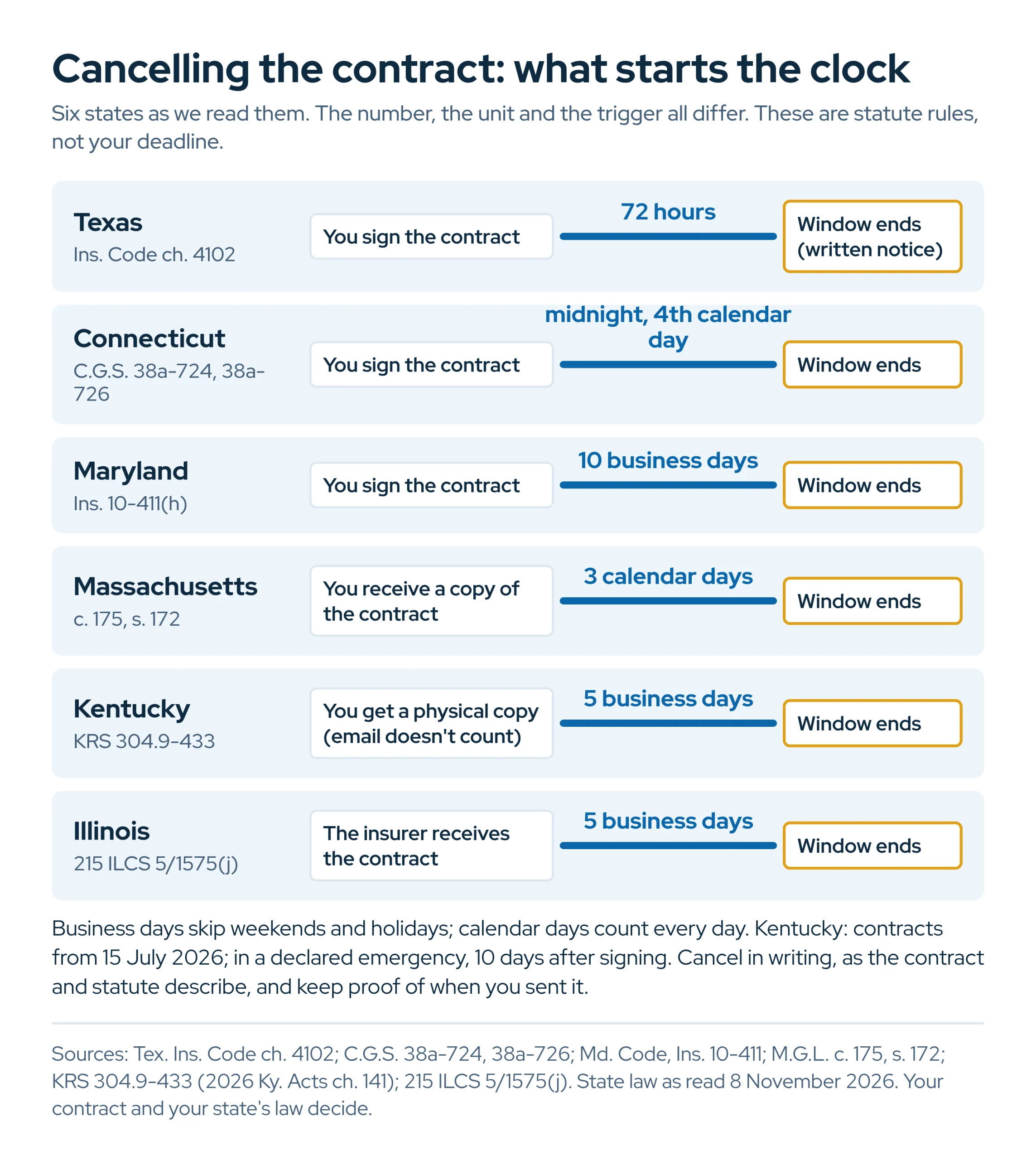
Cancel in writing, to the address in the contract, in the way the statute and the contract describe, and keep proof of when you sent it. Florida’s notice must go by certified mail or another mailing with proof (626.854(7)); Illinois accepts registered or certified mail with return receipt, personal service, or email to the address in the contract (1575(j)); South Carolina accepts mail, email or delivery (38-92-130(I)). Several states then require anything you paid to be returned within 15 business days (North Carolina, Louisiana, Maryland, Virginia, South Carolina, Kentucky, Illinois); Nebraska says 15 days and Idaho 28 days. A few states let the adjuster charge for emergency work done in the window, such as removing water or boarding up (Minnesota 72B.135 subd. 3; Oklahoma 6216.2(B)).
When a public adjuster may approach you, and the money they hold
Several states limit when a public adjuster may offer to take your claim. The rules we read, with their dates:
- While the loss is still happening: South Carolina bars soliciting you during the loss-producing occurrence as your policy defines it (38-92-170(C), in force since 19 May 2026). Illinois bars a proposal while the occurrence continues, while the fire department is at the premises, or between 7:00 p.m. and 8:00 a.m. (215 ILCS 5/1590(b)). Arizona bars it while the occurrence continues or while the fire department or another public safety service is responding at the premises (A.R.S. 20-321.02(B), 2026 Ariz. Sess. Laws ch. 157).
- After a catastrophe: California bars residential solicitation until 7 calendar days after the loss-producing occurrence ends, unless you make contact, and contact between 6 p.m. and 8 a.m. unless you ask for it (Ins. Code 15027, 15027.1, read 18 November 2026).
- Contracts signed in a hurry: in Michigan, a contract signed within 48 hours after the loss-producing occurrence ends is voidable for 10 days (MCL 500.1226(4), read 18 November 2026).
Money can also pass through the adjuster’s hands when the insurer’s check names both of you. South Carolina requires funds a public adjuster holds for you to go into a federally insured escrow or trust account kept in the state (38-92-150). California requires deposit in an escrow or trust account within 15 business days of receipt until 31 December 2026. From 1 January 2027 the money must be deposited within 15 calendar days of receipt and passed on to you within 30 calendar days, shortened to 7 and 15 calendar days where the loss is in a catastrophic disaster, state of emergency or local emergency area; the escrow rules don’t apply if the adjuster can’t get every payee’s endorsement after reasonable diligence or you say in writing that you don’t want an escrow account (Ins. Code 15028.7(c), (d), (f), as amended by SB 1206, Stats. 2026, ch. 685, read 18 November 2026). Kentucky lets the fee be collected only after you have received the insurance money (KRS 304.9-4333(1)). Your contract should say who is named on each check and how the money reaches you; Texas and Oklahoma rules on that are under “How the fee works” above. These are rules on the adjuster’s conduct; what happens on a breach is for the state insurance department to decide.
What changed in 2026
- Kentucky stopped issuing new public adjuster licenses for two years from 13 April 2026 (existing licenses can be renewed), and for two years from 15 July 2026 public adjusters may not negotiate with an insurer on a policyholder’s behalf (2026 Ky. Acts ch. 141; KRS 304.9-430(1)(b), 304.9-4331(7)). The Act’s changes to the contract, fee and cancellation sections, including the 5-business-day window and the 10% cap as now worded, apply to contracts entered into on or after 15 July 2026 (Legislative Research Commission notes to 304.9-433 and -4333).
- South Carolina replaced its public adjuster chapter on 19 May 2026 (Act 209). The new chapter 38-92 caps fees at 10% on every claim, not only catastrophes, and gives 5 business days to rescind. Cite chapter 92, not the repealed chapter 48.
- Pennsylvania enacted HB 1972 as Act 77 of 2026 on 22 October 2026: 10% for catastrophic claims, 20% for others, and longer rescission periods, in force 180 days later (our count: 20 April 2027). Until then 31 Pa. Code 115.2 applies. The Pennsylvania Insurance Department’s announcement summarizes the law.
- Virginia last amended its public adjuster law in 2026 (c. 142); the current text gives 3 business days to rescind, or 5 business days in a catastrophic disaster (38.2-1845.13(A)(12)).
- Florida amended 626.854 again in 2026 (ch. 2026-174); the caps above are from the 2026 text.
- California enacted SB 1206 (Stats. 2026, ch. 685, approved 27 September 2026). From 1 January 2027 it changes the deposit clock for money held for you from 15 business days to 15 calendar days, adds a 30-calendar-day clock for passing it on to you (7 and 15 calendar days in a disaster or emergency area) and adds an email address and a California business address to the contract. The cancellation windows and the 7-day catastrophe solicitation bar don’t change. Until 31 December 2026 the earlier text applies.
- Illinois set its public adjuster license fee at $250 for residents and $500 for non-residents every 2 years from 1 January 2026 (215 ILCS 5/1563, P.A. 104-334). The fee caps and cancellation window in 1570 and 1575 were last changed on 1 January 2024 (P.A. 103-216).
Illinois is worth a note because it is often reported wrongly. Its 10% limit for property “anything but a personal residence” applies only to catastrophic-event claims, but the next subsection caps fees on a personal residence at 10% on any claim (215 ILCS 5/1570(e), as amended by P.A. 103-216, effective 1 January 2024).
Claims you may see, checked
You may see these on other sites and in ads. We checked them against the statutes and the public data we could find.
- “Public adjusters get you 30 to 50% more.” Public adjusters’ ads say this. We found no government or other public dataset that supports it, and no state department page that repeats it. Whether any claim would come out higher depends on the claim.
- “There’s no risk to you.” Florida’s law treats a public adjuster ad that invites a claim by saying there is “no risk” to the policyholder as deceptive or misleading (626.854(8)(a)3). The fee is a real cost, and some states let the adjuster keep a lien for it if you revoke later (Massachusetts c. 175 s. 172).
- “We’ll cover your deductible” or “free roof inspection, plus a gift card”. Florida bars public adjusters from offering a rebate, gift, gift card, cash or a deductible waiver in exchange for a roof inspection or a roof claim, with fines up to $10,000 per act and $20,000 during a declared state of emergency (626.854(23)). South Carolina bars a public adjuster from offering to pay your deductible, or saying it will be waived, to win your business (38-92-170(E)). Other states have their own contractor rules.
- “Fees are always 10%.” No national rule sets a fee. The cap, where one exists, is state law, and it ranges from Delaware’s tiered 2.5% and 12% to Florida’s 20%.
- “You need a public adjuster to file a claim.” You don’t. The state disclosures above say so in as many words, and you can file and negotiate a claim yourself. Our guide to the appraisal clause covers the policy’s own route for disputes about the amount.
Checking a license and making a complaint
Public adjusters are licensed by the state insurance department, and that department takes complaints about them. Ask the department whether the person and the firm hold a current public adjuster license in your state; Virginia’s required disclosure tells policyholders they may contact its regulator for the licensing status (38.2-1845.13(B)). Our complaint pages by state list each department’s complaint page where we could read it, and the NAIC keeps a directory of state insurance departments. We don’t recommend, rank or refer public adjusters, and we don’t review contracts.
Before you sign anything: what to gather and ask

- Your policy, all of it: the declarations page, the policy form and every endorsement, so you can read the Duties After Loss and Suit Against Us conditions yourself.
- Your own record of the loss: photos and video before cleanup, receipts for emergency repairs, the insurer’s estimate and every letter with its date.
- The contract terms in writing: the exact percentage or rate, what it applies to (all payments, or only payments after signing), whether expenses are extra, and the cancellation window with the date it ends.
- The license: confirmed with your state insurance department, not just a card.
- Any ties to contractors: several states require a written disclosure of any financial interest in repair, salvage or appraisal firms (Maryland 10-411(d), North Carolina 58-33A-65(d), Kentucky 304.9-4331(5)).
- What can’t wait: a public adjuster’s contract doesn’t stop the policy’s own deadlines. A proof-of-loss request, a notice-of-claim limit and the suit limit keep running. Our claim deadlines by state show the rules we read in each state.
If you have questions about your rights under a contract you’ve already signed, the state insurance department’s consumer line and your state bar’s lawyer referral service or legal aid can help.
Sources checked on 8 November 2026: Tex. Ins. Code ch. 4102; Fla. Stat. 626.854 (2026); La. R.S. 22:1703, 22:1704; 36 O.S. 6216.1, 6216.2, 6218, 6220.1; N.C.G.S. 58-33A; KRS 304.9-430, -433, -4331, -4333; S.C. Act 209 of 2026 (S.196); Iowa Code ch. 522C (2026); 215 ILCS 5/1570, 1575; Md. Code, Ins. 10-411; Minn. Stat. 72B.135; C.G.S. 38a-724, 38a-726; M.G.L. c. 175 s. 172; Neb. Rev. Stat. 44-9214; N.D.C.C. ch. 26.1-26.8; Va. Code 38.2-1845.1, .13, .14; MCA 33-17-302 (read 6 November 2026); Idaho Code 41-5814, 41-5815; 18 Del. C. 1756; D.C. Code 31-1631.08; 13.4.8.17 NMAC; N.Y. Ins. Law 2108 and the DFS Seventh Amendment to 11 NYCRR 25; 31 Pa. Code 115.2 and Pa. HB 1972 (PN 3550, Act 77 of 2026); 24-A M.R.S. 1476; RSMo 325.050; A.R.S. 20-321 to 20-321.02; Fannie Mae Servicing Guide B-5-01; NAIC Model #228. California Ins. Code 15027 and 15027.1 were read on 6 November 2026. Read on 11 November 2026: K.S.A. 40-5502, 40-5513, 40-5514; MCL 500.1222 to 500.1239; Utah Code 31A-26-311, 31A-26-401, 31A-26-402; OAR 836-071-1100 to 836-071-1195; RCW 48.17 and WAC 284-17; NRS and NAC 684A; Ohio Rev. Code ch. 3951 and Ohio Adm. Code 3901-1-24; RSMo ch. 325; 24-A M.R.S. 1471 to 1477; Iowa Code ch. 555A; N.Y. Personal Property Law 428; HRS 431:9-244; W. Va. Code R. 114-25 (effective 8 April 2026); NMSA 1978, 59A-13-15; Ala. Code 27-9A-3; Tenn. Comp. R. & Regs. 0780-01-91. Rechecked on 18 November 2026: S.C. Act 209 of 2026 (38-92-120, -130, -150, -170); KRS 304.9-430, -433, -4331, -4333 (2026 Ky. Acts ch. 141); 215 ILCS 5/1563, 1570, 1575, 1590; A.R.S. 20-321.02; Cal. SB 1206 (Stats. 2026, ch. 685), Ins. Code 15027 and 15028.7.
Formulas and sources
- Row number (District of Columbia is 9): Arithmetic on the reader's own entries, no outside figure
- Cap type, ordinary claim: State statutes and regulations listed in the table on this page, read 8 Nov 2026 (some 11 Nov 2026)
- Cap type, declared disaster or catastrophe: State statutes and regulations listed in the table on this page, read 8 Nov 2026 (some 11 Nov 2026)
- Cap type, ordinary claim, states added 11 Nov 2026: State statutes and regulations listed in the table on this page, read 8 Nov 2026 (some 11 Nov 2026)
- Cap type, declared disaster or catastrophe, states added 11 Nov 2026: State statutes and regulations listed in the table on this page, read 8 Nov 2026 (some 11 Nov 2026)
- Cap type: 1 cap read, 2 no cap found in sections read, 3 tiered (DE), 4 fee must be under it (ND), 0 not confirmed: State statutes and regulations listed in the table on this page, read 8 Nov 2026
- Cap percentage, ordinary claim: State statutes and regulations listed in the table on this page, read 8 Nov 2026 (some 11 Nov 2026)
- Cap percentage, declared disaster or catastrophe: State statutes and regulations listed in the table on this page, read 8 Nov 2026 (some 11 Nov 2026)
- Cap percentage that applies to your choices (0 = no single percentage): State statutes and regulations listed in the table on this page, read 8 Nov 2026
- Delaware tiered maximum: 18 Del. C. 1756(e): 2.5% of the first $25,000 of the total insurance recovery, up to 12% above $25,000
- Most the fee could be under the cap, on your amount (0 = no figure): Arithmetic on the reader's own entries, no outside figure
- Your amount minus a fee at that maximum: Arithmetic on the reader's own entries, no outside figure
- Delaware maximum as a share of your amount: Arithmetic on the reader's own entries, no outside figure
- Cancellation window, ordinary claim: State statutes and regulations listed in the table on this page, read 8 Nov 2026 (some 11 Nov 2026)
- Cancellation window, declared disaster: State statutes and regulations listed in the table on this page, read 8 Nov 2026 (some 11 Nov 2026)
- Cancellation window (number): State statutes and regulations listed in the table on this page, read 8 Nov 2026
- Cancellation unit, ordinary claim: State statutes and regulations listed in the table on this page, read 8 Nov 2026 (some 11 Nov 2026)
- Cancellation unit, declared disaster: State statutes and regulations listed in the table on this page, read 8 Nov 2026 (some 11 Nov 2026)
- Cancellation unit, states added 11 Nov 2026 (same with or without a disaster): State statutes and regulations listed in the table on this page, read 8 Nov 2026 (some 11 Nov 2026)
- Unit: 1 calendar days, 2 business days, 3 hours, 4 none found, 5 days (kind not stated), 6 see table, 0 not confirmed: State statutes and regulations listed in the table on this page, read 8 Nov 2026
- License (part 1): State statutes and regulations listed in the table on this page, read 8 Nov 2026 (some 11 Nov 2026)
- License (part 2, states added 11 Nov 2026): State statutes and regulations listed in the table on this page, read 8 Nov 2026 (some 11 Nov 2026)
- License: 1 required by the statute read, 2 required but no new licenses until April 2028 (KY), 0 not confirmed: State statutes and regulations listed in the table on this page, read 8 Nov 2026 (some 11 Nov 2026)
Sources
- Texas Insurance Code ch. 4102, public insurance adjusters
- Florida Statutes 626.854 (2026)
- Louisiana R.S. 22:1703
- Louisiana R.S. 22:1704
- Oklahoma Statutes Title 36 (6216.1, 6216.2, 6218, 6220.1)
- North Carolina G.S. ch. 58, art. 33A
- Kentucky KRS 304.9-4333
- Kentucky KRS 304.9-433
- Kentucky KRS 304.9-4331
- Kentucky KRS 304.9-430
- South Carolina S.196, Act 209 of 2026 (ch. 38-92)
- Iowa Code ch. 522C (2026)
- Illinois 215 ILCS 5/1570
- Illinois 215 ILCS 5/1575
- Maryland Code, Insurance 10-411
- Minnesota Statutes 72B.135
- Connecticut General Statutes ch. 701b
- Massachusetts G.L. c. 175, s. 172
- Nebraska Rev. Stat. 44-9214
- North Dakota Century Code ch. 26.1-26.8
- Virginia Code 38.2-1845.13
- Virginia Code 38.2-1845.14
- Virginia Code 38.2-1845.1
- Montana Code 33-17-302
- Idaho Code 41-5815
- Delaware Code Title 18, ch. 17A
- D.C. Code 31-1631.08
- New Mexico 13.4.8 NMAC
- New York Insurance Law 2108
- New York DFS, Seventh Amendment to 11 NYCRR 25 (Regulation 10)
- 31 Pa. Code 115.2
- Pennsylvania HB 1972 (Act 77 of 2026)
- Pennsylvania Insurance Department, Shapiro signs new public adjuster law
- Maine 24-A M.R.S. 1476
- Missouri RSMo 325.050
- Arizona A.R.S. 20-321.02
- Fannie Mae Servicing Guide B-5-01
- NAIC Public Adjuster Licensing Model Act #228
- NAIC directory of state insurance departments
- K.S.A. 40-5513 (Kansas public adjuster compensation)
- K.S.A. 40-5502 (Kansas public adjuster definitions)
- MCL 500.1226 (Michigan adjuster for the insured)
- RSMo chapter 325 (Missouri public adjusters)
- NRS chapter 684A (Nevada adjusters)
- NAC chapter 684A (Nevada adjusters)
- Ohio Adm. Code 3901-1-24 (public adjusters)
- OAR 836-071 (Oregon public adjusters)
- Utah Code 31A-26 part 4 (public adjusters)
- RCW 48.17 (Washington agents, brokers, adjusters)
- WAC 284-17 (Washington licensing)
- W. Va. Code ch. 33, art. 12B (adjusters)
- W. Va. Code R. 114-25, Insurance Adjusters (eff. 8 Apr 2026)
- HRS 431:9-244, contracts between public adjuster and insured
- NMSA 1978, chapter 59A (59A-13-15)
- Ala. Code 27-9A-3
- Tenn. Comp. R. & Regs. 0780-01-91, Public Adjusters
- California SB 1206 (Stats. 2026, ch. 685), Insurance omnibus
- Illinois 215 ILCS 5/1590
- Illinois 215 ILCS 5/1563