In the first days after a storm, the order that usually protects a homeowners claim is: get everyone safe, photograph the damage before anything is moved, make reasonable temporary repairs to stop more damage and keep every receipt, and report the claim to your insurer in writing. After that, the insurer has to respond within the time your state’s rules set, and you keep a record of every call, visit and letter. Wind and hail damage is usually covered by a standard homeowners policy; flooding, including storm surge, usually isn’t. This page walks through those first 30 days in order, with the policy clause or the state rule behind each step. More on roofs, hail and wind is in our Roof, Hail and Wind guides.
General information, not legal or insurance advice, and not a substitute for the advice of an attorney. Your policy’s wording and your state’s law decide, and both change. For help with your claim, your state insurance department’s consumer line and legal aid are free.
The policy wording below comes from the ISO HO-3 specimen form (2000 edition, HO 00 03 10 00), a standard homeowners form that insurers can adopt or adapt, read in the copy published by the Insurance Information Institute, a trade group (archived copy of 2 September 2026). The 2011 edition (HO 00 03 05 11) lists the same duties after a loss. Your own policy may use different wording, and endorsements can change it. Some storm cover comes from separate policies with their own rules: National Flood Insurance Program (NFIP) flood policies follow federal law, and state wind pools, FAIR plans and surplus lines insurers have their own forms and, in places, their own clocks.
The first 30 days at a glance
| When | What usually happens | The rule behind it |
|---|---|---|
| Day 0, once the storm has passed | Safety first. Then photos and video of every damaged area, inside and out, before cleanup | Your duty to help the insurer investigate (specimen Section I Condition B) |
| Days 0 to 3 | Temporary repairs to stop more damage: a tarp, boarded windows, water shut off. Keep receipts and the damaged pieces | “Reasonable Repairs” additional coverage and the duty to protect the property (Condition B.4) |
| As soon as you can | Report the claim to the insurer in writing, with the date of loss and what was damaged | “Prompt notice” (Condition B.1). Some states set an outer limit, such as Florida’s 1 year |
| Days 1 to 15 or so | The insurer acknowledges the claim, opens a file and asks for what it needs | State rules, for example Florida 7 calendar days, Washington 10 business days, Texas 15 days |
| If you can’t stay at home | Extra living costs for a hotel or rental, meals beyond normal, mileage. Keep receipts | Coverage D, Loss of Use |
| If a disaster is declared | Register with FEMA, and file with your insurer too | 44 CFR 206.112: 60 days from the declaration |
| Days 7 to 30 and later | Adjuster’s inspection, the estimate, requests for documents, possibly a sworn proof of loss | Proof of loss within 60 days after the insurer asks (specimen); NFIP: within 60 days after the loss |
| Around day 30 | In some states, a decision or a written reason for more time | Washington: 30 calendar days after notice of claim |
Day 0: safety, then pictures
Nothing on a claim is worth a fall from a wet roof. Stay off damaged roofs, keep clear of fallen wires, and if you run a generator, follow the CDC’s rule: never inside the home or garage, even with doors and windows open, and only outside, more than 20 feet from windows, doors and vents (CDC, carbon monoxide poisoning basics).
Once it’s safe, record the damage before you clean or move anything:
- Wide shots first, then close-ups: each side of the house, the roof from the ground, gutters, siding, windows, fences, sheds, and every damaged room.
- Video, saying the date and what you’re looking at. Keep the original files unedited.
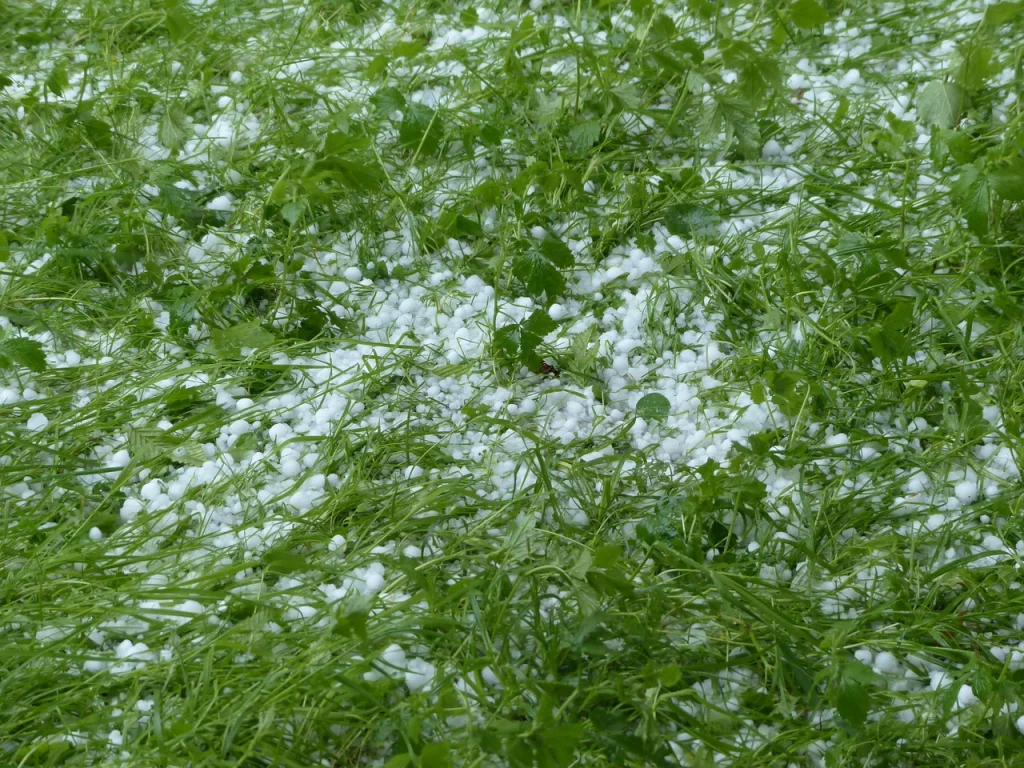
- Signs of what caused it: hailstones next to a coin or ruler, the opening where wind tore off shingles, the water line if water came in from outside. The cause is what decides coverage, so this matters later.
- Belongings: damaged furniture, electronics and clothing, with model and serial numbers where you can read them. The specimen asks for an inventory showing quantity, description, actual cash value and amount of loss, with bills and receipts attached (Condition B.6).
Days 0 to 3: stop more damage, keep every receipt
The standard form puts this on you. Among the duties after a loss, the specimen says you must protect the property from further damage, make “reasonable and necessary repairs” to do so, and keep an accurate record of what those repairs cost (Section I Condition B.4). It also pays for them: the “Reasonable Repairs” additional coverage pays the reasonable cost of measures taken solely to protect covered property from further damage, when the original damage came from a covered peril (Section I Additional Coverage E.2). That money comes out of the policy limit, not on top of it.
The other side of the same rule is the “Neglect” exclusion, which removes cover for loss caused by an insured’s failure to use all reasonable means to save and preserve property at and after the time of a loss (Exclusion A.5). In plain terms: a tarp over a hole the first dry day is the expected step; leaving the hole open for weeks can give the insurer a reason to refuse the water damage that follows. Your policy’s wording decides where that line falls.
- Temporary, not permanent. Tarp the roof, board broken windows, shut off water to a broken line, move belongings out of wet rooms, start drying. Leave permanent repairs, such as a new roof, until the insurer has seen the damage or agreed in writing, unless waiting would cause more damage.
- Keep the evidence. The specimen lets the insurer ask to see the damaged property “as often as we reasonably require” (Condition B.7). Photograph everything you tear out and, where you can, keep samples (a piece of soaked carpet, a few damaged shingles) until the adjuster has been.
- Every receipt: tarps, plywood, fans, the emergency crew’s invoice. Note on each what it was for.
Two of the states we’ve read have written rules about these emergency steps. In Washington, where the policy puts a duty on you to protect the property after a loss, the claim-handling rule effective 18 October 2026 makes it an unfair practice for an insurer to fail to approve your scope of mitigation (the list of emergency work, such as drying out or tarping), or to give you an approved scope, within 5 business days after receiving it; if it rejects your scope, it has to say why it doesn’t meet technical or industry standards, with a dollar itemization of what it disapproved (WAC 284-30-330(20)-(21), WSR 26-17-089). In New York, after a declared state of emergency or disaster for a natural disaster (or terrorism), immediate repairs to windows, exterior walls, exterior doors, roofs, heating, water and electrical systems may be made where needed to protect health and safety, and photos, video, inventories and repair or replacement receipts count as alternative proof of loss that satisfies policy requirements (N.Y. Ins. Law 2618(a)(4)). Both read in official text on 18 November 2026. Elsewhere, the policy’s own duties above decide, along with any state rule we haven’t read; a flood claim under an NFIP policy follows the federal policy’s terms, not these state rules.
Contractors arrive quickly after storms. The Federal Trade Commission (FTC) advises several estimates, a written contract, and “If they want cash up front, walk away.” It also says never to sign your insurance check over to a contractor; a Certificate of Completion from your bank or credit union lets the bank pay each stage after you approve it (FTC, scams after weather emergencies, September 2025). If you sign a contract for $25 or more at your home, even with a seller you invited, the FTC’s Cooling-Off Rule usually lets you cancel until midnight of the third business day after the sale, and for this rule a business day is any day except Sunday and federal holidays (16 CFR 429.0 and 429.1). The rule has exceptions, including a true emergency where you called the contractor and signed a handwritten waiver. Some states add their own: in Florida, a roof repair or replacement contract signed within 180 days of a Governor’s emergency declaration, for a home in the declared area, can be cancelled without penalty within 10 days or by the official start date, whichever comes first. The official start date can come quickly: it is the day work installing materials for the final roof begins, a permit is issued, or a temporary repair to the roof covering or roof is made in compliance with the Florida Building Code, so the window can close before the 10 days are up. The cancellation has to go by certified mail or another mailing with proof, to the address in the contract (Fla. Stat. 489.147(6)).
Report the claim in writing
The specimen asks for “prompt notice” to the insurer or its agent (Condition B.1). It doesn’t give a number of days, and an insurer’s duty to cover depends on whether a failure to meet the duties was “prejudicial” to it. Don’t test that: report as soon as you reasonably can, even before you know the full extent of the damage. You can add damage you find later.
Call or use the insurer’s app if you like, but follow up in writing and keep a copy. In Texas, the clock in the prompt-payment law starts with a “notice of claim,” which the statute defines as written notification that reasonably tells the insurer the facts of the claim (Tex. Ins. Code 542.051(4)). Put in it your policy number, the date of loss, what happened, what is damaged, what temporary repairs you’ve made, and how to reach you if you’ve moved out. Then keep a log: every call with its date, time, the person’s name and what was said.

A few states set an outer limit on notice. In Florida, a claim or reopened claim under a property policy, including one from a surplus lines insurer, is barred unless notice is given to the insurer, as the policy requires, within 1 year after the date of loss; a supplemental claim (more damage from the same peril, found later) within 18 months. For hurricanes, tornadoes, windstorms, severe rain and other weather events, the date of loss is the hurricane’s landfall date or the date the National Oceanic and Atmospheric Administration verifies the event (Fla. Stat. 627.70132(2)-(3)). Texas’s state wind pool, the Texas Windstorm Insurance Association, requires a claim no later than the first anniversary of the date of the damage, which the commissioner may extend by up to 180 days for good cause (Tex. Ins. Code 2210.205 and 2210.573). Those are outer limits, not targets. Our claim deadlines by state lists the notice and suit rules we’ve read for each state, with “not confirmed” where we haven’t.
Wind or water: the line that decides coverage
A storm can do damage several ways, and the standard form treats them differently. In the specimen:
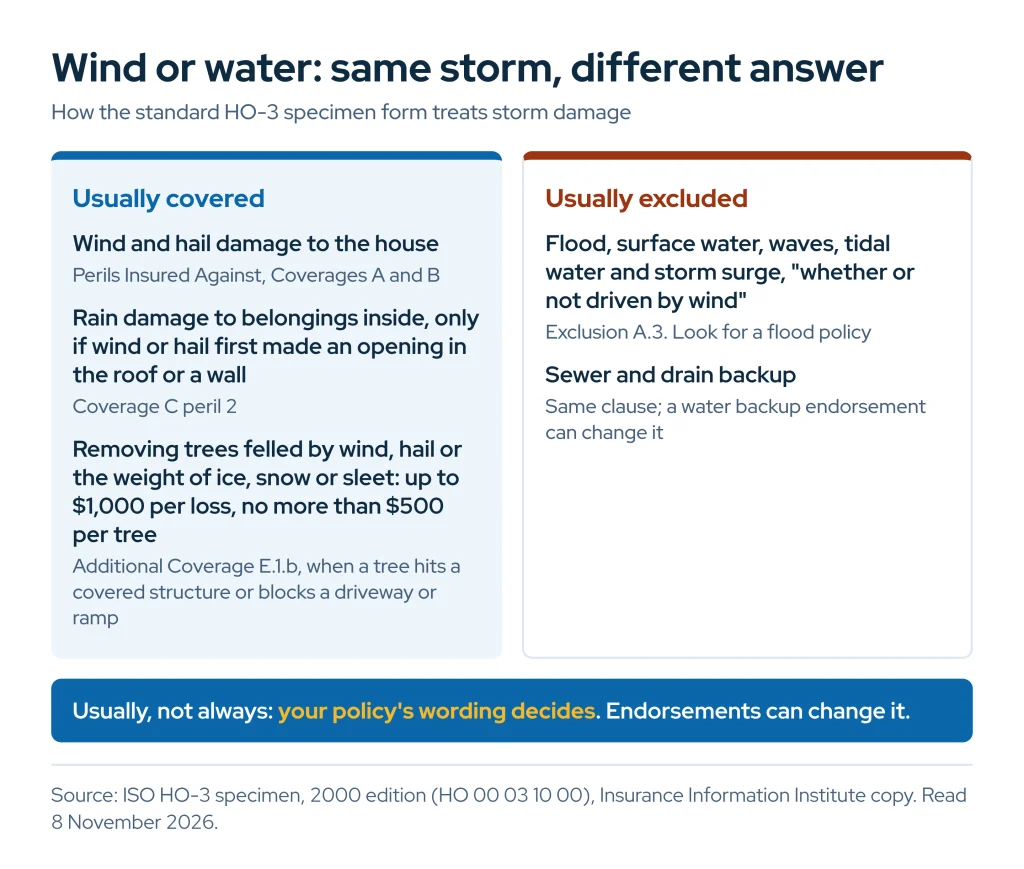
- Wind and hail damage to the house is usually covered: the HO-3 insures the house against risk of direct physical loss unless an exclusion applies (Section I Perils Insured Against, Coverages A and B). Tornado damage falls under the same windstorm wording and has its own page.
- Rain inside the house is the catch. For belongings, the “Windstorm or Hail” peril covers rain damage inside only if wind or hail first made an opening in the roof or a wall and the rain came in through it (Coverage C peril 2). That is why the photos of the opening matter.
- Flood and storm surge are usually excluded: the water damage exclusion covers flood, surface water, waves, tidal water and overflow of a body of water “whether or not driven by wind” (Exclusion A.3). Our page on hurricane damage and homeowners insurance shows how wind, surge and a hurricane deductible split one storm into parts. Sewer and drain backup is excluded in the same clause; a water backup endorsement, if your policy has one, can change that. Fire, explosion or theft that follows water damage is covered.
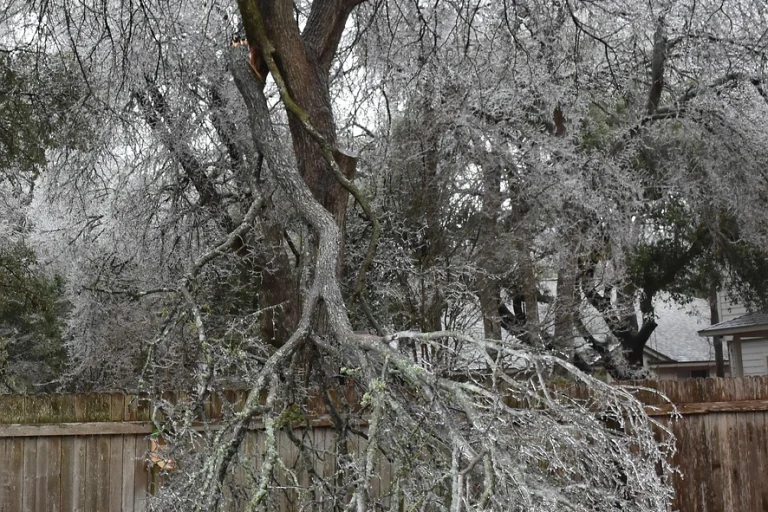
- Fallen trees: the specimen pays up to $1,000 per loss, and no more than $500 per tree, to remove trees felled by windstorm, hail or the weight of ice, snow or sleet when they hit a covered structure or block a driveway or a ramp for a disabled person (Additional Coverage E.1.b). Damage the tree did to the house is a separate question. See trees, storms and your homeowners policy.
If water rose into the house from outside, look for a flood policy. An NFIP Standard Flood Insurance Policy asks you to give prompt written notice and to send a signed, sworn proof of loss “within 60 days after the loss,” even if the adjuster doesn’t give you the form (44 CFR part 61, appendix A(1), VII.G). That clock runs from the date of loss, not from a request, so it is the one most likely to catch people out after a hurricane. FEMA sometimes extends it after large events; check FloodSmart or your flood insurer for a written extension. Our guide to NFIP flood claims covers the flood claim itself.
How fast the insurer must respond: state clocks
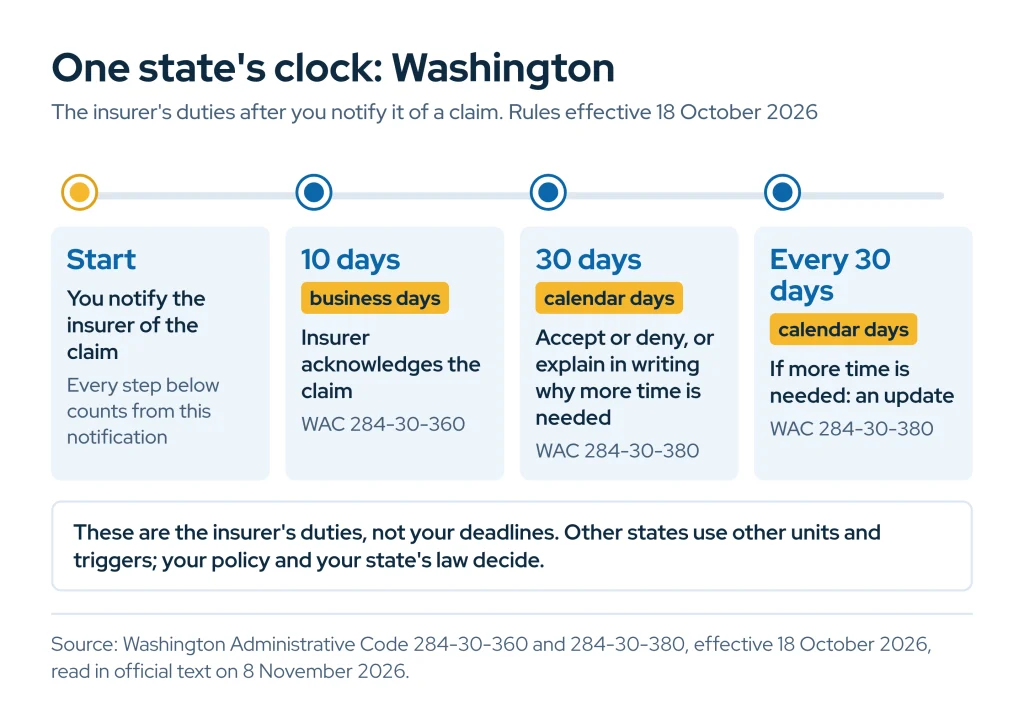
There is no national rule. Each state sets its own claim-handling clocks, with its own units (calendar days, business days, working days) and its own trigger (notice of claim, proof of loss, receipt of requested items). Several add time after a declared catastrophe, and New York has a separate, faster set of clocks for claims from a declared disaster. Five states we’ve read in full, as examples:
| State | Acknowledge | Decide or pay | After a declared catastrophe |
|---|---|---|---|
| Texas (Ins. Code 542.055-.059) | 15 days after written notice of claim: acknowledge, start investigating, ask for items (eligible surplus lines insurers: 30 business days) | Accept or reject in writing within 15 business days after receiving all items needed for final proof of loss (30 days if the insurer suspects arson); if it needs more time, it must say why within that period and then decide by the 45th day after that notice; pay within 5 business days after acceptance (eligible surplus lines insurers: 20 business days). Policies from the state wind pool, TWIA, follow their own clocks instead: accept or deny in writing by the later of 60 days after the claim or after information it asked for, then pay within 10 days (2210.573(d), 2210.5731); the commissioner may extend the 60 days (2210.581). TWIA’s notice also starts its own short limits for appraisal and for notice of intent to sue, so read it the day it arrives (2210.573(e)-(f), 2210.574) | All these deadlines extend by 15 days after a weather-related catastrophe or major natural disaster as the commissioner defines it (542.059(b)) |
| Florida (Stat. 627.70131) | 7 calendar days after a claim communication, with claim forms and instructions | Pay or deny, in whole or part, within 60 days after notice of an initial, reopened or supplemental claim, with a written explanation, unless factors beyond the insurer’s control (defined in 627.70131(5)) prevent it; any physical inspection within 30 days after proof-of-loss statements. The clocks pause during mediation and when material information the insurer asked for isn’t sent within 10 days (627.70131(8)) | After a Governor’s emergency declaration, the Office of Insurance Regulation may give insurers more time, but no more than 30 additional days to pay or deny (627.70131(5)) |
| Louisiana (R.S. 22:1892, 22:1892.2) | Start adjusting within 14 days after notice of loss | Written offer within 30 days after satisfactory proof of loss; pay within 30 days after it | For a “catastrophic loss” (a declared emergency or disaster): start adjusting within 30 days (the commissioner may add up to 30 more); residential claims paid within 60 days after satisfactory written proof of loss |
| Washington (WAC 284-30-360, 284-30-380; effective 18 Oct 2026) | 10 business days after notification of claim | Accept or deny within 30 calendar days after notification of claim, or explain in writing why more time is needed, then update every 30 calendar days | No catastrophe extension in the sections read |
| New York (Ins. Law 2601, 2618) | Ordinary claims: no day count in the statute; Regulation 64 sets 15 business days after notification of the claim (11 NYCRR 216.4(a), read 18 November 2026 on the state’s NYCRR site, which labels its text unofficial). Declared disasters: in writing, as Department of Financial Services regulations set (2618(a)(3)). A claim filed with the insurer’s agent counts as filed with the insurer unless the agent says it can’t take notices of claim (2618(a)(5)) | Ordinary claims: accept or deny within 30 working days after a properly executed proof of loss (2601(a)(4)); the statute treats a failure as an unfair practice when it happens often enough to be a general business practice | When a local emergency, a Governor’s disaster emergency or a presidential declaration covers a natural disaster (wind, storm, hurricane, tornado, ice storm, flood and others) or terrorism, for non-commercial claims from it: accept or reject in writing within 15 business days after a properly executed proof of loss and every item the insurer asked for (30 if arson is suspected); one 15-business-day extension with written reasons; one more, then written notices every 15 business days, while the insurer is barred from reaching the property, and no more than 15 days once it can; pay an agreed amount within 4 business days after the insurer receives the agreement or the claimant meets its conditions, whichever is later (2618(b), (d)) |
Two cautions. First, what happens when a clock is missed differs by state. Texas adds interest and attorney’s fees to a claim the insurer is liable for and handles late (542.060), at a different rate for storm and other weather claims, which also need written notice at least 61 days before a suit (ch. 542A), and Louisiana sets penalties when a court finds the failure arbitrary, capricious or without probable cause (22:1892(B), 22:1892.2(B)); Florida’s 60-day rule says a violation is a breach of the insurance code but not, on its own, the basis for a private lawsuit (627.70131(7)(a)). Our page on bad faith insurance claims explains how those penalty and lawsuit rules fit together. Second, they rarely mean the claim is finished by then. A decision on part of a claim, a request for more documents or a written reason for delay can all be compliant. If an insurer doesn’t respond, a dated written follow-up and then a complaint to your state insurance department are the usual next steps; our complaint links by state lists the departments’ pages we’ve checked. Our state pages set out each state’s clocks, suit limits and complaint routes in full, among them South Carolina, Virginia and New York on the coast, and Texas, Florida and Louisiana.
If you can’t live at home
When a covered loss makes the home unfit to live in, the specimen’s Coverage D (Loss of Use) pays “any necessary increase in living expenses” so the household can keep its normal standard of living, for the shortest time needed to repair or, if you move for good, to settle elsewhere. It pays the increase, not the whole bill: costs you’d have had anyway don’t count, while a hotel or short-term rental, restaurant meals above your normal grocery bill and extra mileage usually do. Keep every receipt and a note of your normal monthly costs for comparison; the specimen lists receipts for additional living expenses among what a proof of loss includes (Condition B.8.g). Additional living expenses goes through it item by item.
Evacuation is a different case. The specimen’s “Civil Authority Prohibits Use” cover applies when a civil authority bars you from your home because of direct damage to neighboring premises by a covered peril, and it lasts no more than two weeks (Coverage D.3). A precautionary evacuation order before a storm hits is not tied to damage, so whether your policy pays for it depends on its wording; ask your insurer in writing. FEMA’s rules allow reasonable lodging costs incurred in anticipation of and immediately before a declared event to be eligible for federal help (44 CFR 206.110(d)).
If the storm becomes a declared disaster
FEMA’s Individuals and Households Program helps with “uninsured or under-insured” necessary expenses; FEMA says it “is not a substitute for insurance” (FEMA, Individuals and Households Program). File with your insurer as well as FEMA. If you have insurance, FEMA may help only when you’ve filed a claim and it was denied, when the payment is significantly delayed through no fault of yours (you agree to repay FEMA from it later), when insurance falls short of the need, or when you can’t use it because no housing is available (44 CFR 206.113(a)(2)-(5)).
- Register within 60 days of the date the President declares the disaster or emergency. FEMA may extend that period, and accepts late registrations for another 60 days from people who explain the delay (44 CFR 206.112). FEMA’s helpline is 1-800-621-3362 (TTY 1-800-462-7585), as listed on DisasterAssistance.gov.
- Maximums: for emergencies and major disasters declared on or after 1 October 2026, $46,400 for housing assistance and $46,400 for other needs assistance (91 FR 70094, 6 November 2026). For those declared from 1 October 2025 to 30 September 2026, $44,800 each (91 FR 61429). FEMA adjusts them each year for inflation. Under the regulation, rental assistance and lodging reimbursement don’t count toward the maximum, and neither do some accessibility-related repairs for people with disabilities (44 CFR 206.110(b)(1)-(2)). These are ceilings, not what any household receives.
- No fees: the FTC notes that FEMA doesn’t charge application fees, and anyone asking for money to help you qualify is running a scam (FTC).
Taxes come later, but one rule starts now. The IRS says that if property is insured, you should file a timely insurance claim; if you don’t, you can deduct only the part of the loss the policy doesn’t cover, such as the deductible (IRS Publication 547, 2025). Living-expense payments are taxable only above the temporary increase in your living costs, and not at all when the casualty is in a federally declared disaster area. From 2026, the personal casualty loss deduction also reaches state-declared disasters (IRS). For a presidentially declared major disaster whose incident period (the dates FEMA sets for the event) began on or after 28 December 2019 and before 1 January 2027, a 2026 law treats the loss as a qualified disaster loss: a $500 floor per casualty instead of $100, no 10%-of-income floor, and a deduction available without itemizing, for tax years beginning after 31 December 2024 (P.L. 119-108, sec. 2, adding 26 U.S.C. 165(h)(6), read 18 November 2026). A disaster whose incident period begins on or after 1 January 2027 falls outside that rule as enacted unless Congress extends it; the ordinary $100 and 10% rules still apply to it. The deduction only reaches what insurance doesn’t pay. Our page on whether homeowners insurance is tax deductible goes through premiums and casualty losses in more detail.
The adjuster’s visit and the paperwork
After a large storm, the insurer’s adjuster may come in person, ask for photos and video, or inspect by drone; Florida’s law expressly allows electronic inspection methods (627.70131(3)(d)). Be there for an in-person visit, walk the adjuster through your photos and the damaged items you kept, and point out the openings where wind or hail got in. Ask for a copy of the estimate in writing. Florida requires the insurer to send any detailed estimate its adjuster generates within 7 days (627.70131(3)(e)); in Louisiana, the insurer must give you its field adjuster’s report within 15 days of your request (22:1892(A)(5)). Dealing with the adjuster covers the visit in more depth.
The specimen’s other duties come into play here: cooperate with the investigation, give records the insurer reasonably asks for, and, if it asks, submit to an examination under oath (Condition B.5 and B.7). If the insurer asks for a proof of loss (a signed, sworn statement of the time and cause of the loss and who else has an interest in the property, such as your mortgage lender, with the repair estimates, inventory and receipts behind the claim), the specimen gives you 60 days after the request (Condition B.8). Mark that date when the request arrives. State rules can change this. In Louisiana, an insurer that requires a proof of loss must use a form approved by the insurance commissioner and based on the statute’s model, send it within 10 business days of receiving the claim, and tell you within 10 business days of receiving it whether it is complete (R.S. 22:1892.3). See proof of loss.
The first check, the deductible and the lender
- The deductible comes off first. Some policies carry a separate wind, hail, named-storm or hurricane deductible set as a percentage of the dwelling limit, which can be much larger than the all-perils dollar amount. It’s on your declarations page, the summary sheet at the front of the policy. Our deductible calculator turns a percentage into dollars; hurricane deductible rules differ by state.
- Two checks, often. Under the specimen, the insurer pays no more than actual cash value (ACV, usually worked out as the replacement cost minus depreciation) until the repair is done, unless it costs less than both 5% of the building’s insurance and $2,500. The rest, the recoverable depreciation, follows once you repair, if you told the insurer within 180 days after the date of loss that you intend to claim it (Condition C.2.d-e). Our recoverable depreciation calculator works through your own numbers.
- The mortgage company’s name is often on the check, because the specimen’s mortgage clause (Condition K) pays losses to the house and other structures (Coverages A and B) to you and the lender “as interests appear.” For loans Fannie Mae owns, its servicing guide tells servicers to issue contents and living-expense money to the borrower immediately, and sets how much of the repair money they may release first, which depends on whether the loan was current at the time of the loss (Fannie Mae Servicing Guide B-5-01). Other loan types have other rules; see the mortgage company and your insurance check.
Things you may hear after a storm
You may see these on other sites or hear them at the door. We checked each against the policy form and the statute.
- “You have a year to file, so there’s no rush.” Not as a general rule. The specimen asks for prompt notice; Florida’s 1-year notice limit is a state statute, and Texas’s wind pool has its own 1-year rule. Late notice can cost you where it harms the insurer’s investigation, and the damage gets harder to prove.
- “We’ll cover your deductible.” Some contractors say this. In Texas, a seller who pays, waives or rebates the deductible without the insurer’s consent on a job paid from a claim commits a Class B misdemeanor, and contracts of $1,000 or more must carry a printed notice saying so (Tex. Bus. & Com. Code 27.02). Florida bars contractors from offering a deductible waiver or other inducement for a roof inspection or a roof claim, with fines up to $10,000 per violation (Fla. Stat. 489.147).
What to do now
- Gather: the whole policy (declarations page, form and every endorsement), your photos and video from before cleanup, every receipt, the adjuster’s estimate, and every letter with its date.
- Do now: stop further damage and keep the receipts, report the claim in writing (to your flood insurer too if water came in from outside), and write down every call.
- Read: your policy’s Duties After Loss, Loss Settlement and Suit Against Us conditions, any wind, hail or hurricane deductible, and your state’s rules in the claim deadlines tool linked above.
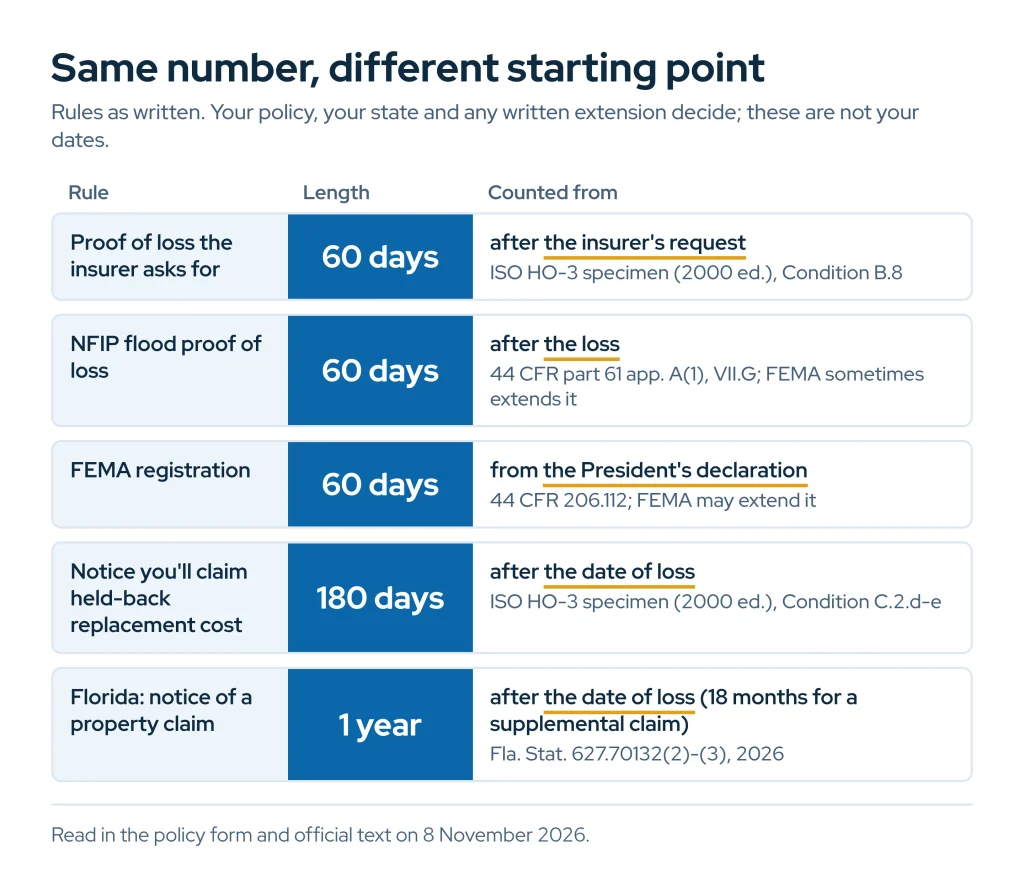
- Can’t wait: a proof-of-loss request (60 days after it in the specimen), an NFIP proof of loss (60 days after the loss), FEMA registration (60 days after the declaration), a state notice limit such as Florida’s 1 year, and the specimen’s 180-day replacement-cost notice.
- Ask: the insurer, in writing, about anything unclear. If it goes quiet or you disagree, call your state insurance department’s consumer line, found in the NAIC’s directory of state insurance departments; legal aid or your state bar’s lawyer referral service can help you find a lawyer.
Sources checked on 8 November 2026: ISO HO-3 specimen form, 2000 edition (HO 00 03 10 00), Section I Coverage D, Additional Coverages E.1-E.2, perils, Exclusions A.3 and A.5, Conditions B and C; 44 CFR part 61 appendix A(1) (SFIP Dwelling Form) VII.G and VII.O; 44 CFR 206.110, 206.112 and 206.113; 91 FR 70094 and 91 FR 61429; 16 CFR 429.0-429.1; Tex. Ins. Code 542.051-.060, ch. 542A, 2210.205, 2210.573, 2210.5731, 2210.574 and 2210.581; Tex. Bus. & Com. Code 27.02; Fla. Stat. 627.70131, 627.70132 and 489.147; La. R.S. 22:1892, 22:1892.2 and 22:1892.3; WAC 284-30-360 and 284-30-380; IRS Publication 547 (2025); FTC and CDC consumer pages; FEMA’s IHP page and DisasterAssistance.gov; Fannie Mae Servicing Guide B-5-01. Added and checked on 18 November 2026: N.Y. Ins. Law 2601(a)(4) and 2618; WAC 284-30-330(20)-(21) (WSR 26-17-089, effective 18 October 2026); P.L. 119-108 sec. 2 (26 U.S.C. 165(h)(6)); the specimen re-read in the archived Insurance Information Institute copy of 2 September 2026.
Sources
- ISO Homeowners 3 – Special Form, specimen, 2000 edition (HO 00 03 10 00), Insurance Information Institute copy, archived 2 Sep 2026
- ISO Homeowners 3 – Special Form, 2011 edition (HO 00 03 05 11), Maine Bureau of Insurance copy
- 44 CFR part 61, appendix A(1), Standard Flood Insurance Policy Dwelling Form (eCFR)
- 44 CFR 206.110, Federal assistance to individuals and households (eCFR)
- 44 CFR 206.112, Registration period (eCFR)
- 44 CFR 206.113, Eligibility factors (eCFR)
- FEMA, Notice of Maximum Amount of Assistance Under the Individuals and Households Program, 91 FR 70094 (6 Nov 2026)
- FEMA, IHP maximums for disasters declared 1 Oct 2025 to 30 Sep 2026, 91 FR 61429 (29 Sep 2026)
- FEMA, Individuals and Households Program
- DisasterAssistance.gov (FEMA helpline)
- 16 CFR part 429, Cooling-Off Rule (eCFR)
- FTC, How to avoid scams after weather emergencies and natural disasters (Sept 2025)
- CDC, Carbon monoxide poisoning basics
- Texas Insurance Code ch. 542 (prompt payment of claims)
- Texas Insurance Code ch. 542A (claims for weather and other forces of nature)
- Texas Insurance Code ch. 2210 (Texas Windstorm Insurance Association)
- Texas Business and Commerce Code 27.02
- Florida Statutes 627.70131 (2026)
- Florida Statutes 627.70132 (2026)
- Florida Statutes 489.147 (2026)
- Louisiana R.S. 22:1892
- Louisiana R.S. 22:1892.2
- Louisiana R.S. 22:1892.3
- WAC 284-30-360 (effective 18 Oct 2026)
- WAC 284-30-380 (effective 18 Oct 2026)
- IRS Publication 547 (2025), Casualties, Disasters, and Thefts
- IRS, Casualty loss deduction expanded and made permanent (updated 15 Sep 2026)
- Fannie Mae Servicing Guide B-5-01, Insured loss events
- FloodSmart (FEMA, National Flood Insurance Program)
- NAIC, State insurance departments directory
- New York Insurance Law 2601 (unfair claim settlement practices)
- New York Insurance Law 2618 (claims after declared disasters)
- WAC 284-30-330, specific unfair claims settlement practices (WSR 26-17-089, effective 18 Oct 2026)
- Public Law 119-108, Doug LaMalfa Federal Disaster Tax Relief Certainty Act (11 Sep 2026), 26 U.S.C. 165(h)(6)