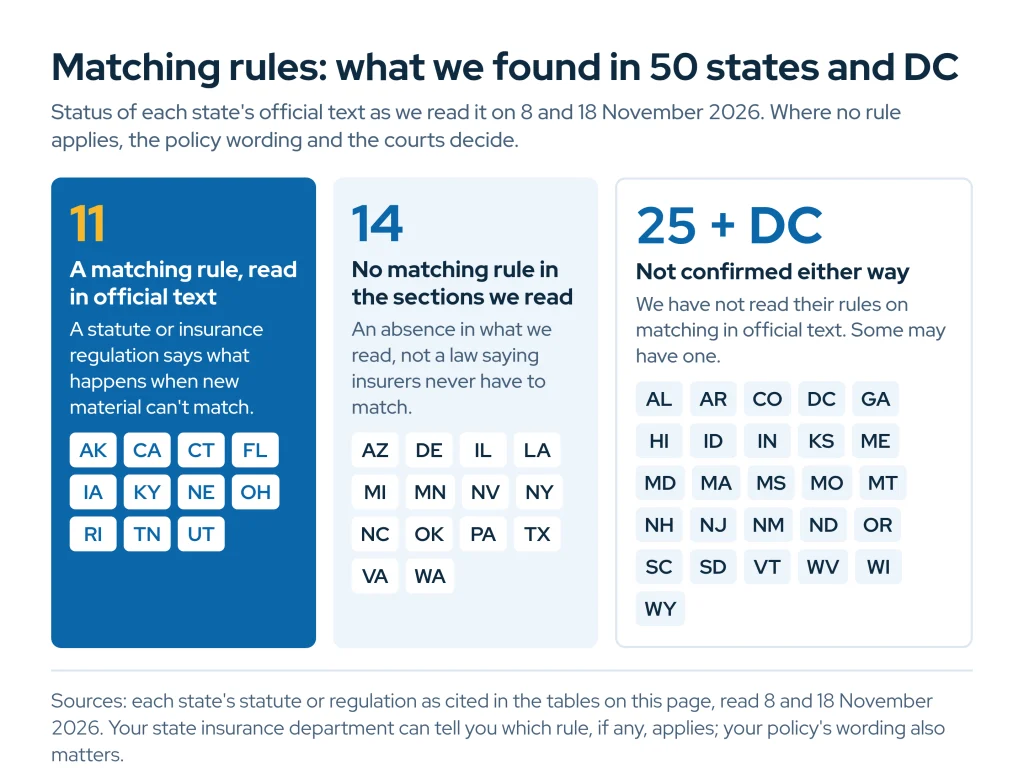
Only in some states, and only as far as each state’s rule reaches; elsewhere your policy’s wording decides. This page is part of our roof, hail and wind guides. The ISO HO-3 specimen form (2000 edition), the standard many homeowners policies build on, pays to repair or replace the damaged part of your house with material of like kind and quality; it has no clause that says the new shingles or siding must match the old. In 11 states we read in official text on 8 November 2026 (Alaska, California, Connecticut, Florida, Iowa, Kentucky, Nebraska, Ohio, Rhode Island, Tennessee and Utah), a statute or insurance regulation says what happens when new material can’t match. The wording differs a lot: “items in the area”, “adjoining areas”, “adjacent items”, “the same line of sight”. In 14 more states we found no such rule in the sections we read (Arizona, Illinois, Michigan and New York were added after a read on 18 November 2026), and for the remaining 25 states and DC we have not confirmed either way. Where no rule applies, the policy wording and the courts decide. Your policy’s wording matters in the 11 states too, because a few of these rules give way to it.
General information, not legal or insurance advice, and not a substitute for the advice of an attorney. Your policy’s wording and your state’s law decide, and both change. For help with your claim, your state insurance department’s consumer line and legal aid are free.
The matching problem in plain terms
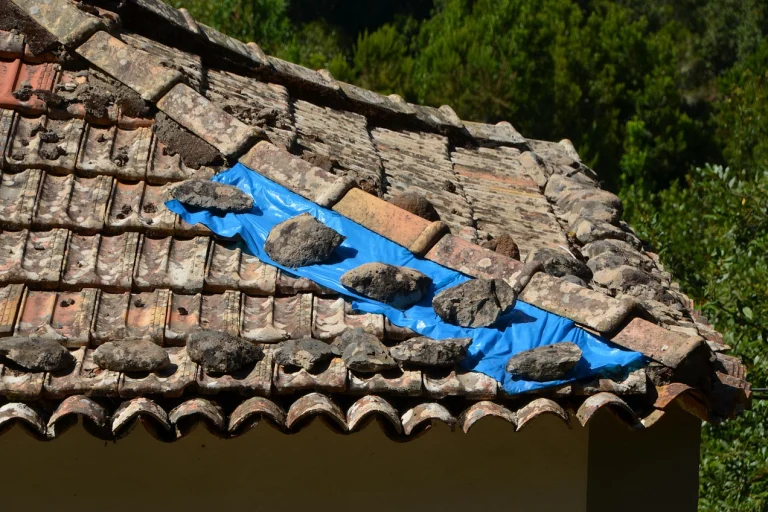
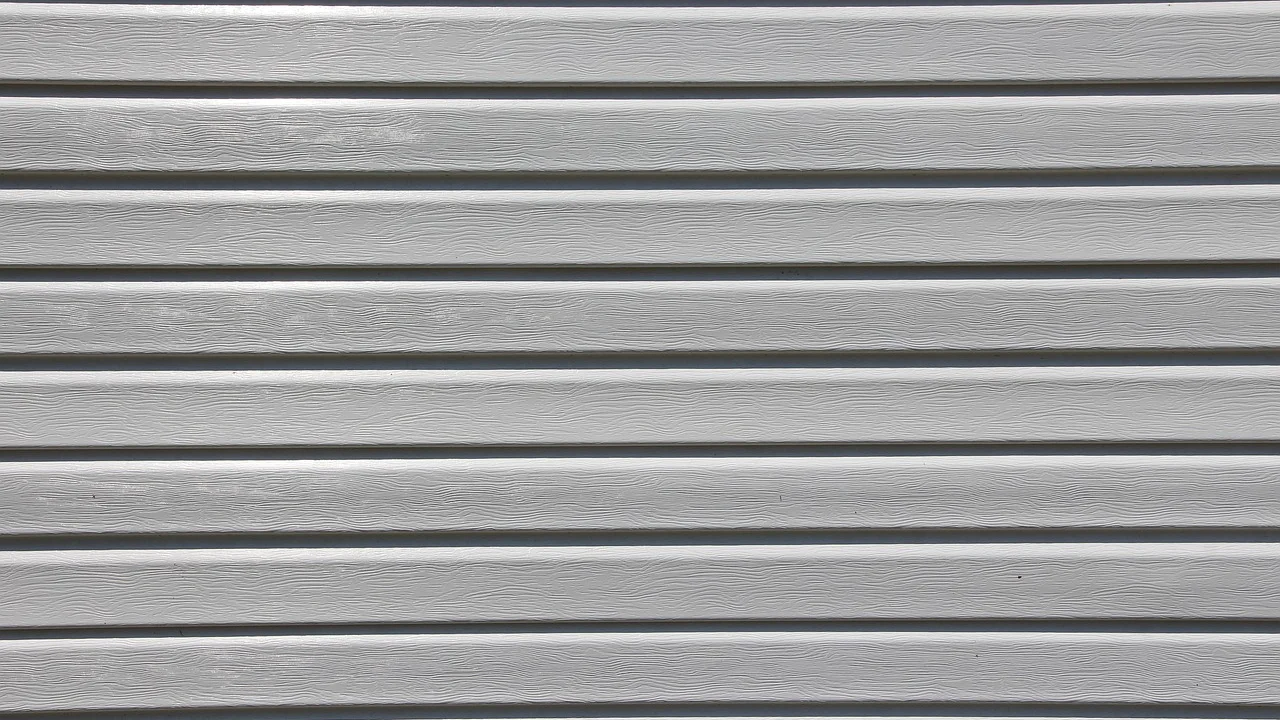
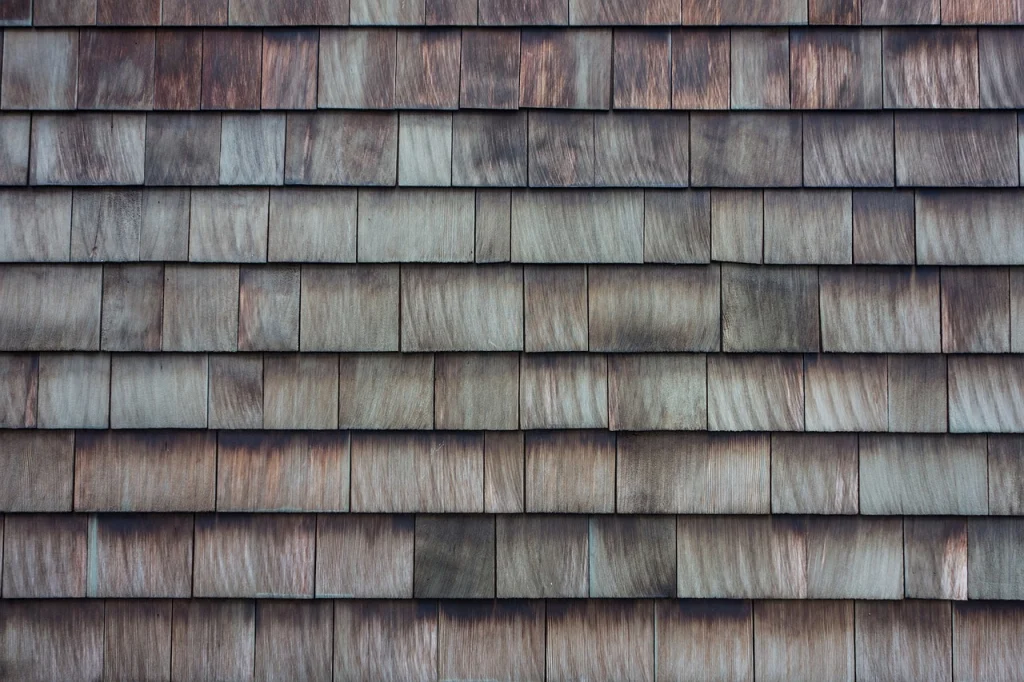
Hail bruises one slope of a roof, or wind tears a row of siding off the north wall. The damaged part can be replaced. But the shingle line has been discontinued, or the siding on the other walls has faded over fifteen years, and new material sits next to old in a visibly different color, texture or size. The question is whether the claim pays only for the damaged pieces, or also for undamaged pieces next to them so the result looks uniform.
That is a question about the extent of the repair. It is separate from whether the damage is covered at all (see hail damage and your roof claim), and separate from how the payout is figured once the scope is agreed. Matching rules only matter once a covered loss needs some replacement.
What the standard policy says
Most homeowners policies build on forms written by Insurance Services Office (ISO), a company that drafts standard policy language that insurers can adopt or change. In the ISO HO-3 specimen form (2000 edition, HO 00 03 10 00), hosted by the Insurance Information Institute (a trade group; copy archived 2 Sep 2026), the Loss Settlement condition pays for a building at replacement cost when it is insured to at least 80% of its full replacement cost: the cost to repair or replace, capped at, among other limits, the replacement cost of “that part of the building damaged” with material “of like kind and quality and for like use” (Section I Condition C.2.a). Under Condition H (Our Option), the insurer may also choose to repair or replace damaged property itself with like kind and quality, if it gives written notice within 30 days after it receives your signed, sworn proof of loss.
The specimen has no clause about matching undamaged parts. That silence is why matching disputes happen: one side reads “that part of the building damaged” as the limit, the other reads “like kind and quality” as including a reasonable appearance. Later ISO editions, state amendatory endorsements and each insurer’s own form can read differently, so check yours.
- Look at your endorsements. Some policies add an endorsement that limits payment for matching undamaged siding or roofing to a set dollar sublimit, or excludes it; others add matching coverage. Kentucky’s insurance department has told admitted insurers that a sublimit endorsement of that kind conflicts with its rule (see the Kentucky row below). The list of endorsements is on your declarations page, the summary page at the front of the policy.
- Look at how the roof is settled. Matching rules mostly speak of policies that settle at replacement cost. If your roof is paid at actual cash value (replacement cost minus depreciation) or on a roof payment schedule, read that endorsement first. Our guide to when insurance pays for a new roof explains the three settlement types.
- Code upgrades are a different coverage. When a building code, not appearance, requires work on undamaged parts, the specimen’s Ordinance or Law additional coverage applies, up to 10% of the Coverage A (dwelling) limit in the 2000 edition (Section I Property Coverages, Additional Coverage E.11). Your policy may give a different amount.
State matching rules we read
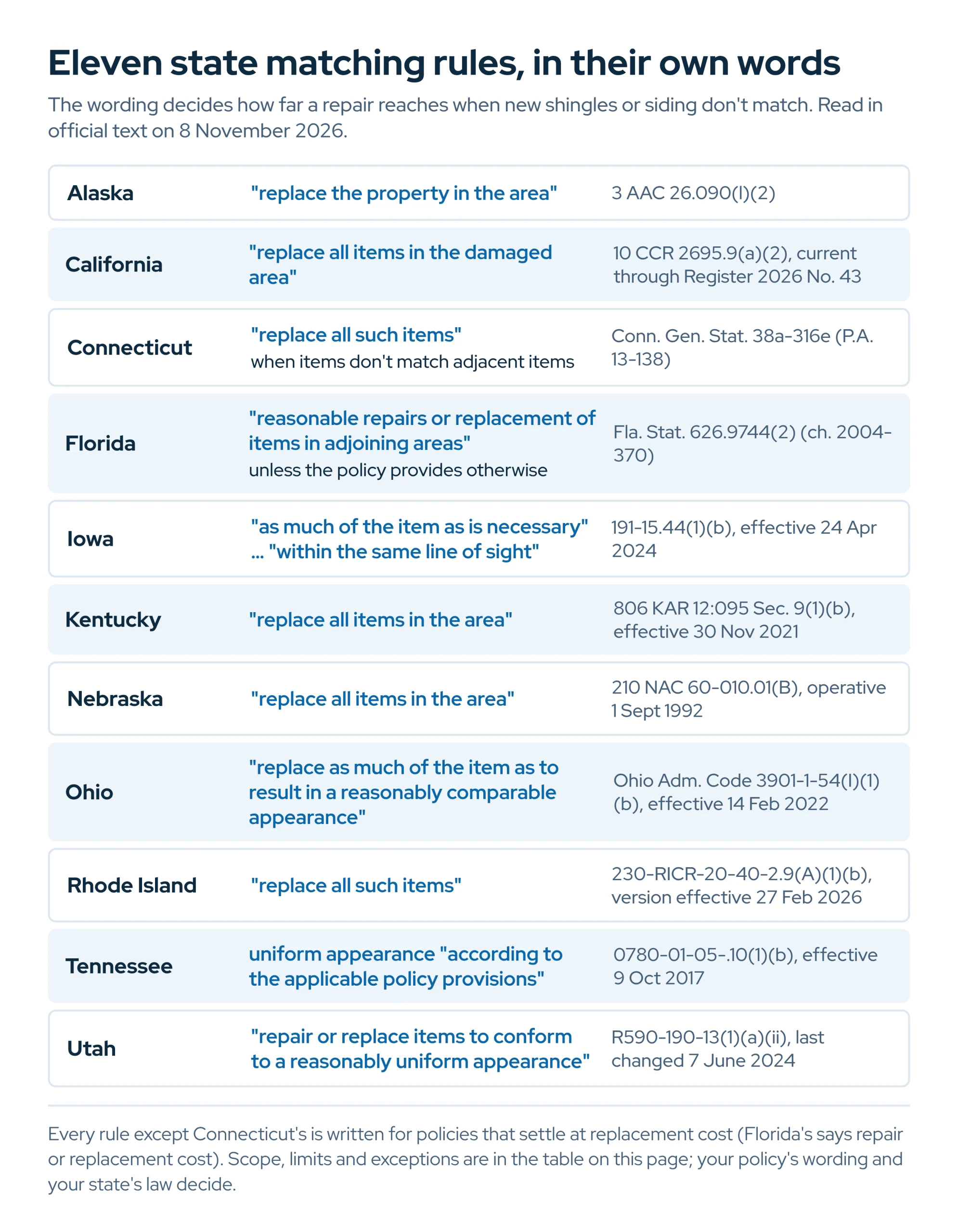
Each of these was read in full section in official text on 8 November 2026, including its scope and exceptions. Most are unfair claims settlement regulations: rules the state insurance department enforces against insurers. Several say outright that they create no private right to sue (noted in the table); our page on insurance bad faith explains what that means for a homeowner. Whether a court will apply a rule in a lawsuit is a separate question we don’t answer here.
| State | What the rule says | Which policies, and limits | Source |
|---|---|---|---|
| Alaska | When replacement property doesn’t match in quality, color or size, the insurer “shall replace the property in the area” for a reasonably uniform appearance. Interior and exterior losses. The claimant pays no betterment or other cost except the deductible. | Claims adjusted on the basis of replacement cost. | 3 AAC 26.090(l)(2) |
| California | When replaced items don’t match in quality, color or size, the insurer “shall replace all items in the damaged area” so they conform to a reasonably uniform appearance. | Residential or commercial property policies that settle first-party losses at replacement cost. The section does not add the interior-and-exterior sentence other states use. | 10 CCR 2695.9(a)(2) (official CCR, current through Register 2026 No. 43) |
| Connecticut | When replacement items don’t match adjacent items in quality, color or size, the insurer “shall replace all such items with material of like kind and quality” for a reasonably uniform appearance. Interior and exterior covered losses. The insurer is not a warrantor of the work, and the section neither authorizes nor bars enforcement of policy terms on settlement disputes. The official annotation notes the state Supreme Court held that, once the insurer concedes a covered peril, the extent of matching is part of the “amount of loss” and goes to appraisal (341 Conn. 735). | Any covered loss to real property; the text is not limited to replacement cost policies. | Conn. Gen. Stat. 38a-316e (P.A. 13-138) |
| Florida | When replaced items don’t match in quality, color or size, the insurer “shall make reasonable repairs or replacement of items in adjoining areas”. In deciding how far to go it may weigh the cost of replacing undamaged parts, how much uniformity can be had without that cost, the remaining useful life of the undamaged part and other relevant factors. The insurer is not a warrantor of the repairs, and the section neither authorizes nor bars enforcement of policy terms on settlement disputes. | Homeowner’s policies that settle first-party losses at repair or replacement cost, and only “unless otherwise provided by the policy”: a policy can change this. | Fla. Stat. 626.9744(2) (ch. 2004-370) |
| Iowa | When replaced items don’t match in quality, color or size, the insurer replaces “as much of the item as is necessary” for a reasonably uniform appearance “within the same line of sight”. Interior and exterior losses. “Exceptions may be made on a case-by-case basis.” The insured pays nothing over the deductible. | Policies that settle first-party losses at replacement cost; not auto claims. | Iowa Admin. Code 191-15.44(1)(b) (ARC 7734C, effective 24 Apr 2024) |
| Kentucky | When replaced items don’t reasonably match in quality, color and size, the insurer “shall replace all items in the area” for a reasonably uniform appearance. Interior and exterior losses. The insured bears no cost over the deductible. The department’s Advisory Opinion 2023-08 (17 Oct 2023) reads “area” as the whole of a part used for one purpose, such as an entire roof or an entire contiguous carpet, and rejects a line-of-sight approach. Its example: if one slope must be reshingled and no matching shingle makes it reasonably uniform with the rest, an entirely new roof. If the same shingle is still made, using it satisfies the rule even if the old roof has weathered. It told admitted insurers to amend non-complying forms, including endorsements that put a sublimit on matching undamaged areas, by 1 Sept 2024. The opinion says it is not legally binding; we did not confirm whether it has since been withdrawn, so check with the department. | Fire and extended coverage type policies that settle first-party losses at replacement cost. The regulation says it creates no private cause of action. | 806 KAR 12:095, Section 9(1)(b) (eff. 30 Nov 2021); Advisory Opinion 2023-08 |
| Nebraska | When replacement items don’t reasonably match in quality, color or size, the insurer “shall replace all items in the area” for a reasonably uniform appearance. Interior and exterior losses. The insured bears no cost over the deductible. | Policies that settle at replacement cost. The rule says it creates no private cause of action. | 210 NAC 60-010.01(B) (department’s copy; operative 1 Sept 1992) |
| Ohio | When an interior or exterior loss requires replacing an item and the new item doesn’t match its quality, color or size, the insurer “shall replace as much of the item as to result in a reasonably comparable appearance”. Unlike most rows here, the rule does not say the insured pays nothing over the deductible: where a settlement leaves the insured paying part as betterment, the insurer must document how it was worked out and the insured’s agreement before the work starts ((I)(1)(c)). | Fire and extended coverage policies that settle first-party losses at replacement cost. The rule says it creates no private cause of action. | Ohio Adm. Code 3901-1-54(I)(1)(b) (effective 14 Feb 2022) |
| Rhode Island | When replaced items don’t match in quality, color or size, the insurer “shall replace all such items” for a reasonably uniform appearance. Interior and exterior losses. The claimant bears no cost over the deductible. | Policies that settle first-party losses at replacement cost. The regulation says it creates no private cause of action. | 230-RICR-20-40-2.9(A)(1)(b) (version effective 27 Feb 2026) |
| Tennessee | When replaced items don’t match in quality, color or size, the insurer replaces items for a reasonably uniform appearance “according to the applicable policy provisions”. Interior and exterior losses. The insured bears no cost over the deductible. | Policies that settle first-party losses at replacement cost. The chapter says it creates no private cause of action, and the phrase “according to the applicable policy provisions” ties the rule to your policy’s terms. | Tenn. Comp. R. & Regs. 0780-01-05-.10(1)(b) (effective 9 Oct 2017) |
| Utah | When repaired or replaced items don’t match in color, texture or size, the insurer “shall repair or replace items to conform to a reasonably uniform appearance” for interior and exterior losses. The insured is responsible only for the deductible. | Policies that settle first-party losses at replacement cost. | Utah Admin. Code R590-190-13(1)(a)(ii) (last changed 7 June 2024) |
Read the differences closely, because they decide how far a repair reaches. “All items in the area” (Kentucky, Nebraska), “the property in the area” (Alaska) and “all items in the damaged area” (California) read more broadly than “as much of the item as is necessary … within the same line of sight” (Iowa) or “as much of the item as to result in a reasonably comparable appearance” (Ohio). Florida lets the insurer weigh cost and remaining life. Connecticut speaks of adjacent items and sends the dispute to appraisal. None of them says every shingle on the house must be new because one was damaged.
States where we found no matching rule
In these states we read the claim-handling statutes or regulations named here and found no matching provision. That is an absence in what we read, not a law saying insurers never have to match: the policy wording and the courts decide, and other sections or court decisions may bear on it.
| State | What we read, and when |
|---|---|
| Arizona | Ariz. Admin. Code R20-6-801, unfair claims settlement practices, whole section (amended effective 7 Jan 2024); its repair and betterment rules speak of automobiles. Read 18 Nov 2026 |
| Delaware | 18 Del. Admin. Code 902, unfair claim settlement practices (archived official copy, current to 26 DE Reg. 112, Aug 2022). Read 8 Nov 2026 |
| Illinois | 50 Ill. Adm. Code part 919, improper claims practices, every section (919.80 last amended effective 22 Jul 2002). Its “like kind and quality” rules are for vehicle parts. Read 18 Nov 2026 |
| Louisiana | The Title 22 claim-handling sections read for our state pages, including La. R.S. 22:1892. Read 8 Nov 2026 |
| Michigan | Insurance Code sections 500.2006 (timely payment), 500.2026 (unfair claims practices) and 500.2833 (required fire policy provisions). Michigan’s administrative rules were not searched. Read 18 Nov 2026 |
| Minnesota | Minn. Stat. 72A.201, unfair claims practices. Court decisions may bear on matching in Minnesota; none is summarized here. Our Minnesota claim rules page describes one reported appraisal case on siding after a 2011 hailstorm. Read 8 Nov 2026 |
| Nevada | NAC chapter 686A, including the claims practice sections 686A.660 to 686A.690. Read 8 Nov 2026 |
| New York | 11 NYCRR part 216 (Regulation 64; the link opens section 216.6), unfair claims settlement practices, every section in force, on the state’s NYCRR site, which labels itself unofficial and was current through 31 May 2022. Its only repair-standard section for property, 216.7, covers motor vehicles. Read 18 Nov 2026 |
| North Carolina | G.S. 58-63-15(11) and the standard fire policy statute. The department’s rules in 11 NCAC 04, read 11 November 2026, have no matching rule for homes: their repair-part rules cover motor vehicles only (.0426). Read 8 Nov 2026 |
| Oklahoma | Title 36 of the Oklahoma Statutes, complete file compiled through the 2025 session (keyword search). Read 8 Nov 2026 |
| Pennsylvania | 31 Pa. Code chapter 146, unfair claims settlement practices. Read 8 Nov 2026 |
| Texas | Texas Insurance Code chapters 542 and 707 and the other claim sections read for our state pages. Read 8 Nov 2026 |
| Virginia | 14VAC5-400, rules governing unfair claim settlement practices, every section. Read 8 Nov 2026 |
| Washington | Chapter 284-30 WAC, as published on 8 Nov 2026, which includes the amendments in force from 18 Oct 2026 (WSR 26-17-089) |
States not confirmed
We have not read these states’ rules on matching in official text, so we say nothing about them either way. Some may have a rule; web lists that name “matching states” disagree with each other, and we don’t repeat them. Each link goes to the state’s official administrative code, statutes or legislature site, where unfair claims settlement rules usually sit, or to the insurance department. Your state insurance department can tell you which rule, if any, applies.
- Alabama, Arkansas, Colorado, District of Columbia, Georgia, Hawaii, Idaho, Indiana
- Kansas, Maine, Maryland, Massachusetts, Mississippi, Missouri, Montana, New Hampshire, New Jersey
- New Mexico, North Dakota, Oregon, South Carolina, South Dakota, Vermont, West Virginia, Wisconsin, Wyoming
South Carolina stays in this list although part of its code has been read: Title 38 chapters 59, 75, 91 and 92 and Regulations chapter 69, read 18 November 2026 for our South Carolina claim rules page, have no matching rule, but its other rules were not read.
Many states’ claim regulations follow a pattern from the NAIC’s model unfair claims regulation. Its matching section, for replacement cost policies, has the insurer replace the non-matching items across the area so the result looks reasonably uniform, inside and out (NAIC Model 902, Section 9.A(2)). A model is not law anywhere until a state adopts it in its own words, and the table above shows how far adopted versions drift from it.
Policies these rules may not reach
- Flood insurance from the NFIP. The Standard Flood Insurance Policy has no matching clause, and it says it and all claim disputes are governed exclusively by FEMA’s flood insurance regulations, the National Flood Insurance Act and federal common law (44 CFR part 61, appendix A(1), Dwelling Form, Article X). A state matching regulation is not the rule for a flood claim. See NFIP flood insurance claims.
- Actual cash value policies. Every rule in the table except Connecticut’s is written for policies that settle at replacement cost (Florida’s says repair or replacement cost).
- Surplus lines, FAIR plans and state wind pools. Whether a state’s rule reaches these depends on that rule’s scope and on the laws that govern each of them. We didn’t read every scope section for these policies, so ask your state insurance department before relying on a rule.
- Building code work. When a code, rather than appearance, forces wider work, that is usually Ordinance or Law coverage. One example of a state law on the code side: Florida says that where a roof or roof section was built, repaired or replaced to the 2007 Florida Building Code or later, and 25% or more of it is being repaired, replaced or recovered, only that portion has to meet the current code (Fla. Stat. 553.844(5), ch. 2022-269). That is a building code rule, not a matching rule.
Claims you may see online
You may see these on other sites. We checked them against the policy form and the rules above.
- “Insurance has to give you a whole new roof if any shingle is damaged.” Not a general rule. The state rules we read apply only when the new material doesn’t match, aim at a reasonably uniform (Ohio: comparable) appearance, and several limit how far that reaches: an area, adjoining or adjacent items, or a line of sight. Kentucky’s department reads its rule as reaching the entire roof when one slope can’t be matched, but that is one state’s non-binding reading of its own rule.
- “Insurers never have to pay for undamaged material.” Also not right as a general rule: the 11 states in our table say otherwise when new material doesn’t match, within their limits.
- “Line of sight is the standard everywhere.” Of the rules we read, only Iowa’s uses it, and Kentucky’s department rejects it for its rule.
- “Some contractors say they can get the insurer to replace everything.” No contractor decides that. Matching is decided by the policy, the state’s rule where there is one and, in a dispute, appraisal, the department or a court.
What to do next
- Get the whole policy. Ask the insurer in writing for a complete copy with every endorsement and the declarations page. Read Loss Settlement, Our Option, Appraisal and any endorsement that mentions matching, siding, roof surfacing or cosmetic damage.
- Record the undamaged areas too. Before anything is torn off, take dated photos and video of the damaged and undamaged sections side by side in daylight. Keep a loose shingle or siding piece if one comes off, and any label, receipt or product name from the original install.
- Ask for the scope in writing. The adjuster’s estimate should list what will be replaced. If it stops at the damaged pieces and the new material won’t match, ask the insurer in writing which policy provision and which state rule it relied on. Our page on working with the insurance adjuster covers how to keep that record.
- Know the dispute routes. If you and the insurer agree the loss is covered but disagree on how much must be replaced, your policy’s appraisal clause may apply (in Connecticut, the official annotation to 38a-316e notes the Supreme Court held that, once the insurer concedes a covered peril, the extent of matching is part of the amount of loss and goes to appraisal). See how the appraisal clause works. You can also file a complaint with your state insurance department; find yours with our complaint links by state.
- Watch the policy’s clocks. Keep track of your policy’s deadlines while a matching question is open, such as the replacement cost notice window in the Loss Settlement condition and the Suit Against Us condition. Our claim deadline rules by state show the shortest suit limit each state we have read allows a policy to set; your policy may give longer. To see how a replacement cost payout and its holdback work with example numbers, try the actual cash value vs replacement cost calculator.
- Ask for free help first. Your state insurance department’s consumer line can say which matching rule, if any, it enforces. For legal advice on your own claim, contact legal aid or your state bar’s lawyer referral service.
Sources checked on 8 November 2026; the Arizona, Illinois, Michigan and New York rows, Kentucky’s regulation and the policy form link rechecked on 18 November 2026. State rules change; each row shows the version we read. Found something out of date? Our corrections page explains how to tell us.
Sources
- ISO Homeowners 3 Special Form specimen, HO 00 03 10 00 (2000 edition), Insurance Information Institute copy, archived 2 Sep 2026
- Alaska Administrative Code, 3 AAC 26.090
- California Code of Regulations, 10 CCR 2695.9 (official CCR)
- Connecticut General Statutes 38a-316e
- Florida Statutes 626.9744 (2026)
- Florida Statutes 553.844 (2026)
- Iowa Administrative Code 191-15.44 (chapter 15, published 28 Oct 2026)
- Kentucky 806 KAR 12:095
- Kentucky Department of Insurance, Advisory Opinion 2023-08 (17 Oct 2023)
- Nebraska Department of Insurance, 210 NAC chapter 60
- Ohio Administrative Code 3901-1-54
- Rhode Island 230-RICR-20-40-2
- Tennessee Rules 0780-01-05, Unfair Claims Settlement Practices
- Utah Administrative Code R590-190
- Delaware 18 Del. Admin. Code 902 (archived official copy)
- Minnesota Statutes 72A.201
- Nevada Administrative Code chapter 686A
- Pennsylvania Code, 31 Pa. Code chapter 146
- Virginia Administrative Code 14VAC5-400
- Washington Administrative Code chapter 284-30
- Louisiana R.S. 22:1892
- North Carolina G.S. 58-63-15
- NFIP Standard Flood Insurance Policy, Dwelling Form, 44 CFR part 61 appendix A(1) (eCFR)
- NAIC Model Regulation 902, Unfair Property/Casualty Claims Settlement Practices (model only)
- 11 NCAC 04 (North Carolina Department of Insurance, Consumer Services Division rules)
- Arizona Administrative Code R20-6-801 (Secretary of State, chapter 20-06)
- Illinois Administrative Code, 50 Ill. Adm. Code part 919
- Michigan Compiled Laws 500.2006
- Michigan Compiled Laws 500.2026
- Michigan Compiled Laws 500.2833
- New York 11 NYCRR 216.6, in part 216 (Regulation 64), state NYCRR site (labelled unofficial, current through 31 May 2022)