Hail damage to the roof of your house is usually covered by a standard homeowners policy. In the ISO HO-3 specimen form (2000 edition, HO 00 03 10 00), the dwelling is insured against risk of direct physical loss unless the form excludes or limits it, and hail is not among the exclusions. Three things can change that answer: an endorsement that excludes “cosmetic” hail damage or pays an older roof at its depreciated value, a separate wind and hail deductible, and an adjuster’s finding that the damage comes from age and wear rather than the storm. Your policy’s wording decides, so read your declarations page and every endorsement listed on it. This page is part of our roof, hail and wind guides.
General information, not legal or insurance advice, and not a substitute for the advice of an attorney. Your policy’s wording and your state’s law decide, and both change. For help with your claim, your state insurance department’s consumer line and legal aid are free.
What the standard form says about hail
Many homeowners policies are built on forms written by Insurance Services Office (ISO), a company that drafts standard policy language insurers can adopt or change. The only text quoted here is the ISO HO-3 specimen form (2000 edition), in the copy the Insurance Information Institute (a trade group) published, archived 2 September 2026. Later ISO editions, state amendments and each insurer’s own form can differ.
- The house and other structures (Coverages A and B) are covered on an “open perils” basis: any direct physical loss is covered unless the form excludes it. Hail is not excluded, so hail that breaks, punctures or knocks off roofing is usually covered.
- What the form does not cover nearby: wear and tear, marring and deterioration; faulty, inadequate or defective maintenance, workmanship or materials; and neglect, which the form defines as an insured’s failure to use all reasonable means to save and preserve property at and after the time of a loss. These are often where hail-roof disputes start: was it the storm, or was it age?
- Belongings inside (Coverage C) are covered only for named perils. “Windstorm or hail” is one, but rain, snow, sleet, sand or dust that gets inside is covered only if wind or hail first made an opening in the roof or a wall.
So the usual answer to “does insurance cover hail damage to my roof?” is yes, if the damage is physical and was caused by hail, and if no endorsement on your policy narrows it. Not every homeowners policy includes wind and hail, though: the Texas Department of Insurance’s after-hail page puts it as “if you have wind and hail coverage on your home policy”. Where it is left out, that cover has to come from a separate policy. On the Texas coast, for example, the Texas Windstorm Insurance Association exists to sell windstorm and hail insurance in the seacoast territory as an insurer of last resort (Tex. Ins. Code 2210.001), and its policies have their own claim clock (below). Your declarations page shows whether wind and hail are covered and under which policy. For the wider picture of how a roof claim runs, see roof insurance claims, step by step.
Functional damage and cosmetic damage
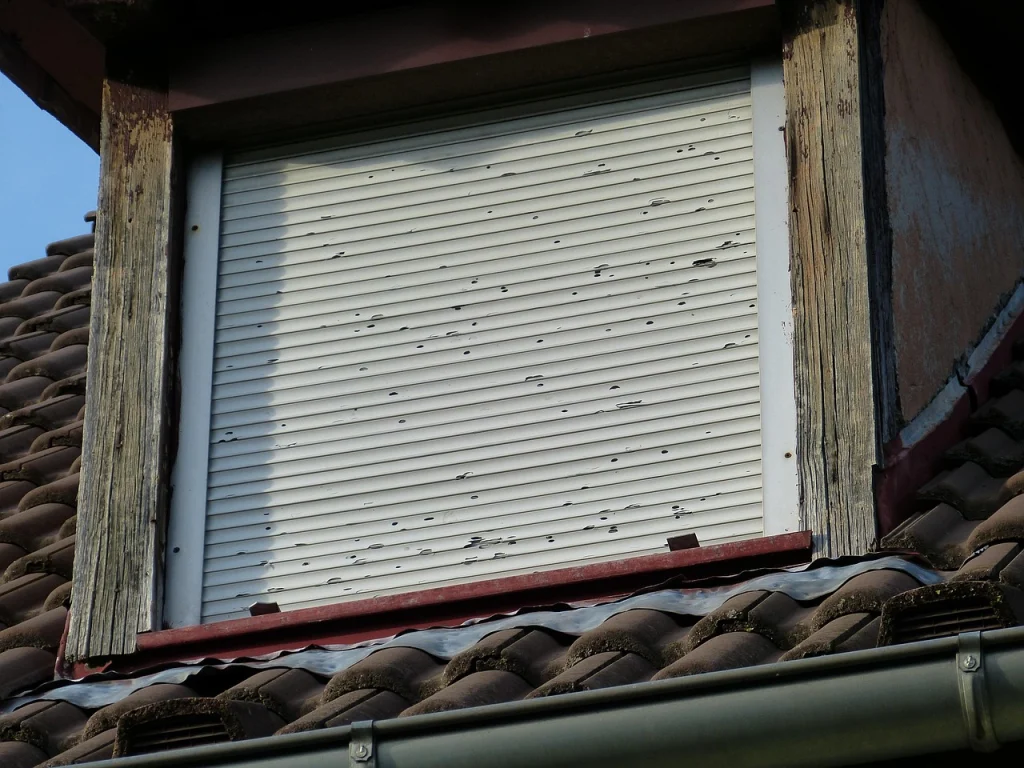
Hail can do two quite different things to a roof. It can fracture shingles, knock granules loose down to the mat, crack tiles, split wood shakes or tear flashing. That kind of damage affects whether the roof keeps water out. Or it can leave dents that change how the roof looks, such as dimples in a metal panel, a vent cap or a gutter, without letting water in. Insurers and policyholders call the first “functional” damage and the second “cosmetic” damage.
Under a plain HO-3 with no cosmetic endorsement, the specimen form doesn’t separate the two. Some policies do, through an endorsement that excludes cosmetic hail damage. One example in official text is the endorsement the Texas Department of Insurance prescribed in 1998, HO-145, Exclusion of Cosmetic Damage to Roof Coverings Caused by Hail (Commissioner’s Bulletin B-0030-98, effective 2 May 1998). It:
- excludes damage that “alters the physical appearance of the roof covering” but doesn’t let water penetrate it or cause it to fail at keeping out the elements over an extended period;
- still covers hail damage that lets water through or makes the roof covering fail at that job;
- defines “roof covering” as the material exposed to the weather, the underlayments and the flashings;
- could be attached only to a policy receiving a premium credit for an impact-resistant roof covering, and was void unless the insured signed it (or the insurer kept a signed copy on file).
That is one endorsement from one state in 1998, shown here as an example of how such wording works. Insurers and rating organizations may file their own cosmetic-damage endorsements, and we haven’t read a current one in official text, so we don’t describe their wording. If your declarations page lists an endorsement with “cosmetic” or “roof surfacing” in its title, read it in full: its definition of cosmetic damage decides what it excludes. Whether a particular dent is cosmetic or functional is a question of fact on each roof, and neither we nor any article can answer it for yours. If a hail roof claim is denied as cosmetic or as wear, the guide to denied roof claims sets out the clause a denial usually rests on and what the rules allow next.
Roof age, actual cash value and the two checks
How a covered roof loss is paid matters as much as whether it is covered. Replacement cost means the cost to repair or replace with like kind and quality today. Actual cash value (ACV) means that cost minus depreciation for age and wear. The Texas Department of Insurance’s roof insurance guide says some policies pay less if the roof is older or worn, that some companies switch roofs to actual cash value as they age, and that your company should tell you when it changes your coverage. Read your renewal notices for that change.
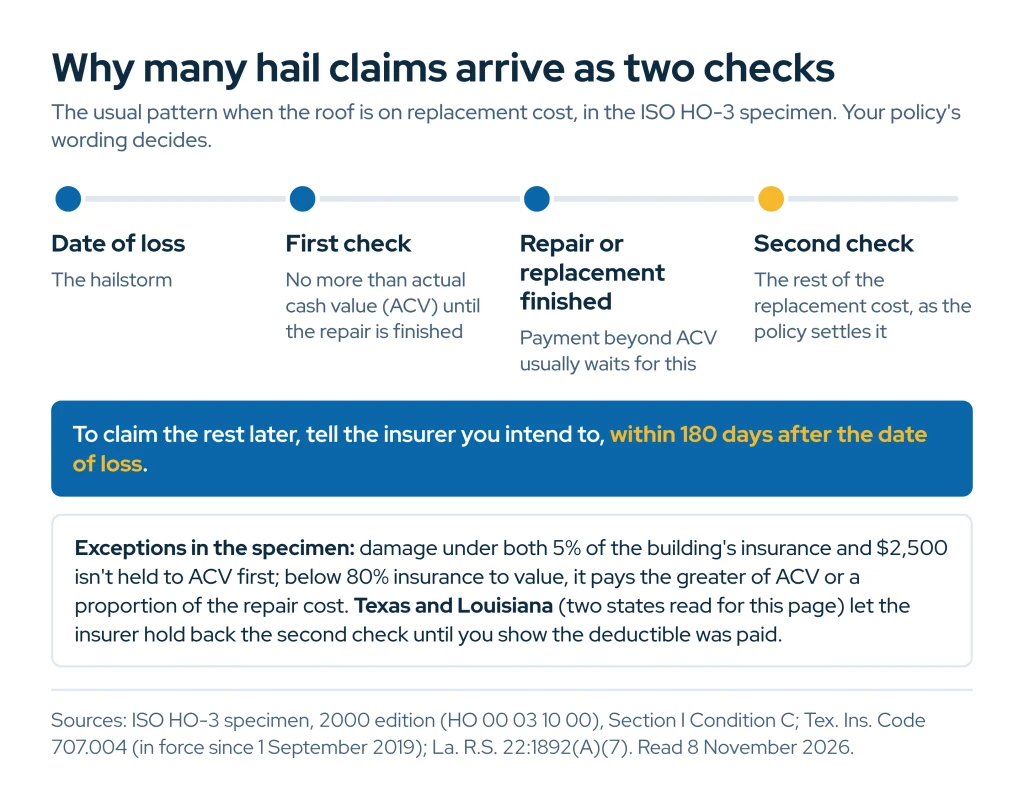
Where the roof is on replacement cost, the ISO HO-3 specimen (2000 edition, Condition C) pays no more than ACV until the repair or replacement is finished, unless the damage costs less than both 5% of the building’s insurance and $2,500. You may take the ACV payment first and claim the rest later if you tell the insurer, within 180 days after the date of loss, that you intend to make that further claim. Full replacement cost settlement also needs the building insured to at least 80% of its full replacement cost just before the loss; below that, the specimen pays the greater of ACV or a proportion of the repair cost. That is why many hail claims arrive as two checks, which TDI’s guide also describes. Our recoverable depreciation calculator works through the arithmetic with your own numbers.
Two states read for this page let the insurer hold back the second check until you show the deductible was paid: Texas Insurance Code 707.004 (in force since 1 September 2019; proof includes a cancelled check, a credit card statement or a signed payment plan) and Louisiana R.S. 22:1892(A)(7). For when a whole new roof is paid for and when it isn’t, see when insurance pays for a new roof.
Wind and hail deductibles
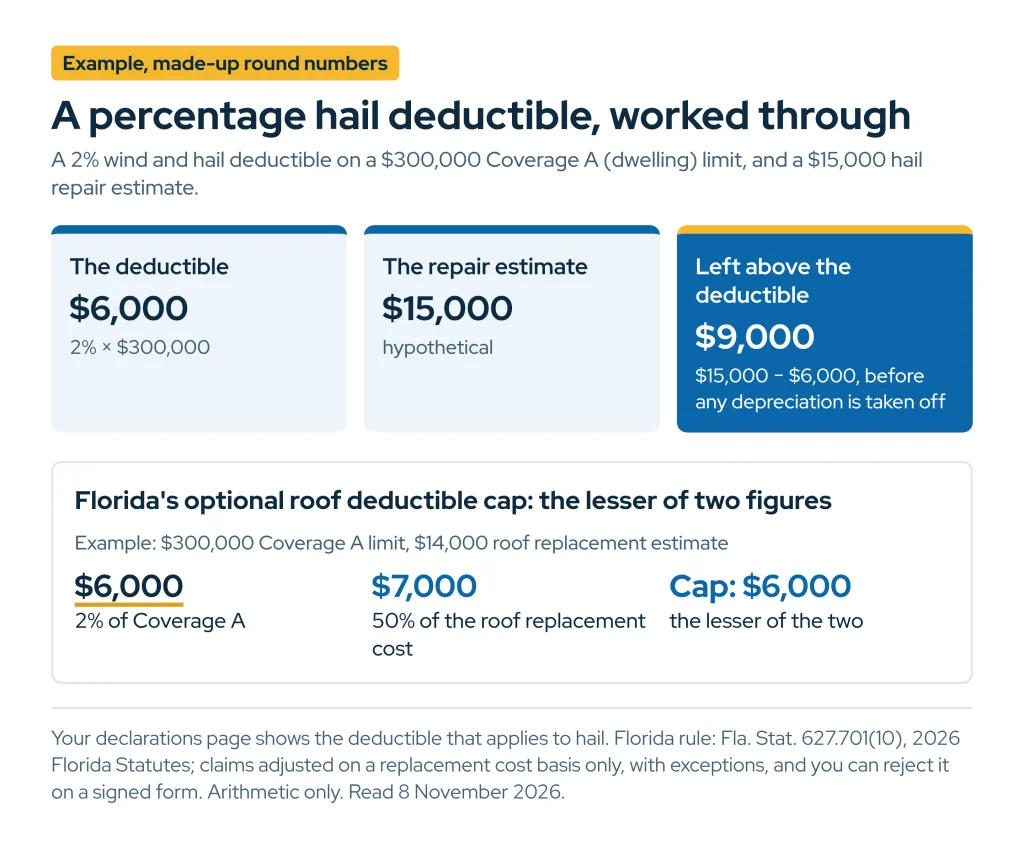
Some policies carry a separate deductible for wind and hail, and it can be a percentage of the dwelling limit (Coverage A) instead of a flat dollar figure. A Texas Department of Insurance consumer column says the wind and hail deductible “is often more” than the deductible for other damage. A percentage deductible works like this example, with round hypothetical numbers: a 2% wind and hail deductible on a $300,000 Coverage A limit is $6,000, so a $15,000 hail repair estimate leaves $9,000 above the deductible before any depreciation is taken off. Check your declarations page for the deductible that applies to hail; the deductible calculator runs the arithmetic on your own figures.
- Texas: the declarations page must list each type of deductible and state its exact dollar amount, and identify any provision that can change it (Insurance Code 2301.056, effective 1 September 2013). The insured must pay any deductible on a first-party property claim (707.002).
- Florida: an insurer may add an optional separate roof deductible of no more than the lesser of 2% of Coverage A or 50% of the cost to replace the roof. It applies only to claims adjusted on a replacement cost basis, not to hurricane roof losses, a total loss, a tree fall that punctures the roof deck, or a repair of less than 50% of the roof, and you can reject it on a signed form (Fla. Stat. 627.701(10), 2026 Florida Statutes). Example: on a $300,000 Coverage A limit and a $14,000 roof replacement estimate, 2% is $6,000 and 50% is $7,000, so that rule caps the roof deductible at $6,000.
- Hurricane and named-storm deductibles: if your policy also has one, check its wording for which storms and which damage it applies to. Those deductibles follow separate state rules: see hurricane and named-storm deductibles by state.
When to report hail damage
Hail damage is often hard to see from the ground, and some of it is noticed only when a leak shows up months later. That makes the date of the storm important. The ISO HO-3 specimen asks for “prompt notice” and sets a suit limit of two years after the date of loss, and the state clocks in the table below run from the date of loss or the date the damage occurred, not from the day you noticed the damage. There is no single national deadline: claims you may read online such as “you have one year to file any hail claim” are not a general rule. A few clocks read in official text for this page:
| Where | Rule | Counted from | Source (read 8 Nov 2026) |
|---|---|---|---|
| ISO HO-3 specimen (2000 edition) | Prompt notice; suit within two years | The date of loss (suit) | Conditions B.1 and G |
| Florida | Notice of a claim or reopened claim within 1 year; a supplemental claim within 18 months (tolled during combat deployment). For windstorms and other weather events, the date of loss is the date the event is verified by NOAA | The date of loss | Fla. Stat. 627.70132 |
| Texas Windstorm Insurance Association (coastal wind and hail policies) | Claim filed no later than the first anniversary of the damage; the commissioner may extend it up to 180 days for good cause | The date the damage occurs | Tex. Ins. Code 2210.205, 2210.573 |
Your policy may give you longer than a state’s rule, and state rules have exceptions. For each state’s claim clocks and the shortest suit limit a policy may set, see claim deadlines by state. Waiting until the last day is never safe.
To pin down the storm date, public weather records help. The National Weather Service counts hail “one (1) inch in diameter or larger” as severe (NWS Birmingham). The Storm Prediction Center posts daily storm reports, labelled preliminary, and NOAA keeps the Storm Events Database. A screenshot of the report nearest your home, kept with your photos, records what was reported that day.
What to do after a hailstorm
The ISO HO-3 specimen’s Duties After Loss condition asks you to give prompt notice, protect the property from further damage, make reasonable and necessary repairs, keep records of what those repairs cost, show the damage when asked, and send a signed, sworn proof of loss within 60 days after the insurer asks for one. In practice:
- Stay off the roof. Photograph from the ground and from windows. TDI’s after-hail checklist says to take pictures and video and list the damage inside and outside.
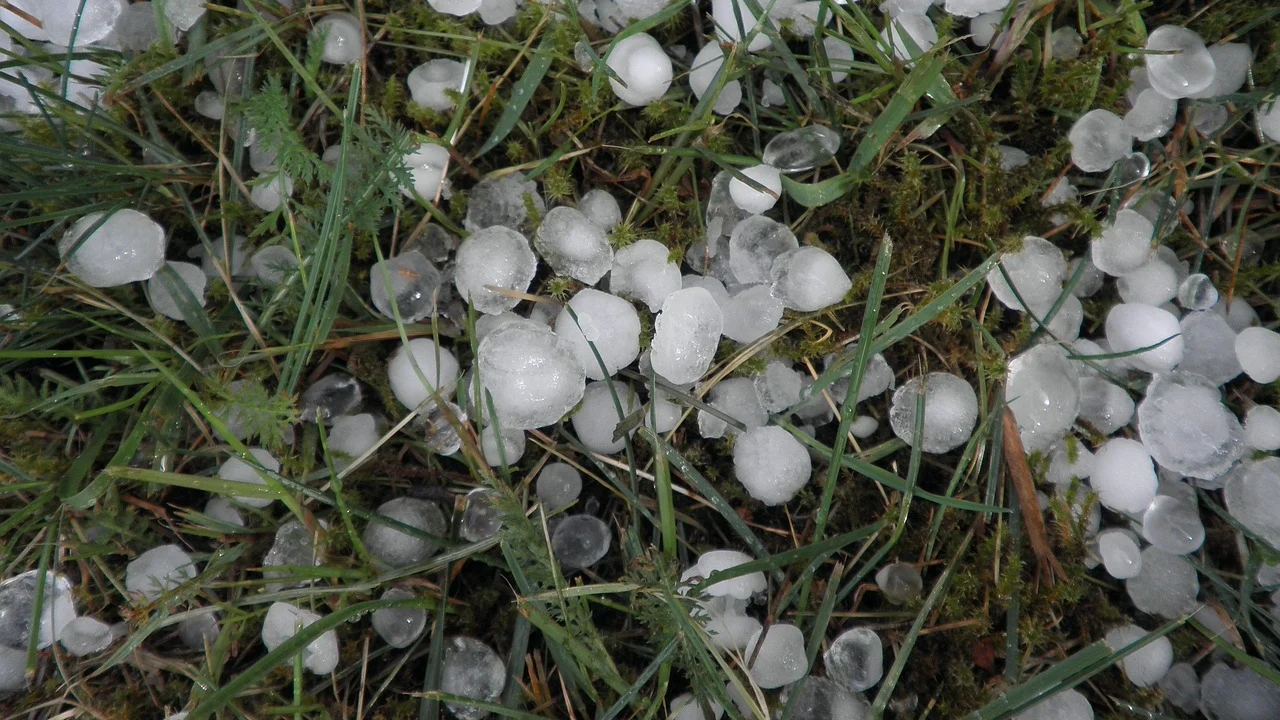
- Record the hail and the softer metals. Hailstones beside a coin or ruler on the day, dents in gutters, downspouts, vent caps, the air conditioner’s fins, window screens, siding and cars. Note the date and time of the storm. Our page on homeowners insurance and AC units covers the air conditioner side.
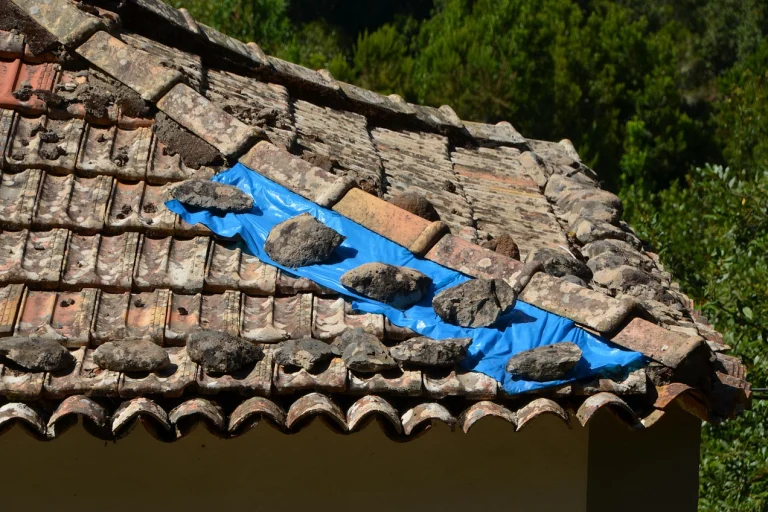
- Stop further damage. Cover holes and broken windows, keep every receipt, and keep damaged pieces until the insurer says you may throw them away.
- Report the claim in writing and write down every call: date, name, what was said. Ask which deductible applies and whether the roof is on replacement cost or actual cash value.
- Be there for the inspection if you can, and ask for the adjuster’s estimate in writing. Compare it line by line with any contractor’s estimate.
- If you disagree on the amount, many policies have an appraisal condition: in the specimen form, either side may demand it when you can’t agree on the amount of loss, and each side names an appraiser within 20 days after receiving the other side’s written request. See how insurance appraisal works. The specimen’s appraisal condition is written for disagreements over the amount of loss; whether a dispute about coverage or the cause of the damage can go to appraisal depends on your policy’s wording and your state’s law. For coverage questions and complaints, your state insurance department’s consumer line can help.
Storm chasers and the contractor rules
After a hailstorm, contractors often knock on doors offering free roof inspections. Many are honest, but several states have written rules for this moment. The Federal Trade Commission’s post-disaster advice says to “never sign your insurance check over to a contractor” and, if a contractor wants cash up front, to walk away. Under the FTC’s Cooling-Off Rule, a sale of $25 or more made at your home generally comes with the right to cancel until midnight of the third business day after the sale. Exceptions include a repair you called the seller for to meet a genuine, immediate personal emergency, where you waived the right in a signed, handwritten statement (16 CFR 429). State roofing and contractor laws read for this page:
| State | Deductible | Cancelling an insurance-paid contract | Contractor acting on your claim | Statute (read 8 Nov 2026) |
|---|---|---|---|---|
| Texas | Paying, waiving, absorbing or rebating the deductible without the insurer’s consent is a Class B misdemeanor; contracts of $1,000 or more paid from a claim must carry a deductible notice | No rule in the sections read | A contractor may not act as a public adjuster on property it works on | Bus. & Com. Code 27.02; Ins. Code 4102.163 |
| Florida | No rebate, gift, cash or deductible waiver for a roof inspection or a roof claim; ads for roof claims must carry a deductible and fraud warning | Any roof repair or replacement contract, insurance-paid or not: within 10 days after signing or by the official start date, whichever is first, if signed within 180 days of events under a Governor’s emergency declaration, on a home in the declared area | May not interpret the policy or adjust the claim without a public adjuster license; fines up to $10,000 per violation | Fla. Stat. 489.147 (last amended 2025) |
| Illinois | No advertising or promising to pay or rebate any part of the deductible | Until midnight of the earlier of the 5th business day after the insurer’s written notice that all or part isn’t covered, or the 30th business day after the insurer receives your proof of loss | May not represent you on the claim, call in or file a claim for you, or climb on the roof without your express permission | 815 ILCS 513/18 |
| Minnesota | No promise to pay the deductible, and no payment for allowing an inspection or making a claim | No rule in this section | May not interpret the policy or adjust the claim without a public adjuster license; the insurer need not consider an estimate from a contractor that breaks the rule | Minn. Stat. 325E.66 |
| Missouri | No advertising or promising to pay or rebate any part of the deductible | Until midnight of the 5th business day after the insurer’s written notice that all or part isn’t covered | May not represent or negotiate for you on the claim | RSMo 407.725 |
| Nebraska | No promise to rebate any part of the deductible (items of nominal value aside); the contract, estimate or work order must carry a deductible notice you sign, sent to the insurer before payment | Until midnight of the later of the 3rd business day after signing or after the insurer’s written notice that all or part isn’t covered | No rule on representing you in the sections read; a contract is void if the contractor breaks the Act | Neb. Rev. Stat. 44-8603, 44-8604, 44-8607, 44-8608 |
Other states may have similar rules that we haven’t read; ask your state’s contractor licensing board or attorney general’s consumer office. Florida also voids assignments of post-loss benefits to anyone under residential and commercial property policies issued on or after 1 January 2023, with narrow exceptions such as a later buyer of the home (Fla. Stat. 627.7152(11), (13)). If the insurance check is made out to you and your mortgage company, the lender’s own process decides how the money is released; ask your servicer for it in writing, and see the mortgage company and your insurance check.
Claims you may hear, checked
- “We’ll cover your deductible.” Each state in the table above bars contractors from offering this, in the terms its statute sets (Texas, for example, without the insurer’s consent; Florida in exchange for a roof inspection or a roof claim), and in Texas the law says the insured must pay the deductible. We checked it against those statutes: in those states, making the offer is itself what the law forbids.
- “If hail hit any shingle, insurance has to replace the whole roof.” Not a general rule. A few states have written matching rules for a reasonably uniform appearance, with limits: see matching rules by state.
- “You have one year to file a hail claim.” Not a national rule. Florida’s notice limit and TWIA’s filing limit are 1 year, the ISO specimen sets a two-year suit limit, and other states and policies differ. Your policy and your state decide.
- “Filing won’t affect your premium.” Not a promise anyone can make. The NAIC’s consumer guide to home insurance says claims go into databases such as CLUE and “often affect” premium and renewal. Weighing a small claim against the deductible is covered in should you file?
Is there a time limit on a hail damage claim?
Usually there are several clocks, and none of them is national. The policy sets its own: the ISO HO-3 specimen (2000 edition) asks for prompt notice, a signed, sworn proof of loss within 60 days after the insurer asks for one, and a lawsuit within two years after the date of loss (Conditions B and G). A suit limit is the time the policy allows to sue the insurer over the claim. State law can set a floor the policy can’t go below, a separate rule for roof damage nobody could see, or a claim clock of its own, such as Florida’s and the Texas Windstorm Insurance Association’s in the table above. A state’s floor is not your deadline: your policy may give you longer, and your policy’s wording decides. Some state rules on hail and suit limits, read in official text:
| State | The rule | Counted from | Source (read 18 Nov 2026) |
|---|---|---|---|
| Oklahoma | A policy that sets a time limit for wind or hail damage to a roof must allow a claim filed after the first anniversary and up to 24 months after the loss, if the damage was not evident without inspection. It is listed as an unfair claim practice and speaks of filing claims, not lawsuits | The date of the loss | 36 O.S. 1250.5(7) (section last amended eff. 1 Nov 2025) |
| Oklahoma | A property policy may not limit the time to sue to less than 1 year; a shorter clause is void | The date of the event that caused the loss | 36 O.S. 3617 (Laws 1957) |
| Texas | A clause limiting the time to sue on a contract to less than two years is void. A clause requiring notice of a claim before you may sue must be reasonable, and one requiring notice within less than 90 days is void. Separately, before suing an insurer other than the Texas Windstorm Insurance Association over a hail or other weather claim, written notice is required at least 61 days ahead, with exceptions | Not stated in these sections; the 61 days run back from the day suit is filed | Civ. Prac. & Rem. Code 16.070(a), 16.071(a) (16.070 as amended eff. 26 Aug 1991); Ins. Code 542A.001, 542A.003 (eff. 1 Sep 2017) |
| Minnesota | The standard fire policy written into the statute: suit within two years | The inception of the loss | Minn. Stat. 65A.01 subd. 3 (2026 Statutes; subd. 3 last amended 2013) |
| Arizona | Property policies: one year to sue, which the insurer may lengthen in its policy | The date of the event that caused the loss | A.R.S. 20-1115(A)(3) (current text; the official page shows no enactment date) |
Exceptions change these clocks. Policies from a state wind pool such as the Texas Windstorm Insurance Association, or from a FAIR plan, carry their own rules; whether a state’s floor reaches a surplus lines policy is not confirmed here. Some states pause the suit clock while the insurer decides a claim, and reopened or supplemental claims can have their own limit (Florida’s is in the table above). The table’s limits count in months and years, except the Texas 90-day and 61-day notice rules, and whether a declared disaster extends any of them is not confirmed in the sections read. For each state’s notice rules, claim clocks and the shortest suit limit a policy may set, see the claim deadlines by state table linked above; the state guides to Texas, Oklahoma and Florida claim rules set out each one in full, and Kentucky’s claim clocks and matching rule are on the Kentucky page, where the suit limit is likewise a floor a policy may lengthen, not a deadline. Waiting until the last day is unsafe: an inspection, an estimate and a proof-of-loss request each take time inside the same clock.
Your next step
- Gather: the full policy, the declarations page and every endorsement (look for “cosmetic”, “roof surfacing”, “actual cash value” or a separate wind and hail deductible), dated photos and video, the storm date and a weather report for it, receipts for temporary repairs, and every letter from the insurer.
- Read: your policy’s Duties After Loss, Loss Settlement and Suit Against Us conditions, and your state’s claim rules.
- Ask: the insurer in writing which deductible applies, whether the roof is settled at replacement cost or actual cash value, and why any part is denied. If you can’t resolve it, your state insurance department’s consumer line is free (find yours in the NAIC’s directory of state insurance departments), and legal aid or a licensed attorney can advise on your facts.
- Mind the clocks: a notice-of-claim limit, a proof-of-loss request with a date on it, or a suit limit can run while you are still collecting estimates.
Sources checked on 8 November 2026; the time-limit rules and the HO-3 specimen rechecked on 18 November 2026.
Sources
- ISO HO-3 specimen form, Homeowners 3 – Special Form (2000 edition, HO 00 03 10 00), Insurance Information Institute (trade group) copy, archived 2 Sep 2026
- Texas Department of Insurance, Commissioner's Bulletin B-0030-98 and Endorsement HO-145, Exclusion of Cosmetic Damage to Roof Coverings Caused by Hail (effective 2 May 1998)
- Texas Department of Insurance, Insurance and your roof: what to know when buying a policy or filing a claim
- Texas Department of Insurance, Hail damage to your home or car? What to do next
- Texas Department of Insurance, What to know about insurance and your roof (consumer column, March 2026)
- Texas Insurance Code ch. 707 (707.002, 707.004)
- Texas Insurance Code 2301.056
- Texas Insurance Code ch. 2210 (2210.001, 2210.205, 2210.573)
- Texas Insurance Code 4102.163
- Texas Business and Commerce Code 27.02
- Louisiana R.S. 22:1892
- Florida Statutes 627.701 (2026)
- Florida Statutes 627.70132 (2026)
- Florida Statutes 627.7152 (2026)
- Florida Statutes 489.147 (2026)
- Illinois Home Repair and Remodeling Act, 815 ILCS 513/18
- Minnesota Statutes 325E.66
- Missouri Revised Statutes 407.725
- Nebraska Insured Homeowners Protection Act, Neb. Rev. Stat. 44-8601 to 44-8608
- FTC Cooling-Off Rule, 16 CFR part 429 (eCFR)
- FTC, How to avoid scams after weather emergencies and natural disasters
- NAIC, A Consumer's Guide to Home Insurance
- NAIC, state insurance departments directory
- National Weather Service Birmingham, severe thunderstorm criteria
- NOAA Storm Prediction Center, storm reports
- NOAA NCEI Storm Events Database
- Oklahoma Statutes Title 36 (complete title, Oklahoma Legislature), 36 O.S. 1250.5(7) and 3617
- Texas Civil Practice and Remedies Code 16.070, 16.071
- Minnesota Statutes 65A.01 (2026)
- Arizona Revised Statutes 20-1115
- Texas Insurance Code ch. 542A (542A.001, 542A.003)