A roof insurance claim usually runs in eight steps: make the roof safe and stop more water getting in, record the damage, report the claim in writing, meet the adjuster, get the insurer’s written estimate and decision, take the first payment, have the roof repaired, then claim any amount held back until the work was done. Whether the roof damage is covered at all depends on what caused it and on your policy’s wording: storm damage is usually covered, wear and age usually aren’t. This guide is part of our Roof, Hail and Wind section and follows a claim from the day of the storm to the last check.
General information, not legal or insurance advice, and not a substitute for the advice of an attorney. Your policy’s wording and your state’s law decide, and both change. For help with your claim, your state insurance department’s consumer line and legal aid are free.
Policy terms below come from the ISO HO-3 specimen form (2000 edition, HO 00 03 10 00), the standard “special form” homeowners policy published by Insurance Services Office, which we read in the copy hosted by the Insurance Information Institute (a trade group; archived 2 Sep 2026). The 2011 edition (HO 00 03 05 11, in the Maine Bureau of Insurance’s copy) keeps the same 60-day proof of loss, 80% insurance-to-value, 5% and $2,500, 180-day, appraisal, 60-day payment and two-year suit terms, under different condition letters; the letters below are the 2000 edition’s. Your insurer’s form, its endorsements and your state’s amendatory endorsement can say something else. Your policy is the one that counts.
The steps at a glance
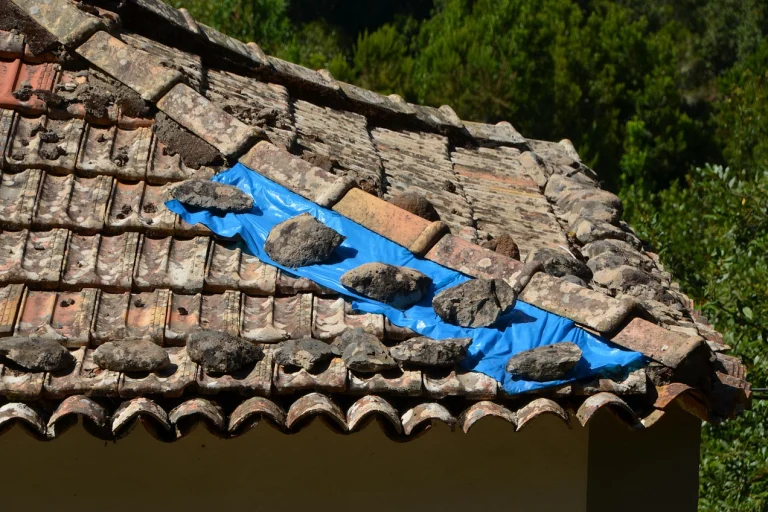
- Make it safe and limit the damage. Tarp or board what you safely can, catch the water, keep every receipt.
- Record the damage before anything is removed: photos, video, the storm date.
- Report the claim in writing and ask what the insurer needs from you.
- The inspection. An adjuster looks at the roof, in person or with photos, video or a drone.
- The estimate and the decision. Ask for the written estimate and the reasons for any part that is denied.
- The first payment. On a replacement cost policy this is often the actual cash value, after the deductible.
- The repair. You choose the contractor and sign the contract.
- The holdback. Send proof the work is done to claim the rest, inside the policy’s time limit.
Before you call: what your policy says about the roof
Ten minutes with your declarations page (the summary sheet at the front of the policy listing your limits, deductibles and endorsements) tells you most of what shapes a roof claim. Look for these things.
- Your deductible for this kind of damage. The deductible is the part of a covered loss you pay before the policy pays. Some policies have a separate deductible for wind and hail, or for hurricanes, and it can be a percentage of the dwelling limit (Coverage A) rather than a flat dollar amount. Florida, for example, requires insurers to offer hurricane deductibles of $500 and of 2%, 5% and 10% of the dwelling limit before issuing a policy (Fla. Stat. 627.701(3)(a)). Our page on hurricane damage claims explains how wind and storm surge are handled separately. The Texas Department of Insurance tells homeowners the wind and hail deductible “is often more” than the one for other damage (TDI, What to know about insurance and your roof, March 2026). Our deductible calculator turns a percentage into dollars on your own figures.
- How the roof is paid for. Replacement cost pays to repair or replace with like kind and quality at today’s prices. Actual cash value (ACV) is that cost minus depreciation, the loss in value from age and wear. TDI warns that “as roofs age, some companies will switch to actual cash value” for the roof, and that “many policies reduce coverage based on your roof’s age and materials” (TDI, Insurance and your roof, updated 1 April 2026; TDI column above). Read the list of endorsements on your declarations page for any that mention the roof, roof surfacing, or a payment schedule.
- What isn’t covered. The specimen form covers the house against “risk of direct physical loss” unless a cause is excluded, and it lists wear and tear, deterioration and faulty workmanship, materials or maintenance among the excluded causes. TDI puts it plainly: your insurer “won’t pay for a new roof just because it’s old or worn out” (TDI, Insurance and your roof). For belongings inside, the specimen pays for rain damage only if wind or hail first made an opening in the roof or a wall (HO 00 03 10 00, Coverage C perils, Windstorm Or Hail). Our page on whether homeowners insurance covers roof leaks goes through where the line usually falls.
- Hurricanes and tornadoes. The specimen form has no separate hurricane or tornado peril: wind damage to the house falls under its “risk of direct physical loss” cover, and for belongings under the named Windstorm Or Hail peril. What it excludes is water: its Water Damage exclusion covers flood, surface water, waves and tidal water “whether or not driven by wind” (HO 00 03 10 00, Section I Exclusion A.3.a), so storm surge and flood water inside the house usually fall to a separate flood policy, not the homeowners claim. A hurricane or named-storm deductible comes from an endorsement and from state rules on when it applies, not from the specimen form; your policy’s wording decides which deductible applies to which damage. Where wind cover comes from a state wind pool or FAIR plan, or the flood policy is an NFIP policy (federal rules, not state law), that plan’s own policy and rules apply instead.
- Insurance to value. The specimen pays full replacement cost on the house only if your dwelling limit was at least 80% of the cost to rebuild it just before the loss; below that it pays the greater of the ACV or a proportion of the repair cost (HO 00 03 10 00, Section I Condition C.2).
Florida only: a personal lines residential policy there may carry a separate roof deductible. The statute caps it at the lesser of 2% of the Coverage A limit or 50% of the cost to replace the roof, allows it only on claims adjusted at replacement cost, and bars it for a hurricane, for a tree or other hazard that punctures the roof deck, for a covered total loss and for repairs to less than half the roof (Fla. Stat. 627.701(10), 2026 Statutes).
Step 1: Make it safe and limit the damage
The specimen form makes this a duty. After a loss you must protect the property from further damage, make “reasonable and necessary repairs” to protect it, and keep an accurate record of what those repairs cost (HO 00 03 10 00, Section I Condition B.4). The same form’s Reasonable Repairs coverage pays the reasonable cost of necessary measures taken solely to protect covered property, damaged by a covered peril, from further damage, inside your existing limit (Section I Property Coverages E.2). The NAIC, the association of state insurance regulators, tells homeowners the same thing: “You’re also required to protect your home from further damage” (NAIC, A Consumer’s Guide to Home Insurance, 2022).
- Stay off a wet, steep or damaged roof. A tarp can wait for someone with the right equipment.
- Inside, move belongings, put out buckets, and take wet items out of the way.
- Keep receipts for tarps, plywood, fans and any emergency service, and photograph the temporary fix.
- Hold off on a permanent repair or replacement until the insurer has seen the damage or agreed in writing that you can go ahead. If you must tear anything out for safety, photograph it first and keep a sample of the damaged shingles or flashing if you can.
Step 2: Record the damage
Take photos and video before cleanup: wide shots of each side of the house, then close-ups of missing or lifted shingles, dented vents and gutters, flashing, ceiling stains, wet insulation in the attic and anything that fell. Photograph from the ground or a window; you don’t need to climb. Write down the date and time of the storm and when you first saw the damage, and keep notes of anything that happened later, such as a new leak in the next rain.
The date matters. In Florida, for claims from hurricanes, tornadoes, windstorms, severe rain or other weather events, the date of loss is the date a hurricane made landfall or the date the weather event is verified by the National Oceanic and Atmospheric Administration (Fla. Stat. 627.70132(3)). Other states’ rules differ, and many policies count their time limits from the date of loss. If hail was the cause, our guide to hail damage roof claims goes into it in more detail.
Step 3: Report the claim in writing
The specimen form asks for “prompt notice” to the insurer or your agent (Section I Condition B.1). It sets no day count, and it says the insurer has no duty to provide coverage if a failure to perform the duties after loss is prejudicial to it. Some states set a hard outer limit. Florida bars a new or reopened property claim unless notice is given to the insurer under the policy’s terms within 1 year after the date of loss, and a supplemental claim (for more loss or damage from the same peril) within 18 months after the date of loss; the rule covers eligible surplus lines policies too, and the limits are paused while a servicemember named on the policy is deployed to a combat zone (Fla. Stat. 627.70132(2), read 8 November 2026). Those are outer limits, not targets: reporting soon after the storm keeps the evidence fresh and avoids an argument about damage that got worse while you waited.
A phone call or app report is fine to start, but follow it with something written that shows the date: an email, a message through the insurer’s portal, or a letter. In Texas, the statutory claim clocks start from a “notice of claim”, which the Insurance Code defines as written notification that reasonably tells the insurer the facts of the claim (Tex. Ins. Code 542.051(4)). In your report, give the date and cause, what you have seen, the temporary repairs you made, and ask which forms and documents the insurer wants. Write down the claim number, and from now on note the date, name and gist of every call.
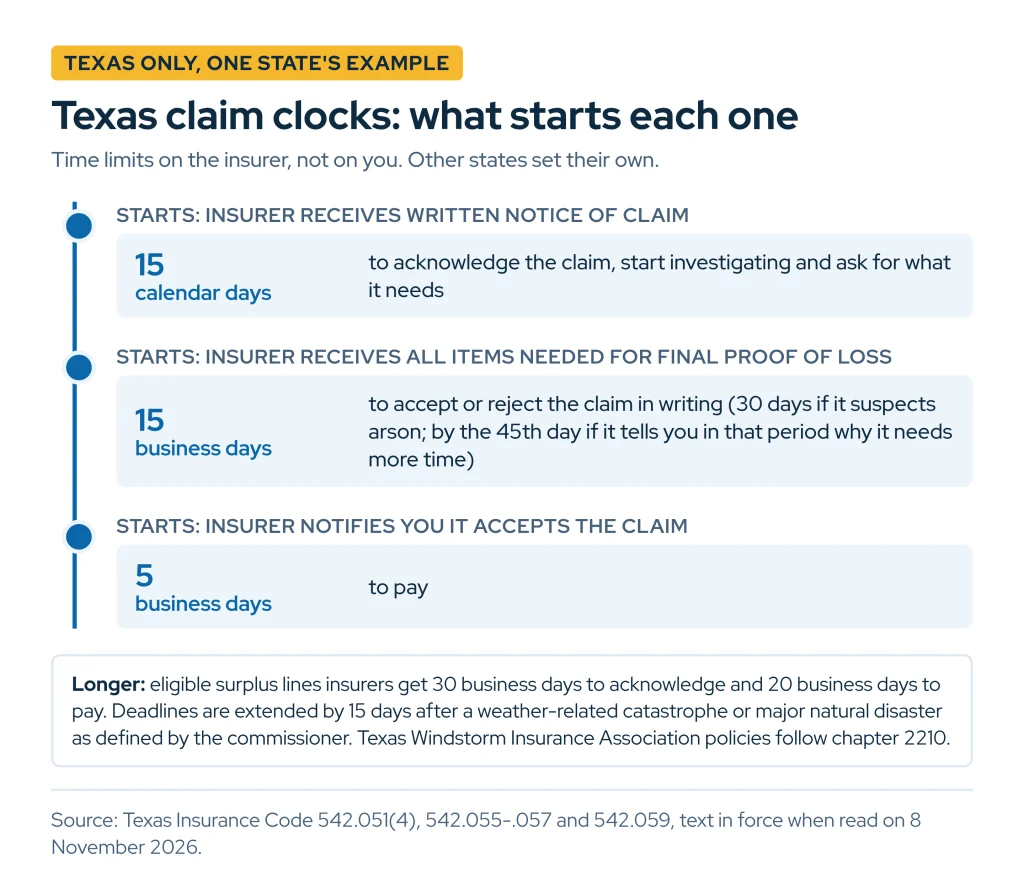
How fast the insurer must answer is state law, not a national rule. Texas, for example, gives insurers 15 calendar days after they receive notice of a claim to acknowledge it, start investigating and ask for what they need; 15 business days after receiving everything needed for final proof of loss to accept or reject it in writing (30 days if they suspect arson; if they tell you within that period why they need more time, they must decide by the 45th day after that notice); and 5 business days after notifying you of acceptance to pay. Eligible surplus lines insurers get longer (30 business days to acknowledge, 20 business days to pay), and the deadlines are extended by 15 days after a weather-related catastrophe or major natural disaster as defined by the commissioner (Tex. Ins. Code 542.055-.057, 542.059, read 8 November 2026). Texas Windstorm Insurance Association policies follow their own rules in chapter 2210. Our claim deadlines by state table gives every state’s clocks we have read, with the units and what starts each one, and marks the rest “not confirmed”.
Step 4: The inspection
The insurer assigns an adjuster, who may be its employee or an independent contractor, and who will usually want to see the damage (NAIC consumer guide). Insurers also inspect with photos, video calls and drones; Florida’s statute expressly allows these “electronic methods” and still lets the insurer send someone in person (Fla. Stat. 627.70131(3)(d)). In Florida, an adjuster who inspects in person must give you their name and state license number, and a physical inspection must take place within 30 days after the insurer receives the proof-of-loss statements (627.70131(3)(b)).
- Be there if you can, and walk the adjuster through your photos, the attic and the inside damage, not just the roof.
- Ask what the adjuster saw and whether anything was counted as wear, an earlier storm or poor installation rather than this event. Write down the answer.
- The NAIC suggests it “might help” to have your contractor meet with you and the adjuster. A contractor can point out damage; negotiating your claim is another matter (below).
Who may speak for you. A public adjuster is a freelance adjuster who charges you a fee to work your claim; not all states allow them, and those that do require them to be licensed (NAIC consumer guide). Some states also bar roofers from the role. Texas forbids a contractor to act as a public adjuster, or advertise to adjust claims, on any property where it is or may be doing the work (Tex. Ins. Code 4102.163). Florida forbids contractors to interpret policy provisions, advise you on your coverage or adjust a claim for you unless they hold a public adjuster license (Fla. Stat. 489.147(2)(d)). If you are weighing a public adjuster, our public adjuster fees by state table shows the license rules and fee caps we have read.
Step 5: The estimate and the decision
Ask for the adjuster’s written, line-by-line estimate. It lists each item (tear-off, underlayment, shingles, flashing, vents, gutters, inside repairs), the quantity and price, any depreciation taken, and the deductible. Florida requires the insurer to send you any detailed estimate within 7 days after its adjuster generates it, and to explain in writing any payment below that estimate (Fla. Stat. 627.70131(3)(e), (7)(a)). Elsewhere, ask.
Compare it with your contractor’s estimate line by line. Differences in roof area, waste, layers to remove, flashing, code-required items and inside damage are common and can often be settled with measurements and photos. Under the specimen form the insurer may also ask, within 60 days of its request, for a signed, sworn proof of loss, a formal statement of the time and cause of loss and other details the form lists, such as other insurance, liens and detailed repair estimates (Section I Condition B.8); our proof of loss guide explains it. The same list of duties lets the insurer ask you, as often as it reasonably requires, to show the damaged property, give it records and documents to copy, and submit to an examination under oath (formal questioning under oath, which you sign), out of the presence of any other insured (Section I Condition B.7).
Virginia: changes to an adjuster’s estimate. When an insurer reduces a loss estimate of $3,000 or more, Virginia bars it from altering an adjuster’s estimate, photo report or narrative report unless it gives the policyholder a detailed explanation of why each reducing change was made, adds a detailed list of all changes and who made or ordered each one, and keeps every version of the report (Va. Code 38.2-510(D), added in 2026 by Acts ch. 672; current text read 18 November 2026). Other states’ rules differ.
Repair or replace, and matching. The estimate may repair part of a roof rather than replace all of it. TDI tells homeowners their insurer “might not pay to replace the entire roof, even if the new shingles don’t match the old ones perfectly” (TDI, What to know about insurance and your roof). A few states have written matching rules; others have none we found. See matching rules by state, and our page on when insurance pays for a new roof for how full replacement gets decided.
Under the specimen form, the amount is payable 60 days after the insurer receives your proof of loss and either you agree on it, a court enters final judgment, or an appraisal award is filed (Section I Condition I). Your state’s claim rules may set shorter clocks.
Step 6: The first payment
On a replacement cost policy the roof is often paid in two parts. TDI describes it this way: “the company will pay with two checks. The first check will be a partial payment,” and the rest comes after repairs have started (TDI, Insurance and your roof). The specimen form’s version: the insurer pays no more than the actual cash value until the repair or replacement is complete, unless the cost to repair is both less than 5% of the insurance on the building and less than $2,500, in which case it settles at replacement cost straight away (HO 00 03 10 00, Section I Condition C.2.d). The amount held back is often called recoverable depreciation.
Example, made-up round numbers. A house is insured for $300,000. The adjuster’s estimate puts the roof at $16,000 to replace, takes $6,000 of depreciation for age and wear, and the wind and hail deductible is $2,000.
| Line (example only) | Amount |
|---|---|
| Replacement cost estimate | $16,000 |
| Minus depreciation | $6,000 |
| Actual cash value | $10,000 |
| Minus deductible | $2,000 |
| First payment, with these numbers | $8,000 |
| Held back until the work is done | $6,000 |
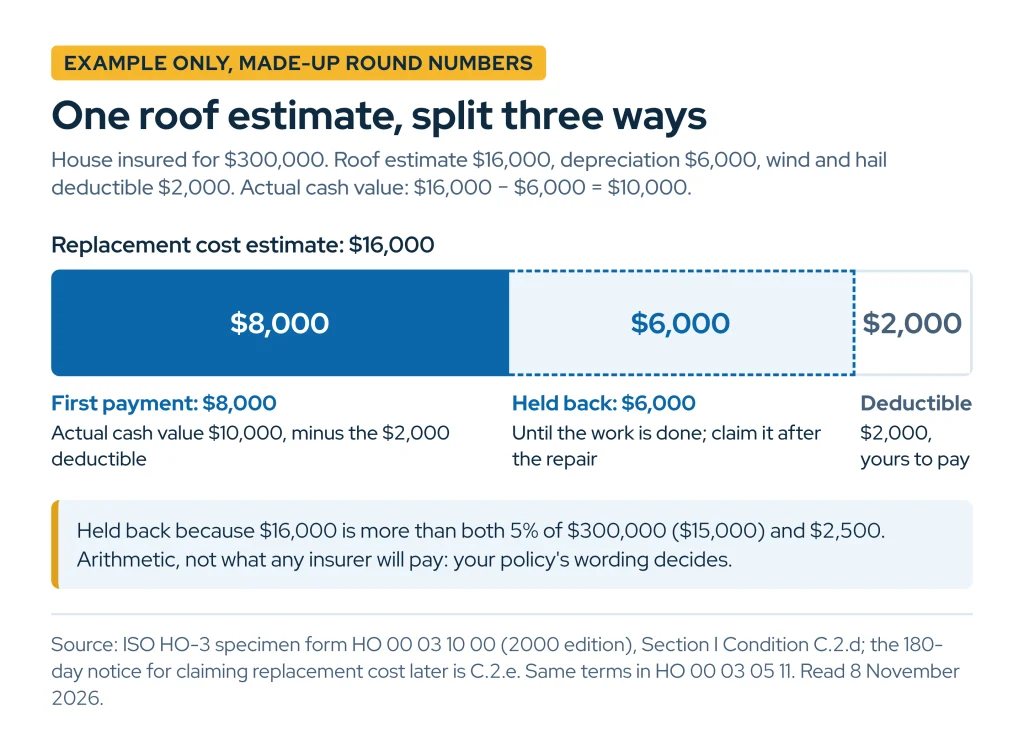
Our recoverable depreciation calculator runs the same sums on your own estimate. On an actual cash value roof, the $6,000 in this example isn’t held back to be paid later; it simply isn’t part of the payment.
The mortgage company on the check. If you have a mortgage, the specimen’s mortgage clause pays Coverage A and B losses to the lender and you “as interests appear” (Section I Condition K), so the check often names both. The lender’s servicer then has its own process for releasing repair money; our insurance check and mortgage company page sets out the Fannie Mae and FHA rules we have read. The Federal Trade Commission’s advice is to “never sign your insurance check over to a contractor”, and to ask your bank or credit union about a Certificate of Completion so payments go out in stages after you approve each one (FTC, How To Avoid Scams After Weather Emergencies and Natural Disasters, September 2025).
Step 7: The repair
You choose who repairs your roof. The insurer’s estimate is a figure for the work, not a referral. The FTC suggests estimates from more than one contractor, a written contract read carefully, copies of the contractor’s license and insurance, a reasonable down payment rather than cash up front (“If they want cash up front, walk away”), and final payment only when the work is done (FTC page above).
Your right to cancel. Under the FTC’s Cooling-Off Rule, a sale of $25 or more that a seller makes at your home, even one you invited, can be cancelled until midnight of the third business day after the sale (the rule counts Saturdays as business days, not Sundays or federal holidays), and the seller must give you the notice and a cancellation form (16 CFR 429.0-429.1). The rule has exceptions; one applies when you contacted the seller for a bona fide immediate personal emergency and signed a separate handwritten, dated statement giving up the right. Florida adds its own: if a roof repair or replacement contract was signed within 180 days of events that led the governor to declare a state of emergency, and the home is in the declared area, the homeowner may cancel it without penalty within 10 days after signing or by the official start date, whichever comes first, by certified mail, return receipt requested, or another mailing with proof. The official start date is when installation of materials for the final roof begins, a permit is issued or a code-compliant temporary repair to the roof is made, so a tarp job can end the window early (Fla. Stat. 489.147(6)).
The deductible is yours to pay. You may see roofers advertise that they will “cover your deductible”. In Texas, the insured must pay any deductible (Tex. Ins. Code 707.002), and a seller who pays, waives, absorbs or rebates it without the insurer’s consent commits a Class B misdemeanor; contracts of $1,000 or more expected to be paid from a claim must print a notice saying so (Tex. Bus. & Com. Code 27.02). In Florida, a contractor may not offer a deductible waiver, rebate, gift or anything else of value for a roof inspection or for making a roof claim, and faces up to a $10,000 fine for each violation (Fla. Stat. 489.147(2)(b), (3)). Other states have their own rules; we haven’t read them for this page.
Signing away the claim. Some contractors ask for an “assignment of benefits”, which hands your insurance payment, and often control of the claim, to them. In Florida, an assignment of post-loss benefits under a residential property policy issued on or after 1 January 2023 is void (Fla. Stat. 627.7152(13)). Elsewhere, read any form that mentions assignment, direction to pay or authorization before signing it.
Step 8: Claim what was held back
When the work is finished, send the insurer the final invoice, photos of the new roof and anything else it asks for, and ask for the held-back amount in writing. Two limits in the specimen form matter here. You may take the actual cash value first and claim the rest later only if you notify the insurer, within 180 days after the date of loss, that you intend to do so (Section I Condition C.2.e). And the insurer pays replacement cost only once the repair or replacement is actually complete (C.2.d). In the specimen form the 180 days is a limit for that notice, not for finishing the work; your own policy’s loss settlement clause may say something else, so read it and send the notice in writing well inside its period.
Some states let the insurer wait for proof you paid the deductible. In Texas, an insurer with replacement cost coverage may refuse to pay withheld recoverable depreciation until it receives reasonable proof you paid the deductible, such as a canceled check, a money order receipt, a credit card statement or a financing contract (Tex. Ins. Code 707.004). Keep proof of every payment you make to the roofer.
If more damage turns up during the work, such as rotted or broken decking under the old shingles, ask the contractor to photograph it and tell the insurer in writing before it is covered over, so it can be added to the claim. Contractors and insurers often call this a “supplement”. The specimen form has no separate supplement procedure: the added damage goes through the same duties after loss, and its two-year suit limit still counts from the date of loss (Section I Condition G), not from the supplement, though state law and your own policy can set a different period (see “If you disagree” below). Florida calls a claim for more loss from the same peril, including costs that come up while repairs are under way on an open claim, a supplemental claim and allows notice within 18 months after the date of loss (627.70132(1)(b), (2)); elsewhere, check your policy and state rules.
If you disagree
Start by asking the insurer, in writing, for the reasons and the policy provisions behind the decision. The NAIC’s advice is to try to resolve it with the insurer first and not to feel “rushed or pushed to agree” (NAIC consumer guide). When the insurer turns down the roof claim itself, our page on a denied roof claim covers the clauses such denials usually rest on and what to ask for in writing. If the disagreement is only about the amount, many policies have an appraisal clause: in the specimen form, either side may demand appraisal, each picks an appraiser within 20 days after receiving the other’s written request, and a judge can be asked to pick the umpire if the appraisers can’t agree on one within 15 days (Section I Condition E); see how the appraisal clause works. Your state insurance department’s consumer services staff can also take a complaint; the complaint links by state list each department’s page we have checked.
Time limits keep running while you talk. The specimen form allows suit only within two years after the date of loss (Section I Condition G), but state law can change that period, and some states set only the shortest period a policy may give, not a deadline of their own. Florida, for example, allows 5 years from the date of loss to sue for breach of a property insurance contract and voids contract terms that shorten a statute of limitations (Fla. Stat. 95.11(2)(e), 95.03); Texas voids any contract limit shorter than two years (Tex. Civ. Prac. & Rem. Code 16.070). The deadlines table linked in step 3 lists the other states we have read. Whether a decision is right, and what to do about it, are questions for a licensed attorney or your state insurance department, not for this page.
What to do now
- Gather: the full policy with its declarations page and every endorsement, your photos and video, receipts for temporary repairs, the claim number, every letter and email with its date, the adjuster’s estimate and your contractor’s.
- Read: your policy’s Duties After Loss, Loss Settlement, Appraisal and Suit Against Us conditions, and any endorsement that mentions the roof or a wind and hail deductible.
- Do now: stop more water getting in, report the claim in writing, and keep a log of every call.
- Don’t let slide: a proof-of-loss request, the policy’s period for claiming replacement cost (180 days after the date of loss in the specimen form), a notice-of-claim limit such as Florida’s 1 year, and the suit limit in your policy and state law.
- Ask for help: the insurer in writing, your state insurance department’s consumer line, legal aid or a licensed attorney.
Sources checked on 8 November 2026; the policy-form terms and the hurricane, examination under oath, Virginia and supplement lines rechecked on 18 November 2026.
Sources
- ISO Homeowners 3 Special Form specimen, HO 00 03 10 00 (2000 edition), copy hosted by the Insurance Information Institute (archived 2 Sep 2026)
- ISO Homeowners 3 Special Form, HO 00 03 05 11 (2011 edition), Maine Bureau of Insurance copy
- NAIC, A Consumer's Guide to Home Insurance (2022)
- Texas Department of Insurance, Insurance and your roof (updated 1 April 2026)
- Texas Department of Insurance, What to know about insurance and your roof (March 2026)
- Texas Insurance Code chapter 542 (542.051, 542.055-.057, 542.059)
- Texas Insurance Code chapter 707 (707.002, 707.004)
- Texas Insurance Code 4102.163
- Texas Business and Commerce Code 27.02
- Code of Virginia 38.2-510 (D added by 2026 Acts c. 672)
- Texas Civil Practice and Remedies Code 16.070
- Florida Statutes 627.70131 (2026)
- Florida Statutes 627.70132 (2026)
- Florida Statutes 627.701 (2026)
- Florida Statutes 627.7152 (2026)
- Florida Statutes 489.147 (2026)
- Florida Statutes 95.11 and 95.03 (2026)
- FTC Cooling-Off Rule, 16 CFR part 429 (eCFR)
- FTC, How To Avoid Scams After Weather Emergencies and Natural Disasters (September 2025)