Wind damage to a roof is usually covered by a standard homeowners policy, because windstorm is not one of the standard form’s exclusions for the house itself. Whether a particular claim is paid usually turns on five questions: did wind cause the damage, or did age and wear; did rain get in through an opening the wind made; was any of the water flood or storm surge, which the homeowners form excludes “whether or not driven by wind”; which deductible applies (an ordinary one, or a separate wind/hail, named-storm or hurricane deductible); and does your policy cover wind at all, since some coastal homes insure it on a separate policy, such as the Texas Windstorm Insurance Association. Your policy’s wording decides each of these. Two kinds of windstorm have their own pages: hurricane damage, where storm surge and a hurricane deductible come in, and tornado damage. This page is part of our roof, hail and wind guides.
General information, not legal or insurance advice, and not a substitute for the advice of an attorney. Your policy’s wording and your state’s law decide, and both change. For help with your claim, your state insurance department’s consumer line and legal aid are free.
Wind damage to roof: what the standard policy says
Most US homeowners policies follow forms written by Insurance Services Office (ISO). The wording below comes from the ISO HO-3 specimen form, 2000 edition (HO 00 03 10 00), hosted by the Insurance Information Institute, a trade group. Later editions, state endorsements and each insurer’s own form can differ, so treat this as the usual pattern, not your policy.
- The house and other structures (Coverages A and B) are written as “open perils”: the form covers risk of direct physical loss unless something is excluded. Windstorm is not on the exclusion list, so roof damage that wind causes is usually covered.
- What is excluded for the house includes wear and tear, marring and deterioration; mechanical breakdown and latent defect; rust, corrosion and dry rot; settling, shrinking, bulging or expansion of foundations, walls, floors, roofs or ceilings, with the cracking that results; and birds, vermin, rodents or insects (Section I, Perils Insured Against, A.2.c.(6); see termite damage and homeowners insurance). Faulty workmanship, materials and maintenance are excluded too (Exclusion B.3). For both of these lists, the form adds that an ensuing loss to the house that no other provision excludes is covered.
- Your belongings (Coverage C) are covered only for named perils, and “Windstorm or Hail” is one of them. That peril does not cover belongings damaged inside by rain, snow, sleet, sand or dust unless the direct force of wind or hail first damages the building and makes an opening in a roof or wall that the weather comes through.
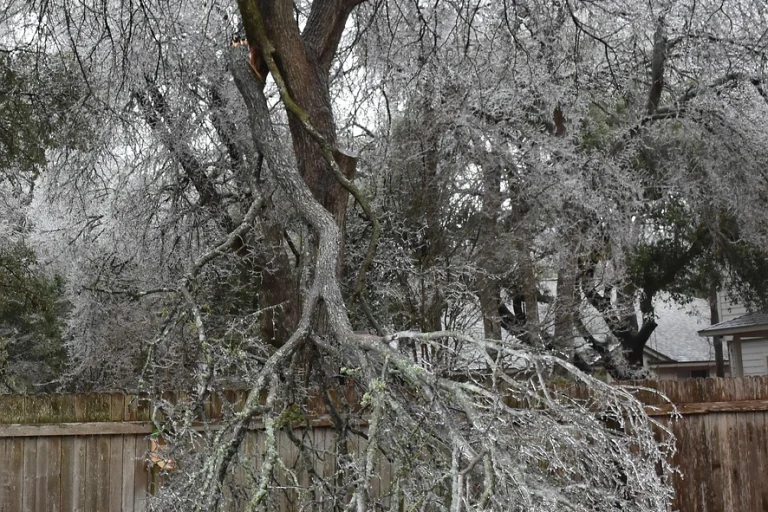
- Fallen trees. The form pays reasonable expense, up to $1,000 per loss, to remove your trees felled by windstorm, hail or the weight of ice, snow or sleet when they damage a covered structure, or block a driveway so a registered vehicle can’t get in or out, with no more than $500 for any one tree in the 2000 edition (Additional Coverage E.1.b). Trees, shrubs and plants themselves are covered only for named perils that do not include windstorm (E.3).
| Situation | Usual answer under the 2000 ISO HO-3 specimen | Clause it rests on |
|---|---|---|
| Shingles torn off or lifted in a windstorm | Usually covered, less the deductible | Coverage A open perils; windstorm not excluded |
| Shingles that failed because they were worn out | Usually excluded | A.2.c.(6) wear and tear, deterioration |
| Rain soaking a sofa through a wind-made hole in the roof | Usually covered | Coverage C “Windstorm or Hail”, opening condition met |
| Rain soaking a sofa through an old leak with no storm opening | Usually excluded | Coverage C opening condition not met |
| Storm surge or wind-pushed flood water in the house | Usually excluded | Exclusion A.3 Water Damage, “whether or not driven by wind” |
| Removing your wind-felled tree that hit the house | Usually covered up to $1,000 per loss ($500 per tree) | Additional Coverage E.1.b |
Wind or wear and tear

Because the form covers wind but excludes wear, deterioration and faulty workmanship, the open question on a wind roof claim is often cause, not coverage. An older roof can still be damaged by wind; a newer roof can still have shingles that were never fastened properly. The insurer usually decides this after inspecting the roof. What helps you is a record that ties the damage to a dated storm:
- The date and the weather. The National Weather Service calls a thunderstorm severe when it can produce hail an inch or larger or wind gusts over 58 mph (NWS). The Storm Prediction Center posts each day’s wind, hail and tornado reports and labels them preliminary (SPC storm reports); NOAA keeps the longer-term record in its Storm Events Database. A report near your home on the date is useful context. It doesn’t prove what happened to your roof.
- Photos and video before anything is moved: the roof from the ground, shingles and debris in the yard, damaged gutters, flashing and vents, and any interior stains with the date.
- Earlier photos, an inspection report or the roof’s install date, if you have them. They show what the roof looked like before the storm.
- Neighbours’ damage on the same street, photographed from public ground.
If the insurer decides the shingles failed from age rather than wind, our page on roof claims denied as wear and tear covers what state rules say a denial letter must contain and what comes next.
Don’t climb onto a roof after a storm. Photos from the ground or a window are enough to start a claim.
Rain that gets in after the wind
Interior water is often the larger part of a wind claim. In the 2000 specimen, the “opening” test (wind or hail must first damage the building and make an opening in a roof or wall) is written into the Windstorm or Hail peril for your belongings. The building itself is covered under the open-perils wording instead, which has no opening test in that edition: the worn or badly installed roof is excluded, but the form says an ensuing loss to the house that no other provision excludes is covered. How that applies to rain through an old roof depends on the exact wording and the facts. Your insurer’s form may add an opening test for the building too, so check yours.
Florida writes the same opening idea into law for hurricane claims: “hurricane coverage” includes ensuing interior damage from rain, snow, sleet, hail, sand or dust if the direct force of the windstorm first damages the building and makes an opening that the weather comes through (Fla. Stat. 627.4025(2)(a), read 8 November 2026). Our roof leak guide covers leaks with no storm behind them.
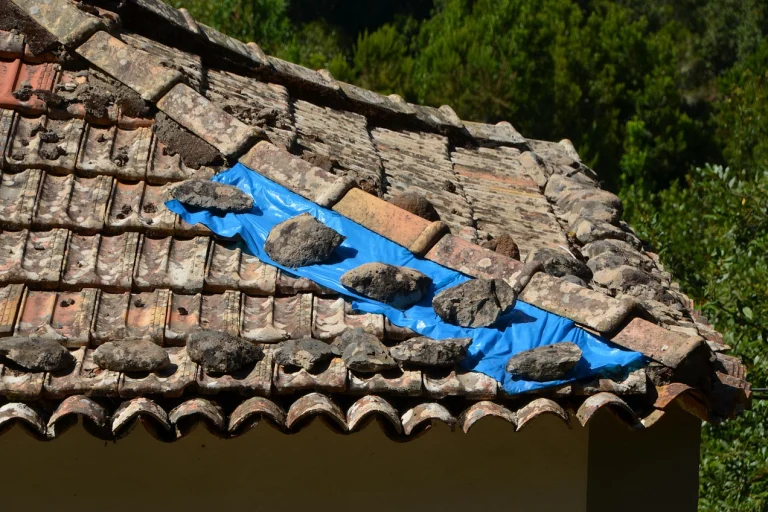
The form also requires you to protect the property from further damage, make reasonable and necessary repairs to do so, and keep an accurate record of what those repairs cost (Section I Condition B.4, Duties After Loss). A tarp over a hole is the usual example. Keep the receipt and photos of the hole before the tarp went on.
Wind or flood: two policies, two claims
In a hurricane or tropical storm, the roof and the ground floor can be damaged by different things on the same day. The two kinds of policy split them cleanly:
- The homeowners form excludes water damage: flood, surface water, waves, tidal water, overflow of a body of water, or spray from any of these, “whether or not driven by wind” (2000 specimen, Exclusion A.3.a). The exclusions in that section apply even when another cause, such as wind, contributes at the same time or in any order. So wind-driven storm surge is not covered as wind. Fire, explosion or theft that results from the water is covered.
- The NFIP flood policy excludes wind. The Standard Flood Insurance Policy (Dwelling Form) pays only for direct physical loss by or from flood, and lists “theft, fire, explosion, wind, or windstorm” among its exclusions (44 CFR part 61, appendix A(1), V.A and V.D.8).
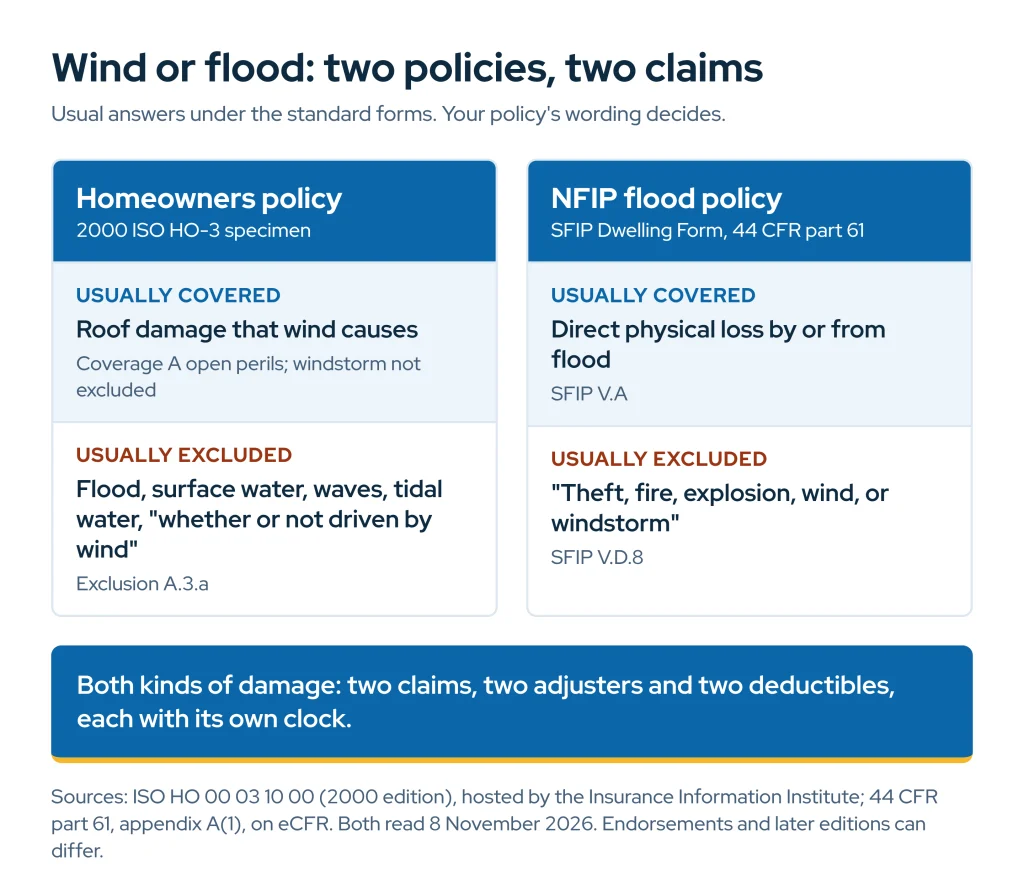
If both kinds of damage happened, that means two claims, two adjusters and two deductibles, each with its own clock. The flood policy’s clocks are federal: proof of loss within 60 days after the loss, unless FEMA extends it in writing, and suit within one year after the written denial (SFIP VII.G.4 and VII.O). Our flood exclusion guide and NFIP claim guide go through them. Photos of the water line on walls, and of roof and window damage above it, help both adjusters separate the two.
Wind/hail, named-storm and hurricane deductibles
The standard form pays only the part of the total covered loss that exceeds the deductible shown on your declarations page (2000 specimen, Section I deductible clause). Some policies carry a separate deductible for wind and hail, or for named storms or hurricanes, and it may be written as a percentage of the dwelling limit (Coverage A) rather than as a dollar amount. A percentage deductible can be much larger than the all-other-perils deductible.
Example only, with round hypothetical numbers: a $300,000 Coverage A limit with a 2% wind deductible gives a $6,000 deductible. With a $9,000 repair estimate, $3,000 is above the deductible, before depreciation or any other policy term. Our deductible calculator works the arithmetic on your own numbers.
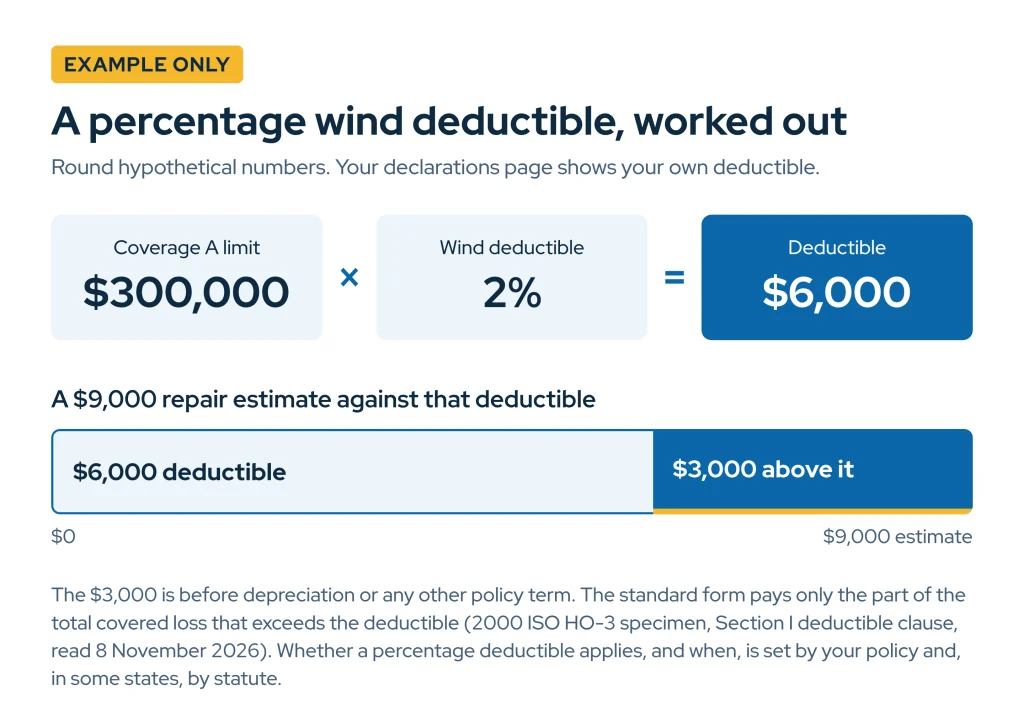
Whether a percentage deductible applies, and when it is triggered, is set by your policy and, in some states, by statute. States we have read (8 November 2026):
| State | Rule read | Source |
|---|---|---|
| Florida | Before issuing a policy, insurers must offer hurricane deductibles of $500, 2%, 5% and 10% of the dwelling limit (with some exceptions, mostly by dwelling value). The hurricane deductible applies once per calendar year to all hurricane losses with the same insurer or group; later hurricanes use the greater of what is left or the other-perils deductible. A “hurricane” is a storm the National Hurricane Center has declared a hurricane, and it runs from the first NHC hurricane warning for any part of Florida until 72 hours after the last hurricane watch or warning for any part of Florida ends. The dollar value of the hurricane deductible must be shown on the declarations page. These rules are for personal lines residential policies. | Fla. Stat. 627.701(3)-(5); 627.4025(2)(c) |
| Florida, roof deductible | An insurer may include a separate roof deductible, offered at issue or added at renewal with notice; you can reject it by signing a form the Office of Insurance Regulation approves. It may not exceed the lesser of 2% of Coverage A or 50% of the cost to replace the roof. It applies only to claims adjusted at replacement cost, and not to a hurricane, a tree fall or other hazard that punctures the roof deck, a covered total loss of the home, or a roof loss needing repair of less than 50% of the roof. | Fla. Stat. 627.701(10) |
| Louisiana | On homeowners and other policies for one- or two-family owner-occupied homes issued or renewed by authorized insurers from 1 January 2010, a separate named-storm or hurricane deductible applies once per calendar year; later storms that year use the greater of the remaining amount or the deductible for all other perils. For new policies effective after 1 January 2023, the insurer must give you a commissioner-prescribed form listing each named-storm, hurricane and wind/hail deductible and ask you to sign it; the form is for information and doesn’t change the policy. | La. R.S. 22:1337 |
| Texas | The declarations page must list each type of deductible and its exact dollar amount, and identify any provision that can change it. No percentage cap or trigger statute found in the sections read. | Tex. Ins. Code 2301.056 |
| Other states | Not covered on this page. Check your declarations page and our state-by-state guide. | Not confirmed here |
Other states’ trigger and once-a-season rules are on our hurricane deductibles by state page.
Wind/hail exclusions and separate wind deductibles
A wind/hail exclusion is the bigger question on a coastal roof claim, because it decides which policy you claim on before any deductible is applied. The 2000 ISO specimen doesn’t exclude windstorm or hail, so where a homeowners policy leaves wind out, the exclusion comes from an endorsement or from the insurer’s own form. The NAIC, the national association of state insurance regulators, says homeowners policies in most states cover windstorm and hail, but policies in coastal areas often exclude it, so the risk needs a separate policy (A Consumer’s Guide to Home Insurance, 2022, read 18 November 2026). Look on your declarations page and in its list of endorsements for one whose title or wording removes windstorm or hail; that endorsement’s wording decides what it removes and where any rain that came in through a wind-made opening is claimed.
What we read on wind exclusions and separate wind policies (18 November 2026):
- Florida. An insurer issuing a residential property policy must provide windstorm coverage, but must also make a windstorm exclusion available at the policyholder’s option. A homeowner can exclude wind only by writing or typing out a statement set in the statute and giving it to the insurer, signed and dated by every named insured (a business owner uses its letterhead instead), and, if the home has a mortgage or lien, with the lender’s written approval; the lender is told when a new or replacement policy has no wind coverage. The exclusion lasts for the policy term and each renewal, and can be changed only at renewal. Apart from the lender notice, the section doesn’t apply to homes eligible for wind-only coverage from Citizens Property Insurance Corporation, the state-created insurer, which has its own policy terms, or to certain homes in Citizens’ coastal account that Citizens can’t cover (Fla. Stat. 627.712(1); Fla. Stat. 627.712, 2026 Statutes, last amended by ch. 2023-217, read 18 November 2026). Whether the section reaches surplus lines policies is not confirmed here.
- North Carolina. In the beach and coastal areas, the North Carolina Insurance Underwriting Association (the Coastal Property Insurance Pool) offers separate windstorm and hail policies, available only for homes whose other property insurance is written by a licensed insurer. Catastrophic wind and hail losses, as the Association determines with the Commissioner’s approval, are adjusted by that licensed insurer, not by the Association. Its named-storm wind and hail deductible is at least 1% of the insured value (G.S. 58-45-35(b), (e) and 58-45-45(a2), read 18 November 2026). See our North Carolina claim rules guide.
- Texas. The Texas Windstorm Insurance Association has its own claim statute; it is set out in the next section.
- Other states. Not confirmed here. Several states have a wind pool, a FAIR plan (an insurer of last resort) or both, each with its own form and rules. Your state insurance department, listed in the NAIC’s directory, can tell you which applies where you live.
A separate wind deductible is a different thing from an exclusion: the wind is still covered, but a different deductible comes off. South Carolina’s regulation shows how wide it can be. A wind/hail deductible there is any separate deductible for losses from wind or hail, however it is named and whether it is a percentage or a dollar amount, so it isn’t limited to named storms; a named-storm deductible counts only a hurricane, tropical storm or tropical depression named by the National Weather Service or the National Hurricane Center, not a storm named by the media. Insurers, surplus lines insurers included, must show a worked example for a $100,000 policy and print a capitalised warning on the policy and the declarations page, and adding or raising one of these deductibles at renewal needs the named insured’s signed or initialled acknowledgment of the example. The same rules cover a hurricane deductible, and the amended version applies to policies issued or renewed from 120 days after it was published (S.C. Code Regs. 69-56, amended effective 26 June 2020, read 18 November 2026).
If wind is on a separate policy, a storm can mean two or three claims: wind with the wind policy, anything else with the homeowners policy, and flood with a flood policy, each with its own deductible, adjuster and clocks. Condo (HO-6) and renters (HO-4) policies and dwelling-fire forms carry their own deductible and wind terms, so read the form you hold. Our hurricane deductibles by state page, linked above, sets out each state’s trigger, window and once-a-year rules as read.
When wind isn’t in your homeowners policy: TWIA
In Texas, the source of that separate policy for many coastal homes is the Texas Windstorm Insurance Association (TWIA), which the Legislature created in 1971 to offer wind and hail coverage to people who cannot get it in the regular market (Ins. Code ch. 2210). The Texas Department of Insurance says TWIA covers the 14 first-tier coastal counties (Aransas, Brazoria, Calhoun, Cameron, Chambers, Galveston, Jefferson, Kenedy, Kleberg, Matagorda, Nueces, Refugio, San Patricio and Willacy) and parts of Pasadena, Morgan’s Point, Shoreacres, Seabrook and La Porte east of State Highway 146 in Harris County (TDI, TWIA overview, 1 October 2026).
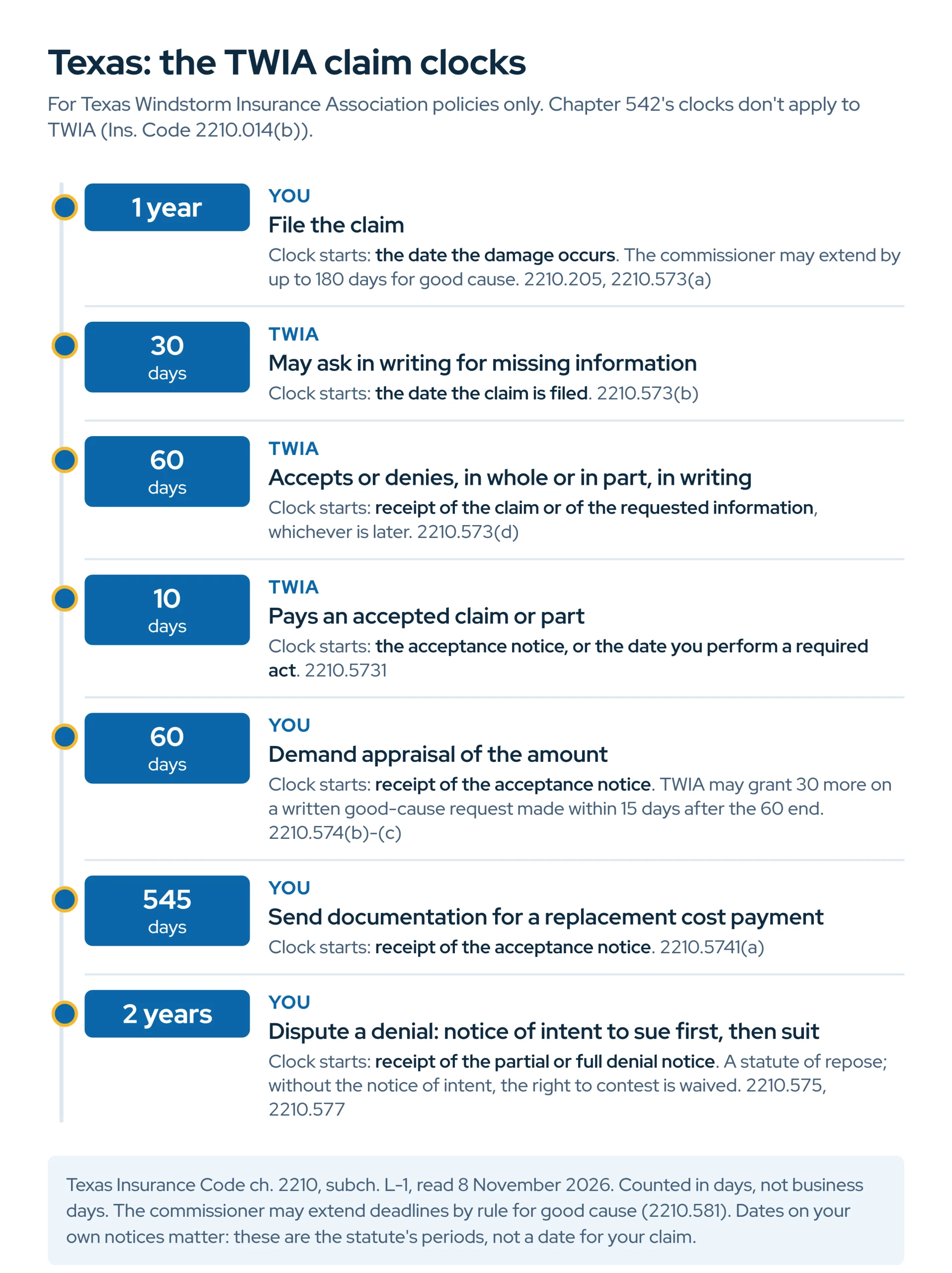
TWIA claims run on their own statute, not on the general Texas claim rules: Chapter 542’s claim clocks don’t apply to TWIA, and Chapter 542A’s pre-suit notice rules for weather claims don’t either (Ins. Code 2210.014(b), 542A.002(b)). The rules, from Texas Insurance Code chapter 2210 (read 8 November 2026):
| Step | Time limit | What starts the clock | Section |
|---|---|---|---|
| File the claim | Not later than the first anniversary (1 year); the commissioner may extend by up to 180 days on a showing of good cause | The date the damage occurs | 2210.205, 2210.573(a) |
| TWIA may request missing information in writing | Within 30 days | The date the claim is filed | 2210.573(b) |
| TWIA accepts or denies, in whole or in part, in writing | By the later of 60 days after the claim or 60 days after the requested information | Receipt of the claim or of the information | 2210.573(d) |
| TWIA pays an accepted claim or part | Within 10 days | The acceptance notice, or the date you perform a required act | 2210.5731 |
| Demand appraisal of the amount | Within 60 days; TWIA may grant 30 more on a written request showing good cause, made within 15 days after the 60 days end | Receipt of the acceptance notice | 2210.574(b)-(c) |
| Send documentation for a replacement cost payment | Within 545 days | Receipt of the acceptance notice | 2210.5741(a) |
| Dispute a denial: notice of intent to sue, then suit | Suit within 2 years (a statute of repose). The notice of intent must come first, within that period; without it, the right to contest the denial is waived. TWIA may require mediation or a moderated settlement conference first | Receipt of the partial or full denial notice | 2210.575, 2210.577 |
Two more TWIA points matter for roofs. TDI says TWIA offers residential deductibles of $100, $250 or 1%, with optional larger deductibles of 1.5% to 5%; your declarations page shows which you have. And TDI says additions, alterations, re-roofs and other repairs must meet the windstorm building code for the home to stay eligible for TWIA coverage. TDI certifies that work with a Certificate of Compliance (WPI-8). Structures built before 1 January 1988 don’t need a WPI-8 for TWIA coverage, and some residential structures without every WPI-8 can still be covered with a surcharge (TDI overview, pages 28, 29 and 38). Ask whoever replaces your roof, before work starts, how the inspection and certificate will be handled.
For Texas wind claims with a private insurer, Chapter 542 sets the claim clocks (15 days, not business days, to acknowledge after written notice of claim; 15 business days to accept or reject after receiving everything the insurer needs to secure final proof of loss, or up to 45 days after the insurer tells you, within those 15 business days, why it needs more time; 5 business days to pay after accepting; 15 more days after a weather-related catastrophe or major natural disaster as defined by the commissioner; longer periods for surplus lines insurers) (Ins. Code 542.055-.059). Chapter 542A requires written notice at least 61 days before filing suit on a claim for property damage caused wholly or partly by forces of nature, such as wind, hail or a hurricane, with some exceptions (542A.001, 542A.003). Our Texas claim rules guide has the detail.
The clocks after a windstorm
There is no national claim deadline. The policy and state law set them:
- The policy. The 2000 ISO specimen asks for “prompt notice” of a loss, a signed, sworn proof of loss within 60 days after the insurer asks for it, and suit within two years after the date of loss (Conditions B and G). State law often changes the suit limit.
- Florida. A claim or reopened claim, including under a surplus lines policy, is barred unless notice is given to the insurer within 1 year after the date of loss, and a supplemental claim within 18 months after the date of loss; both limits are tolled while a named insured who is a servicemember is deployed to a combat zone or combat support posting that materially affects their ability to file. For hurricanes, tornadoes, windstorms and other weather events, the date of loss is the hurricane’s landfall or the date NOAA verifies the event (Fla. Stat. 627.70132(2)-(3), read 8 November 2026).
- A separate wind policy. TWIA’s clocks are in the table above. Other wind pools and FAIR plans follow their own policy and statute; their clocks are not confirmed here. An NFIP flood policy follows federal rules, not state law.
- Every other state: our claim deadlines by state tool shows the claim-handling clocks and suit-limit rules we read in each state’s statute or regulation, with the citation and the date we read it, and says “not confirmed” where we haven’t. Your policy may give you longer. Check its Duties After Loss and Suit Against Us conditions.
Roofers at the door after a storm
After a windstorm, you may be offered a free inspection, a promise that “insurance will pay for a whole new roof”, or an offer to “cover your deductible”. Here is what we read on those claims.
- Deductible offers from contractors are illegal in several states. In Texas, a seller who pays, waives, absorbs or rebates an insured’s deductible without the insurer’s consent commits a Class B misdemeanor, and contracts of $1,000 or more expected to be paid from a claim must carry a printed notice saying so (Bus. & Com. Code 27.02). Florida bars contractors from offering a deductible waiver, rebate or gift for a roof inspection or claim, and from interpreting policies or adjusting claims without a public adjuster licence, with fines of up to $10,000 per violation (Fla. Stat. 489.147).
- Florida’s cancellation window. A Florida roof repair or replacement contract signed within 180 days of events covered by a Governor’s state-of-emergency declaration for your area may be cancelled without penalty within 10 days after signing or by the official start date, whichever comes first. The official start date is when installation of materials for the final roof begins, a permit is issued, or a code-compliant temporary repair is made. The notice goes by certified mail, return receipt requested, or another mailing with proof (489.147(6)).
- “A whole new roof.” No clause in the standard form promises a full replacement because some shingles blew off. The 2000 specimen pays the replacement cost of the part of the building that was damaged, with material of like kind and quality (Condition C.2.a), and some states add matching rules. See when insurance pays for a new roof.
- The check. The FTC says never to sign your insurance check over to a contractor (FTC consumer advice).
How the roof is paid
Under the 2000 specimen, buildings are settled at replacement cost, without deduction for depreciation, when the dwelling is insured to at least 80% of its full replacement cost (below that, the greater of actual cash value or a proportion), but the insurer pays no more than actual cash value until the repair is done (the 2000 form doesn’t define actual cash value; it is commonly figured as replacement cost less depreciation, and some states set how), unless the repair costs less than both 5% of the building’s insurance and $2,500. You can take the actual cash value first and claim the rest later if you tell the insurer, within 180 days after the date of loss, that you intend to do so (Conditions C.2.a, C.2.b, C.2.d and C.2.e). If your policy has an endorsement that changes how the roof is paid, such as a payment schedule or actual cash value for the roof, that endorsement governs; your declarations page lists your endorsements. Our recoverable depreciation calculator shows the first check and the holdback on your own numbers. If you have a mortgage, the check may name your lender too.
What to do next
- Stay safe, then stop more damage. Cover openings if you can do it safely, and keep every receipt (Duties After Loss, B.4).
- Photograph everything before cleanup, with the date: roof from the ground, debris, gutters, ceilings, belongings. If there was water at ground level, photograph the water line too.
- Find your full policy: the declarations page (your deductibles and whether wind is excluded), every endorsement, and the Duties After Loss and Suit Against Us conditions.
- Report the claim in writing to the right insurer, or to both if wind and flood are insured separately, and note the date. Write down every call: date, name, what was said.
- Know what can’t wait: a proof-of-loss date if the insurer asks for one, Florida’s 1-year notice rule, TWIA’s 1-year filing rule, the NFIP’s 60 days after the loss for proof of loss, and your state’s suit limit.
- If you disagree, ask the insurer in writing for its reasons and the policy language it relies on. Your state insurance department’s consumer line is free; find it in the NAIC’s directory of state insurance departments. Legal aid, or your state bar’s lawyer referral service, can point you to a licensed attorney.
Sources checked on 8 November 2026, and on 18 November 2026 for Florida Statutes 627.712, North Carolina G.S. chapter 58 article 45, South Carolina Code of Regulations 69-56 and the NAIC consumer guide (2022): ISO HO 00 03 10 00 specimen (2000 edition); 44 CFR part 61 appendix A(1) on eCFR; Texas Insurance Code chapters 542, 542A, 2210 and 2301 and Business and Commerce Code 27.02; Florida Statutes 627.4025, 627.701, 627.70132 and 489.147 (2026); Louisiana R.S. 22:1337; TDI’s TWIA overview (1 October 2026); National Weather Service and Storm Prediction Center pages.
Sources
- ISO HO-3 specimen form, 2000 edition (HO 00 03 10 00), hosted by the Insurance Information Institute
- 44 CFR part 61, appendix A(1): Standard Flood Insurance Policy, Dwelling Form (eCFR)
- Texas Insurance Code chapter 2210 (Texas Windstorm Insurance Association)
- Texas Insurance Code chapter 542 (prompt payment of claims)
- Texas Insurance Code chapter 542A (claims arising from forces of nature)
- Texas Insurance Code 2301.056 (deductibles on the declarations page)
- Texas Business and Commerce Code 27.02 (deductible payment required)
- Texas Department of Insurance: TWIA overview (1 October 2026)
- Florida Statutes 627.4025 (2026)
- Florida Statutes 627.701 (2026)
- Florida Statutes 627.70132 (2026)
- Florida Statutes 489.147 (2026)
- Louisiana R.S. 22:1337
- National Weather Service: Severe Thunderstorm Safety
- NOAA Storm Prediction Center: storm reports
- NOAA NCEI: Storm Events Database
- FTC: How to avoid scams after weather emergencies and natural disasters
- NAIC: state insurance departments
- Florida Statutes 627.712 (2026): residential windstorm coverage and windstorm exclusions
- North Carolina G.S. chapter 58, article 45 (Coastal Property Insurance Pool)
- South Carolina Code of Regulations 69-56 (hurricane, named storm or wind/hail deductible), amended eff. 26 June 2020
- NAIC: A Consumer's Guide to Home Insurance (2022)