A homeowners policy usually pays toward a new roof only when a covered event, such as wind, hail, a falling tree or fire, damaged it, and only for as much of the roof as that damage, the repair standard in the policy and any code or matching rule require. It usually doesn’t pay because a roof is old, worn or near the end of its life. Even when the whole roof is replaced, how much the insurer pays depends on whether your roof is settled at replacement cost, actual cash value or a roof payment schedule, and on your deductible. Your policy’s wording decides, and state law changes some of the answers. This guide is part of our roof, hail and wind claims section.
General information, not legal or insurance advice, and not a substitute for the advice of an attorney. Your policy’s wording and your state’s law decide, and both change. For help with your claim, your state insurance department’s consumer line and legal aid are free.
The five questions that decide it
- What caused the damage? A covered peril (an event the policy insures against) or wear and age, which is usually excluded.
- How much of the roof is damaged? The standard form pays to repair or replace the part that was damaged, not the whole roof by default.
- Can it be repaired to match? If matching shingles can’t be found, some states have written rules on how far replacement must go.
- Does the building code require more? Under the standard form, code-upgrade costs are paid only through ordinance or law coverage, usually with its own limit.
- How is your roof settled? Replacement cost, actual cash value or a roof schedule. Your declarations page and endorsements say which.
If you’re not yet sure the damage is covered at all, start with whether homeowners insurance covers roof leaks, which takes the cause question in detail.
What the standard policy promises
The Insurance Services Office (ISO), an industry forms body, publishes a standard homeowners form that we use as the reference here; each insurer’s own form can differ. The ISO HO-3 specimen form (2000 edition, HO 00 03 10 00) is the one we read in full for these clauses. Wind pools and FAIR plans, such as the Texas Windstorm Insurance Association, and surplus lines insurers issue their own forms, so read the form your policy actually uses.
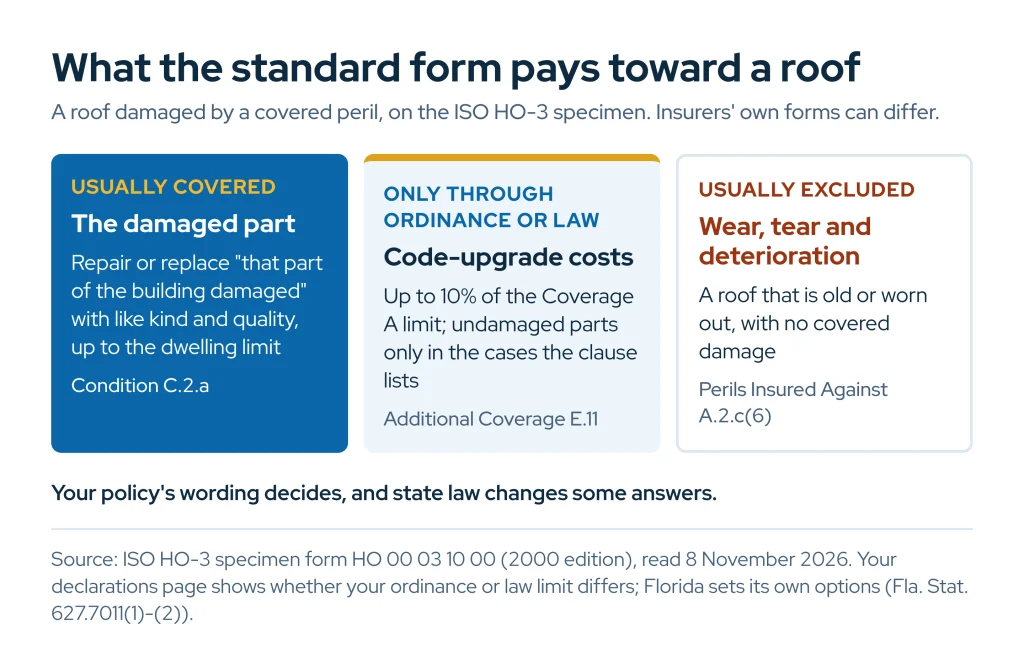
- The repair standard. On a building insured at replacement cost, the form pays the cost to replace “that part of the building damaged” with material of like kind and quality and for like use, up to the dwelling limit and no more than you actually spend (Section I Condition C.2.a). That’s the clause most roof disputes turn on: it promises the damaged part, not a new roof.
- The insurer’s option to repair. If it gives written notice within 30 days after receiving your signed, sworn proof of loss, the insurer may repair or replace the damaged property itself with like kind and quality (Condition H).
- Wear and age. The form doesn’t cover loss caused by wear and tear, marring or deterioration, among other listed causes (Section I Perils Insured Against, A.2.c(6)).
- Insurance to value. Full replacement cost applies if the dwelling is insured to at least 80% of its full replacement cost just before the loss; below that, the form pays the greater of actual cash value or a proportion (Condition C.2.a and b).
The Texas Department of Insurance puts the age point plainly on its consumer page: “your insurance company won’t pay for a new roof just because it’s old or worn out” (TDI, Insurance and your roof, updated 1 April 2026).
Repair or replace: where the line falls
The standard form sets no percentage of damaged shingles at which a whole new roof is owed. Whether the damaged part is repaired or the roof is replaced comes down to the facts the adjuster and you document: how many slopes were hit, whether the damaged shingles can be replaced with material of like kind and quality, whether the repair would leave a visible mismatch, and what the local building code requires once work starts.
You may see this on other sites: “insurance has to give you a whole new roof if any shingle is damaged.” We checked it against the policy form and the state rules we’ve read, and it isn’t the rule. Where a state has a written matching rule, it speaks of items in the area, adjoining areas or adjacent items, and a reasonably uniform or comparable appearance, not of the whole roof in every case.
Matching rules where we’ve read them
Matching is the question of what happens when new shingles can’t match the old ones in quality, color or size. The standard form doesn’t answer it directly. Some states do, in a statute or regulation, usually for policies that settle at replacement cost. Rules read in official text on 8 November 2026:
| State | What the rule says | Source |
|---|---|---|
| Florida | When replaced items don’t match in quality, color or size, the insurer makes reasonable repairs or replacement of items in adjoining areas. It may weigh the cost of replacing undamaged parts, the uniformity possible without that cost, the remaining useful life of the undamaged part and other relevant factors. The section opens with “unless otherwise provided by the policy”. | Fla. Stat. 626.9744(2) (2004) |
| Connecticut | When replacement items don’t match adjacent items in quality, color or size, the insurer replaces all such items with material of like kind and quality for a reasonably uniform appearance, interior and exterior. The official annotation notes the state Supreme Court held that, once the insurer concedes a covered peril, the extent of matching is part of the amount of loss and goes to appraisal (341 Conn. 735). | Conn. Gen. Stat. 38a-316e (P.A. 13-138) |
| Ohio | On fire and extended coverage policies that settle at replacement cost, when an interior or exterior loss requires replacing an item and the new item doesn’t match, the insurer replaces as much as needed for a “reasonably comparable appearance”. The rule says it creates no private cause of action. | Ohio Adm. Code 3901-1-54(I)(1)(b) (effective 14 Feb 2022) |
| Texas, Louisiana, Oklahoma, North Carolina | No matching rule found in the sections read. That’s an absence in what we read, not a statute saying there is no duty: the policy wording and the courts decide. | Our 8 Nov 2026 state reads |
Many states follow a pattern from the NAIC’s model claims regulation, which has the insurer replace all items in the area for a reasonably uniform appearance when replacement items don’t match, on interior and exterior losses (NAIC Model 902, Section 9.A(2)). A model is not law in any state until that state adopts it in its own words. Other states with a written matching rule in regulation include California (10 CCR 2695.9(a)(2)), Rhode Island (230-RICR-20-40-2.9), Iowa (191 IAC 15.44(1)(b)) and Alaska (3 AAC 26.090); our state-by-state matching rules page has every state we’ve read and links the official code for the rest.
Replacement cost, actual cash value and roof schedules
Even when the whole roof is replaced, the check depends on how your policy settles the roof. There are three ways you may see:
Replacement cost, usually in two checks
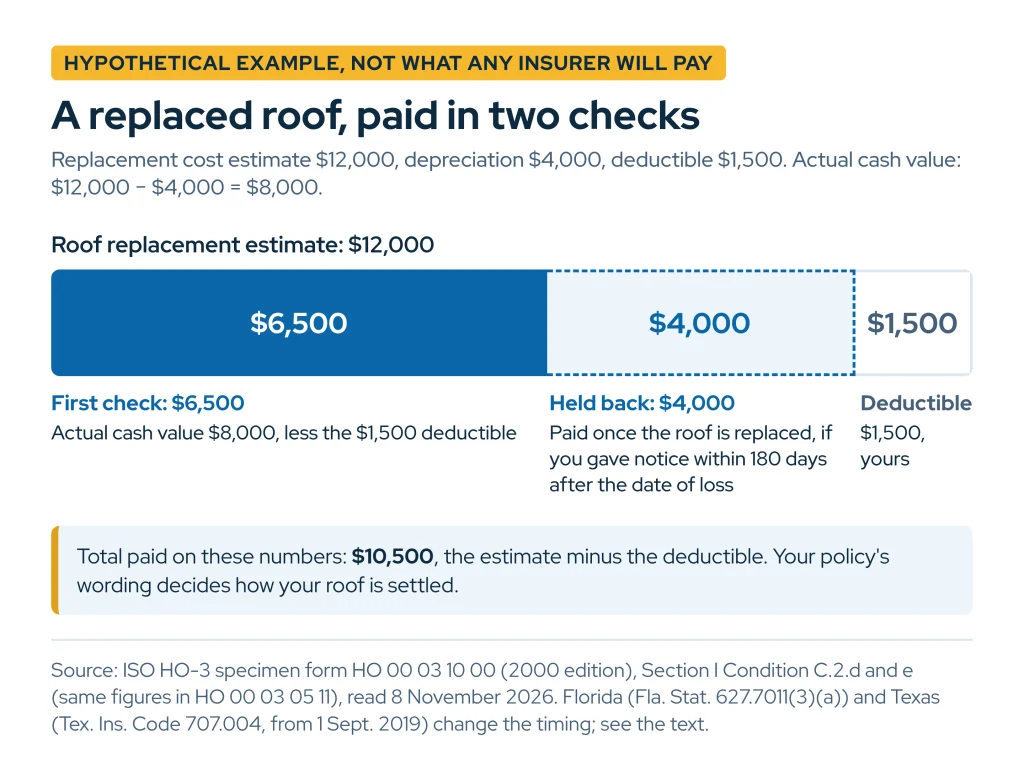
Replacement cost means the cost to repair or replace at today’s prices, without a deduction for depreciation. Under the ISO specimen the insurer pays no more than actual cash value (replacement cost minus depreciation for age and wear) until the repair or replacement is actually complete, unless the cost is both under 5% of the building’s insurance and under $2,500. You may take the actual cash value first and claim the rest later if you notify the insurer of your intent within 180 days after the date of loss (2000 edition, Condition C.2.d and e; the 2011 edition, HO 00 03 05 11, on the Maine Bureau of Insurance site, has the same figures). The part held back is often called recoverable depreciation.
Example (hypothetical round numbers, not what any insurer will pay): a home insured to at least 80% of its replacement cost, a roof replacement estimate of $12,000, depreciation of $4,000 and a $1,500 deductible. Actual cash value is $8,000, so the first check would be $6,500. Under a form like the ISO specimen, the $4,000 held back is paid once the roof is replaced, if you gave notice within the 180 days. Total paid on these numbers: $10,500, which is the estimate minus the deductible. Try your own numbers in the recoverable depreciation calculator.
Two states change the timing by statute:
- Florida: on a dwelling insured at replacement cost, the insurer must first pay at least the actual cash value less the deductible, then pay the rest “as work is performed and expenses are incurred”. If a separate roof deductible applies, it may hold the roof payment at actual cash value until you show you paid that deductible. After a total loss of the dwelling, replacement cost is paid without holdback (Fla. Stat. 627.7011(3)(a)).
- Texas: an insurer may refuse to pay withheld recoverable depreciation until it receives reasonable proof that you paid the deductible, such as a canceled check or credit card statement (Tex. Ins. Code 707.004, effective 1 Sept. 2019).
Actual cash value roofs
Some policies, or an endorsement added to them, settle the roof covering at actual cash value, so the roof’s age reduces the payment and there is no second check. The Texas Department of Insurance warns that “as roofs age, some companies will switch to actual cash value”, that a company might not cover a roof in poor condition at all, and that it “should tell you” when it changes your coverage (TDI). For one example of the wording, a TDI-prescribed Texas Windstorm Insurance Association form, TWIA-400 “Actual Cash Value – Roofs” (effective 27 Nov 2011), replaces the loss settlement for wind or hail damage to the roof covering, which it defines as the exposed roofing, underlayments and required flashings, with actual cash value, in exchange for a lower premium; the form says it is void on a policy with a wind or hail deductible above 1% of the dwelling limit (TWIA-400 on TDI’s site). Texas law lets the insurance commissioner, by rule, authorize TWIA to provide actual cash value coverage on the roof covering instead of replacement cost, with a premium reduction and a disclosure on the face of the policy (Tex. Ins. Code 2210.207(e)). We didn’t check whether TWIA still issues that edition of the form; it shows how such endorsements read.
TDI’s own example, for a house insured for $200,000 with a 2% ($4,000) deductible and a $10,000 roof damaged throughout by a covered storm (TDI, Replacement cost or actual cash value?, updated 24 Jan 2024):
| TDI example | Roof value used | Minus deductible | Policy would pay |
|---|---|---|---|
| Replacement cost, any roof age | $10,000 | $4,000 | $6,000 |
| Actual cash value, 5-year-old roof | $8,500 | $4,000 | $4,500 |
| Actual cash value, 10-year-old roof | $7,000 | $4,000 | $3,000 |
| Actual cash value, 20-year-old roof | $4,000 | $4,000 | $0 |
Those figures are TDI’s illustration, not any insurer’s rate or depreciation method. To turn a percentage deductible like that 2% into dollars on your own dwelling limit, use our homeowners deductible calculator.
Roof payment schedules
Some policies carry a roof payment schedule endorsement instead, which ties the roof payment to a table printed in the endorsement. We haven’t found one published by a regulator to read, so we don’t describe how such tables work or quote any percentages: if your policy has one, its own table decides. If your declarations page lists a roof schedule, an actual cash value roof endorsement or a cosmetic damage exclusion (covered on our hail damage roof claims page), read that endorsement before you get estimates. TDI suggests checking for changes to your roof coverage each time you renew; it’s also worth checking that the roof age on your policy is right.
Code upgrades: ordinance or law coverage
When a damaged roof is repaired or replaced, the local building code may require more than the old roof had. Florida’s statute, for example, directs the Florida Building Commission to require that a roof replacement on a site-built single-family home include a secondary water barrier and strengthened or corrected roof-deck attachment, as part of retrofitting homes built before the Florida Building Code (Fla. Stat. 553.844(2)-(3)). The ISO specimen’s replacement cost settlement leaves out those extra costs except through its Ordinance or Law additional coverage (2000 edition, Condition C and Additional Coverage E.11). That coverage:
- lets you use up to 10% of the Coverage A (dwelling) limit for the increased costs of a code that regulates repair of the part damaged by a covered peril, and the form calls this additional insurance, on top of the dwelling limit;
- reaches undamaged parts only when the building must be totally demolished because of covered damage, or when replacing part of the undamaged portion is necessary to complete the repair of the damaged part;
- doesn’t cover loss in value caused by a code, or testing and cleanup for pollutants.
Your declarations page and endorsements show whether your policy carries a different ordinance or law limit. Our ordinance or law coverage calculator sets that limit against a code-upgrade estimate, on numbers you enter. Florida has its own rule: before issuing a homeowners policy the insurer must offer replacement cost coverage that includes law and ordinance costs, which may be limited to 25% or 50% of the dwelling limit as the policyholder selects, and a policy is deemed to include the 25% level unless the policyholder rejects it in writing on an approved form. That coverage applies only to repairs of the damaged portion unless total damage exceeds 50% of the structure’s replacement cost (Fla. Stat. 627.7011(1)-(2)). Separately, Florida’s matching statute says the insured may not be required to pay for betterment required by ordinance or code except the deductible, unless the policy specifically excludes or limits it (626.9744(1)).
Florida also limits how far a partial roof job has to go. If a roof or roof section was built, repaired or replaced under the 2007 Florida Building Code or a later edition, and 25% or more of it is being repaired, replaced or recovered, only that portion has to meet the current code (Fla. Stat. 553.844(5), ch. 2022-269). We didn’t read the building code section this overrides. For what your local code requires, ask your city or county building department.

Deductibles, and why no contractor may “cover” yours
The deductible applies to a roof claim as to any other. Some policies have a separate wind and hail deductible, which can be a percentage of the dwelling limit (TDI’s example above uses 2%), so a storm claim can carry a larger deductible than other claims; TDI suggests asking about this before you buy (TDI). Our pages on hurricane damage claims and tornado damage and your policy go through which deductible a storm loss usually falls under. Florida lets an insurer add a separate roof deductible, which the policyholder may reject on an approved form, of no more than the lesser of 2% of Coverage A or 50% of the roof’s replacement cost, only on replacement cost claims, and never for a hurricane, a covered total loss of the main structure, a tree fall or other hazard that punctures the roof deck, or a repair of less than 50% of the roof; when it applies, no other deductible may be applied to that loss (2026 Florida Statutes, Fla. Stat. 627.701(10)).
“We’ll cover your deductible” is an offer some contractors make. In several states the law forbids it:
- Texas: the insured must pay any deductible (Ins. Code 707.002). A seller who, without the insurer’s consent, pays, waives, absorbs or rebates the deductible, or advertises that it will, commits a Class B misdemeanor; contracts of $1,000 or more reasonably expected to be paid from a claim must carry a 12-point bold notice that Texas law requires the insured to pay the deductible (Bus. & Com. Code 27.02, amended effective 1 Sept. 2019).
- Florida: a contractor may not offer a waiver of the deductible, a rebate, gift or anything of value for letting it inspect your roof or for making a roof claim, and roof contracts must include a notice of that; if the notice is missing, you may void the contract within 10 days after signing it. Fines run up to $10,000 per violation (Fla. Stat. 489.147).
- Nebraska: a residential contractor may not promise to rebate any part of a deductible, including by an allowance or discount (Neb. Rev. Stat. 44-8604, Laws 2012, LB943).
We haven’t read other states’ rules for this page; ask your state insurance department.
Contractors, the check and your right to cancel
- Who can negotiate your claim. In Texas a contractor may not act as a public adjuster or advertise to adjust claims on property it works or may work on, even with a licence or a power of attorney (Ins. Code 4102.163). In Florida a contractor may not interpret your policy, advise you on coverage or adjust your claim unless it holds a public adjuster licence (489.147(2)(d)).
- Cancelling a roof contract. Florida: you may cancel a roof contract without penalty within 10 days after signing it or by the official start date (when permanent work starts, a permit is issued or a code-compliant temporary repair is made), whichever comes first, if you signed it within 180 days of events under a Governor’s emergency declaration covering your area. A temporary repair to the roof made in compliance with the Florida Building Code also starts that date, so the window can close quickly; the statute says the notice goes by certified mail or another mailing with proof (489.147(6)). Nebraska: you may cancel, by written notice, a residential contractor’s contract paid from insurance until midnight of the later of the third business day after signing or after the insurer’s written notice that all or part of the claim isn’t covered; include a copy of that insurer notice if it applies. The contractor must return payments within 10 days, but may keep the reasonable value of work you agreed in writing was needed to prevent damage to the home (Neb. Rev. Stat. 44-8603).
- The check. The Federal Trade Commission says to “never sign your insurance check over to a contractor” and suggests arranging a Certificate of Completion with your bank or credit union so payments go out in stages after you approve the work (FTC, September 2025). If you have a mortgage, the standard form pays dwelling losses to you and the mortgage company as their interests appear (2000 edition, Condition K), so both names are often on the check; ask your mortgage servicer for its written process for releasing the money.
Roof age and your policy: Florida, and Virginia from 2027
Roof age also decides whether some insurers will write or renew a policy at all. Florida limits this for homeowners policies issued or renewed on or after 1 July 2022: an insurer may not refuse to issue or renew solely because of the age of a roof under 15 years old. For a roof at least 15 years old, it must let you have an authorized inspector check the roof at your expense before requiring a new roof, and it may not refuse solely for roof age if the inspection shows 5 or more years of useful life left. Roof age counts from the last time 100% of the roof was built or replaced under the code then in effect, or from the start of partial replacements that together reached 100% (Fla. Stat. 627.7011(5), 2026 Florida Statutes, last amended 2024, read 18 November 2026). The section doesn’t apply to mobile home policies or to policies that aren’t homeowners’ policies (627.7011(6)), and it doesn’t stop an insurer from declining for other lawful reasons. It is an underwriting rule: it doesn’t make an insurer pay for a roof on a claim.
Virginia, from 1 January 2027. A new subsection of the Virginia Code adds a similar rule for asphalt shingle roofs (Va. Code 38.2-2114(K), from 2026 Acts chapters 657 and 658, read 18 November 2026; the version in force until 1 January 2027 has no such subsection). From that date, an insurer may not refuse coverage, cancel or refuse to renew a policy on an owner-occupied dwelling solely because of the age of its asphalt shingle roof if the roof is under 15 years old, or without letting the owner or buyer give written proof of the roof’s actual age. Receipts or contracts from the installation, building permits or an authorized inspector’s report count as that proof; without proof, the insurer must allow an inspection at the owner’s or buyer’s expense. For a roof at least 15 years old, the insurer must allow an inspection by an authorized inspector (a licensed home inspector, a contractor licensed in Virginia’s residential building class, a professional engineer, or anyone else the insurer recognizes as qualified for a general home inspection) before requiring a new roof, and if the inspector reports 5 or more years of useful life left, replacement can’t be made a condition of issuing or renewing the policy. Roof age is counted the same way as in Florida. The notice periods when homeowners insurance is cancelled or not renewed because of the roof are on a page of their own.
The Virginia rule has limits written into it. The insurer may still require repair or replacement of damaged, deteriorated or deficient parts the inspection report notes, and it need not cover a roof with unrepaired damage, defects or other conditions an authorized inspector notes; once the owner or buyer fixes them, those conditions alone can’t be the reason to refuse, cancel or not renew. “Refuse coverage” means only the base policy: endorsements, deductibles and other terms may still change, but only on specific, documented risk characteristics of the property, not to get around the rule. The subsection speaks only of policies on owner-occupied dwellings, so a dwelling policy on a home the owner doesn’t live in is outside its words. The section’s own exceptions (38.2-2114(E)) say it doesn’t apply to policies written through the Virginia Property Insurance Association, the state’s FAIR plan, or to a new policy that has been in force under 90 days when a cancellation or nonrenewal notice is sent, unless it is a renewal. Whether it reaches surplus lines policies is not confirmed in official text. Like Florida’s, it is an underwriting rule and doesn’t make an insurer pay for a roof on a claim. For how either state’s rule applies to your policy, ask your state insurance department.
If you disagree with a repair-only decision
- Get it in writing. Ask for the adjuster’s estimate, the roof measurements and photos, and the reason for repair rather than replacement, citing the policy provision relied on. In Virginia, a 2026 addition to the unfair claim settlement practices law says that when an insurer reduces a loss estimate of $3,000 or more, it may not alter or amend an adjuster’s estimate, photo report or narrative report without giving the policyholder a detailed explanation of why, a list of every change and who made or ordered it, and keeping every version of the report (Va. Code 38.2-510(D), 2026 Acts chapter 672, read 18 November 2026; the date that chapter took effect is not confirmed in official text).
- Appraisal. If you and the insurer disagree on the amount of loss, the ISO specimen lets either side demand appraisal; each names an appraiser within 20 days after receiving the other’s written request, and if the appraisers can’t agree on an umpire within 15 days, either side may ask a judge to choose one (2000 edition, Condition E). The clause speaks only of a disagreement on the amount of loss; your policy’s wording and your state’s law decide what else can go to appraisal. See how the appraisal clause works.
- If the whole claim is turned down. Our page on what to do when a roof claim is denied goes through the usual reasons and the rules that apply.
- Complain to the state. Your state insurance department takes complaints about claim handling at no cost. Find yours in the NAIC’s directory of state insurance departments.
Your next step
- Gather: the full policy with its declarations page and every endorsement, photos and video of each roof slope and the inside ceilings before any cleanup, the date of the storm, and every letter from the insurer with its date.
- Do now: stop further damage (a tarp, with receipts), report the claim in writing, and write down each call: date, name and what was said.
- Read: the policy’s Loss Settlement, Ordinance or Law, Duties After Loss and Suit Against Us conditions, and any roof endorsement.
- Ask: the insurer, in writing, how your roof is settled and what the holdback is; your state insurance department’s consumer line for the rules in your state; a licensed attorney or legal aid if the claim is denied or stalls.
- Can’t wait: any proof-of-loss date the insurer sets (60 days after its request under the ISO specimen); the 180-day notice of intent to claim replacement cost under that form; in Florida, notice of a claim or reopened claim within 1 year after the date of loss and of a supplemental claim within 18 months, surplus lines policies included, with both limits paused while a servicemember named insured is deployed to a combat zone or combat support posting that materially affects filing; for a weather claim the date of loss is the date a hurricane made landfall or, for a tornado, windstorm, severe rain or other weather event, the date the National Oceanic and Atmospheric Administration verifies it (Fla. Stat. 627.70132(2)-(3)); on a TWIA policy, a claim no later than one year after the damage occurs, which the insurance commissioner may extend by up to 180 days for good cause (Tex. Ins. Code 2210.573 and 2210.205); and your policy’s suit limit (two years after the date of loss in the ISO specimen; state law often changes it, see the claim deadlines by state). The step-by-step order is on our roof insurance claim guide.
Sources checked on 8 November 2026, with the roof-age rules and the Virginia sections rechecked on 18 November 2026. On 8 November we read the ISO HO 00 03 10 00 specimen, the cited Florida (2026 Florida Statutes), Texas, Nebraska and Connecticut statutes, Ohio’s rule, NAIC Model 902, the TDI consumer pages and the TWIA-400 form on TDI’s site, and the FTC’s page. On 18 November we reread Fla. Stat. 627.7011(5) and read Va. Code 38.2-2114 (both versions, before and from 1 January 2027) and 38.2-510. Your policy’s wording and your state’s law decide; if you spot an error, tell us through our corrections page.
Sources
- ISO HO-3 specimen form, HO 00 03 10 00 (2000 edition), III-hosted copy
- ISO HO-3 form HO 00 03 05 11 (2011 edition), Maine Bureau of Insurance copy
- Texas Department of Insurance, Insurance and your roof (updated 1 Apr 2026)
- Texas Department of Insurance, Home policies: Replacement cost or actual cash value? (updated 24 Jan 2024)
- TWIA-400 Actual Cash Value – Roofs, prescribed by TDI (effective 27 Nov 2011)
- Fla. Stat. 626.9744, claim settlement practices (matching, betterment)
- Fla. Stat. 627.7011, replacement cost, law and ordinance, roof age
- Fla. Stat. 627.701(10), roof deductible
- Fla. Stat. 627.70132, notice of property insurance claim
- Fla. Stat. 553.844, roofs and windstorm mitigation
- Fla. Stat. 489.147, prohibited property insurance practices
- Conn. Gen. Stat. 38a-316e, matching
- Ohio Adm. Code 3901-1-54 (effective 14 Feb 2022)
- Va. Code 38.2-2114, including subsection K on asphalt shingle roof age (effective 1 Jan 2027; 2026 Acts cc. 657, 658)
- Va. Code 38.2-510(D), changes to a reduced loss estimate (2026 Acts c. 672)
- NAIC Model 902, Unfair Property/Casualty Claims Settlement Practices Model Regulation
- Tex. Ins. Code ch. 707, payment of deductible
- Tex. Bus. & Com. Code 27.02
- Tex. Ins. Code 2210.205, 2210.207 and 2210.573, TWIA claim filing and roof coverage
- Tex. Ins. Code 4102.163
- Neb. Rev. Stat. 44-8604
- Neb. Rev. Stat. 44-8603
- FTC, How to avoid scams after weather emergencies and natural disasters (Sept 2025)
- NAIC, State insurance departments