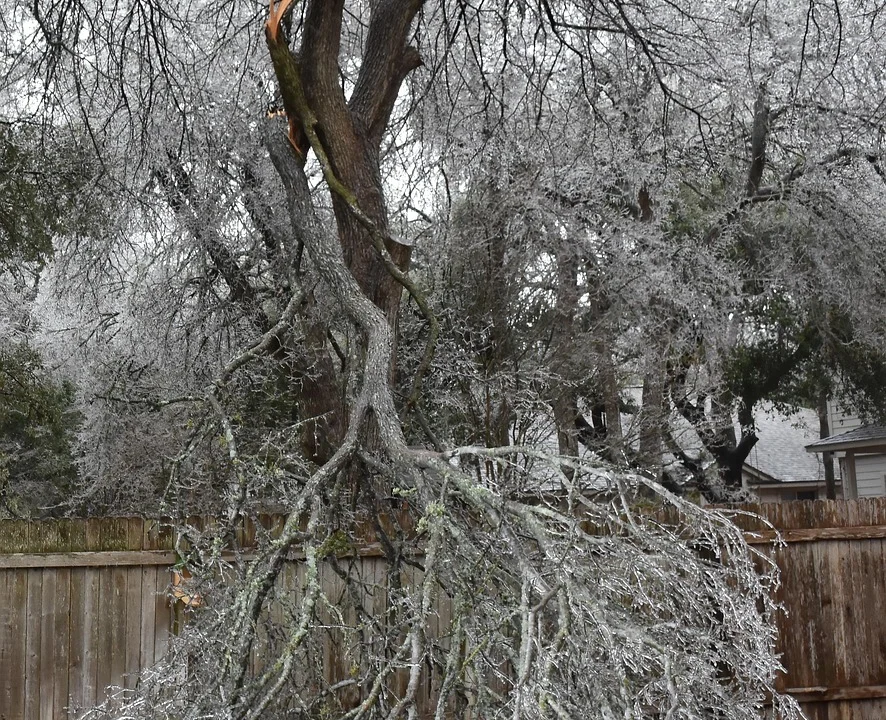
When a storm brings a tree down on your house, a standard homeowners policy usually pays to repair the house, less your deductible. Removing the tree is a separate, much smaller allowance: in the standard form it is capped at $1,000 per loss and $500 per tree, and it applies only for the causes the form lists and only if the tree hit a covered structure or blocked your driveway or an accessibility ramp. A tree that falls on the lawn and hits nothing is usually not covered, and the tree itself is usually not covered when wind brings it down. Your policy’s wording decides each of these, and it can differ from the standard form. This guide is part of our roof, hail and wind section.
General information, not legal or insurance advice, and not a substitute for the advice of an attorney. Your policy’s wording and your state’s law decide, and both change. For help with your claim, your state insurance department’s consumer line and legal aid are free.
This page reads the rules from the standard homeowners form itself: the ISO HO-3 specimen form in its 2011 edition (HO 00 03 05 11, the copy published by the Maine Bureau of Insurance) and its 2000 edition (HO 00 03 10 00, a sample copy published by the Insurance Information Institute, a trade group, in the copy archived on 2 September 2026). Many insurers write their own forms or add state endorsements, so treat these as the common pattern, not as your policy. Where we read a clause only in the 2000 edition, we say so. Condo (HO-6), renters (HO-4) and dwelling-fire policies are written on different forms, and their tree and debris rules are not covered here: check that form’s own Debris Removal clause.
The short answer, case by case
| What happened | What the ISO HO-3 specimen usually does | Where it says so |
|---|---|---|
| A storm drops a tree on your house | Repairs to the house usually covered, less the deductible; tree removal usually up to the capped allowance, if wind, hail, ice, snow or sleet brought down your tree (or a named peril brought down a neighbor’s) | Coverage A; Additional Coverage E.1.b |
| A tree lands on a garage attached to the house | Usually covered as part of the house, less the deductible, inside the dwelling limit | Coverage A (structures attached to the dwelling) |
| A tree lands on a detached garage, shed or fence | Usually covered the same way, inside the Other Structures limit | Coverage B |
| A tree falls on the lawn and hits nothing | Removal usually not covered; the tree itself usually not covered for wind | E.1.b; E.3 |
| A tree blocks your driveway or an accessibility ramp, nothing damaged | Removal usually covered up to the capped allowance, if wind, hail, ice, snow or sleet brought down your tree (or a named peril brought down a neighbor’s) | E.1.b(1), (2) and (4) |
| Your neighbor’s tree falls on your house | Usually your own policy pays for the house repair, the same as for your own tree; your insurer may try to recover from the neighbor if the neighbor was at fault | Coverage A; Subrogation condition |
| Your tree falls on your neighbor’s house | Usually the neighbor’s own policy; your liability coverage only if you are legally liable | Coverage E |
| A tree falls on your car | Usually not homeowners insurance; auto comprehensive coverage, if you carry it | Coverage C excludes motor vehicles |
| You want a risky tree taken down before it falls | Usually not covered: nothing has been damaged yet | Coverage A covers direct physical loss |
The house, the garage and what was inside
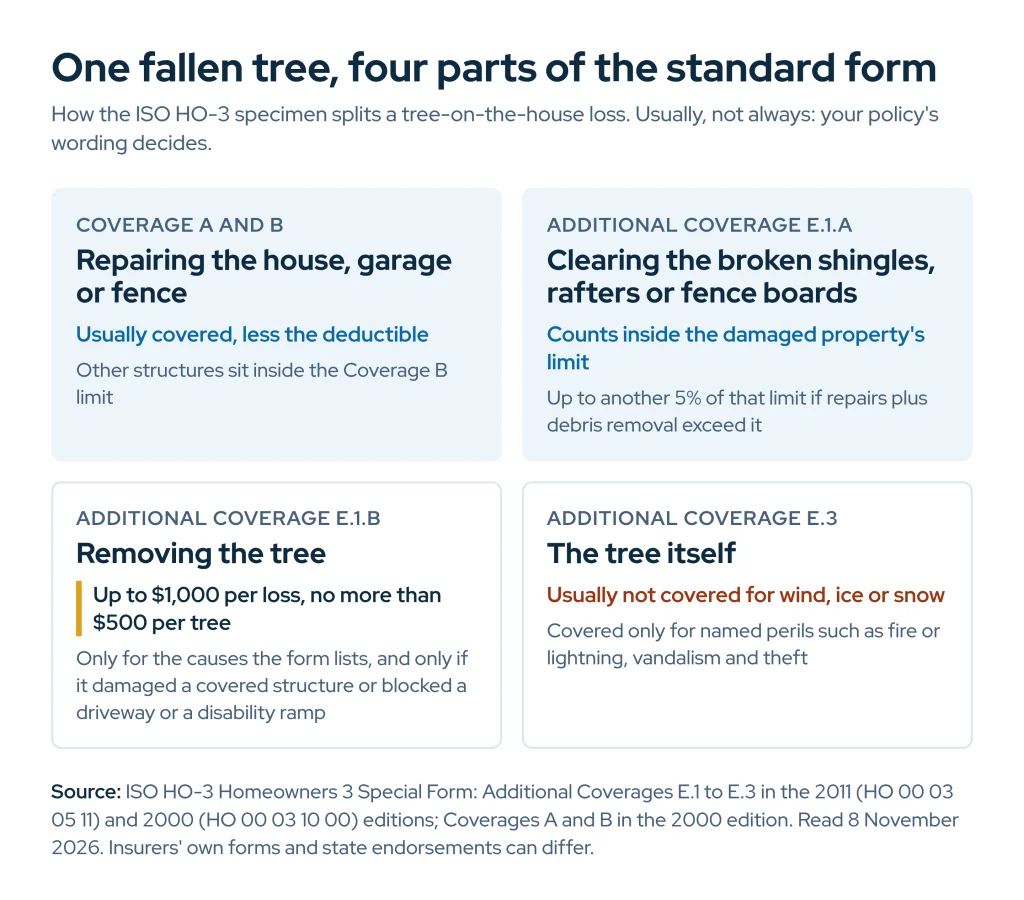
The house (Coverage A) and other structures (Coverage B). In the 2000 edition, the HO-3 covers the dwelling and other structures against “risk of direct physical loss” unless an exclusion applies. People call this “open perils”: the form doesn’t list what is covered; it lists what isn’t. A tree falling on a building is not among the exclusions, which is why a tree through the roof is usually a covered loss. Other structures are things on your property set apart from the house by clear space, such as a detached garage, a shed or a fence. In the 2000 edition, the Coverage B limit is no more than 10% of the dwelling limit, and using it does not reduce the dwelling limit; your declarations page shows the amount in your policy. One narrow exclusion to know about if a fence is involved: the form does not cover damage to a fence, patio, pavement or pool from freezing, thawing, or the weight or pressure of water or ice itself, whether wind-driven or not (2000 edition).
When the tree hits a garage. Which part of the policy answers depends on how the garage stands. In the 2000 edition, Coverage A covers the dwelling “including structures attached to the dwelling”, so an attached garage is usually repaired as part of the house, inside the dwelling limit. A detached garage falls under Coverage B, and so does one joined to the house only by a fence, utility line or similar connection. The form doesn’t list garage doors separately, so a door crushed along with the garage usually follows the same split. For a garage door a tree has bent or broken, our garage door coverage page goes further. Two Coverage B exclusions can matter: a structure rented or held for rent to someone who isn’t a tenant of the house is not covered unless it is used only as a private garage, and a structure used for a business, or to store business property beyond what the form allows, is not covered. A car inside the garage is a question for your auto policy, as the section on cars below explains. Your policy’s wording decides, and your declarations page shows both limits.
Your belongings (Coverage C). Belongings are covered only for the perils the form names, and two of those named perils come with conditions that matter after a tree falls (2000 edition wording):
- Falling objects: property inside the building is covered only if the roof or an outside wall is first damaged by the falling object.
- Windstorm or hail: rain, snow or sleet that gets inside is covered only if wind or hail first made an opening in the roof or a wall and the weather came in through it.
So a branch that crashes through the roof and lets rain soak the bed below is the kind of loss these perils describe. A slow drip through an old roof after the same storm is a different question.
If you can’t stay in the house. When a covered loss makes the home unfit to live in, Coverage D (loss of use) pays the increase in living costs for the shortest time needed to repair or relocate. Our page on additional living expenses explains what that usually includes and which receipts to keep.
Tree removal: the $1,000 and $500 limits
Tree removal sits in an Additional Coverage called Debris Removal (E.1). The 2011 and 2000 editions read the same on every point below:
- Whose tree, felled by what. Your own trees count when they are brought down by windstorm or hail, or by the weight of ice, snow or sleet. A neighbor’s trees count when they are brought down by any peril the form names for your belongings (Coverage C), a longer list that includes windstorm, hail and lightning. Whether ice counts for a neighbor’s tree is less clear, because the form writes its weight of ice, snow or sleet peril for belongings around damage to property inside a building.
- Only if the tree does damage or blocks access. The tree must damage a covered structure, or, without damaging one, block a driveway on your property so that a registered car can’t get in or out, or block a ramp or other fixture built to help a person with a disability enter or leave the house.
- The limits. Up to $1,000 is the most the form pays for tree removal in any one loss, “regardless of the number of fallen trees”, and no more than $500 of it for any one tree. The 2011 and 2000 editions both say so.
- Extra money. The form calls this “additional insurance”: it is on top of the dwelling limit, not taken out of it.
Clearing away the debris of the damaged property itself, such as broken shingles, rafters or fence boards, falls under the first part of the same coverage (E.1.a). That cost counts inside the limit for the damaged property. If repairs plus debris removal come to more than that limit, the form adds up to another 5% of the limit for the debris removal.
The deductible. The standard form (2000 edition wording) takes one deductible from “the total of all loss payable under Section I”. A few Additional Coverages say that no deductible applies to them. The tree-removal coverage doesn’t say that, so in the specimen the deductible comes out of the claim as a whole, tree removal included. Our deductible calculator works out a dollar or percentage deductible on your own numbers.
State insurance departments don’t all describe this the same way. The Texas Department of Insurance says trees and limbs that fall in your yard “usually aren’t covered”. The Maryland Insurance Administration says many policies pay a limited amount, usually between $500 and $1,000, whether the tree damages an insured structure or just falls in the yard. The standard form pays only in the cases listed above. That gap is the reason to read the Debris Removal clause in your own policy before you pay for removal and expect it back.
A worked example, with made-up numbers
Example only: these round numbers are invented, and this is the specimen’s arithmetic, not what any insurer will pay. An ice storm brings down two of your trees. One lands on your detached garage; the other lies across the driveway. The tree service bills $1,400 for the first tree and $900 for the second. The garage repair estimate is $6,000. Your deductible is $1,000.
| Line | Bill (example) | Specimen’s limit | Counted |
|---|---|---|---|
| Tree on the garage (ice, your tree, damaged a covered structure) | $1,400 | $500 for any one tree | $500 |
| Tree across the driveway (ice, your tree, blocked the driveway) | $900 | $500 for any one tree | $500 |
| Tree removal for this loss | $2,300 | $1,000 per loss | $1,000 |
| Garage repair (Coverage B) | $6,000 | Coverage B limit | $6,000 |
| Total before the deductible | $7,000 | ||
| Less the deductible, taken once | −$1,000 | ||
| Result of the arithmetic | $6,000 |
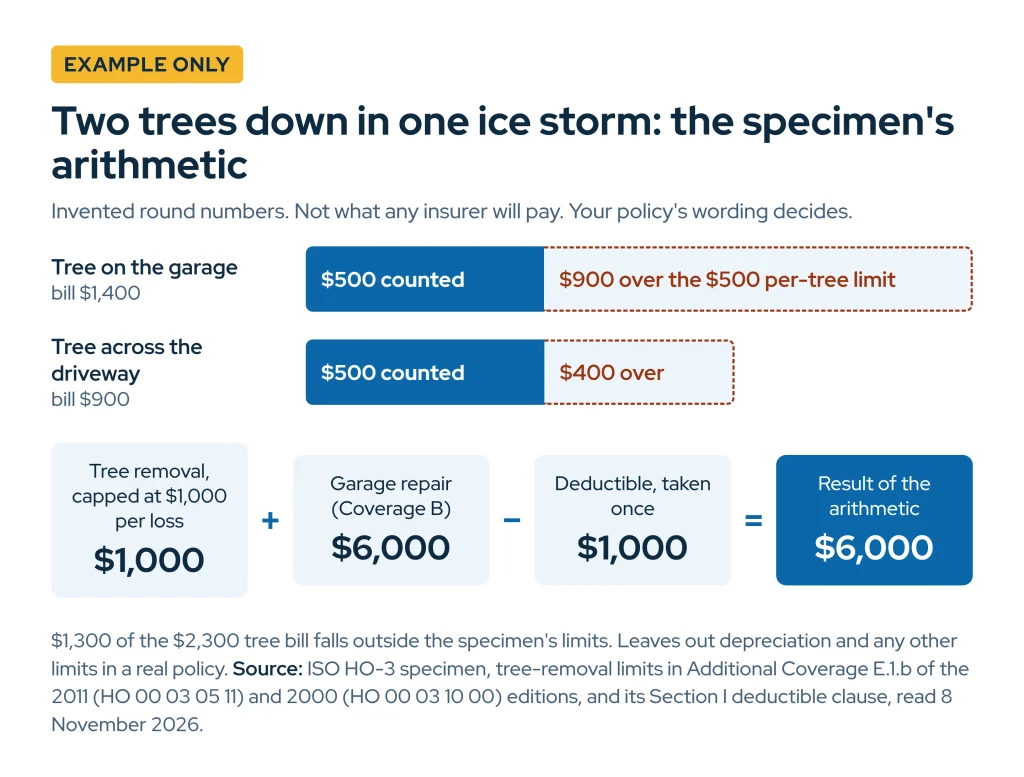
Two things the example shows. First, $1,300 of the $2,300 tree bill falls outside the specimen’s limits. Second, if only the driveway tree had come down, the most the specimen’s removal coverage reaches is $500, which is less than a $1,000 deductible. A tree service may bill lifting a tree off a roof and hauling it away as one job, while the form puts debris of the damaged building (E.1.a) and tree removal (E.1.b) in different places. Ask the adjuster in writing how the estimate splits the two.
The trees themselves: why wind damage usually isn’t covered
Losing a mature oak can hurt more than a dented gutter, but the standard form treats trees, shrubs, plants and lawns narrowly. Additional Coverage E.3 covers them only for fire or lightning, explosion, riot or civil commotion, aircraft, vehicles not owned or driven by someone who lives there, vandalism or malicious mischief, and theft. Wind, ice and snow are not on that list. The limit is 5% of the dwelling limit for all trees, shrubs, plants and lawns together, with no more than $500 for any one of them, and nothing for plants grown for business. The 2011 and 2000 editions read the same here. The Maryland Insurance Administration describes the same pattern: snow, ice and wind damage to trees is generally not covered.
When the tree was dead or dying
Many readers fear a denial because the tree “should have come down years ago”. There is no simple rule here. The 2000 edition excludes loss caused by faulty or inadequate maintenance (Section I Exclusion B.3), and it also lists wear and tear and deterioration among causes it does not cover. Exclusion B also says that an ensuing loss to the house or other structures that nothing else in the policy excludes is still covered. How those clauses apply to a tree that fell on a house depends on the policy’s exact words and the facts, and in a dispute the courts of your state decide. The Iowa Insurance Division puts it this way: “If a tree falls due to neglect, disease, or rot, and the risk was known beforehand the claim may be denied.” Notice the “may” and “known beforehand”.
Before anything is cut up and carted away, photograph the break, the stump and the root ball. They show what the tree looked like inside when it came down. If a denial letter cites maintenance, ask for the exact policy wording it relies on, in writing. Our page on a denied home insurance claim explains the next steps.
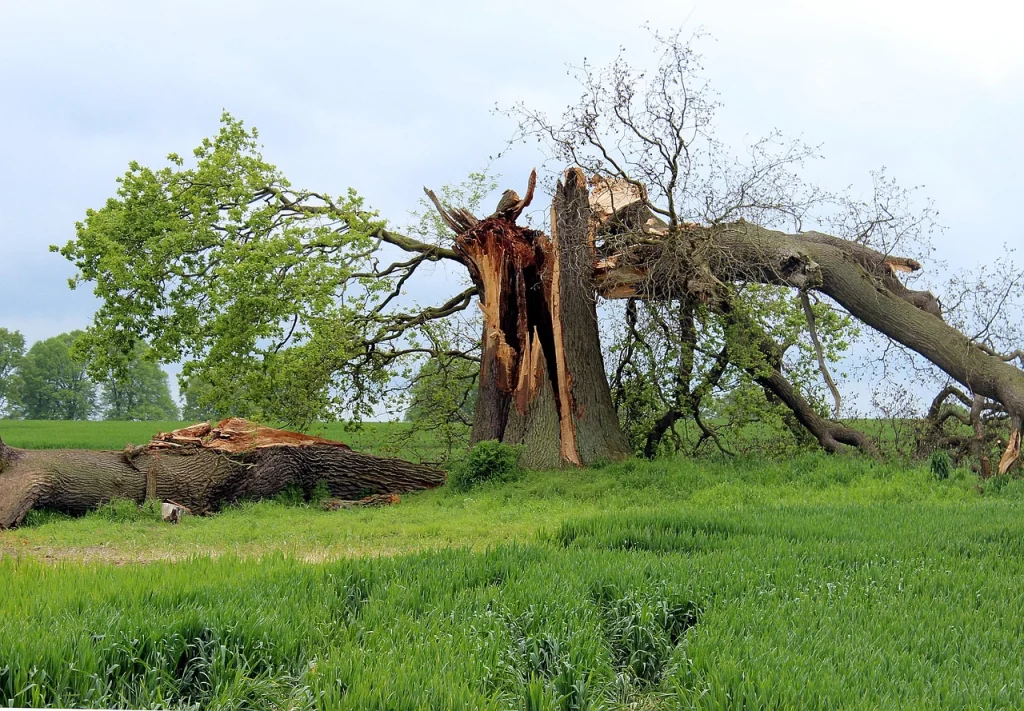
Your neighbor’s tree, or yours on their house
A neighbor’s tree on your house. The state insurance departments of Texas, Maryland, Oklahoma and Iowa all describe the same pattern: you usually claim on your own policy. Iowa adds that you pay your own deductible. The Texas Department of Insurance says the neighbor’s policy probably won’t pay “unless your neighbor was at fault”, because a neighbor “isn’t responsible for acts of nature”. If your insurer pays and believes the neighbor was at fault, it may try to recover what it paid from the neighbor or their insurer. This is called subrogation. The Maryland Insurance Administration gives the example of a neighbor who knew the tree was dead. The Oklahoma and Iowa departments add that your deductible may come back to you if that recovery succeeds. Our page on Oklahoma home insurance claim rules sets out that state’s claim clocks.
The standard form’s Subrogation condition (2000 edition) says you may waive your rights of recovery against someone in writing before a loss. If you haven’t, the insurer may require you to assign those rights to it for the amount it paid, and you must sign the papers and cooperate. So tell your insurer before you sign anything with the neighbor, such as a release or a “we’ll split it” agreement.
Your tree on a neighbor’s house. Their house is usually their own insurer’s claim. Your liability coverage (Coverage E, 2000 edition wording) pays damages for which you are “legally liable”, and whether you are depends on your state’s law and the facts. The Iowa Insurance Division says you “could be liable if your neglect or poor maintenance contributed to the fall”. If a neighbor or their insurer writes to you about it, the standard form’s liability conditions ask you to give your insurer written notice “as soon as is practical”. The same form lets the insurer investigate and settle any claim or suit it decides is appropriate, which is why the letter belongs with your insurer.
A tree on your car. The standard form’s Coverage C does not cover motor vehicles such as your car (2000 edition). Departments in Texas, Maryland and Iowa all point to the comprehensive part of an auto policy instead. Iowa adds that a liability-only auto policy leaves you to pay for your own car’s repairs.
Hurricanes, windstorms and the deductible that applies
Your declarations page may show more than one deductible: an all-other-perils amount, and a separate wind or hail, named-storm or hurricane deductible, which may be written as a percentage of the dwelling limit. Which one applies depends on the storm and on the policy’s own trigger wording, and some states set those triggers by law. The 2000 edition of the standard form doesn’t use the words hurricane or tornado at all: for the house it covers any direct physical loss that isn’t excluded, and for belongings and the tree-removal limits the wording that usually applies is its Windstorm or Hail peril. So a tree a tornado brings down is usually handled like any wind-felled tree, and a hurricane or named-storm deductible applies only if the declarations or an endorsement say so for that storm. Our page on tornado damage claims applies the same wording to a whole-house loss. Our page on hurricane and named-storm deductibles by state lists the rules we have read, and our page on hurricane damage claims covers the line between wind and storm surge.
Check too whether your homeowners policy covers wind at all. Some homes, often near the coast, have windstorm excluded from the homeowners policy, with wind cover bought as a separate policy, sometimes from a state wind pool or FAIR plan. If your declarations page or an endorsement shows a wind exclusion, a tree brought down by wind is a question for that separate policy, with its own deductible, limits and claim rules. A tree brought down by flood water raises the homeowners form’s flood exclusion; flood cover is a separate policy, such as one from the National Flood Insurance Program.
One state rule we have read names trees. In Florida, an insurer may include a separate roof deductible in a home policy, capped at the lesser of 2% of Coverage A or 50% of the cost to replace the roof; it applies only to claims adjusted on a replacement cost basis, and the policyholder must be offered the chance to reject it on a signed form. By statute, that roof deductible does not apply to a roof loss “resulting from a tree fall or other hazard that damages the roof and punctures the roof deck”. It also doesn’t apply to hurricane roof losses, a total loss of the home under Florida’s valued policy law, or repairs to less than half the roof (Fla. Stat. 627.701(10), 2026 text, read 8 and 18 November 2026). Where the roof deductible doesn’t apply, check which of the policy’s other deductibles does.
After a tree comes down: what the policy asks of you
- Stay clear of power lines. Treat any wire tangled in the tree as live. The Iowa Insurance Division’s advice is to stay away from downed power lines and damaged structures and to call emergency services if there is a safety risk.
- Photograph and film before anything moves: the tree, where it landed, the roof from the ground, the rooms below, the break and the stump. The Texas Department of Insurance says to take photos before you move the tree or make repairs, and the Maryland Insurance Administration says to photograph all damaged property before debris is removed.
- Stop further damage, and keep the receipts. The standard form’s Duties After Loss condition asks you to protect the property, make reasonable and necessary repairs, and keep an accurate record of what they cost. Its Reasonable Repairs coverage (E.2) pays for necessary steps to protect covered property from further damage, such as a tarp over the hole. It does not raise your limits.
- Report the claim promptly, in writing. The form asks for “prompt notice” and does not give a day count. Write down the date, name and content of every call.
- Ask before paying for full removal. Ask the insurer in writing which removal costs it treats as part of the repair and which fall under the tree-removal limit.
- Watch for public debris pickup. After a large storm, the Maryland Insurance Administration notes, a local government may arrange debris removal and ask you to sign a right-of-entry form. Photograph everything before it goes.
- Be careful with door-to-door crews. The Federal Trade Commission’s advice after disasters is to confirm a contractor’s licence with your state or county, walk away from anyone who wants cash up front, and “never sign your insurance check over to a contractor” (FTC, updated September 2025). If your lender is named on the check, our mortgage check tool explains how release usually works.
Time limits matter too. The specimen form’s Suit Against Us condition requires any lawsuit to start within two years after the date of loss (2000 and 2011 editions), and state law often changes that period. Some states also set notice-of-claim limits. Our claim deadlines by state show the rule in each state we have read. Your policy may give you longer. Waiting until the end of any period is risky.
If the damage is close to your deductible, our page on whether to file a home insurance claim sets out what each choice involves. For the wider storm picture, from tarps to a second inspection, see storm damage claims: the first 30 days.
Your next step
Get your full policy, not just the declarations page, and read three clauses: Debris Removal (for the tree-removal limit and the conditions it sets), Trees, Shrubs and Other Plants, and Duties After Loss. Gather photos and video taken before cleanup, the tree service’s itemised bill, any tarp or emergency receipts, and every letter with its date. If something in a claim decision is unclear, ask the insurer in writing for the policy wording it relies on. Your state insurance department’s consumer line can explain the claim rules in your state for free; the NAIC’s directory of state insurance departments lists each one. For a question about liability between you and a neighbor, legal aid or your state bar’s lawyer referral service can help.
Sources: ISO HO-3 specimen form, 2011 edition (HO 00 03 05 11), Maine Bureau of Insurance copy, Section I Additional Coverages E.1 to E.3; 2000 edition (HO 00 03 10 00), Insurance Information Institute (trade group) sample copy, archived 2 September 2026, Coverages A to E, Perils Insured Against, Section I Exclusions, Conditions and Subrogation; Texas Department of Insurance, fallen tree branches and insurance (24 January 2026); Maryland Insurance Administration, what to do if a tree falls on your property; Oklahoma Insurance Department, fallen trees and homeowners insurance; Iowa Insurance Division, tree damage and insurance (1 August 2025); Florida Statutes 627.701(10); FTC consumer advice on scams after disasters.
Sources checked on 8 November 2026; the 2000 edition of the standard form (Coverages A and B, Debris Removal, Windstorm Or Hail) and Florida Statutes 627.701(10) rechecked on 18 November 2026.
Sources
- ISO HO-3 Homeowners 3 – Special Form, HO 00 03 05 11 (2011 edition), Maine Bureau of Insurance copy, read 8 Nov 2026
- ISO HO-3 Homeowners 3 – Special Form, HO 00 03 10 00 (2000 edition), Insurance Information Institute (trade group) copy, archived 2 Sep 2026, read 8 and 18 Nov 2026
- Texas Department of Insurance, Does insurance cover fallen tree branches? (24 January 2026)
- Maryland Insurance Administration, What to do if a tree falls on your property
- Oklahoma Insurance Department, Fallen trees and homeowners insurance: what's covered?
- Iowa Insurance Division, August Consumer Connection: Tree Damage and Insurance (1 Aug 2025)
- Florida Statutes 627.701(10), separate roof deductible (2026 text, read 8 and 18 Nov 2026)
- FTC, How to avoid scams after weather emergencies and natural disasters (updated Sep 2025)
- NAIC, State insurance departments directory